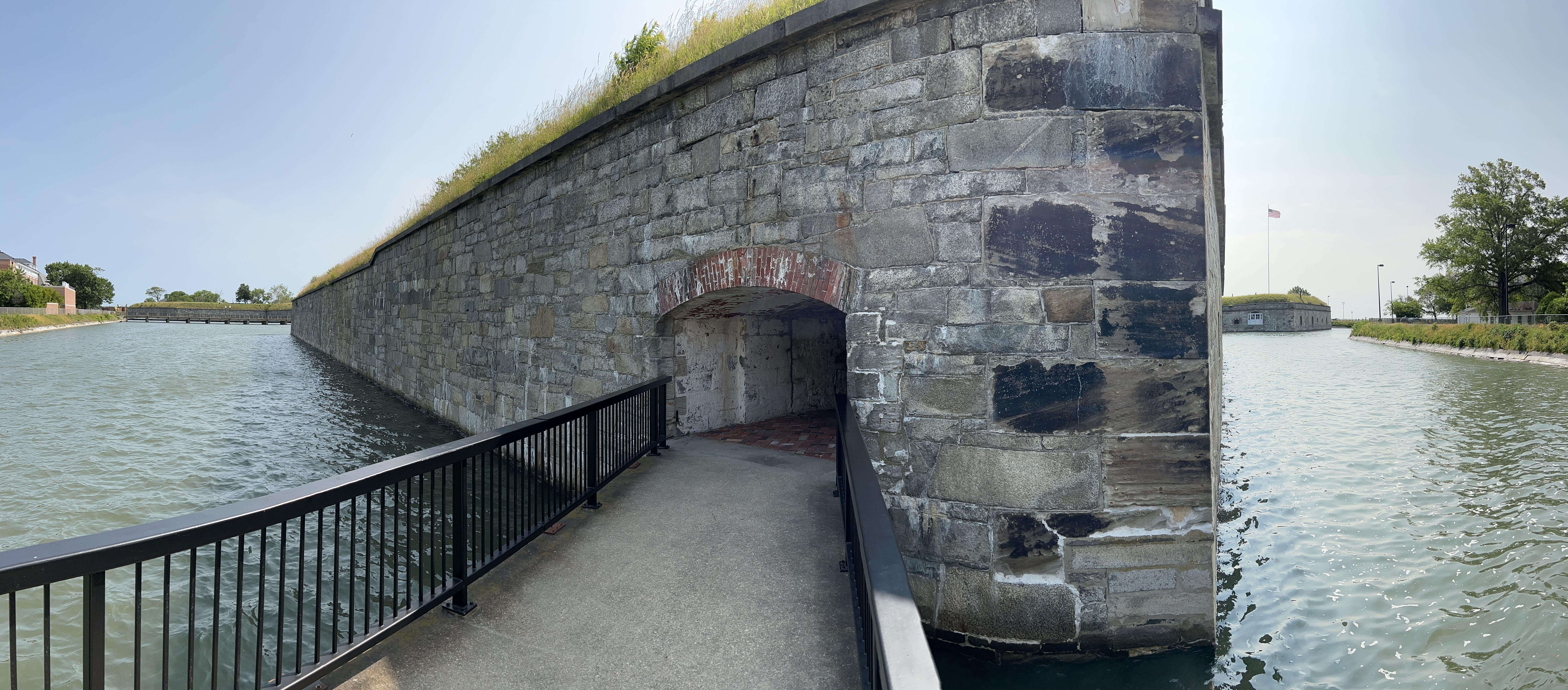
The English sited a fort here in their Virginia colony at the mouth of the James River to protect Jamestown and the deep water entrance to the Chesapeake known as Hampton Roads, and now the Norfolk Navy Base sits across the river. The current fort is the largest masonry fort in the US, and although it was not directly involved in any battles, the Monitor v Merrimack battle was witnessed from its lighthouse, the oldest on the Chesapeake. Lincoln planned the capture of Norfolk here. Confederate leader Jefferson Davis was imprisoned here, decades after Lt Davis had been involved in sending captured Chief Black Hawk to prison here. Robert E. Lee improved the moat system above. Edgar Allan Poe served here (and later returned to recite his poetry).
But the most important history here began in 1619, when the first Africans were brought here by British privateers who stole them from the Spanish, and they were immediately put to work by the English colonists beginning the abomination of slavery in the American colonies. The first African American child, William Tucker, was born here in 1624. (First, unless you include Spanish St Augustine Florida, where there were 16th century slaves, as well as slaves in the Coronado and DeSoto expeditions).
The day Virginia seceded, three slaves, Baker, Townsend & Mallory, escaped and sought refuge here. Their owner sent a Confederate officer to claim his property. Without any official policy, the Union General Butler decided that the three men were illegal property or ‘contraband’ and refused to return them. Butler supported educating, training and enlisting them. This ‘contraband decision’ was widely published in newspapers and became Union policy until Emancipation. Many other escaped slaves similarly sought protection at this and other Union forts and camps, and communities with contraband schools began. Nearby Hampton University began as one of those schools, attended by 16 year old Booker T. Washington in 1872, fully 253 years after slavery started here in this country.
 Zero Carbon Travel
Pingback: Fredericksburg and Spotsylvania County Battlefields Memorial National Military Park | Zero Carbon Travel
Pingback: Booker T. Washington National Monument | Zero Carbon Travel
Pingback: Colonial National Historical Park | Zero Carbon Travel
Pingback: All Parks in the Mid-Atlantic, Zero Carbon | Zero Carbon Travel
Pingback: Captain John Smith Chesapeake National Historic Trail | Zero Carbon Travel
Pingback: Road to Abolition | Zero Carbon Travel
Pingback: All Civil War Battles, Zero Carbon Travel | Zero Carbon Travel
Pingback: The Road to Equal Education | Zero Carbon Travel
Pingback: All Civil War Battles, Zero Carbon | Zero Carbon Travel
Pingback: All War of 1812 Parks | Zero Carbon Travel
Pingback: Tuskegee Institute National Historic Site | Zero Carbon Travel
Pingback: Captain John Smith Chesapeake National Historic Trail | Zero Carbon Travel