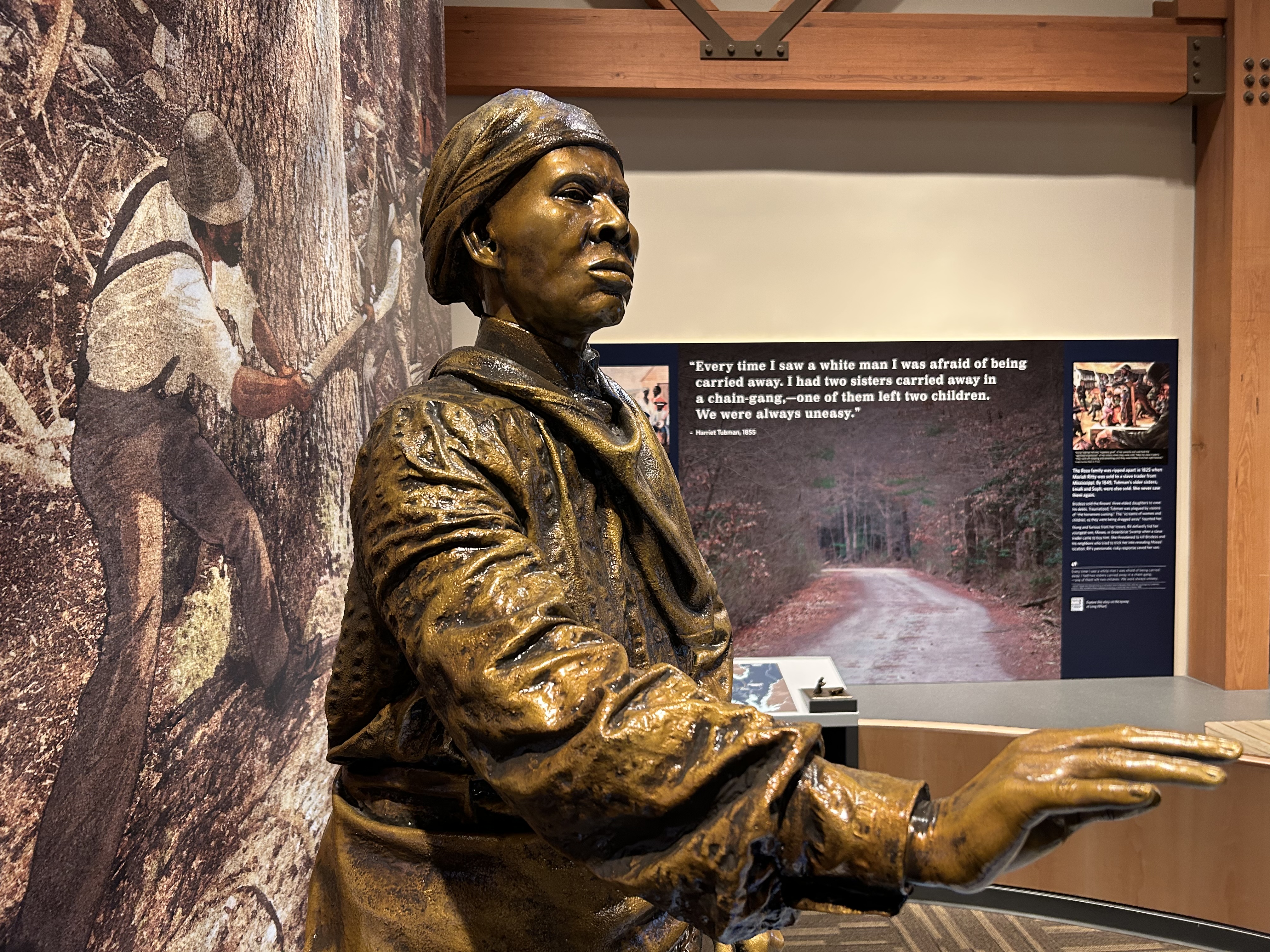
Harriet was born in remote southeastern Maryland, and her knowledge of survival skills in the marshy fields and forests of the area helped her free 70 slaves directly and many more indirectly through her instructions. Now, the NPS NHP, Maryland State Park, and National Monument within the Blackwater National Wildlife Refuge are managed jointly. Unlike her home site in Auburn NY, there are no structures from her time here, but the visitor center has exhibits telling her story and busting many of the myths about her, such as the ‘secret messages’ in quilts. The brochure further explains that she could not have sung “Swing Low, Sweet Chariot”, since it was written by an Oklahoma Cherokee after the Civil War. But she did sing “Go Down Moses” and “Bound for the Promised Land”.
“I had reasoned this out in my mind;
Harriet Tubman
there was one of two things I had a right to, liberty or death;
if I could not have one, I would have the other,
for no man should take me alive.”
The stories of her childhood, her Underground Railroad missions and of the Combahee River raid are all told here, as is the story of her friendship with the Abolitionist Thomas Garrett. While he did not risk his life as Harriet did, he was involved in almost three thousand escapes over four decades, at considerable personal financial cost. His partnership with Harriet must have felt serendipitous to both. She was a natural, simple, pure person of faith, from childhood, but especially since her injury-caused epilepsy. The Quakers held strong convictions of faith, even over the law, and prized simplicity, humility and doing good deeds. Each was exactly what the other needed, a Moses leading her people out of the wilderness into the promised land, and a network of believers willing to contribute time, money and help to end the abomination of slavery. Yet despite their acts, millions remained enslaved.
 Zero Carbon Travel
Pingback: All Parks in the Mid-Atlantic, Zero Carbon | Zero Carbon Travel
Pingback: Captain John Smith Chesapeake National Historic Trail | Zero Carbon Travel
Pingback: Road to Abolition | Zero Carbon Travel
Pingback: Women’s History Month | Zero Carbon Travel
Pingback: Freedom’s Frontier National Heritage Area | Zero Carbon Travel
Pingback: Boston Harbor Islands National Recreation Area | Zero Carbon Travel
Pingback: Aunt Marjorie, who drove the Lincoln Highway in 1925 | Zero Carbon Travel