
[Updated after 3rd visit, including Oaks tour and Carver Museum.] I admit I was frustrated the first two times I drove here from California, unable to access either Booker T. Washington’s house or George Washington Carver’s Museum and finding incorrect information on the website and app. And I might have ranted about how other sites appear to be better funded. But all is now forgiven.
Like many emancipated slaves, Booker had no surname. When he showed up at school, he just said his last name was Washington. After walking across much of Virginia to go to school near Hampton Roads, he became a teacher at Hampton University, before being hired to run the Tuskegee Institute, now University. Ever hard-working, practical and focused on improvement, his students developed many valuable skills to support their families, including brick making. His students built his impressive mansion, The Oaks, across the street from Tuskegee University, using the design by our nation’s first African American architect, Robert Taylor, who trained at MIT as its first black student. Booker T., ever persuasive, recruited Taylor, who designed many buildings that are now part of both this national historic site and the university.
It is difficult to overestimate the importance Booker T. Washington had in advancing the lives of people who for centuries were not allowed to learn how to read. An advisor to US Presidents, world traveling speaker, practical educator, builder, mentor, and author, his practical focus drew criticism from WEB Du Bois and Frederick Douglass, who focused on ‘higher achievements’, but ultimately, they all worked towards the same goal of progress. All continue to inspire generations to learn, grow and excel. Inside the house on tour, I learned about Booker T’s wives, who also contributed to education. By necessity, black women have often had to assume a role as matriarch, when it was difficult or even impossible to keep families together.
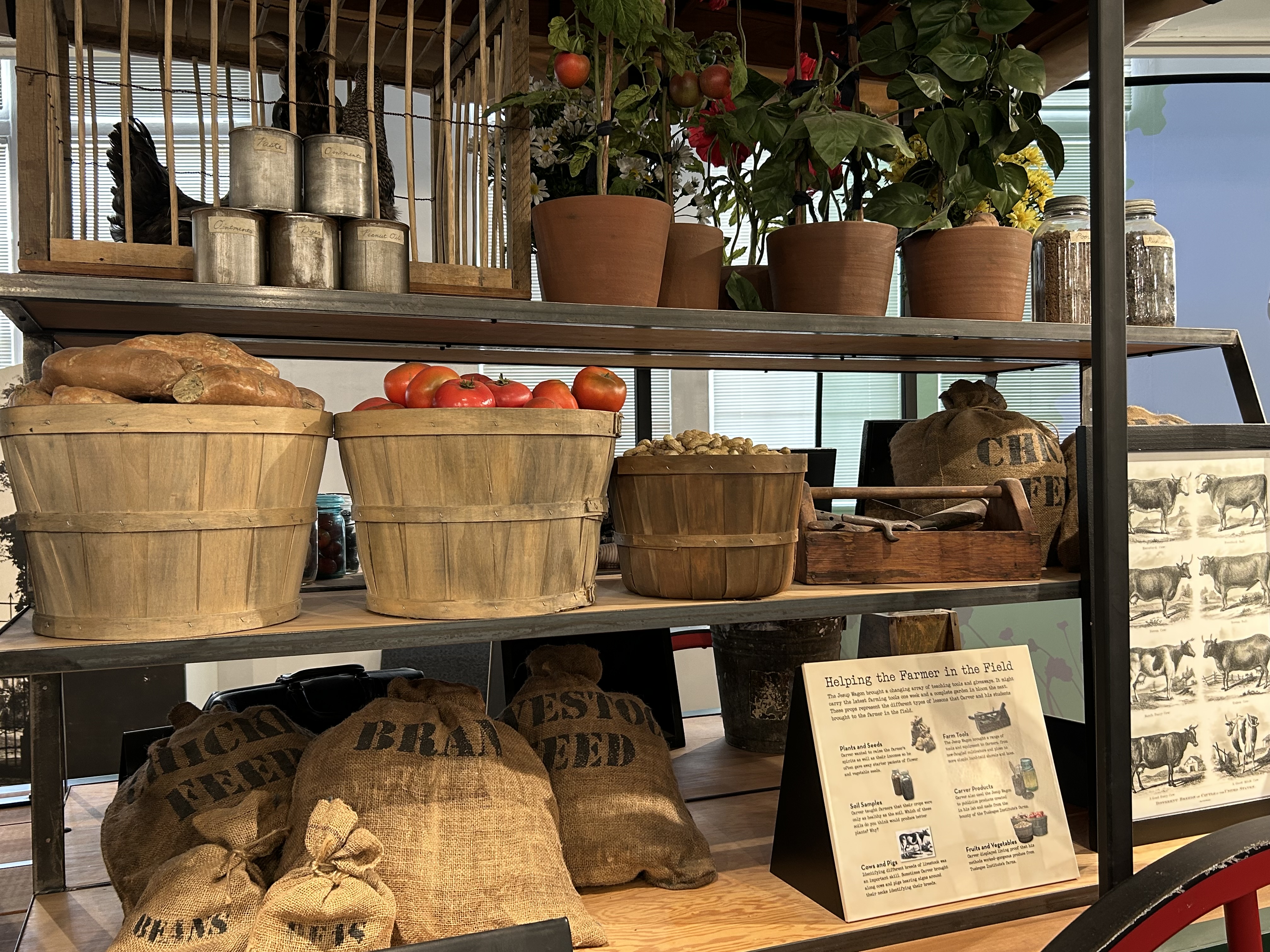
Booker T. Washington also hired George Washington Carver to teach and help improve the lives of African Americans, and the Carver’s museum on campus (see photo below) reveals his broad scientific interests beyond the peanut. Carver was an ecologist, who focused on profitable uses for peanuts in order to improve soil health, a forward-looking view that has only become more important over time. But following Washington’s practical focus, Carver spent much of his time in direct outreach to rural communities, bringing solutions and advice out in wagons.
I’m sure Washington could not have imagined that his institute would have been used by the US government to run a 40 year ”experiment” on black men, neither treating nor disclosing their diagnosis of syphilis. (See ”Miss Evers’ Boys” also set in Tuskegee & starring Laurence Fishburne). He might be pleased to know that there’s a private museum on campus dedicated to teaching the history of that infamous experiment as well as the genetic legacy of Henrietta Lacks. But doubtless Washington would have been out fundraising to develop the broader community of Tuskegee, which shows signs of economic neglect.

 Zero Carbon Travel
Pingback: George Washington Carver National Monument | Zero Carbon Travel
Pingback: Fort Monroe National Monument | Zero Carbon Travel
Pingback: Booker T. Washington National Monument | Zero Carbon Travel
Pingback: The Road to Equal Education | Zero Carbon Travel
Pingback: Tuskegee Airmen National Historic Site | Zero Carbon Travel
Pingback: National Heritage Areas of Alabama | Zero Carbon Travel
Pingback: All Southeast Sites * | Zero Carbon Travel