Cedar Creek and Belle Grove National Historical Park

The park service Belle Grove site is near the north entrance to Shenandoah National Park, near the West Virginia border. Cedar Creek feeds into the Shenandoah River nearby, and this large agricultural valley in Virginia was home to James Madison’s brother in law, who had up to 100 slaves or so working his grain fields at any given time. Nelly Madison Hite named the plantation house Belle Grove Manor after her birthplace Belle Grove Plantation which is on the Rappahannock River near Fredericksburg, also in Virginia, and that’s now a historic B&B. James Madison was also born there and died at his Montpelier estate, which is near Charlottesville Virginia.

In 1864 Confederate troops routed Union soldiers in a surprise foggy morning attack. In the afternoon, General Sheridan arrived with more troops and won the day. The fighting approached the front porch above and left a couple bullet holes still visible. General Grant ordered many such farms in the valley burned to break the rebellion, causing hardship and starvation. Of course, the crops had all been grown by slave labor, so in the long run the owners’ hardship was finally needing to pay their workers.

The ‘struggle of southern women to be able to feed their families’ was due to a combination of factors: blockaded ports, burned plantations and escaped slave labor—the last factor perhaps the largest and longest lasting. Even poor whites benefited from cheap food, clothing & tobacco grown by slaves, which needs to be remembered when reading arguments that ‘most white southerners did not own slaves and were fighting to preserve a way of life’. Even poor whites knew that they would lose social status and have to start doing hard labor themselves if slavery ended. The end of slavery meant the end of that morally reprehensible way of life for all whites in the south, and the men who enlisted all knew it and chose to fight to preserve slavery.

There are reenactments, trenches and fields to explore, some monuments, a partner tour of Belle Grove Manor above, and a small partner museum with Civil War memorabilia across the street. The park is within the broader Shenandoah Valley Battlefields historic district, so there’s plenty to see in the area too. The basement of the manor has an interesting exhibit reconstructing the kitchen and showing artifacts of life in the time of slavery. If you’re interested in the defeated, there’s a picture of a dying Confederate general being comforted by G. A. Custer and also Coronation Tea in the gift shop.

Gettysburg National Military Park

This grand Pennsylvania monument is appropriate for this critical turning point in the Civil War in July of 1863. Lee’s northernmost advance on Washington ended, his retreat to Virginia began, and with Vicksburg ending a day later, Lincoln finally had the victory he needed to prove the Union capable of winning the war. The battlefield runs right through town, with bullet-hole houses, up onto Cemetery Hill, where the Union lines held off Lee’s massive frontal assault—a reversal of the usual Union v Confederate roles. The land has been carefully preserved to evoke the day, and the park app’s auto tour tells the many stories of bravery, such as Hancock’s numerous maneuvers in the nick of time. Visiting the cemetery brings Lincoln’s address to life. This is another powerful park to remember this Memorial Day weekend.

Gettysburg has the finest museum (a favorite) at any of the military and battlefield parks. Particularly the park film, short films, quotations, exhibits, bookstore, and, well, everything. It’s worth paying the extra fee to the park partner that runs it. Through first rate research, they get the balance correct between views at the time and the facts. It takes longer to see than most park museums, but for once I felt I understood not just the battle, but the context and meaning behind the struggle. There’s also a phenomenal period panoramic painting of the battle, which is a historic work of art itself. And if you are able to hire a park guide to take you around the battlefield in your own car, that’s the best way to get your questions answered and make sense of the three day battle over much of the same ground. My brother and I were extremely fortunate to secure the expert assistance of our former teacher, who has many years of experience working here and to whom we are very grateful.

Many Civil War sites bend over backwards to present ethically indefensible archaic views as valid, as if they are obliged to reprint Confederate propaganda without context. But that would be like presenting ‘witchcraft’ as valid, because it was believed in colonial Salem. Not only does Gettysburg get it right, but they also clearly blame the north for their role in whitewashing history. Segregationist President Woodrow Wilson supported Jim Crow restrictions to get African Americans back to work for low wages and to win white votes. Most of the Confederate monuments I find objectionable are only 100 years old and come from this era of white northern and southern ‘reconciliation’. We still need to fix this historic problem of treating both sides as having fought for valid causes.

Antietam National Battlefield

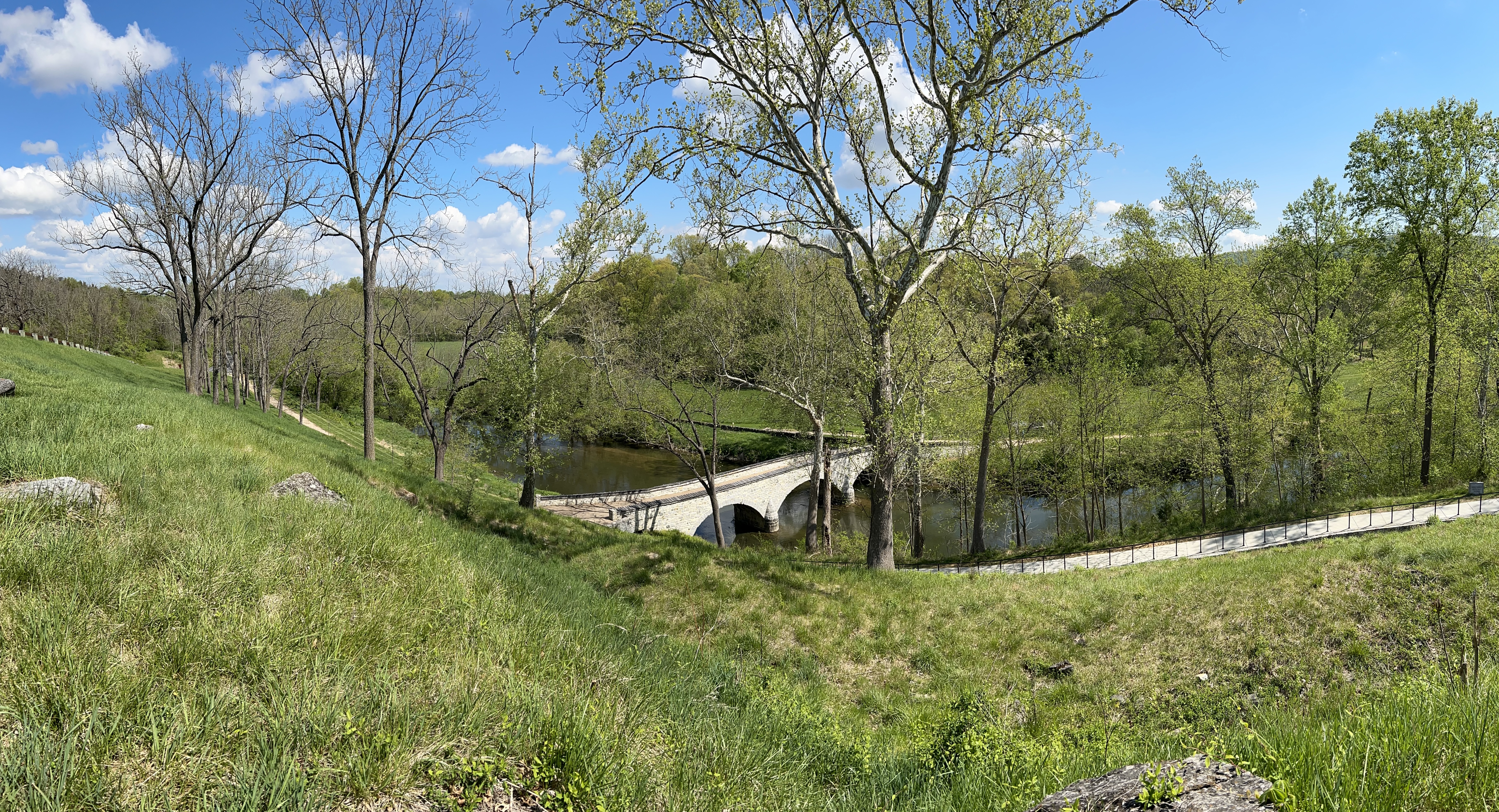
A few quibbles with the park film, Gen. Lee was not “the most handsome man ever to wear a uniform”, the US Army should not be described—at least in this country—as “the enemy”, and Antietam was not a ‘draw’. Like at the bridge above, the Confederate Army held the high ground, the Union Army attacked, and at the end of the day, the Union occupied the field, north, south and center. Since a truce was declared after 12 hours of fighting to clear the field of 23,000 casualties, technically it may have been a “redeployment” back to Virginia, but the war turned on these fields and hills in Maryland. And Lee retreated.

This one battle was bloodier than all of America’s previous wars, and, especially due to photos of the aftermath, it forever changed our perception of war. Clara Barton followed the sound of battle and arrived to provide medical aid, years before she founded the Red Cross. Any hope of a negotiated settlement was gone, and Lincoln drafted the Emancipation Proclamation within a few days.

Manassas National Battlefield Park

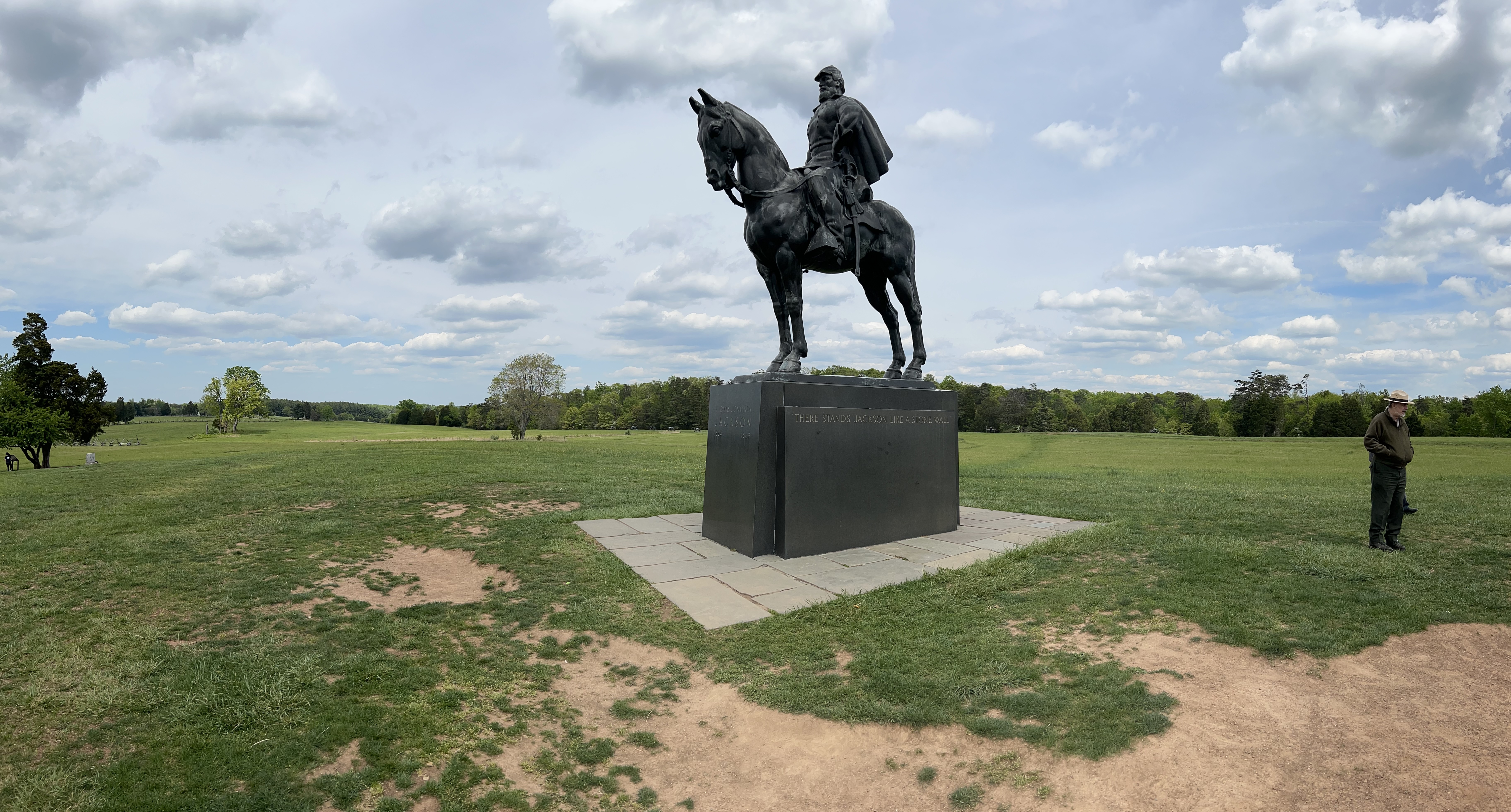
Both the first and second battles here (aka Bull Run) were severe losses for the Union ending in retreats to DC. In the first, Stonewall Jackson above got his nickname, and in the second, Robert E. Lee took command. 900 dead first, and 3,300 dead second.

The ranger is giving a tour of Henry Hill, explaining how Jackson’s forces were expertly positioned and how the Union artillery were stupidly placed in front of them, in range, without infantry support, ahead of their line, without scouting the area. A counter-attack was readied, countermanded and overrun, revealing the lack of infantry. Jackson’s troops attacked with ‘a rebel yell’, and the Union retreated in panic. Which also sums up the rest of the battle.

There’s a driving tour for the second battle, where again the Union forces were incompetently led into rash attacks, poorly executed. In contrast, Lee’s army executed maneuvers, defended and counter-attacked well, with good timing, and Jackson even captured supplies behind lines. Again on this hill, faced with defeat, the Union forces defended before retreating at night.

From a military perspective, the Confederate generals here fought admirably. The hero worship can be excessive (Ranger: ‘neither Jackson nor his horse took steroids’) and misplaced (we have no monuments to Yamashita, Tojo or Rommel). The Confederate victories prolonged the war—in defense of slavery—and increased the cost in American lives.

Palo Alto Battlefield National Historical Park

[Note: Starting today, I’m switching to Monday, Wednesday & Friday posts to keep more up to date.]

The strange elk in the background are actually Nilgai, an Asian Antelope that escaped from a ranching project and now live in the park. In a way, it’s appropriate to start with an invasive species, since this park marks the start of the Mexican American War. In the 1840’s President Polk campaigned on expanding the country westward and as President sent troops to the Rio Grande, even though Mexico viewed it as their territory. Mexico, having only recently won its independence in 1821, was having trouble managing its northernmost territories, and lost control of much of Texas during a revolt by American settlers in the 1830’s. When Mexico’s army crossed the Rio Grande to expel the interlopers, Polk claimed that America was under attack and the war was on.

Mexico laid siege to a small fort on the north bank of the Rio Grande, and US troops were rushed in from up the coast to reinforce it. The two forces met in the middle here in a dry part of the delta. The US had better artillery, and the Mexicans had more men. The US troops were under command of Zachary Taylor, who later turned his war fame into a successful run for President, and many veterans of this battle would go on to serve in the Civil War. Lt. US Grant, who opposed war with Mexico personally, engaged in his first battle here. Between heavier guns firing more deadly shells, light guns quickly turned to face flanking attacks, and well trained US troops who engaged in hand to hand combat between here and the fort, the Mexican Army was forced to retreat. Around 100 Mexican troops and 10 US troops died in battle here.

Today the field is marked with flags and cannon to show the positions of the two sides and ‘interpretive exhibits’—small signs—to explain what happened in different places where the troops faced off. Closer to Brownsville, there’s a much smaller battlefield, the Resaca de la Palma, where the Mexican Army bravely made a stand to protect their retreat. There is a viewing platform of the resaca, meaning ‘often dry river delta channel’ (and not ‘hangover’, as the word means today). The siege of the fort was lifted, but the fort’s leader Major Brown and one other US soldier were killed in action. The fort and eventual city, Brownsville, were later named for the young officer.

Although the site only covers the first week of the war that took place in what’s now the US, the war raged on for two more years with US troops taking cities deep into Mexico, until Mexico agreed to cede Texas and sell its rights west all the way to the Pacific. Mexico lost 1/2 its territory and the US doubled in size. As interesting and consequential as the history is, the site is a well-marked field with a path for each army, so it requires some imagination and curiosity to appreciate. The small visitor center is educational, bilingual, has an informative film, and has enthusiastic and knowledgeable rangers and volunteers. But by all means go out on the battlefield, if only to see the wildlife. I saw over a dozen Nilgai, several hawks hunting in the tall grasses, a crested caracara, and more. This is a well-known area for birders.

Reconstruction Era National Historical Park

Reconstruction began in November of 1861, when US Navy & Army forces destroyed two forts and took Port Royal, because when all the white planters fled in the Confederate retreat, 10,000 slaves took over their sea island plantations. Union policy at the time was to declare the former slaves “contraband” or illegal property seized by the military. But the pressure was on President Lincoln to resolve their status permanently. First, he quietly authorized the Union’s first black regiment—the 1st South Carolina Volunteer Infantry which by November of 1862 mustered 1000 men and engaged in battle—, and then he finalized his executive order to free the slaves.

“all persons held as slaves within any State…
in rebellion against the United States,
shall be then, thenceforward, and forever free”

Emancipation Proclamation of President Abraham Lincoln

Among the great mossy oaks here at Camp Saxton on the 1st day of January in 1863, our nation’s first black regiment gathered here with their friends and families to all become the first people freed by Lincoln’s Emancipation Proclamation. Then the 1st SC Volunteers received their regimental colors as proud soldiers of the Union Army, under the command of one of John Brown’s conspirators in the raid on Harpers Ferry. Harriet Tubman was also here as a volunteer spy and liberator, and in June she guided three gunboats and the 2nd SC Volunteers up the Combahee River 25 miles north in a dangerous raid that freed 700 slaves. Other African American regiments from Kansas, Massachusetts and other states in both the north and south soon followed, and by the end of the war, 200,000 African Americans enlisted to make up 10% of the Union Army.

As soon as Port Royal was liberated, Philadelphian abolitionists Laura Towne, Ellen Murray and Charlotte Forten, who was African American, arrived and began the most important part of reconstruction: teaching. While not the first African American school, in 1862 they founded the Penn School to teach people who had been denied formal education for generations. The Gullah Geechee people had created their own language and had kept many cultural traditions alive, including the delicious Lowcountry boil or Frogmore stew, and, when given the opportunity for formal education, they began learning basic, practical skills to live independently, everything from shoemaking and auto repair to cooking and nursing. At the Penn Center, I met a Gullah Geechee woman who still speaks the language and who was treated as a child by one of the first physicians to graduate from the Penn School.

The Gullah Geechee sea islands remained in Union hands throughout the war and became central to the Union “anaconda” naval blockade. The hero Robert Smalls (see Fort Sumter), after helping convince Lincoln to enlist African Americans, purchased the home of his previous owner here, using his congressionally awarded bounty for the Planter, and represented this district in Congress for five terms. The beautiful, historic neighborhoods of Beaufort were retained by the descendants of freed slaves by strict preservation laws, resulting in a sharp contrast with nearby predominantly white golfing communities like Hilton Head. In a historic echo, 100 years after the Union used Beaufort as a base to fight the Confederacy, the Reverend Dr Martin Luther King, Jr and the Southern Christian Leadership Conference chose the Penn Center as a base for their Civil Rights campaigns, including planning the March on Washington and the Poor People’s Campaign. Dr King wrote his I Have A Dream speech here in Gantt cabin on the Penn Center campus.

Plan your visit thoughtfully. To the west, Camp Saxton is hidden at the water’s edge between a navy base, the ruins of Fort Frederick and a residential neighborhood. In town, the visitor center in the historic zone’s old firehouse has very knowledgeable rangers who skillfully and kindly disabused me of my misconceptions. To the east, the Penn Center has exhibits (for a donation) on the school, the Gullah Geechee community and the important Civil Rights work done here. There are two dozen historic building on campus including a dock and a Rosenwald school. Many, such as the Brick Baptist Church, aren’t presently open to the public, but Darrah Hall is open with park staff, information and exhibits. A wonderful volunteer discussed whether the Reconstruction Era ever really ended. Plan more time for the Penn Center partner exhibits, less time for the downtown Beaufort visitor center and enough time at Camp Saxton to stand under the Emancipation Oaks (and take a better photo than I did).

Fort Pulaski National Monument

This Civil War era fort still shows the pockmarked scars from Union artillery. A later famous Lt Robert E Lee helped design the tidal sluice gates and canal for the moat which circumscribes the fort, and he had assured the commander that the walls would hold. And it did hold for 112 days against a Union siege in April of 1862. But despite the impressive moat, drawbridges, masonry, and reinforced internal structures, the invention of rifled artillery made the fort obsolete, as this test of the experimental weapons demonstrated. The wall on the left end had to be rebuilt after the spinning explosive shells opened huge gaps. After 30 hours bombardment, the fort surrendered and the port of Savannah was blocked by the Union’s anaconda. Otherwise, the fort is in good condition, with good views from the tops of the walls, and walking around the inside makes for an interesting visit.

Fort Sumter and Fort Moultrie National Historical Park

Charleston is a magnificent old port city, well worth an extensive visit. Beyond the colorful stately homes, historic churches and carriage rides, there’s the fateful battle that ignited the Civil War and much more. When I visited Fort Sumter by park ferry (before renouncing carbon travel), my kids and I stared in awe at the ships and harbor. In May of 1862, Robert Smalls, an enslaved ship’s pilot, secretly commandeered a confederate steamship, the Planter, brought his family and friends aboard under cover of darkness and maneuvered the ship out of Charleston, past forts and ships to deliver it to the Union. Fort Wagner of Glory fame (see Boston & New Bedford) was one of those confederate forts at the mouth of the harbor, before the sea took it.

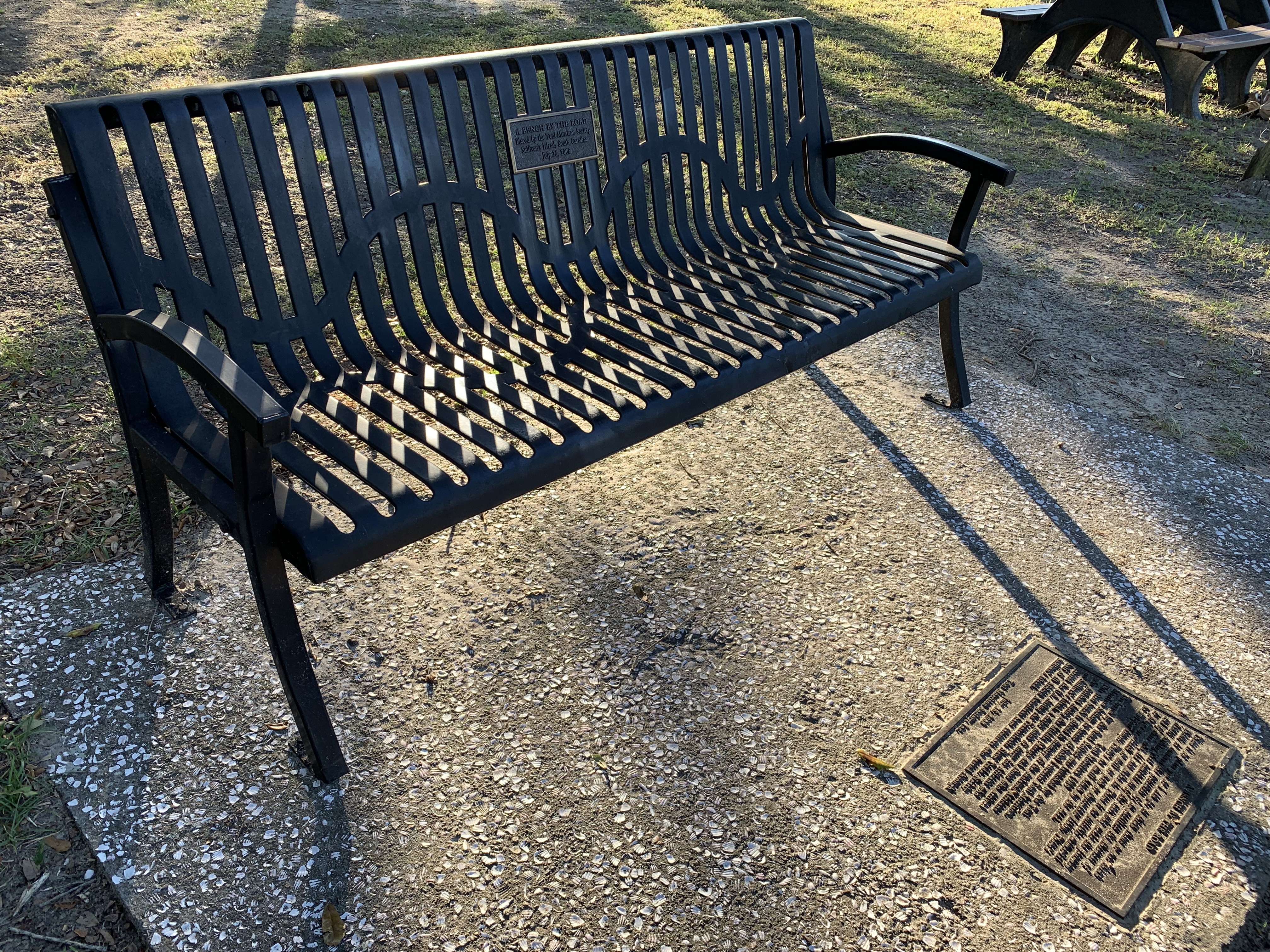
Why the bench? Beloved author Toni Morrison once explained that she wrote that book in part due to the lack of suitable monuments to capture the enormity of slavery, despite centuries of oppression and discrimination. From the impact on Africa, the millions killed in the transatlantic passage, the millions bred in captivity, the millions worked until death, the millions separated, raped and tortured, to the millions kept in ignorance and darkness for centuries, there has been no full accounting, no complete understanding and precious little effort to try. Since the interview, benches have been place in a few places around the world, including the back corner here, at Fort Moultrie near the dock.

“There is no place you or I can go, to think about or not think about,
to summon the presences of, or recollect the absences of slaves . . .
There is no suitable memorial, or plaque, or wreath, or wall, or park, or skyscraper lobby.
There’s no 300-foot tower, there’s no small bench by the road.
There is not even a tree scored, an initial that I can visit or you can visit
in Charleston or Savannah or New York or Providence or better still on the banks of the Mississippi.” 

Toni Morison, from an interview in 1989

This vast crime against humanity, slavery, was the cause of the Civil War, not the attack on Fort Sumter. And the bench, while far too small a gesture, is a good place to start thinking about it. Another step would be to fund grants and awards to the descendants of enslaved people for producing literature and other great works, to help make up a little of the deficit caused by centuries of enforced silence, forbidden literacy and lives erased.

Fort Point National Historic Site

The Civil War era fort was obsolete as soon as it was built, since rifled cannon penetrated brick walls, and the one threat it faced, the CSS Shenandoah via the Indian and Pacific, called off their mission when they learned the war had ended months earlier. (They spent their round the world voyage attacking whaling ships out of New Bedford, since they often had escaped slaves on their crews.) Before that, there was a Spanish fort here, which was taken over by the Mexicans and then by a band of Americans including Capt. Fremont and Kit Carson, shortly before California became a state.

These days, it’s best used as a place to get a nice photo of the Golden Gate Bridge (when it’s less foggy). The fort is open on weekends, and you can get a good photo from the roof. I walked down from Battery East, but walking or biking from Crissy Field is nicer. There is parking at the fort, although it requires persistence navigating, since more roads are open to bikes than cars around here.

Harpers Ferry National Historical Park

Since each park is unique, I would never be able to say which is my favorite. But this one is.

Here, at the confluence of the Shenandoah and Potomac Rivers, in 1859 the abolitionist John Brown led 18 men to capture the armory, arsenal, and rifle factory here, killing three men, freeing slaves and taking the town’s leaders captive, before being captured by Col. Robert E. Lee and martyred after a brief trial, becoming the first person executed for treason in America. Brown believed he was right, did not intend for anyone to die and argued at trial that “had I interfered on behalf of the rich, the powerful… or any of that class… this court would have deemed it an act worthy of reward.”

Native Americans lost this land to European settlers during the 16th and 17th centuries. Washington explored the area for his canal project and recommended an armory be built here. The armory supplied Lewis & Clark’s expedition, and the arsenal supplied weapons for the Civil War. During which the town changed hands eight times including the destruction of the arsenal, the capture of 12,500 Union soldiers by Stonewall Jackson and the critical resistance to the confederate army marching on DC. Major Delaney, the only African American field officer in that war, came from here, alongside many USCT recruits. Frederick Douglass and W.E.B. DuBois organized and lectured here, where the Freedman’s School and Storer College educated the descendants of slaves.

Thomas Jefferson stood on a rocky overlook and said “this scene is worth a voyage across the Atlantic.” The mountains, rocky cliffs, rivers, swamps, and floodplains here support diverse wildlife, including three species of hawk, a harrier and the bald eagle. There are over 20 miles of hiking trails in the park, including part of the Appalachian Trail (park & hike). And the tavern in town serves a draft amber ale called Almost Heaven.

“Almost heaven, West Virginia
Blue Ridge Mountains, Shenandoah River”

John Denver