Fredericksburg and Spotsylvania County Battlefields Memorial National Military Park

While this is the longest park name, they could have gone with “Fredericksburg, Chancellorsville, The Wilderness and Spotsylvania Court House Battlefields Memorial National Military Park”. This is the largest military park covering 70 miles and three years of battles. Outside historic Fredericksburg, there are few buildings to see, including the Old Salem Church (another battle site), Ellwood (where Jackson’s left arm is buried) and the Stonewall Jackson Shrine. There are miles of fields, forests, trenches, historic trails, foundations, key military positions, markers, and memorials, with well over 40 tour stops, and there were visitors at every battlefield even until dusk.

Fredericksburg is roughly halfway between DC and Richmond, the Confederate Capital, which explains the numerous, bloody battles fought in the area. Spotsylvania is the name of the county. Fredericksburg was a Union disaster, under General Burnside, who ordered repeated attacks up the steep hills held by entrenched Confederates, but unlike Antietam all attacks failed and ended in retreat. At Chancellorsville—a one house village— the next year, General Hooker had executed an end run around Lee’s forces in the hills above Fredericksburg, but Stonewall Jackson executed an end run around Hooker’s forces. Jackson was killed, but the Union retreated in another defeat. Lee, confident after many victories, went north to Gettysburg. Another year later, General Grant returned to the Wilderness and Court House of Spotsylvania, finally making progress towards Richmond.

Chatham House, the Union HQ where both Clara Barton and Walt Whitman worked in the hospital, has a commanding view of Fredericksburg above, where Union artillery supported the failed assault. Washington, Jefferson and Madison were among the visitors to the wealthy plantation home that predates the country. Lincoln met with some of his generals here during the war. In the 1920’s the owners built a magnificent formal garden, which makes a nice break from the gruesome battlefields. Fredericksburg also has a historic walking tour, with some buildings that predate the Revolution, monuments to founding fathers and a slave auction block.

There is a common factual error in too many park films on the Civil War: that slavery only became an issue when Lincoln issued the Emancipation Proclamation. This conceit defies all plain fact. Lincoln was anti-slavery from childhood and argued against it his entire life, including all his campaigns and in every office he held. The primary political division in the country pre Civil War was about slavery. Most northern states were not only anti-slavery but had worked on ending slavery since the Revolution. The Abolitionist movement began in Europe in the 1770s and was active openly in the north and in secret in the south before the Civil War. Every southern state that seceded, cited preservation of slavery as the reason. Lincoln’s hesitancy in making it official policy at the outset was due to the few northern border states that were still in the gradual process of ending slavery. Lincoln might have accepted a negotiated settlement early in the war, but the Confederates rejected it, being willing to fight to the death to keep their fellow humans in eternal bondage.

General Lee is quoted at the visitor center in Fredericksburg as expressing his sympathy for the white refugees fleeing south, but he apparently had zero regard for the far greater number of black refugees fleeing north. The Fredericksburg park film expresses much anguish for the destruction of pianos and other household goods, but only briefly mentions that 1/4 of the town were slaves when the Union troops arrived to liberate them. Tens of thousands of slaves fled Virginia through here during the war, crossing the Rappahannock River in Fredericksburg and getting passes to travel to refugee camps at Fort Monroe and near DC, seeking the safety of the Union. The lost property that the Confederate newspapers bewailed was largely human property.

Those who hold these Confederate generals in high esteem need to ask themselves why their heroes cared so much about the white residents and not at all about the black residents? It’s possible to admire Von Manstein for his strategies and Rommel for his tactics, but it’s not possible to ignore the 6 million Jews their government killed in the Holocaust. The Civil War ended 158 years ago. Moral judgements must be made about the cause of the war and the motives of the participants. The Confederate cause was evil, and we must not make heroes of those who served the cause of slavery. Stonewall Jackson was not a saint, so he does not deserve a shrine on national park land.

Cedar Creek and Belle Grove National Historical Park

The park service Belle Grove site is near the north entrance to Shenandoah National Park, near the West Virginia border. Cedar Creek feeds into the Shenandoah River nearby, and this large agricultural valley in Virginia was home to James Madison’s brother in law, who had up to 100 slaves or so working his grain fields at any given time. Nelly Madison Hite named the plantation house Belle Grove Manor after her birthplace Belle Grove Plantation which is on the Rappahannock River near Fredericksburg, also in Virginia, and that’s now a historic B&B. James Madison was also born there and died at his Montpelier estate, which is near Charlottesville Virginia.

In 1864 Confederate troops routed Union soldiers in a surprise foggy morning attack. In the afternoon, General Sheridan arrived with more troops and won the day. The fighting approached the front porch above and left a couple bullet holes still visible. General Grant ordered many such farms in the valley burned to break the rebellion, causing hardship and starvation. Of course, the crops had all been grown by slave labor, so in the long run the owners’ hardship was finally needing to pay their workers.

The ‘struggle of southern women to be able to feed their families’ was due to a combination of factors: blockaded ports, burned plantations and escaped slave labor—the last factor perhaps the largest and longest lasting. Even poor whites benefited from cheap food, clothing & tobacco grown by slaves, which needs to be remembered when reading arguments that ‘most white southerners did not own slaves and were fighting to preserve a way of life’. Even poor whites knew that they would lose social status and have to start doing hard labor themselves if slavery ended. The end of slavery meant the end of that morally reprehensible way of life for all whites in the south, and the men who enlisted all knew it and chose to fight to preserve slavery.

There are reenactments, trenches and fields to explore, some monuments, a partner tour of Belle Grove Manor above, and a small partner museum with Civil War memorabilia across the street. The park is within the broader Shenandoah Valley Battlefields historic district, so there’s plenty to see in the area too. The basement of the manor has an interesting exhibit reconstructing the kitchen and showing artifacts of life in the time of slavery. If you’re interested in the defeated, there’s a picture of a dying Confederate general being comforted by G. A. Custer and also Coronation Tea in the gift shop.

Gettysburg National Military Park

This grand Pennsylvania monument is appropriate for this critical turning point in the Civil War in July of 1863. Lee’s northernmost advance on Washington ended, his retreat to Virginia began, and with Vicksburg ending a day later, Lincoln finally had the victory he needed to prove the Union capable of winning the war. The battlefield runs right through town, with bullet-hole houses, up onto Cemetery Hill, where the Union lines held off Lee’s massive frontal assault—a reversal of the usual Union v Confederate roles. The land has been carefully preserved to evoke the day, and the park app’s auto tour tells the many stories of bravery, such as Hancock’s numerous maneuvers in the nick of time. Visiting the cemetery brings Lincoln’s address to life. This is another powerful park to remember this Memorial Day weekend.

Gettysburg has the finest museum (a favorite) at any of the military and battlefield parks. Particularly the park film, short films, quotations, exhibits, bookstore, and, well, everything. It’s worth paying the extra fee to the park partner that runs it. Through first rate research, they get the balance correct between views at the time and the facts. It takes longer to see than most park museums, but for once I felt I understood not just the battle, but the context and meaning behind the struggle. There’s also a phenomenal period panoramic painting of the battle, which is a historic work of art itself. And if you are able to hire a park guide to take you around the battlefield in your own car, that’s the best way to get your questions answered and make sense of the three day battle over much of the same ground. My brother and I were extremely fortunate to secure the expert assistance of our former teacher, who has many years of experience working here and to whom we are very grateful.

Many Civil War sites bend over backwards to present ethically indefensible archaic views as valid, as if they are obliged to reprint Confederate propaganda without context. But that would be like presenting ‘witchcraft’ as valid, because it was believed in colonial Salem. Not only does Gettysburg get it right, but they also clearly blame the north for their role in whitewashing history. Segregationist President Woodrow Wilson supported Jim Crow restrictions to get African Americans back to work for low wages and to win white votes. Most of the Confederate monuments I find objectionable are only 100 years old and come from this era of white northern and southern ‘reconciliation’. We still need to fix this historic problem of treating both sides as having fought for valid causes.

Antietam National Battlefield

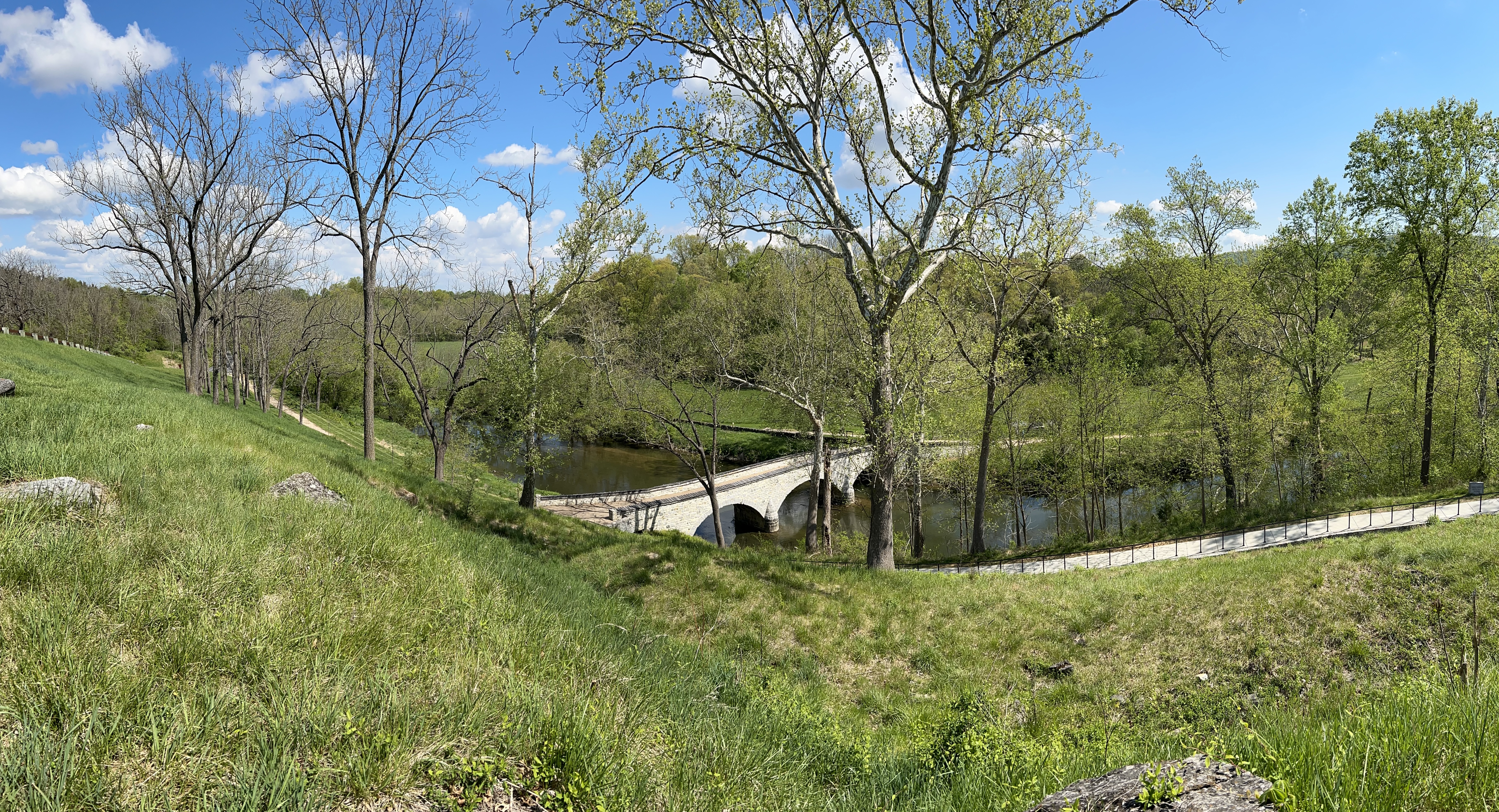
A few quibbles with the park film, Gen. Lee was not “the most handsome man ever to wear a uniform”, the US Army should not be described—at least in this country—as “the enemy”, and Antietam was not a ‘draw’. Like at the bridge above, the Confederate Army held the high ground, the Union Army attacked, and at the end of the day, the Union occupied the field, north, south and center. Since a truce was declared after 12 hours of fighting to clear the field of 23,000 casualties, technically it may have been a “redeployment” back to Virginia, but the war turned on these fields and hills in Maryland. And Lee retreated.

This one battle was bloodier than all of America’s previous wars, and, especially due to photos of the aftermath, it forever changed our perception of war. Clara Barton followed the sound of battle and arrived to provide medical aid, years before she founded the Red Cross. Any hope of a negotiated settlement was gone, and Lincoln drafted the Emancipation Proclamation within a few days.

Fort Monroe National Monument

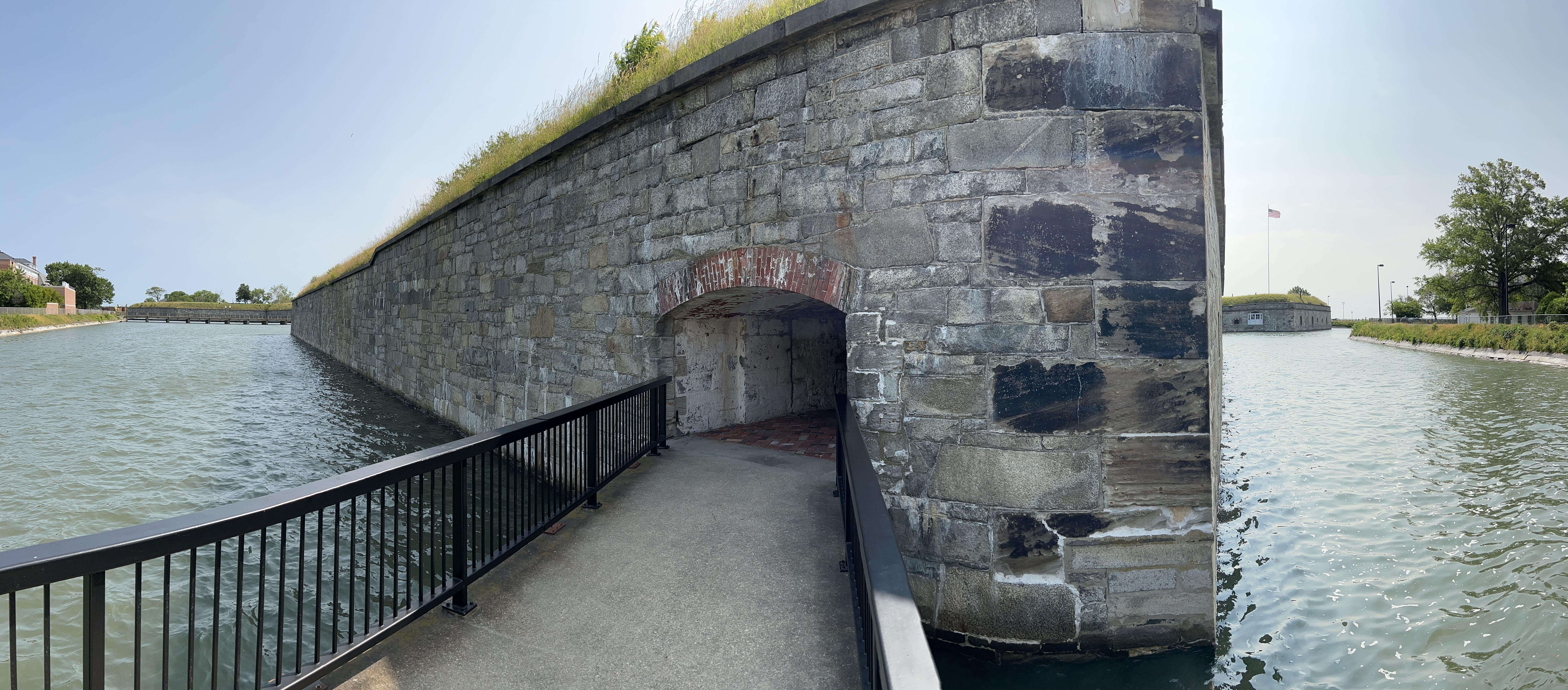
The English sited a fort here in their Virginia colony at the mouth of the James River to protect Jamestown and the deep water entrance to the Chesapeake known as Hampton Roads, and now the Norfolk Navy Base sits across the river. The current fort is the largest masonry fort in the US, and although it was not directly involved in any battles, the Monitor v Merrimack battle was witnessed from its lighthouse, the oldest on the Chesapeake. Lincoln planned the capture of Norfolk here. Confederate leader Jefferson Davis was imprisoned here, decades after Lt Davis had been involved in sending captured Chief Black Hawk to prison here. Robert E. Lee improved the moat system above. Edgar Allan Poe served here (and later returned to recite his poetry).

But the most important history here began in 1619, when the first Africans were brought here by British privateers who stole them from the Spanish, and they were immediately put to work by the English colonists beginning the abomination of slavery in the American colonies. The first African American child, William Tucker, was born here in 1624. (First, unless you include Spanish St Augustine Florida, where there were 16th century slaves, as well as slaves in the Coronado and DeSoto expeditions).

The day Virginia seceded, three slaves, Baker, Townsend & Mallory, escaped and sought refuge here. Their owner sent a Confederate officer to claim his property. Without any official policy, the Union General Butler decided that the three men were illegal property or ‘contraband’ and refused to return them. Butler supported educating, training and enlisting them. This ‘contraband decision’ was widely published in newspapers and became Union policy until Emancipation. Many other escaped slaves similarly sought protection at this and other Union forts and camps, and communities with contraband schools began. Nearby Hampton University began as one of those schools, attended by 16 year old Booker T. Washington in 1872, fully 253 years after slavery started here in this country.

Manassas National Battlefield Park

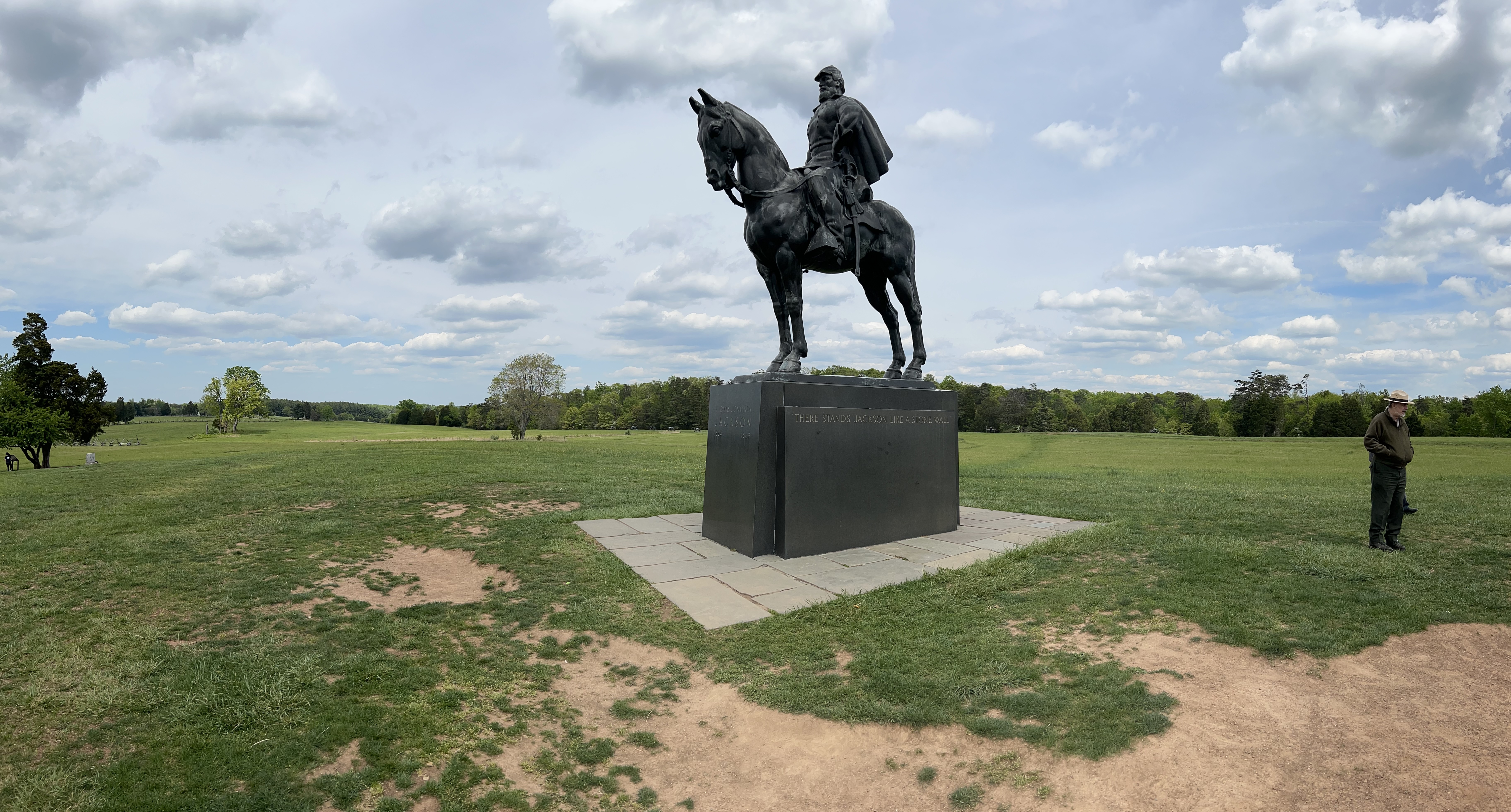
Both the first and second battles here (aka Bull Run) were severe losses for the Union ending in retreats to DC. In the first, Stonewall Jackson above got his nickname, and in the second, Robert E. Lee took command. 900 dead first, and 3,300 dead second.

The ranger is giving a tour of Henry Hill, explaining how Jackson’s forces were expertly positioned and how the Union artillery were stupidly placed in front of them, in range, without infantry support, ahead of their line, without scouting the area. A counter-attack was readied, countermanded and overrun, revealing the lack of infantry. Jackson’s troops attacked with ‘a rebel yell’, and the Union retreated in panic. Which also sums up the rest of the battle.

There’s a driving tour for the second battle, where again the Union forces were incompetently led into rash attacks, poorly executed. In contrast, Lee’s army executed maneuvers, defended and counter-attacked well, with good timing, and Jackson even captured supplies behind lines. Again on this hill, faced with defeat, the Union forces defended before retreating at night.

From a military perspective, the Confederate generals here fought admirably. The hero worship can be excessive (Ranger: ‘neither Jackson nor his horse took steroids’) and misplaced (we have no monuments to Yamashita, Tojo or Rommel). The Confederate victories prolonged the war—in defense of slavery—and increased the cost in American lives.

Harriet Tubman Underground Railroad National Historical Park

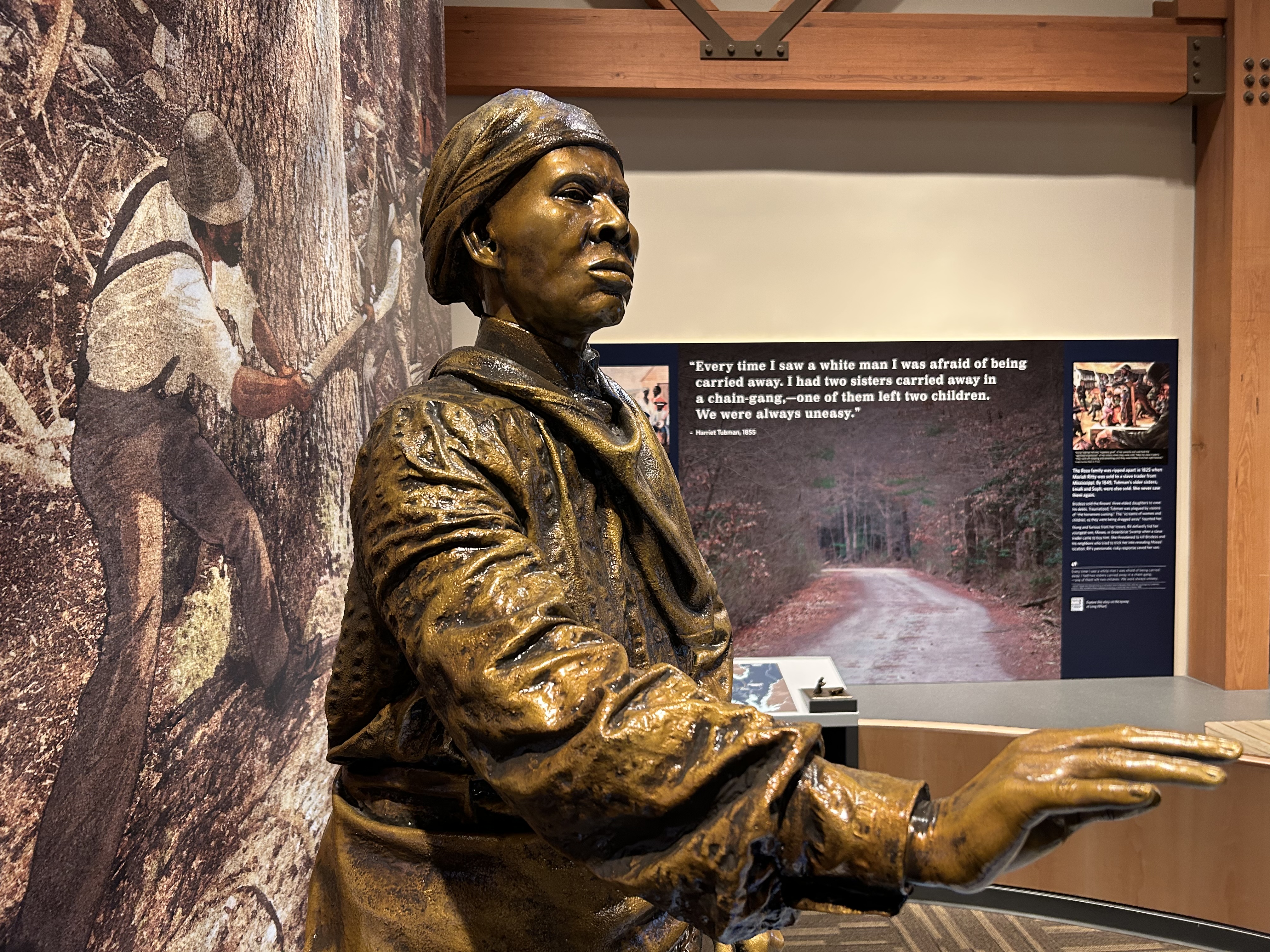
Harriet was born in remote southeastern Maryland, and her knowledge of survival skills in the marshy fields and forests of the area helped her free 70 slaves directly and many more indirectly through her instructions. Now, the NPS NHP, Maryland State Park, and National Monument within the Blackwater National Wildlife Refuge are managed jointly. Unlike her home site in Auburn NY, there are no structures from her time here, but the visitor center has exhibits telling her story and busting many of the myths about her, such as the ‘secret messages’ in quilts. The brochure further explains that she could not have sung “Swing Low, Sweet Chariot”, since it was written by an Oklahoma Cherokee after the Civil War. But she did sing “Go Down Moses” and “Bound for the Promised Land”.

“I had reasoned this out in my mind;
there was one of two things I had a right to, liberty or death;
if I could not have one, I would have the other,
for no man should take me alive.”

Harriet Tubman

The stories of her childhood, her Underground Railroad missions and of the Combahee River raid are all told here, as is the story of her friendship with the Abolitionist Thomas Garrett. While he did not risk his life as Harriet did, he was involved in almost three thousand escapes over four decades, at considerable personal financial cost. His partnership with Harriet must have felt serendipitous to both. She was a natural, simple, pure person of faith, from childhood, but especially since her injury-caused epilepsy. The Quakers held strong convictions of faith, even over the law, and prized simplicity, humility and doing good deeds. Each was exactly what the other needed, a Moses leading her people out of the wilderness into the promised land, and a network of believers willing to contribute time, money and help to end the abomination of slavery. Yet despite their acts, millions remained enslaved.

Fort Washington Park

In August of 1814, the British launched a two-pronged attack on our nation’s Capital: a naval raid up the Potomac and an overland raid from the Chesapeake. Due to shallow water the land troops reached Washington DC first. DC was poorly defended, as Secretary of War Armstrong had decided that the Capital was not of strategic value?!? The British burned the White House and many other government buildings. Before the fleet reached the original fort here (Warburton), Captain Dyson decided to spike the guns, blow up the magazine and retreat?!? The British fleet sailed right past the smoldering ruin and took Alexandria. In September, the British fleet sailed to Baltimore where they had a different experience with Fort McHenry.

The much larger Fort Washington was built after the war on the old fort’s foundations, and it has a commanding view of the Potomac where Piscataway Creek enters. This fort’s guns were updated several times, but they were not used in battle as the Union maintained naval superiority during the Civil War. Due to fears that Maryland might change sides and give this fort to the Confederacy, additional forts were built around DC. The walk down to the lighthouse (above center) is pretty.

Thaddeus Kosciuszko National Memorial

This is a difficult site to visit, since it’s only open seasonally, on weekends, in the afternoon, in an area with very little parking. The site is tiny, consisting of a few displays, a short film, and this recreation of his room in a boarding house here in Philadelphia. So, why do we have a site for a Polish citizen?

Thaddeus left Poland and arrived almost simultaneously with the British fleet at the outbreak of the Revolutionary War. He had military education and soon found himself employed as an engineer. Long story short, Kosciuszko was the one who chose the site and designed the fortification at Saratoga, which became the turning point of the war. He also designed and oversaw construction of the fort at West Point, which was deemed impenetrable by the British. He also joined the southern campaign and even fought in the last skirmish at the end of the war.

He returned to Poland, declared independence from Russia, and was wounded and exiled when his insurrection failed. The site here is also considered a Polish historic site. He lived in the room above for many years and was close friends with many American Revolutionary War leaders, including Thomas Jefferson. He asked Jefferson to use his American pension to free slaves through his will, but somehow the case eventually lost in court. Jefferson may have been the wrong person to entrust for that.

First State National Historical Park

One of the prettiest partner sites in the park, the Old Swedes Church dates back to 1698 when the King of Sweden funded it to support his small community. (If you do the tour, take the stories about the ghosts and the character who requested the funds with a grain of salt—there are a number of hoaxes out there). The Swedes arrived here in a Dutch ship, the Kalmar Nyckel in 1638, traded with the Native Americans for beaver pelts, and they built a fort named after their progressive young Princess Christina. Eventually, the British took over the area, but there’s now a fabulous recreation of the 17th century tall ship—which does day sails in summer—next to the site of the fort.

Delaware was spared most of the battles of the Revolution, besides a skirmish at a bridge and a naval engagement in the river, and also had no Civil War battles, but its history is nonetheless fascinating. The name comes from Baron De La Warr, the first Governor of the Virginia colony. The land was part of the King’s grant to William Penn—on the condition he take his Quaker friends with him—and was technically part of Pennsylvania until 1787. At the south end of the park, John Dickinson’s plantation holds tours about his writings in favor of independence, his signing of the Constitution and his decision to free his slaves by 1786. Delaware was a key vote during the decision to issue the Declaration of Independence. Two of its three delegates split, and the third, who was ill, rode overnight to cast his vote in favor and to exhort the other state delegates to join. The first state ratification of the Constitution was done in Dover, near the Green, but the tavern were it took place is gone.

Delaware Quakers were active in the Underground Railroad, and there’s a statue of Harriet Tubman and Thomas Garrett in Wilmington. One African American conductor was arrested, jailed, and auctioned off in front of the old State House in 1848. As Samuel Burris was being carted off into slavery, his purchaser whispered to him, “not to fear, you have been purchased with abolitionist gold and I will spirit you away to Philadelphia”.

Due to the main visitor center behind the Old Court House in New Castle still being under construction, and due to the plethora of partner organizations, the sites and tours may seem a bit disorganized or amateurish, but the locals know their history and are proud of it. The Old Court House has many original artifacts, portraits and exhibits to see on the interesting tour. Try eating at one of the old Colonial Era taverns or tea rooms, and you’ll likely learn more lore from the locals.