Trail of Tears National Historic Trail

The trail is a crime scene, but we must remember, understand, judge and commit ourselves to being better. In the early 1800s, the Cherokee, Chickasaw, Choctaw, Muskogee (Creek) and Seminole tribes in the southeast were trying to balance their own culture while adapting to new ways of life. Sequoyah had created a Cherokee alphabet by 1821, and many had assimilated into the new communities, often through intermarriage, building homes, farms and businesses alongside immigrant families.

But many voters (at the time white males) had deep racist fear and hatred of Native Americans (and also wanted their land), so they voted for politicians who would remove the tribes. Andrew Jackson had a successful political career, and purchased a plantation and over a hundred slaves to work it. Appointed a colonel in the Tennessee militia, he gained national fame during the War of 1812–an expansionist war of choice against Native Americans and their British backers: “Remember the Raisin”. Jackson led troops including regiments from some of the five ‘civilized tribes’ above in the slaughter at Horseshoe Bend in 1814. One of his soldiers was Sequoyah, who saw first hand how the rebellious ‘Red Sticks’ were cut down by superior weapons. Jackson used the victory to betray his Native American allies by forcing the Muskogee who had fought on both sides to cede almost half of Alabama and much of southern Georgia in the 1814 Treaty of Fort Jackson.

Within 10 years of Horseshoe Bend, the Chickasaw had ceded 1/2 their territory, along the Mississippi River in western Kentucky and Tennessee (between Shiloh and Fort Donelson), retaining much of northern Mississippi (around Brices Cross Roads and Tupelo). The Choctaw lost their land near Vicksburg, and lived south of the Chickasaw. The Muskogee were restricted to a fraction of their land around Horseshoe Bend in eastern Alabama (around the Freedom Riders Monument). The Seminole had lost around 1/2 of Florida and lived in the swampy center. And the Cherokee still held their land in the mountainous corner of Alabama, Georgia, Tennessee and North Carolina, from Little River Canyon—which became a waypoint on the trail—and Russell Cave—which had been continuously inhabited for 10,000 years—, to Kennesaw Mountain and Chattahoochee River up to Chickamauga and Chattanooga, and up to the Smoky Mountains. (Yes, much of the Civil War was fought over land stolen from natives 50 years earlier).

Jackson is remembered for winning the Battle of New Orleans, but we should also remember the aftermath of the War of 1812, which ended when John Quincy Adams negotiated the Treaty of Ghent. Spanish Florida had been allied with the British, who had forts on the Panhandle. When they withdrew, they gave over one fort to a group of Seminole and African Americans. This became known as the ‘Negro Fort’ which caused great concern among those who benefited from slavery in the southeast. General Jackson sent in forces, and the fort was leveled when a cannonball hit the powder magazine. The Seminole Wars continued for decades, and the history of natives, African Americans and negotiations over Florida is fascinating.

Adams, who supported financial compensation for the five tribes, won a contingent election for President in 1824, but then Jackson defeated Adams overwhelmingly in 1828 and was reelected in 1832. As President, Jackson refused to follow a Supreme Court ruling in favor of the Cherokee, and he supported segregation of natives and both state and federal jurisdiction over native land. Jackson supported and signed the ‘Indian Removal Act’ of 1830, intending to remove the five tribes from their remaining land. Tens of thousands of Cherokee, Chickasaw, Choctaw, Muskogee and Seminole were removed from the southeast and relocated to Oklahoma with thousands dying on the forced migration trail: rounded up and held in forts, with few possessions, homes looted, families separated, marched under guard, some in chains, suffering cold and exposure, denied medical help, including women, children and the elderly. Stops along the way included Arkansas Post, Little Rock, Pea Ridge and Fort Smith in Arkansas and Wilson’s Creek in Missouri.

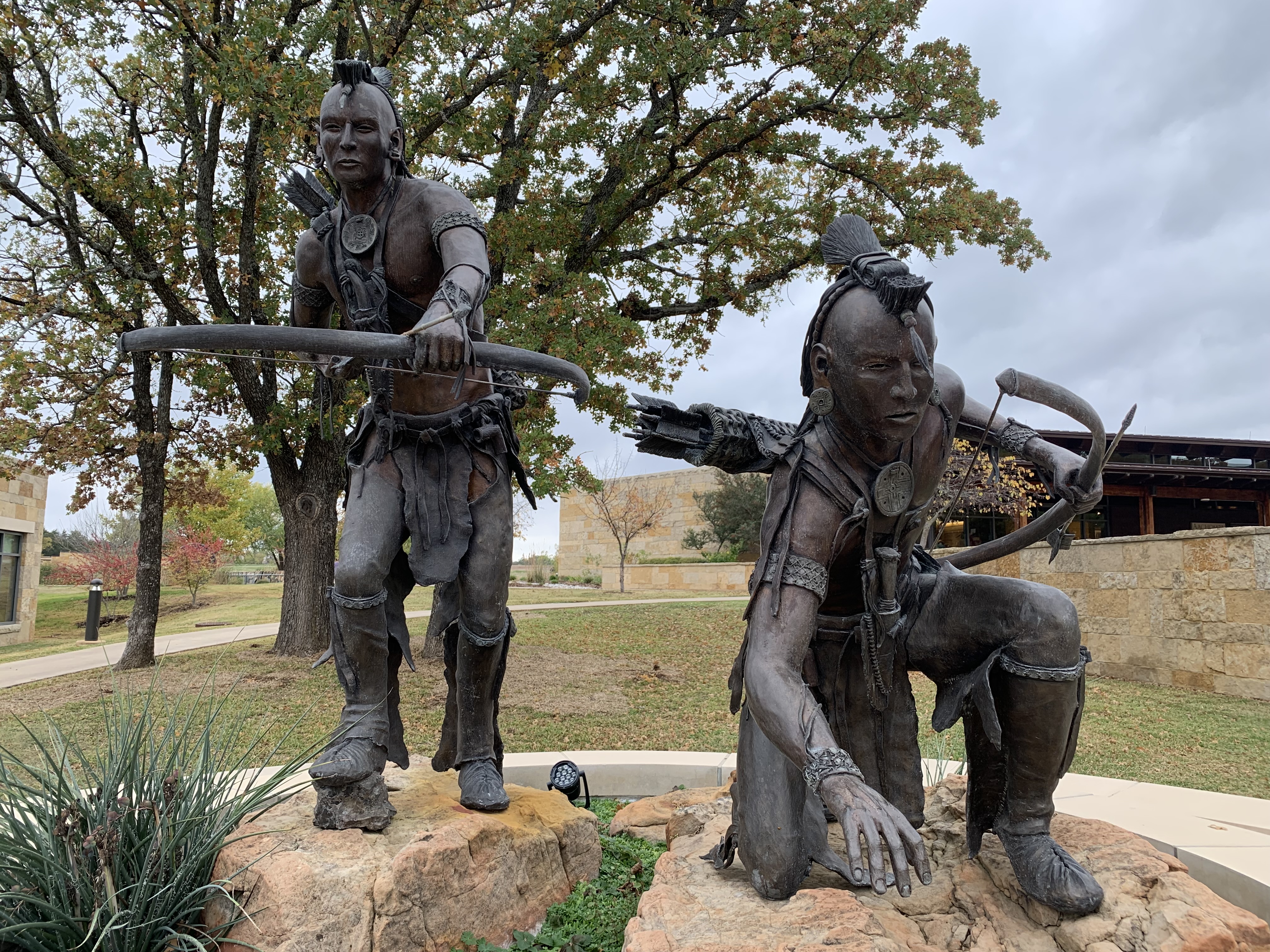
The historic trail focuses on the Cherokee, but the removal act was for all tribes east of the Mississippi. The Chickasaw (see photo above) were able to sell some of their land and moved first. The Choctaw were cheated by treaty but moved too. Many Seminole continued to fight, with some moving to Oklahoma and others to reservations deeper in central Florida. The Muskogee ceded their public land to Alabama, and Jackson refused to defend their private property from being stolen. The rest moved after the Creek War of 1836. The Cherokee also lost their land that year in a treaty their leaders didn’t sign. Jackson used bribery, fraud, intimidation and war to effect the removal. Over 70,000 Native Americans living east of the Mississippi, including the north, were removed under his policies for 8 years and enforced by his Vice President and successor Van Buren.

Some of the Cherokee hid in the mountains, and their descendants still live in towns like Cherokee, on the southern border of Smoky, where you can see signs in Sequoyah’s written language. Eastern Oklahoma territory became tribal reservations for the Cherokee in the north, Chickasaw in the south, Choctaw in the southeast and both Muskogee and Seminole in the middle. Today, the tribes there thrive, have found ways to come to terms with the trail’s brutal history and have chosen to move forward. This is an inspiring example to face the facts, recognize the evil acts and resolve to be better people.

Lewis & Clark National Historic Trail

Thomas Jefferson’s Monticello home has maps and mementos from Lewis & Clark’s expedition all over his front hall, showing how interested he was in the Native Americans, geography, flora & fauna, and other discoveries. He also had strategic interests in mapping both the huge Louisiana territory he purchased from France and the further lands to the Pacific. Having read Captain Cook’s voyages, he was interested in discovering any practical, cross-country trading routes.

And there was plenty of competition. De Anza had explored up the coast to San Francisco in 1776, and the Spanish were busy establishing missions in California. The Russians staked their claim in Alaska before 1800 and were beginning to explore down the coast. The Scottish explorer Mackenzie had already followed Native American travel routes to the Arctic along the river later named for him and crossed the continent in 1793, arriving within months of the naval expedition of Vancouver. The British made no secret of their intention to expand their fur trading to the Columbia River.

So Jefferson scraped together $2,324 from an uncooperative Congress and gave the money to Captain Meriwether Lewis and William Clark, younger brother of the famous war hero. Jefferson personally tutored Lewis in geography, hiring experts to assist in medicine, navigation, botany and taxidermy, giving Lewis full access to his legendary library, likely the largest private one in the US. Jefferson was fascinated by the reports of the expedition, following it closely, but he spoke little about the full plan publicly—except to justify the expense to Congress—to keep the reports from foreign rivals.

The first boat was completed in Pittsburgh, and Lewis launched into the Ohio River there at the end of August, 1803, with some crew, arms from Harpers Ferry, 200 lbs of dried soup, tobacco, wine, trade goods, med kit, and his Newfoundland dog, Seaman. He met up with Clark’s team in Louisville, KY, including Clark’s slave York, who became the first African American explorer known to cross overland to the Pacific. They traveled down the Ohio to the Mississippi and then up the Missouri, past Ste. Geneviève and St Louis, where they spent the winter. Then they paddled up river past the confluence of the Niobrara to Knife River (see photo), ND, where young Sacagawea joined the expedition with her French husband and their baby, after the expedition wintered nearby.

In the spring, they continued up river past what would become the Fort Union Trading Post, past the Milk River confluence, and each time they came to a fork, they would need to decide which was the Missouri River, often exploring both forks. Eventually, they reached the headwaters and traveled overland past what would later be the Big Hole Battlefield, before finding their way down the Clearwater, Snake and Columbia Rivers, with help from the Nez Perce. Mapping that Native American trade route over the Rockies was one of the expedition’s key accomplishments. Finally, they reached the Pacific and wintered at Fort Clatsop, beating a Russian explorer who arrived that spring.

On their way back, Lewis took a more northerly route, close to Glacier, and Clark southerly, along the Yellowstone River, before meeting again on the Missouri. The Spanish sent troops to arrest them, but couldn’t catch up, as traveling downriver back the way they came was much quicker. Jefferson was very pleased with the expedition’s success, grew corn samples at Monticello and reported Lewis & Clark’s scientific discoveries to Congress.

Jefferson appointed Lewis Governor of Louisiana Territory, but many hated Lewis for protecting Native American rights and spread conspiracies against him. Lewis’ territorial secretary and rival smeared him in letters to Washington, causing the government to refuse to reimburse Lewis for expedition expenses, which bankrupted Lewis, only two years after the expedition returned. On a trip to Washington to clear his name and his debts, he was likely murdered on the Natchez Trace, suspiciously described as a ‘suicide’ despite multiple injuries. Seaman survived the expedition, but the faithful dog refused food and died immediately after Lewis’ mysterious death.

Sacagawea, their teen interpreter and diplomat, died at 24, but Clark helped support her children. Clark was less generous with York, who had expected to gain his freedom but was refused. Clark lived longer than Lewis and was Governor of Missouri territory from 1813 to 1820. A credible report later placed York in Wyoming, living among natives as a Chief.

Washington-Rochambeau Revolutionary Route National Historic Trail

After the patriots defeated the British at Saratoga—thanks to Kosciuszko—, the French openly took our side against their rivals, sending a fleet with an army under the command of Lieutenant General Jean-Baptiste Donatien de Vimeur, Comte de Rochambeau. They landed in Newport, RI, but the British blocked their fleet from leaving. The troops camped in Providence, and then marched west, stopping in Cranston, RI, Lebanon & Hartford, CT, before eventually joining Washington’s army near White Plains, NY in the Hudson Valley. They camped together for the winter in Morristown, NJ. Then they marched south, past Washington’s early victories in Princeton and Trenton, NJ, before arriving to parade before Congress in Philadelphia.

From there, their plans became secret. Most expected the joint force to attack New York. But General Baron von Steuben had recommended using both land and sea forces to trap the British army in Virginia, and both Washington and Rochambeau agreed. They marched together through Wilmington, DE, to Maryland, where they split up. The French sent their fleet south from Newport, and the British sent their fleet from New York. But Rochambeau had picked Virginia to take advantage of a second French fleet arriving from the West Indies. Boats were also launched from the north end of the Chesapeake Bay to ferry French troops safely and quietly to Virginia. Washington’s troops quickly marched past his home in Virginia and through Fredericksburg—later a Civil War site—before joining his friend General Gilbert du Motier, Marquis de Lafayette, who knew nothing of the plan.

Lafayette had come to America at age 19 with his own funds to join Washington long before France did, and he fought bravely, winning crucial battles and getting wounded. He had returned to France to encourage them to attack England, was briefly arrested for disobeying the King, and returned to continue fighting. When the French finally sent troops, Lafayette recommended various aggressive plans to Rochambeau to retake New York, but Rochambeau was cautious and dismissive. Washington counseled patience and sent Lafayette south to Virginia to capture the traitor Benedict Arnold, whose victory on the American side at Saratoga ironically had convinced the French to ally with the Americans. Lafayette was frustrated at being sent so far from all the action, not knowing Washington had plans for the young general.

The British had invaded Virginia (second time), coming up from near Moore’s Creek in North Carolina, had taken Petersburg (also Civil War) that spring and under Benedict Arnold that summer had taken and burned Richmond (see Civil War). Cornwallis took command and decided to establish his base in Yorktown (again Civil War) on the coast. Arnold advised Cornwallis to move inland for safety, Cornwallis ignored the advice and sent Arnold to Connecticut, where he burned New London.

The French Chesapeake fleet landed their 9,000 troops at the York River to join Washington’s 9,000 troops on the peninsula and trap Cornwallis. The combined French fleets defeated and blocked the British fleet at the mouth of the Chesapeake Bay. Lafayette led the siege at Yorktown—with Alexander Hamilton leading a critical assault (see photo). Cornwallis, surrounded and cut off from relief or escape by sea, surrendered. We would not have won this critical battle of our Independence War without our French allies, especially their fleets, their siege tactics and the element of surprise. After the war ended 2 years later, the French sailed back from Boston. A worthy trail indeed.

Incidentally, Benedict Arnold fled to England after hearing about the surrender at Yorktown. Arnold, after failing to convince the British to keep fighting, became a pirate in the Caribbean, was captured by the French, bribed the guards to escape and was rewarded by the British with 15,000 acres near Ontario, Canada, where he died at 60.

For the record, the rock-paper-scissors game ‘Rochambeau’ is mis-transliterated from the Japanese ‘Jan-Ken-Pon’ game adapted from the 2200 year old Chinese game ‘Shoushiling’.

Captain John Smith Chesapeake National Historic Trail

John Smith was an explorer, adventurer and leader whose stories, maps and detailed descriptions of life in the ‘New World’ helped convince many early immigrants to cross the Atlantic to the colonies. As a young soldier John Smith was held captive by the Turks, as a leader of the first British colony he was captured by the Powhatan, and as an explorer in New England he was held hostage by French pirates. Respectively, he escaped, was saved by Pocahontas (more than once), and negotiated his own release. He learned the local native language, forced upper class colonists to labor for food, and didn’t return to England until after some gunpowder exploded in his canoe.

The affiliated “trail” covers the rivers that flow into the Chesapeake Bay, but to be clear, Captain Smith only explored the rivers as far as he could navigate in his exploratory small ship. His maps show the bays, not the lengths of non-navigable rivers shown as part of the trail. The trail extends far up various rivers, but neither Smith nor crew went to most of those places. I was confused on this point until the Susquehanna visitor center expert answered my questions.

The trail extends from Hampton Roads near Fort Monroe where the bay opens to the Atlantic, up the James River past Jamestowne, past places that would later be Grant’s HQ in Petersburg, the Confederate Capital of Richmond, and across the Appalachian Trail and the Blue Ridge Parkway where the James becomes the Jackson River. The trail goes past Yorktown and up the two rivers that form West Point. And the trail goes up the Rappahannock River past Fredericksburg.

The trail goes up the Potomac, past where George Washington would be born, past Piscataway, Fort Washington and Kenilworth parks, and it continues up past the Jefferson, Lincoln, LBJ and MLK memorials, past Roosevelt Island, next to the GW Parkway, past Clara Barton’s house up to the Great Falls at the C&O Canal. The trail runs up the Patuxent River and up to Baltimore. The trail goes up the Susquehanna River (both branches) past Steamtown and into Central New York State north of the Upper Delaware River. And the trail also covers the Del-Mar-Va side of the bay, where Harriet Tubman was born. Again, Smith went as far as he could, but not past rocky shallow shoals or past any falls.

Smith also later explored and named much of New England, but this Chesapeake trail alone is certainly worthy of exploration. Someday, I’d like to return and see it by boat! And speaking of hopping around the country, Monday posts are going to cover National Parks on the West Coast, while Thursday posts will range more widely, covering more trails across the country. Enjoy!

The Old Spanish Trails

This post covers five national historic trails in the southwest. I hope they inspire your travels.

El Camino Real de Tierra Adentro, the Royal Road of the Interior, followed ancient Native American trading routes to connect the northern colonies of New Spain with the Aztec capital conquered by Cortés in 1521. In 1598, Juan de Oñate brought a colony of settlers north from Mexico City to the pueblos around Santa Fe, near Taos, Bandelier and Pecos. The trail crosses El Paso, past the Salinas Pueblo and past the Petroglyphs in Albuquerque. In 1680, 2,000 Spanish missionaries, settlers and soldiers fled south on this road after the Pueblo Revolt, before returning 12 years later. Santa Fe New Mexico became the crossroad of international trade in North America.

El Camino Real de Los Tejas, the Royal Road of the Friends, runs from the Mexican border near Laredo, through the San Antonio missions, into Louisiana near Cane River Creole. Tejas is a Spanish version of a native Caddo word for ‘friend’ and became the name of the state of Texas. The Spanish established missions at the east end of the trail in the 1690s, withdrew after conflict with the Caddo, and then returned in the 1710s to establish the capital of their Texas colony in Louisiana. Due to conflict with the French in Louisiana, they relocated the missions to San Antonio, after negotiating peace with the Apache, and eventually moved their provincial capital there. Unfortunately for the Spanish, the trail encouraged many American settlers to move in, and they fomented a revolt leading to the US annexation of Texas.

In 1775, Juan Bautista de Anza led another colony of Spanish settlers north from Mexico to establish San Francisco. The 1,200 mile trail is named for him, and it passes roughly through the following park sites in Arizona and California.

The Old Spanish Trail was also built on ancient native trade routes expanded by Spanish, Mexican and American explorers, including Kit Carson. It connects Santa Fe with Los Angeles, via a few alternate branches through Colorado, Utah, Arizona & Nevada, and the branches pass roughly through the following park sites.

After Mexican Independence in 1821, Americans found that they could travel to New Mexico without fear of being arrested and jailed in Mexico City. The Santa Fe Trail connects to St Louis, passing roughly through the following park units. Today, the Santa Fe & Old Spanish trails roughly parallel the BNSF Railroad and Route 66.

Arizona National Scenic Trail

This forest service trail runs between the borders of Mexico and Utah. The southern Sky Islands section includes Coronado National Monument and Saguaro National Park near Tucson, and the terrain ranges from low desert to 10,000’ mountains. The next Sonoran Uplands section crosses seasonal desert rivers and passes by the Tonto National Monument (see photo). The Volcanic Field & Ponderosa Pine Plateau includes Walnut Canyon near Flagstaff. And the northern Plateaus & Canyons section crosses through the southern part of the new Grand Canyon National Monument and both south and north rims of the Grand Canyon before reaching Utah.

While I’ve visited the park units along the way, hiking long sections of the trail is too challenging for me, with risks from heat stroke to flash floods. But it would be an adventure! Driving to the parks along the trails is an easy way to see a few of the highlights, and I will be posting about several more trails this fall.