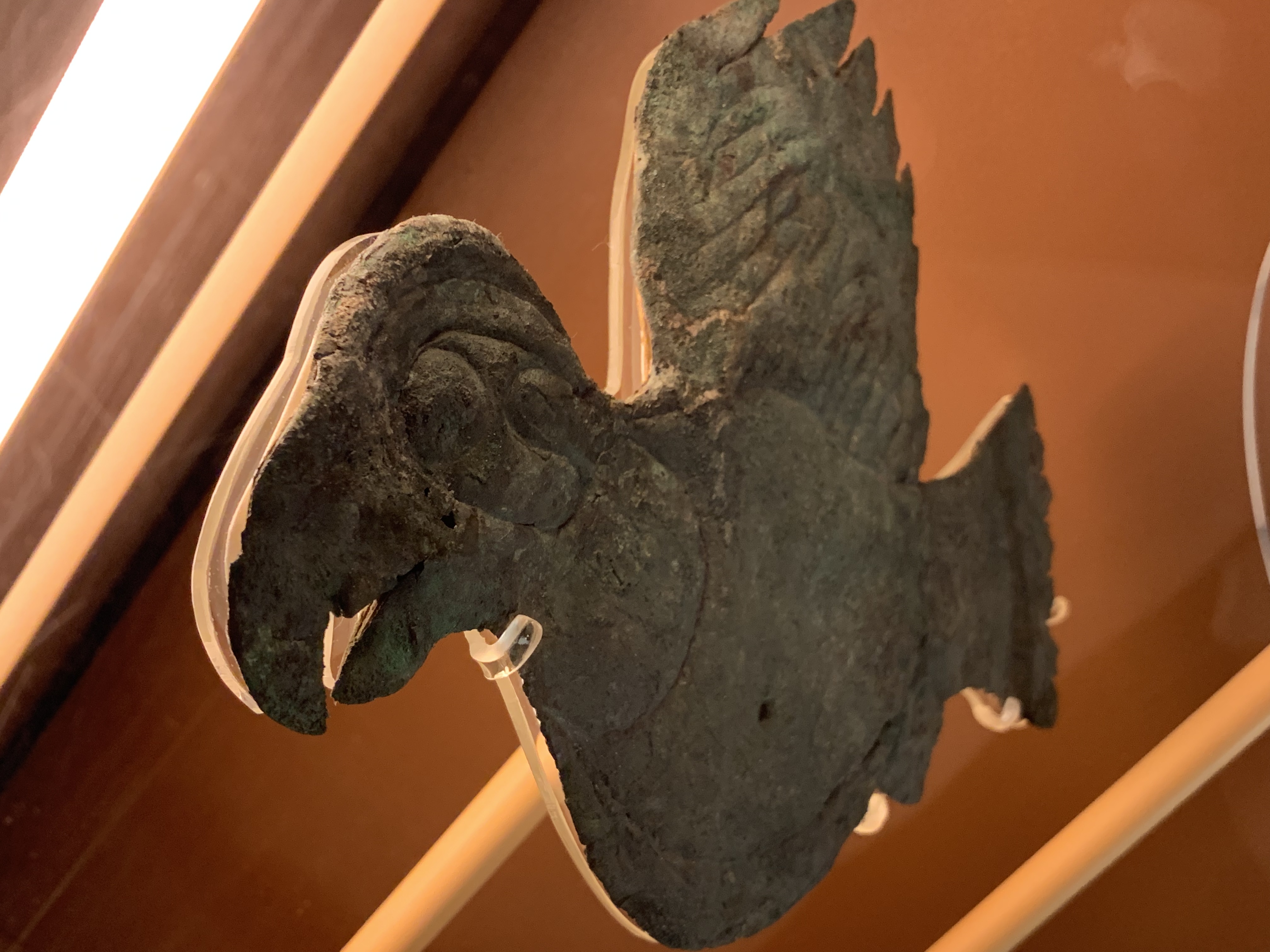
Does this bird look like a Peregrine Falcon or a parrot? I ask, because some of the folks at this Native American archaeological site suggested the former and seemed pretty insistent that the Eastern Woodlands people must have been “completely separate” from the Southwestern people who traded parrots widely at the time. Having just driven along the Canadian, Arkansas, Mississippi and Ohio Rivers, I can confirm that people who traveled by canoe could easily cover that distance. Of course, if it’s a Carolina Parakeet (now extinct), then it would have been native to both Ohio and Colorado.
Some archaeologists and anthropologists resist making obvious conclusions. Each native site focuses on its speciality, often avoiding drawing any connection between contemporaneous, sequential or geographically neighboring cultures. For me, it’s clear that the Paleo, Archaic, Woodland, Mississippian and Puebloan people are all related ancestors of today’s Native Americans. It’s silly to ask “what happened to the people who built these?” Because, as Native Americans universally answer, “we’re still here; they were our ancestors”. Pretending that an early Native American culture just magically popped up out of nowhere and then mysteriously disappeared (as the park film sort of suggests) is stupid and ignores the role of European-Americans who plowed over evidence of the early people after driving their descendants off their land.
Native Americans living in North & South America still travel and interact with each other, as they did for thousands of years spreading different ideas, crops, weapons, tools, and materials across our continents. The Alibates Flint Quarries, Russell Cave, and Ocmulgee Mounds parks units all show evidence of fairly continuous use over the entire 17,000 year period until Europeans began to encroach. Poverty Point, Hopewell and Chaco Culture sites all show extensive trade routes over thousands of miles. These people all built similar sites aligned with the sun and moon, in round and square shapes, at different times and in different places from 1500 BC to 1500 AD. Every site I have been to and every description I’ve read describes Native Americans as using feathers and bird figurines for ceremonies and adornment. The park service should make these connections, so visitors can appreciate the full scale of Native American culture. At least UNESCO is now recognizing Hopewell as a World Heritage Site in reflection of its importance as a religious pilgrimage and burial site for Native Americans across the continent.
Here’s the link to my visits to all parks in Ohio.
 Zero Carbon Travel
Pingback: Hopewell Furnace National Historic Site | Zero Carbon Travel
Pingback: Yucca House National Monument | Zero Carbon Travel
Pingback: Canaveral National Seashore | Zero Carbon Travel
Pingback: Keweenaw National Historical Park | Zero Carbon Travel
Pingback: All Parks in the Midwest, Zero Carbon | Zero Carbon Travel