All Frank Lloyd Wright World Heritage Sites by EV

UNESCO chose eight Frank Lloyd Wright sites for World Heritage status, and I visited them all this year by EV. An exhaustive tour of Wright’s designs could visit 100 sites, but the Heritage 8 are sufficient for me. My cross country trip went from Hollywood, to Arizona, Wisconsin, Chicago, Pennsylvania and finally to New York, but it’s easier to understand his life’s work below chronologically.

His home and studio in Oak Park Illinois showcases his various styles, influences and experiments, including his first design: his own home. While this is the one site I visited that is not on the World Heritage list, just walking the neighborhood is worth the trip.

Unity Temple in Oak Park in 1905 is a church built for his mother.

Robie House at University of Chicago in 1910 is my favorite, built for a wealthy client who only lived in it briefly.

Taliesin in Spring Green Wisconsin in 1911, later rebuilt after a dramatic tragedy, used funds from Robie to build a family country home with a school for his acolytes.

Hollyhock House in Hollywood California in 1921, was built for a theatrical oil heiress who fired him for going over budget.

Fallingwater (above) in Mill Run Pennsylvania in 1937, is his most iconic private residence, built for a wealthy department store owner whose son gave it to the park service.

Taliesin West in Scottsdale Arizona in 1937, used funds from Fallingwater to build a winter home with another school for his acolytes.

Jacobs House in Madison Wisconsin in 1937, was built to demonstrate that Wright could design something affordable on a budget.

The Guggenheim in New York City in 1959, was built to display art and to be art, for the future.

I hope you enjoyed this brief tour of 50+ years of the most widely recognized designs from America’s greatest architect.

Fallingwater

As you may be able to tell from the folks walking through my photo, Fallingwater is popular. There were tours for about a dozen each running every few minutes constantly. The house and 1500 acres were donated by the client’s son. The reserve is now 5,000 acres in rural Pennsylvania. I ate lunch at Polymath Park, about 45 minutes away, where they have four Wright homes, a Treetop restaurant and even let a few lucky folks spend the night.

This World Heritage site may be Wright’s greatest private home, his masterpiece of organic architecture. The multilevel home and guesthouse are built over the Bear Run Falls and into the rocky hillside. Several steps descend into the creek, and there are pools for swimming, for enjoying the creek and even for washing up. Unsurprisingly, the home has had some leaks, water and flood damage, but overall the waxed stone floors, stone walls and stucco covered steel reinforced cantilevered structures retain their stunning appearance. The many patios extend out over the water providing myriad views while adding to the modern exterior design.

The Kaufmanns owned Pittsburgh’s premier department store and welcomed employees here to play tennis, swim and enjoy nature. They also collected art, and much of their collection is still here, including an original from their friend Diego Rivera, who visited here with Frieda Kahlo. Much of the furniture is original and designed by Wright. Instead of abstract, complicated, multicolored glass window designs, Wright used plain glass windows, but in fascinating ways, especially by running the glass all the way to the corner from two sides without any corner support. From across the creek below the house, there is a stacked column of such windows running between floors, and each opens to provide an exquisite series of views that descend like the falls from the small upstairs room to the creek. Iconic.

Unity Temple

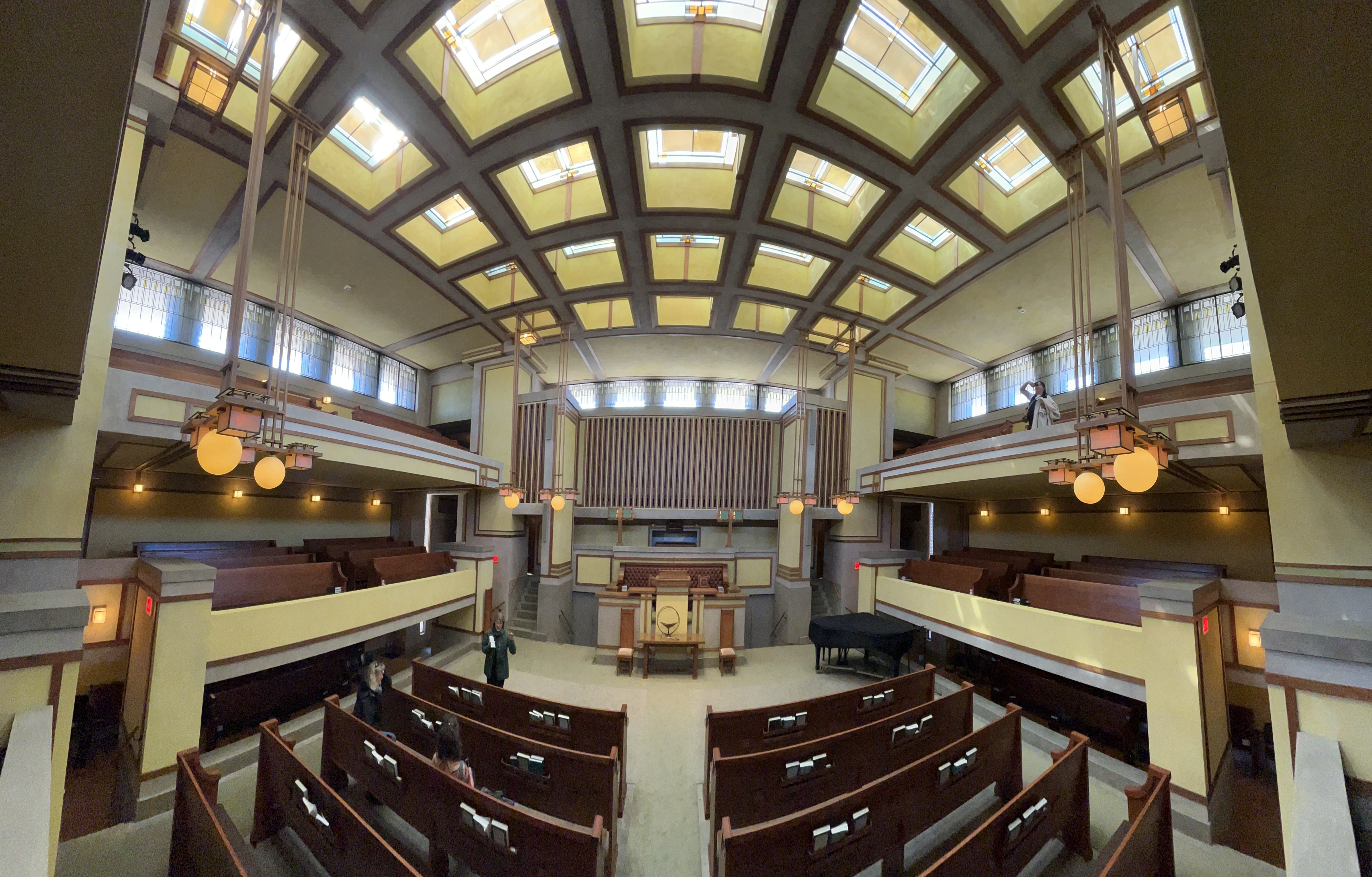
Frank Lloyd Wright’s mother got him the job of designing a new church for her Unitarian congregation in their Oak Park neighborhood. Still used by the Unitarian Universalists today, this progressive architecture combines Egyptian and Japanese elements in a uniquely American temple. Wright’s signature custom light fixtures, intricate skylights, wheat colorings and guided journey from low, dark compressed spaces into the release of high open space and light from above, all contribute to a sense of awe. This World Heritage Site has been restored to exceptional condition and is open for excellent, detailed tours.

Robie House

This classic 1910 Frank Lloyd Wright house is in the middle of the University of Chicago. Take the self-guided walking tour to learn about some of the nearby famous buildings. The campus is Oxford style, but Wright shattered traditional norms in this multilayered brilliant home.

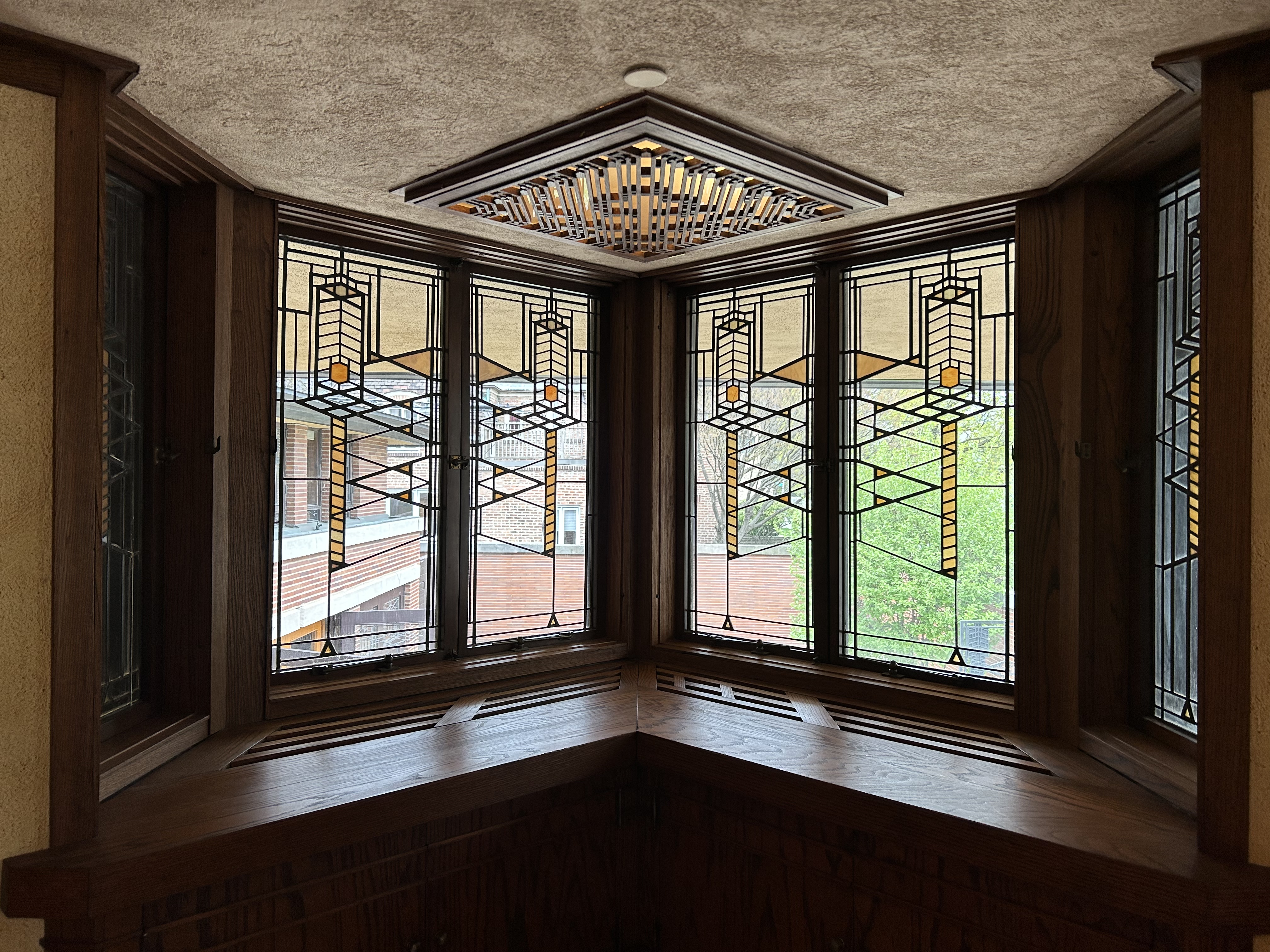
The footprint is long and narrow, which Wright used to advantage, capturing light along the long south side, adding pointy ends, like the breakfast nook above on each end, and an open floor plan the length of the home. The colored glass in the window has iridescent multihued glazes on the outside, including pink, purple and lavender. Outside the home emphasizes the horizontal with brick colored mortar up and plain mortar sideways, and inside the vertical. From outside the home appears private, behind walls, with the front door hidden, but from inside, especially upstairs, the home has open views of what were once open fields and are now busy campus structures and spaces.

This World Heritage site is fascinating and is one of the most important architectural works of the 20th century.

Oak Park Studio Home

OK, this is neither a park unit nor a heritage site, but there are a dozen Frank Lloyd Wright houses within a block or two, well worth a short stroll. And this was his working home, which he built at age 22 in 1889 and where he designed many of his best works. (Suburban Chicago ‘villages’ like this one grew rapidly after the Great Fire in 1871). Until you see the neighborhood with the fancy Victorian homes that were there when Wright began his career, it’s difficult to appreciate what he was competing against. Wright demonstrated that Americans could innovate and not merely copy European styles.

The home is notable for its Egyptian influence. At the time, Americans understood the East—near, mid & far—broadly as ‘Oriental’, and Wright even blended Mayan, Japanese and Egyptian styles together, in his own exotic mythology, not copied but stolen, reimagined and given new interpretation and life. Wright also used the home to experiment with bay windows, recessed lighting and various high ceilings and to display such modern conveniences as indoor plumbing and electricity. The home has been restored to 1907 including some rare pieces of furniture—and a Steinway built into a staircase that you have to see to believe—, to capture more of Wright’s ideas which reappear perfected in his later masterpieces.

Taliesin

Frank Lloyd Wright’s Welsh grandparents bought a large parcel of land out here in Wisconsin, and his mother asked Frank to come back from Europe—where he was philandering with the wife of a client—and design a home here. He did and named it Taliesin (say ‘Tally-Essen’), which as I said before, means ‘brow’ in Welsh. To expand on that, it really is named after a 5th century bard of early Britain whose works were partly preserved in a Welsh book, so it takes on the meaning of ‘high-brow’ or ‘highly cultured, scholarly and well-versed in rare interests’. Wright obviously identified with the term positively, as he used it to name his most personal home, where he chose to live longest. In an amusing letter on display in the visitor center, Wright claims to love Wisconsin in part for the lack of ‘high-brows’, although he notes that Wisconsin does have several people who are ‘educated beyond their capacity’.

Unfortunately, his mistress and two of her children moved into the house and were killed in a fire started by a servant, who poured kerosene on the floors, locked the doors and dispatched all but one fire survivors outside with an axe. Wright rebuilt and lived here with his third wife (his second OD’d). The room above was built for a photo shoot in the 1950s, and shows the wooded hills and river valley that reminded his grandparents of Wales. Wright also built a high ‘bird-walk’, or narrow balcony jutting straight out, with phenomenal views that defines the home from the road below. The house is filled with Japanese influences and Asian art. His many students lived and worked in the barn they helped redesign and build, and a few still live here today.

Taliesin West

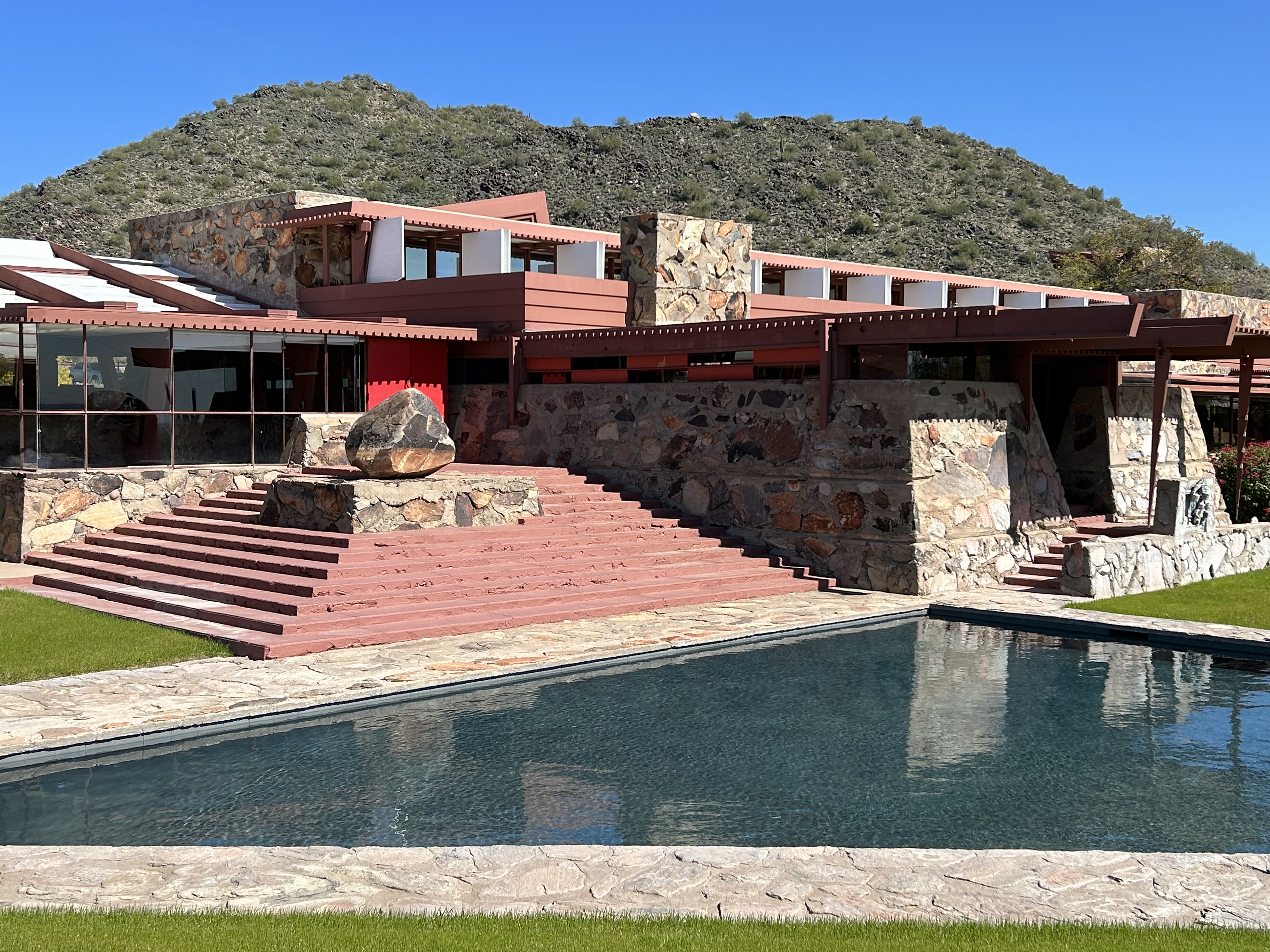
Frank Lloyd Wright’s winter home until his death in 1959, this World Heritage site is a remarkable example of his architecture. The architect preferred to build just below the top of a hill, on the ‘brow’ or taliesin in Welsh. The triangular pool brings the background mountains into the foreground, and the front walk forms a point like the bow of a ship to admire distant mountains, like islands across the undulating desert landscape where cholla cactus looks like coral. Besides the bright red door behind the rock and the small ornately carved scene to the right, there are Chinese influences throughout, including many more carvings, an elaborate story panel, a round garden door, a bell, a dragon and other architectural touches. Inside you can sit in his origami chairs and study the internal structure of a nautilus or the draft blueprint of the Guggenheim. Wright brought his students and apprentices to live and work, and he established an institute dedicated to his school of architecture. Situated in the tony Scottsdale neighborhood, the audio tour of the property is detailed, takes you around step by step and explains his architectural philosophy. Guided tours are also available, and schedules & numbers are strictly limited to keep a steady flow through the small parking lot and on the tours.

Hollyhock House

Frank Lloyd Wright designed this home for a theatrical oil heiress socialist in 1919. While it is not one of the national park units, the National Park Service successfully applied for UNESCO World Heritage status. The architecture is a fascinating mix of Mayan and Japanese influences and Wright’s own distinct style. The fountain outside flowed into the moat in front of the fireplace (above) and out into the garden. From the hollyhock garden outside, there’s a marvelous view of the Griffith Observatory and the Hollywood sign.

Aline Barnsdall grew disenchanted with the over budget project and fired the absent architect before it was completed in 1921 by his son. She gave the property to the city on condition that they let an art club use it for many years. Despite almost being demolished for redevelopment and suffering damage in the Northridge Earthquake, the house is being restored to its 1920s appearance, has an art exhibit inside, and is part of the Barnsdall Art Park, which includes a theater and community art space.

Several buildings and rooms are still off limits, one damaged terrace has been fenced off and there’s some construction chaos outside, as of my visit in February. But it was sunny and 78° F with sun bathers and families enjoying the beautiful hilltop park, and inside the timed ticket limited visitors enjoyed detailed explanations from many knowledgeable guides on the ‘self-guided’ tour. There are currently 8 Frank Lloyd Wright houses in the US on the World Heritage list, and I plan to visit them all this year.