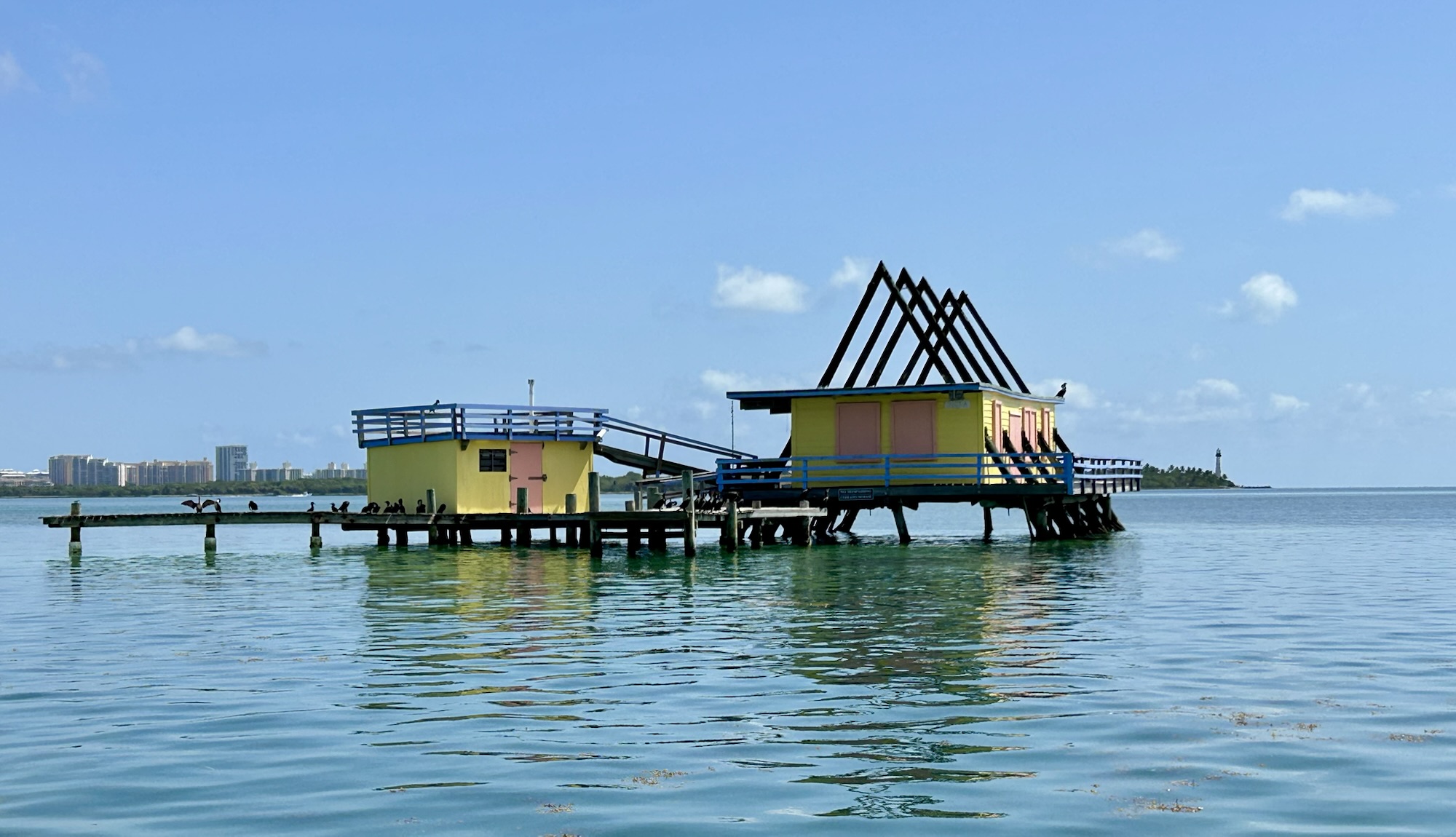
A few stilt houses have survived hurricanes and are allowed to remain in this huge marine park just outside Miami. The lighthouse in the background was once part of the Underground Railroad, as boats would risk the reefs to come here at night to pick up escaped slaves and fleeing Native Americans to live in the Bahamas, which ended slavery in 1834. While the Key Biscayne in the background above is a barrier island, the Florida Keys are part of an ancient reef that begins here, includes Key West and runs to the Dry Tortugas.
The best way to see the park is by boat. I took a very small tour from Coconut Grove out to the flats, to snorkel on both ocean and bay sides of Elliot Key, and had lunch on Boca Chica. The reef I remember from the 1980s has been devastated by carbon pollution from fossil fuels—elkhorn & staghorn corals are functionally extinct here now—with widespread coral bleaching and only a fraction of the marine life. But it still has life. I counted dozens of species including a beautiful French angelfish, various colorful parrotfish, spiny urchin and a lobster. From the surface we saw mating loggerheads, a manatee, and many birds, but the vast majority of wildlife is just below the surface. Let me show you what I mean.
In the bigger, more famous neighboring park in southern Florida, the paid guide assured me that the American alligator “is a solitary creature, you never see more than one or two together”. In Big Cypress, I counted 16 alligators in one puddle and 17 in the next. Unlike most other wildlife I try to photograph, the alligators don’t run away; they look you right in the eyes and even slowly move towards you. Some are easy to spot, but while I was counting, three more were sneaking up on me.
Most of the million acres in Big Cypress and its smaller partners are actually prairie habitat for the endangered Florida panther, but there was a devastating fire recently, in our rapidly heating world. I drove the loop road instead, looking for gators in the gullies, but I often found myself looking up at the various trees to look at the air flowers hanging on to trunks and branches. In the hardwood hammocks, you might see some tree snails. And I saw a lot of birds, especially wood storks and other large wading birds.
Coming from the Naples side, I stayed in Everglades City, which is tucked in between the Ten Thousand Islands, the Everglades western estuaries and mangrove islands, and Big Cypress. Before the highway was extended to Key West, many visitors took boats to Key West from Everglades City. They’re rebuilding the hurricane damaged visitor center there in the name of Marjorie Stoneman Douglas, who wrote the book, River of Grass, that led to the protection of 2.5 million acres of lower Florida. Fortunately, large commercial efforts to farm, graze and otherwise exploit the land had all failed, so the environmental coalition won. Carbon pollution raises sea levels, so the future is uncertain. But for now, this is a good place for adventure travel out into the mangroves.
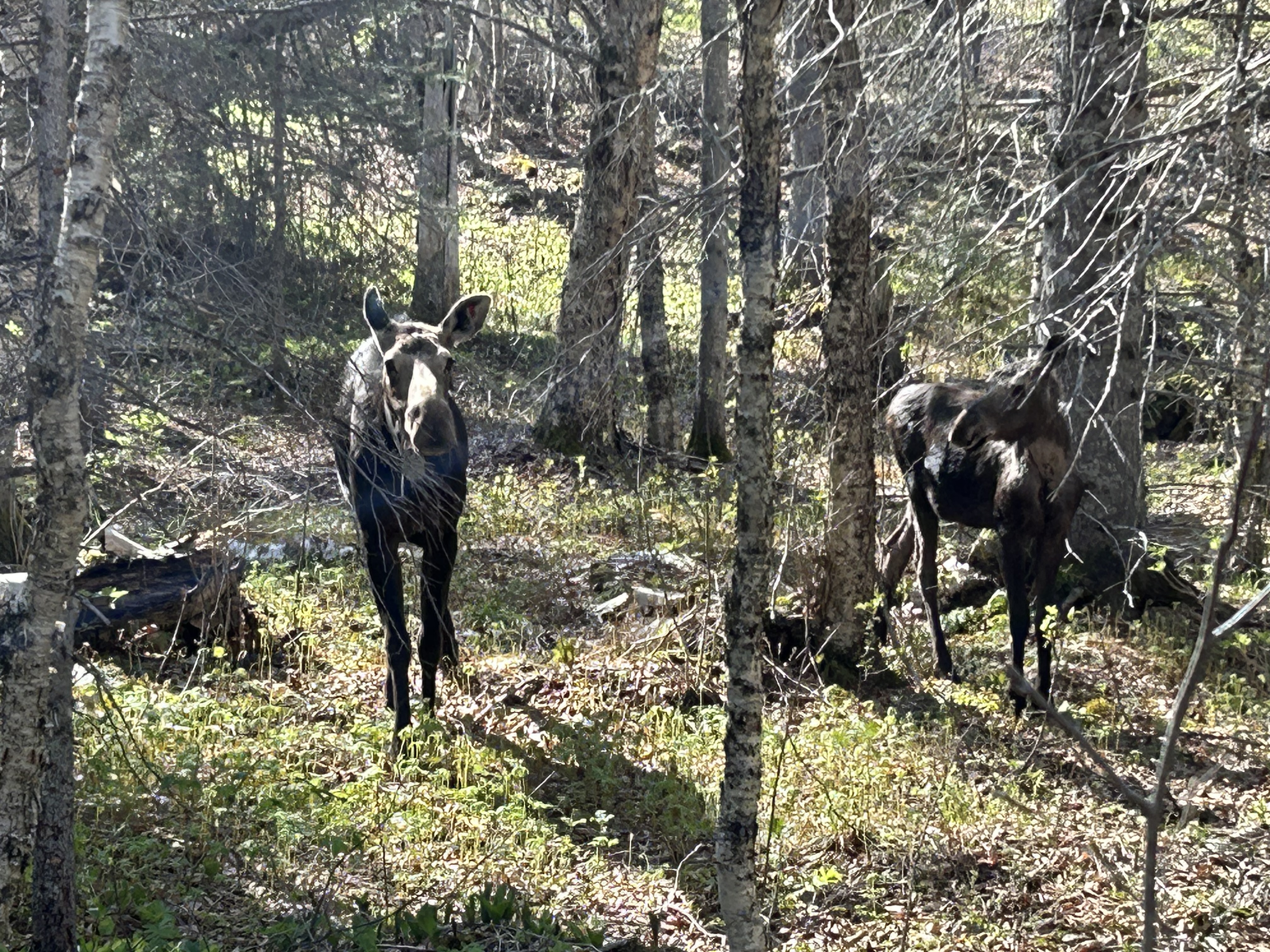
Best Park: Isle Royale. Wildlife, wilderness, multi-day hiking, boating, camping, forests, mountains, waters. Isle Royale, above, is the best Midwest park in many categories, despite being the least visited national park in the lower 48.
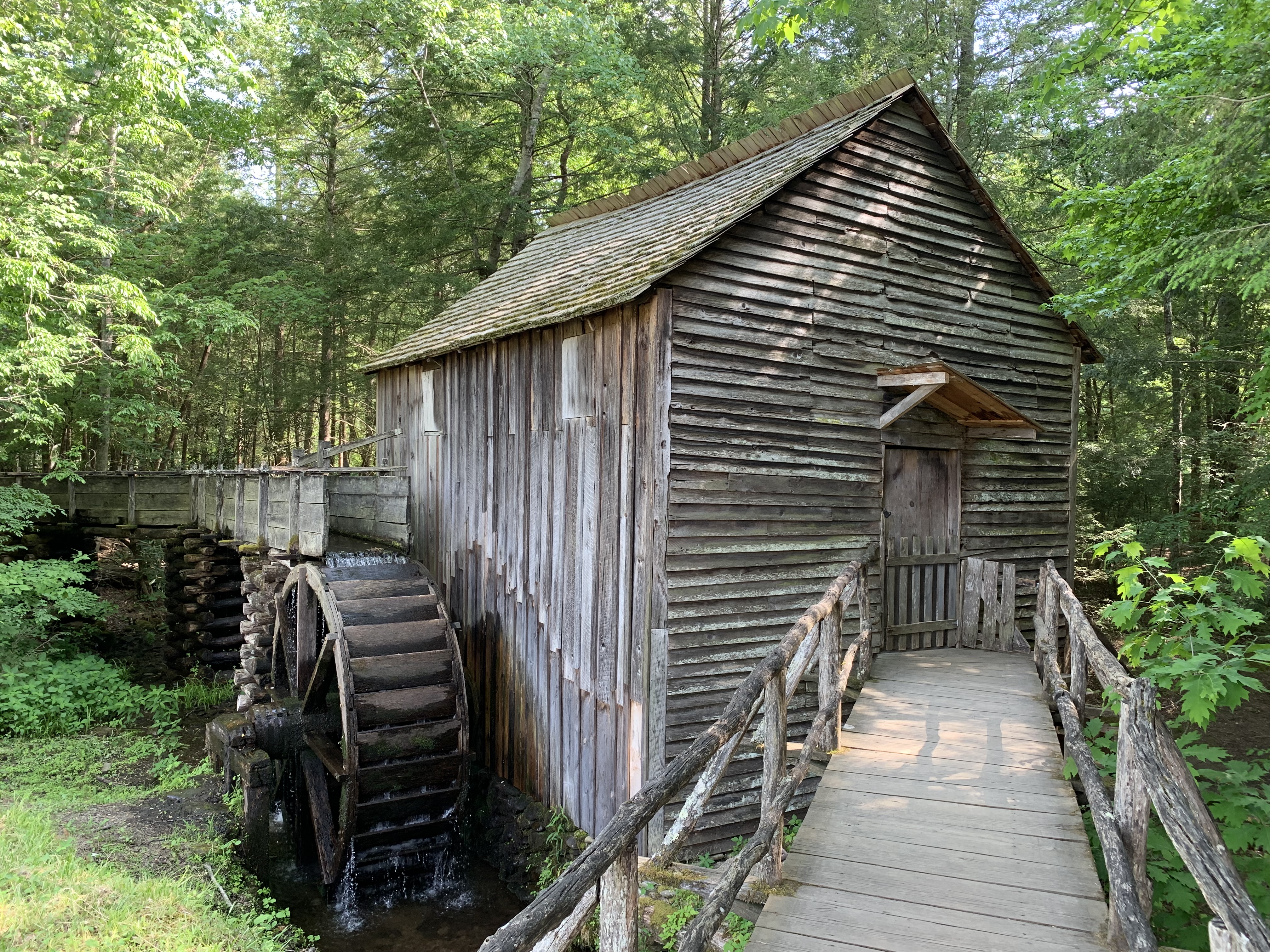
Some Cherokee still live in the Blue Ridge Mountains, although the western North Carolina heritage area is more focused on waterfalls, sights along the Blue Ridge Parkway, bluegrass music, the Great Smoky Mountains, and more. The Cherokee, angry about their stolen lands, sided with the British during the Revolutionary War, while their Piedmont—central NC—neighbors, the Catawba, sided with the Patriots.
A particularly beautiful area in the US, the Blue Ridge includes the headwaters of the New River and the eastern states highest mountain (Mitchell), gorge (Linville) and waterfall (Whitewater Falls), plus the homes of interesting people, including the poet Carl Sandburg. There’s also rich diversity of species and frequent wildlife sightings. I love driving through, and I have to admit to bending my itinerary a few times to see something new here.
The Gullah Geechee area is much larger, stretching from North Carolina to Florida, including some great national park units, like Reconstruction Era, Cumberland Island and Timucuan Preserve. I heard Gullah spoken several times in the Carolinas, and there are numerous spots along the coast in four states to stop and learn about quilts, baskets, and other crafts. I love the food, always wanting to stop for boiled peanuts, country captain, perloo or other dishes. Gullah Geechee is a living culture, a unique community, an integral part of our history, and this distinct heritage is woven deep into our collective roots.
I understand that Gullah developed as a common dialect among slaves who had lived or passed through Angola, hence the name. A great public TV program on the English language taught me a bit about Gullah years ago. You already know some of the words that come from Gullah, like gumbo, jitters, and tote. The settlement on Cumberland and the plantation at Timucuan have clues about the Caribbean crops of indigo and sea cotton brought to grow in the barrier islands and about the enslaved people who worked the plantations. Not only did the communities survive, but they retained some of their African and Caribbean connections, linking us with living communities in other countries today.
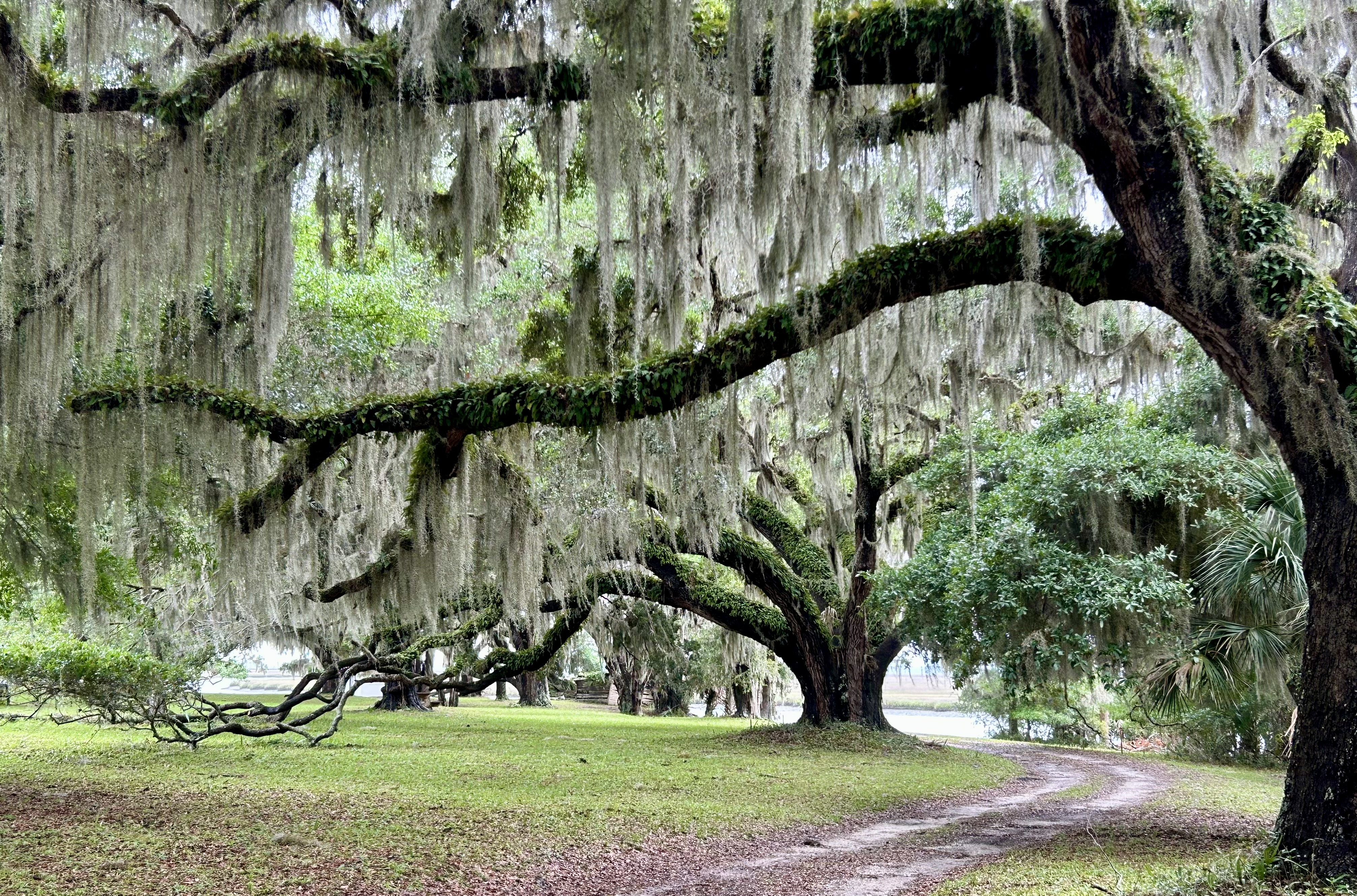
Decades later, I returned to see the southern live oaks that have haunted my dreams. Now I know the ferns that grow on the tops of their branches are called resurrection ferns, since they revive to a bright green after it rains. As a teen, I was told that humans could eat the Spanish Moss that hangs down from their branches, but returning as a tourist I was told that no humans ever did, only horses. I was too ashamed to admit I ate some long ago and thought it tasted OK.
Since I had been to the island before, I knew the only way to get to the north end on a day trip was to take a tour, so I joined the NPS recommended van tour and got to see everything from the settlements at the north to the Dungeness ruins in the south. The photo above is behind the Plum Orchard mansion, one of a few Carnegie family homes built on the island. The Carnegies were excluded by the other billionaires on neighboring Jekyll Island, so many of them settled here. Plum Orchard is beautiful and has interesting innovations, but plantation style troubles me. The center of the island is protected wilderness, and it feels like an ancient forest or overgrown jungle. Along the way we saw wild boar, wild horses, an alligator, several armadillos, and many beautiful birds.
I don’t always try to draw historic connections between parks, but bear with me this once. The natives here were related to the Timucuan. The Gullah Geechee (next week’s post) descendants of slaves are related to those all along the coast up to Reconstruction Era and down into Florida. The southern live oaks from this island were used to build the “iron sides” of the USS Constitution in Boston. Nathaniel Greene, commanding general of the Southern Campaign of the Revolutionary War, died shortly after retiring near Savannah Georgia, and his wife remarried and moved to Cumberland Island. There, Greene’s daughter Louisa cared for one of his cavalry officers, Henry Lee—veteran of Eutaw Springs—, before his death and burial at Dungeness mansion. Lee’s son was Robert E. Lee of Arlington House. And, if you want one more parks connection, the Carnegie’s innovative household DC power was likely overseen by Thomas Edison.
When I first arrived on the island several decades ago, I was invited as a guest of someone who knew the owners into a grand old home under the oaks for a meal, stories on the porch and an after dinner cognac, my first. As I recall, there was some discussion about whether the home would have to become an inn to survive, and we all agreed that it was important for beautiful old historic places to be preserved. (It later became the exclusive Greyfield Inn of Kennedy wedding fame). Folks need to come to places like Cumberland Island to try to imagine what it was like all those years ago, to walk along the barrier island beaches, to see the wild horses, to learn about dugout canoes, see photos of Primus and Amanda Mitchell who went from slaves to church and settlement founders, to learn about sea island cotton, and especially to feel the special old grandeur under those southern live oak trees.
Alaska awaits, but in the meantime, I have visited all 4 National Parks and 16 park units in the Pacific Northwest region, plus 2 heritage areas, 1 affiliate, trails and biospheres. Part of the Manhattan Project NHP is in Washington too.
The four national parks all contain snow capped volcanoes. There are fossil, cave and geologic sites, 3 lake recreation areas, and many fascinating historic sites to enjoy. The region is beautiful, with rugged coastline, forests, mountains and wildlife.
Best Park in the southwest: Big Bend NP in Texas. It has canyons, hiking, rivers, wildlife, views and it takes at least 2-3 days to see it properly. But go around winter, as it’s becoming dangerously hot much of the year.
Best State in the southwest: New Mexico. Some of the best natural wonders and native cultural sites in the country.
Best Culture: New Orleans Jazz NHP. Get the ranger to play some of Louis Armstrong’s old trumpet recordings. And then go out, explore, eat, drink and find some live music.
Best National Trail: Butterfield Overland Stage. Although it only ran for a few years, it cuts near the Mexican border through many fascinating historic sites.
Best Native Ruins/ Sacred Sites: Chaco Culture. Tough to get to. Unforgettable.
Best Paddling: Big Thicket. Slalom your kayak through the swamp. Glorious!
Best Recreation: Hot Springs NP. Take a hike or go shopping, if you like, but try to find a place to soak in the old style. Relax and enjoy!
Best Wildlife: Padre Island NS. Hike or better paddle along the shores and count the different species of birds.
Best World Heritage Site: Taos Pueblo. One of the oldest continuously inhabited places in the US.
Kayaking around Scorpion Rock, above, is truly a great national park experience. You are completely surrounded by wildlife, with brown pelicans flying in formation above, various seabirds perched and nesting on the rocky cliffs, harbor seals and California sea lions popping up curiously, and a brown kelp forest below with colorful sea stars and garibaldi fish. Our adventure tour had us on the water for several hours exploring both east and west of the scorpion ranch dock. Due to a fault line running through the volcanic rock, combined with powerful waves, this particular corner of Santa Cruz Island has perhaps the largest concentration of sea caves in the world, and I kayaked past a big blow hole, through several arches, skirting a gyrating whirlpool, around a pillar, and far enough into the back of one cave that the entrance almost disappeared in the swell. Wonderful!
If that’s your cup of tea, get in touch with the Santa Barbara Adventure Company, who can arrange a whole day tour. The guides were excellent, despite being frequently interrupted by seals and sea lions, and offered memorable stories to explain what we were paddling through and to inspire us to pay closer attention and care more about the natural world around us. Some flexibility helps, as weather can affect camping, ferry crossings and kayaking conditions significantly. The ferry operator contacted me the night before my trip to advise me of a storm that would bring hazardous winds, rains to turn my campsite to mud, and the likelihood of a canceled return ferry. They suggested changing to a day trip to avoid all that, so I left my camping gear in my trunk and had a spectacular, slightly rushed, day on the water.
I feared that I would not get to see the Island Fox, but one popped out as we were eating a late lunch (see below). Frankly, I needn’t have worried about not seeing any wildlife, especially on a kayak tour. Black oystercatchers, several different cormorants, the island scrub jay, pigeon guillemots, and a wandering tattler were just a few birds we saw. A large pod of common dolphin greeted our ferry’s arrival at Santa Cruz Island and played in our wake, and I spotted several whale spouts on the ride back.
I recommend arriving the day before your trip, going to the visitor center near the ferry dock, and watching the park film, narrated by a local high school grad named Kevin Costner of Water World fame. There you can learn about the islands, the Chumash cultural heritage, and all that you hope to see. The five Channel Islands are often called the Galapagos of the US, and, having been to the actual Galapagos, I must say it’s not true. There are similarities, including some seabirds resembling penguins, numerous playful seals & sea lions, and the sense of being surrounded by species in an extraordinarily special place, but there are no giant tortoises or brightly colored iguanas or other tropical species. The Channel Islands are unique in their own right, in a Mediterranean climate, on a busy seaway for whales and other marine mammals, remarkably accessible from one of the country’s largest urban areas. Marvelous!
I write this on the Sea of Cortez, where sparrows chirp in the palms, brown pelicans splash down to catch their lunch, a whale takes a quick breath before diving down again, and a sign on the beach warns me not to step on stingrays. Most of the time, we live and work in air conditioned buildings, watch fiction on screen, and eat processed foods produced by big agricultural conglomerates. Nature often seems distant, filtered and controlled, which suppresses our natural affinity with other living creatures. Here, I am surrounded by many different forms of life, filling my senses, each living free. Looking out over the ocean is calming, and the smell of salt in the air reminds me that our roots are in the ocean; it’s in our blood. When we are in nature, we feel more connected with all living things that eat, breathe and cheat death, like we do.
But our selfish thoughtlessness now risks mass extinctions, as we unbalance the living world oblivious to the damage done by our pollution. Anger is what I feel most when contemplating the climate crisis, but also despair. People refusing to change, repeating lies, smugly imagining themselves smarter than scientists. Despair about the coming diseases, droughts, mass extinctions, famines, floods, heatwaves, refugees, storms and wildfires. Do we not fear death, like those trapped in their attics during Katrina or engulfed in Lahaina on Maui? Have we lost our survival instinct?
I’ve already seen huge wilderness forests, in areas largely untouched by man, burned over 95% in wildfires 100 or 1000 times larger than normal. I’ve stumbled on the moraine where glaciers once clung to mountaintops. I’ve swum along dead coral reefs that were brimming with fish when I was a teenager. In Mexico last year I heard about the decline in monarch butterflies in their winter refuge after migrating from all across North America. This year I heard about the decline in gray whales, breeding less due to less food, as our carbon pollution is rapidly changing the ocean’s temperature, acidity and salinity, poisoning the lifeblood of the smallest and simplest organisms upon which larger ones rely to survive.
We are betraying our evolution. I feel shock, despair and anger that my fellow humans knew and mostly refused to act. Pain of loss is what I feel when I know that future generations will never again experience the bounty of life we once had, to learn from or appreciate the living natural beauty we could have enjoyed, but recklessly gave up, unwilling to change our behavior.
Next week, I’ll wrap up this trip to Baja, and then we need to work on thinking rationally.
In 2024, my total reached 400 *including 3 extra types*—affiliates, heritage areas and trails—even though they aren’t official national park units. My official total is 385 (out of 433).
My earlier favorites mostly hold, with several important changes.