This photo looks down from the High Bridge at the end of the road 11 miles from Stehekin (rent an e-bike) on Lake Chelan. Here the bridge connects to the Pacific Crest Trail which cuts northeast across the southern wilderness on the last leg to Canada. The northern wilderness section of the multi-park complex is across the Skagit Wild & Scenic River and west of Ross Lake up to the Canadian border.
Both the north and south roadless wilderness areas have many high peaks with receding glaciers, so the hiking isn’t easy. And the wildlife includes black bears, cougars, gray wolves and grizzly bears. Careless campers closed one campsite by leaving food for bears to find, and another was closed due to grizzlies fighting over a nearby carcass. Being long of tooth and short of courage, I just hiked the short Agnes Gorge Trail on the edge of the wilderness to catch some more glimpses of rushing Stehekin River.
Wilderness, of course, has now ended. Now that our carbon pollution is changing the climate globally, there is nowhere on earth unaffected by humans. With that change comes responsibility. Since we no longer allow nature to keep itself in equilibrium, we must act to restore balance. We broke it, so now we own it. The park has increasingly fierce wildfires, which we exacerbated. So the extra damage is our fault, and we must fix it.
Although a neighbor to Arches, this park is very different. While the arches are easily approached by car and on foot, exploring the canyon lands requires long river journeys, multi-day backcountry camping, rock-climbing, mountain biking or challenging 4X4 drives. The three main sections, Islands of the Sky, Needles and the Maze aren’t even linked by 4×4 roads or hiking trails. Arches can be thoroughly explored in a single day or enjoyed in a couple hours. Canyonlands in entirety needs weeks, specialized gear, teamwork and planning.
I’ve planned a half dozen different trips here, but so far I’ve only actually managed one superficial visit to peer down into the foreboding, dark deep maroon canyons far below. I took in the views from the Islands of the Sky, observing the Colorado River somewhere down in the photo above, the Green River from another overlook 13 miles down the road, and the Grand View at the southern point looking over miles of canyons across to Needles and the Maze. The popular view point Mesa Arch was crowded with photographers at dawn despite the freezing temperature.
John Wesley Powell explored this last great unexplored area of the US in 1869, traveling down the Green River from Dinosaur through Desolation Canyon to the confluence with the Colorado River and on through Cataract Canyon to Glen and the Grand Canyon. Powell and his crew mapped and named major features in these four national parks, especially Canyonlands, so I recommend visiting his museum in Green River, Utah, watching the film there or reading accounts of his expeditions. Powell was a one armed veteran of Shiloh and a trained geologist who led a group of grizzled veterans and explorers through this land in a few small wooden boats when common wisdom said “impossible”. This is a great park to celebrate Powell and all our adventurous western explorers, including Beckwourth, Fremont, Ashley, Manly, Gunnison, the Spanish and the Native Americans.
“It is true of the Nation, as of the individual, that the greatest doer must also be a great dreamer.”
Teddy Roosevelt
On the re-wilded island in the Potomac River amid a couple miles of wildlife trails, there’s a statue of Teddy Roosevelt along with a few granite inscriptions of his thoughts and exhortations on youth, manhood, nature and the state. Nature is slowly reclaiming the plaza’s landscaping, and nobody was there on a drizzly weekday morning. So I felt like I had stumbled across a forgotten sacred space in the forest. Once, a man of great vision, recognizing the importance of wilderness to our spirit and future, fought to protect nature from being wasted by myopic man. He challenged us to overcome our misfortunes, “find delight in the hardy life of the open”, and do our duty to preserve our natural resources for the next generation. Let us not forget him. Let us honor his vision.
“There are no words that can tell of the hidden spirit of the wilderness, that can reveal its mystery, its melancholy and its charm”
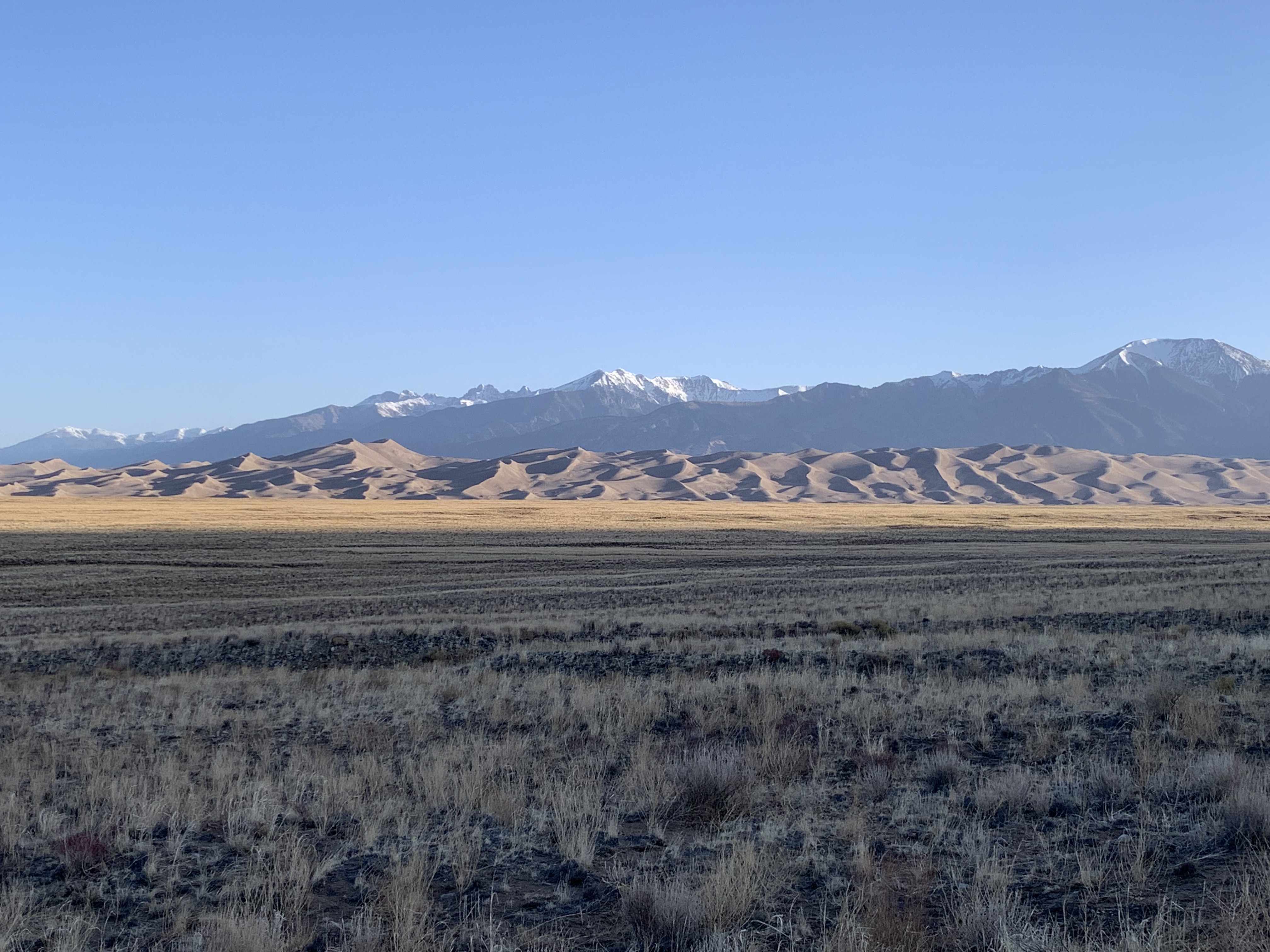
I’m obviously not much of a photographer, but I like this one. The tallest dunes here are over 700 feet, but they’re dwarfed by the surrounding mountains. Since I camped at Piñon Flats in the park, I was able to take this just as the sun came over the mountains, which added shadows for contrast. I hiked into the dunes before dawn and along the creek, but it’s not easy to take an interesting picture of so much brown sand, even in such a beautiful, surreal landscape in the moonlight. The dunes and the neighboring preserve are basically all wilderness, easily hiked into, and our footprints quickly disappear.
Whenever I wander into any wilderness, I always wonder about what we value. I have both a BS & MBA in business, and I worked in HQ at a Fortune 100 financial firm for a couple decades. And it seems to me that capitalism is terrible at valuation. One problem is that the first business to claim a resource is often just the first idea that comes along. There may be a better and more profitable use for a resource, but the quickest way to make money is typically the one that’s chosen. Another problem is that business people aren’t very innovative. If they see one business is successful in an area, then they will often just copy that idea. Economically, we’re far better off with a diverse set of competitive products and services than with a small number, because then we’re more resilient to market changes. But short term thinking dominates, which leads to over-investment in a few businesses, rather than a broad, diverse range of businesses.
It doesn’t take any special training to see this. Drive through most towns and see the same chain restaurants everywhere. Look at how similar most vehicles are or how all the fields in an area grow the exact same crop or raise the same cattle. Business is mainly herd behavior, and few want to risk money to develop a completely new business. Capitalists need tax incentives to change. Traditional car companies killed the electric car, then ignored Tesla, and now are demanding that the government build a charging network for them to compete. Who knew America’s largest and oldest corporations were such whiny cowards who need taxpayer handouts before they will adapt?
Why do I think about valuation in the wilderness? Because if the first guy to find this place had owned a cement company, he would have started carting off these dunes to make concrete. And then other concrete material suppliers would have copied him, lowering profits to nearly zero. And the wilderness would have been gone before anyone bothered to think whether there were any other better uses. The same is true of forests, wetlands, prairies, rivers, valleys, mountains and oceans. Capitalism rewards the first, fastest, cheapest exploiter for destroying wilderness, and penalizes long term thinking. Because time is money.
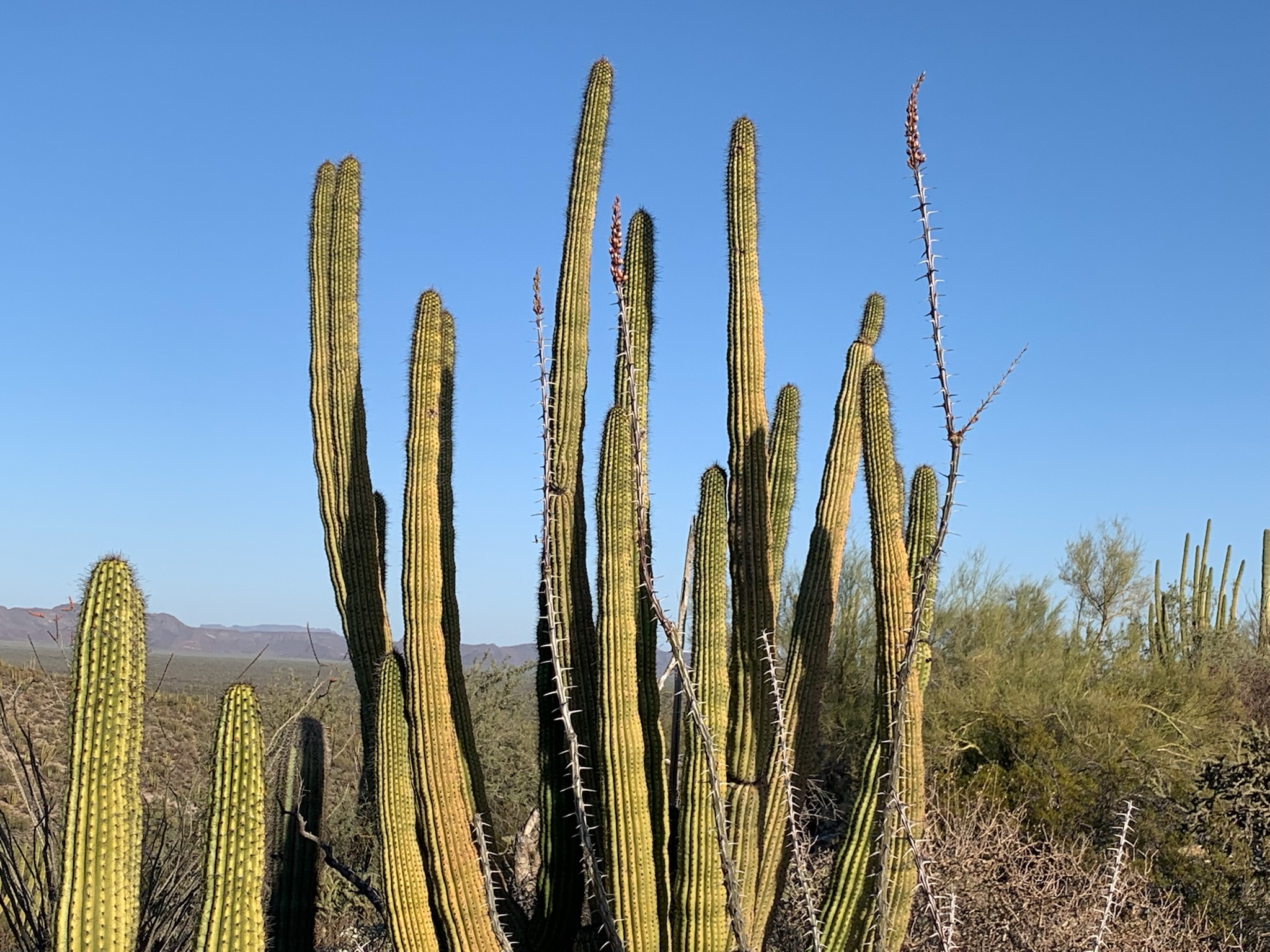
The skinny shrub reaching up in front of the cactus is Ocotillo, just beginning to bloom.
The ranger asked good questions. Given that we live in the Anthropocene or Human epoch, what exactly does wilderness mean to us now? This was one of my favorite ranger talks.
There’s a tiny endemic fish living in a corner of this park near the Mexican border. But because groundwater levels are now dropping sharply, the Quitobaquito pupfish’s natural habitat could disappear within a few years.
Some local school kids helped build a pond behind the visitor center to try to save the pupfish. The park service is re-lining the original Quitobaquito Springs to try to retain more water, but the springs are shrinking. People have been impacting the environment here for over 10,000 years, and, whether we like it or not, the little fish is now dependent on whether we choose to save it.
Ranger Kate asked the campers what we should do. The most common questions were about whether the Mexicans were at fault by siphoning off “our” water. They are actually on a different aquifer south of the Sonoyta River. And that jingoistic attitude really misses the point of being in an International Biosphere, next to the Pinacate y Gran Desierto de Altar Biosphere Reserve in Mexico. We’re supposed to be sister parks working together to save an internationally important natural area.
One suggestion was to “relocate the fish to a more viable habitat”. But if you take the pupfish out of Quitobaquito, are they still really Quitobaquito pupfish? Zoos don’t really prevent extinction in the wild.
I voted to add water to maintain the habitat. People think nothing of draining a river for a new golf course community and destroying ecosystems by burning fossil fuels. So why not reverse that destructive and short-sighted attitude and take this one chance to spend a few dollars to save a species?


 Zero Carbon Travel