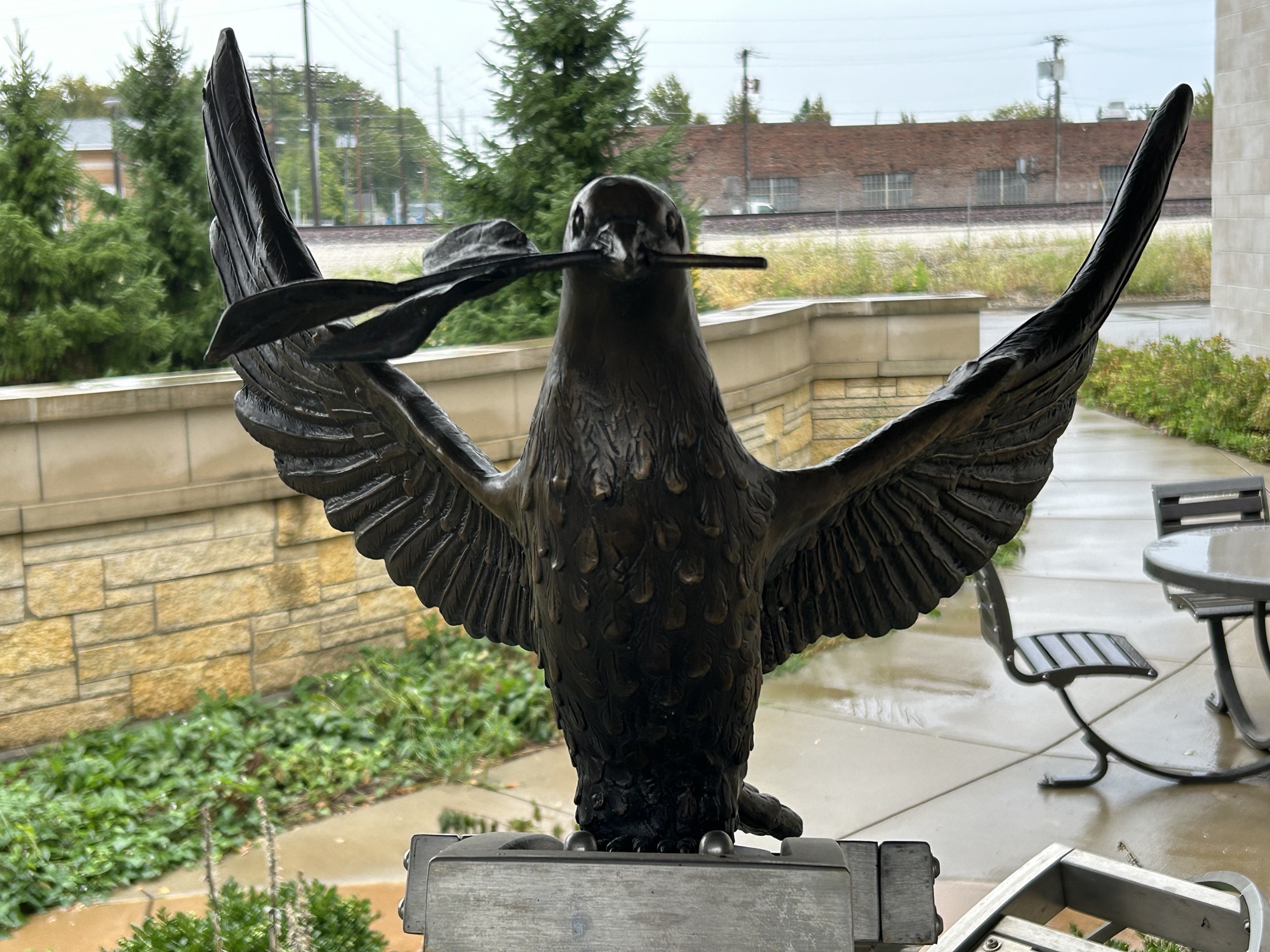
This new park established by President Biden this August is still a fenced off construction area next to the railroad tracks, but there are several art installations dedicated to the riot, including the dove above and a mural at the Children’s Hospital next door. 11th Avenue along the site is known as Reconciliation Way, to commemorate the terrible events here in 1908.
In mid August 1908, in Springfield Illinois, a white mob of five thousand lynched 2 black men, killed 7 others, burned out millions of dollars worth of black homes and businesses and also targeted Jews and whites deemed sympathetic to the black community. The police did nothing to stop the riot. The burning, looting, ransacking and violence lasted 3 days until put down by the state militia, which resulted in 6 dead rioters.
Church leaders blamed the victims for being “sinful”. Although everyone knew the perpetrators and many were arrested, only one 15 year old was convicted after he confessed to stealing revolvers, shooting at black people and starting 15 fires. The others denied any responsibility, the witnesses denied seeing them, and the charges were dismissed. The judge denied that there was racism in Springfield.
Many Americans were shocked by the scale of the violence in Abraham Lincoln’s home town, and civil rights advocates like W.E.B. Du Bois and Ida B. Wells helped form the NAACP in 1909 in response. In 1910 speaking before the NYC Republican Club (the party of Lincoln), Du Bois argued that if racial hierarchy were the natural order of the world, then there would be no need to use social and physical weapons to oppress a race.
“So soon as the prejudiced are forced into this inevitable dilemma, then the real bitterness and indefensibility of their attitude is revealed; they say bluntly that they don’t care what [slurs] may be capable of—they do not like them and they propose to keep such folk in a place of permanent inferiority to the white race—by peaceful policy if possible, but brute force if necessary. And when a group, a nation or a world assumes this attitude, it is handling dynamite. There is in this world no force as the force of a man determined to rise. The human soul cannot be permanently chained.”
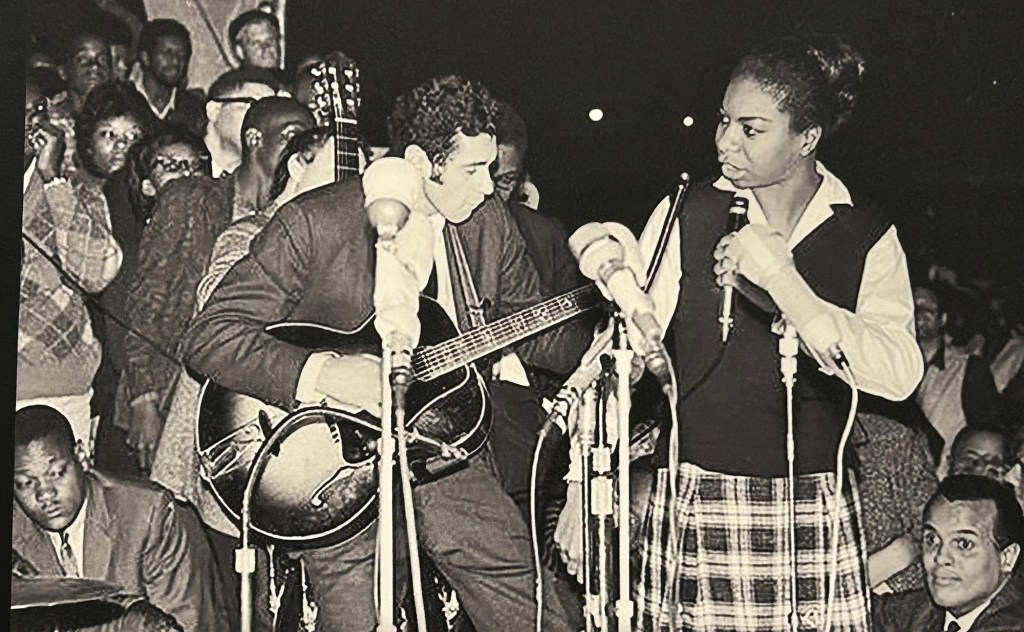
Nina Simone on the march from Selma to Montgomery, with Harry Belafonte lower right.
Black History is about much more than emancipation and education. Beyond the basic rights to liberty and literacy, Americans have a right to pursue happiness. All year long, the national park service celebrates those who broke the barriers that denied black people their full rights as citizens.
The African Burial Ground predates our country, includes both free and slave, and is today a powerful symbol of the right to belong, be recognized and be remembered. New Philadelphia, Illinois, was the first town in American officially founded by an ex-slave in 1836. Camp Nelson became a focal point for escaped slaves during the Civil War, both as refugees deserving help and as soldiers with a right to fight in uniform. Nicodemus, Kansas, 1877, is the oldest black settlement west of the Mississippi, and it still lives. Jazz began before the turn of the century in New Orleans. In 1903, Charles Young, born a slave, became the first black national park superintendent, and in 1917 became the first black Army Colonel (surpassing Dr Alexander Augusta, Bvt. Lt. Col. during the Civil War).
The Springfield Race Riot of 1908 sparked the creation of the NAACP, illustrating both the danger of race hatred and the need for African American advancement. In 1911, Maggie Walker, daughter of a slave, became the first African American woman to found and run a bank, among her many civic accomplishments in Richmond, Virginia, and nationally. In April 1939 after being refused the right to sing elsewhere, Marion Anderson made national news singing at the Lincoln Memorial.
WWII brought new opportunities, including employment for African American women among the Rosie the Riveters who built our fleets and the Tuskegee Airmen who helped turn around the war by defending our bombers over Germany. Tragically, segregation in the military led to the Port Chicago disaster in 1944, which in turn led to desegregation in the military.
Eisenhower was President in 1955, and America was a very conservative, 88% white, 95% Christian country. Still, when Mamie Till-Mobley’s boy was brutally murdered in Mississippi, she shocked the conscience of the nation with his open casket, sparking the Civil Rights Movement. In 1961, black and white Freedom Riders rode buses to integrate interstate travel, lunch counters and restrooms, but were attacked by “Citizens Councils for Racial Integrity”: the KKK. Despite school desegregation, Normandy Veteran Medgar Evers was denied law school admittance due to his race, so he worked with the NAACP on desegregation, civil rights protests and an investigation into Till’s murder. Returning home the morning after listening to JFK (below) promising to desegregate “hotels, restaurants, theaters, retail stores, and similar establishments”, Evers found his FBI protection detail had been suddenly withdrawn, and he was shot in his driveway, unintentionally desegregating the white hospitals of Mississippi shortly before dying.
That September, the KKK killed four young black girls by bombing a church in Birmingham. In November, JFK was assassinated. But the movement did not stop; it grew. In 1965, in Selma, Alabama, three times residents marched towards Montgomery to try to register to vote and to protest. First, they were beaten bloody and unconscious on the street by police on horseback. Second, they were stopped by legal action. And Third, they marched 54 miles to the capitol in Montgomery, joined by people from across the country, 25,000 strong, ultimately securing the Voting Rights Act a few months later.
The Reverend Dr Martin Luther King, Jr, who led that march and many others, gave his life for Civil Rights, along with many others. On 28 August 1963 in front of the Lincoln Memorial, he said, “I have a dream that my four little children will one day live in a nation where they will not be judged by the color of their skin but by the content of their character.” Well, two of his children are now dead, and his youngest is 60. I believe we failed to achieve his dream in his timeframe. But we must not stop trying.
”One hundred years of delay have passed since President Lincoln freed the slaves, yet their heirs, their grandsons, are not fully free. They are not yet freed from the bonds of injustice. They are not yet freed from social and economic oppression. And this Nation, for all its hopes and all its boasts, will not be fully free until all its citizens are free.”
President John F. Kennedy, Televised Address to the Nation on Civil Rights, 11 June 1963
 Zero Carbon Travel