Little River Canyon National Preserve

One popular question is itinerary planning, which is essential, although my plans never survive contact with the road. The same trails must be picked up again in different seasons, and inevitably, they retrace the steps of early Americans. The old hunting grounds, early trade routes, forts and battlegrounds often overlap in places like this, and, especially when they’re preserved in a more natural state, it’s easier to imagine those who came this way before us.

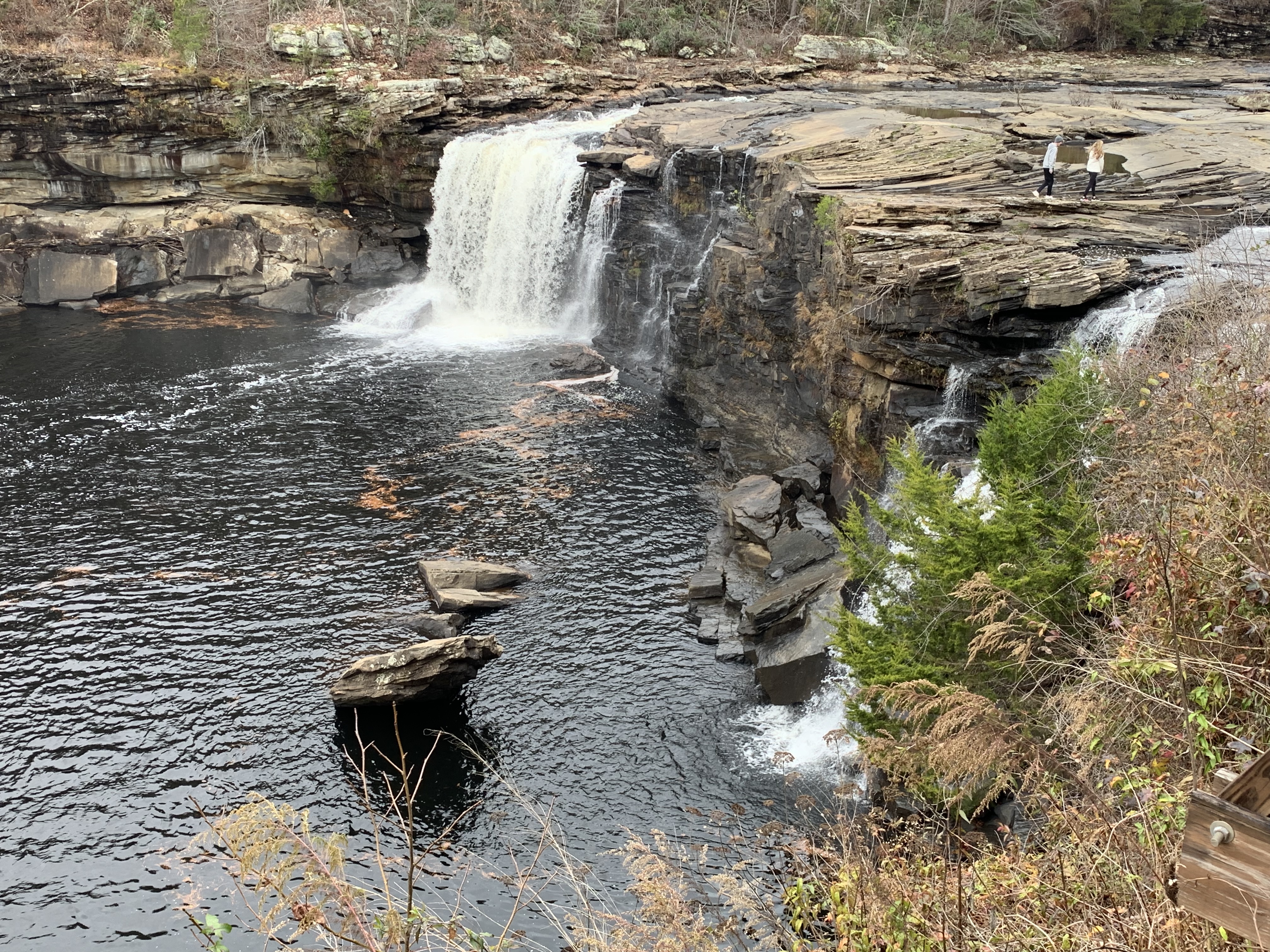
After their long history of interacting with the Spanish, French and British in the southeast, five tribes had become accustomed to European ways enough to be called “civilized”: the Choctaw, Chickasaw, Creek, Seminole and Cherokee. But the US government forcibly removed them to Oklahoma anyway. Most crossed the Mississippi near Memphis, as I did. The Cherokee were split into three groups: the old settlers who moved west before the removal, those forced to walk the Trail of Tears, and those who escaped removal and still live east of Great Smoky. Here, at a natural crossing point through the canyon palisades, the couple in the photo above walk on the Trail of Tears, near where Cherokee families were rounded up into a wooden palisade known as Fort Payne.

The park helps preserve that history, although the primary mission is to protect the many species that live in this important nature sanctuary. The canyon is known among rock climbers for the challenging cliffs, and if you hike downstream there’s a swimming hole near Martha’s Falls. The river isn’t runnable by amateurs, so stick to the scenic drive along the rim, admire the views from a half dozen overlooks and try not to miss the peak foliage like I did. The road isn’t wide enough for both bikes and cars, and, as usual, the former lose out. There’s a park film at the friendly visitor center and an Ol’ Tymer’s BBQ nearby.

Time for me to get back on the road. I passed through Muscle Shoals on my way here, but now I have Georgia on my mind. Places like this are bittersweet, when you reflect on the past or consider the future, but that’s what enriches travel. And our choices make a difference too. Supporting Native American businesses, for example, seems the least we should do to recognize past wrongs. And unless we stop our carbon pollution, these small sanctuaries will prove insufficient to preserve diverse species for any who may follow us.

Golden Gate National Recreation Area

This most-visited park protects land in San Francisco, Marin and San Mateo Counties, but most of the fun stuff for visitors is near the Golden Gate Bridge. The southern units include the unimaginatively named Ocean Beach, Fort Funston which is great for watching hang gliding, Rancho Corral de Tierra for horseback riding, and Sweeney Ridge which has views, hikes and wildlife. If you’re on your way north to Muir Woods and Point Reyes, then you can wind your way up the coast past Muir and Stinson Beaches, past Bolinas Lagoon and through the bucolic Olema Valley. If you have young kids, a stop at the Bay Area Discovery Museum is fun, especially if you’re going to Sausalito. The urban units include Alcatraz, Fort Mason, the Presidio, China Beach, and Lands End near the Legion of Honor art museum.

But if you’re focusing on San Francisco, then you may want to start with the bridge. On the north side, there are nice views from the Marin Headlands, not just Vista Point, but through the tunnel to the Marin Headlands along the loop road to the old forts. On the south side, there are good views from Lands End to the Presidio. If you’re taking photos, note that the north end of Baker Beach is clothing optional. Crissy Field, the naturally restored area once used by the Wright Brothers, is popular for kite surfing, which must be a fun way to see the bridge. Fort Point is under the south east side of the bridge, about as close as you can get without being on the bridge. At the last northbound exit, there’s a visitor center with a small parking lot and info about the bridge, and if you want to go on the bridge, one side is for pedestrians, the other for bicyclists and the middle for cars ;).

The Presidio was originally fortified by the Spanish in 1776, passed to Mexico, and then was taken by the US around 1846. It was an important military base for every US conflict for the next 140 years, and it includes a national cemetery, an officers club dating back to Spain, a former military hospital now used by Lucasfilm (see Yoda above), and a museum dedicated to Walt Disney, who stole some of his best ideas from Oakland’s Fairyland, along with a whole list of other interesting projects. The park leases many of its historic buildings as private residences. I don’t normally write long travel guides to parks, but I can’t help it as I used to live near the Sutro Baths ruin. OK, one last tip. Reserve tickets for Alcatraz months earlier than you think is necessary and try to do the night tour if possible. Unfortunately, the only way out there is by fossil fuel ferry.

Before the bridge was even conceived, the opening from the Pacific into the San Francisco Bay with passage up the Sacramento River was known as the golden gate, and people came from all over the world to get rich quick. In Chinese the area was called 金山 meaning ‘Gold Mountain’, and San Francisco is still called 舊金山 or ‘Old Gold Mountain’ today. (Many Chinese immigrant dreams were quashed by racist immigration policies, despite laboring on the railroads, levees and in a variety of businesses). Of course, nowadays, the path to riches is in the Bay Area’s high tech industries, where dreams are spun into gold. Which is why Yoda is a fine image for the Golden Gate NRA.

Fort Point National Historic Site

The Civil War era fort was obsolete as soon as it was built, since rifled cannon penetrated brick walls, and the one threat it faced, the CSS Shenandoah via the Indian and Pacific, called off their mission when they learned the war had ended months earlier. (They spent their round the world voyage attacking whaling ships out of New Bedford, since they often had escaped slaves on their crews.) Before that, there was a Spanish fort here, which was taken over by the Mexicans and then by a band of Americans including Capt. Fremont and Kit Carson, shortly before California became a state.

These days, it’s best used as a place to get a nice photo of the Golden Gate Bridge (when it’s less foggy). The fort is open on weekends, and you can get a good photo from the roof. I walked down from Battery East, but walking or biking from Crissy Field is nicer. There is parking at the fort, although it requires persistence navigating, since more roads are open to bikes than cars around here.

Cedar Breaks National Monument

I hiked out here 2 miles round trip to Spectra Point to get a view with Bristlecone Pines, so that you can tell this is not another photo of Bryce. There are a number of Bristlecone Pines here and a few more near Chessmen Ridge Overlook, although they are likely younger than some at Great Basin. By the way, if you’re looking for cedar trees, there never were any. Early visitors from back east mistakenly thought that the juniper trees were cedars, and the misnomer stuck. Cedar Breaks is over 10,000’, so it’s a step or two above Bryce, but since it extends down through and exposes the same layer of rock, it looks similar near the top. The view down the gorge looks down over 5,000’ towards also misnamed Cedar City, so you get a good look at the various layers of the grand staircase. Be careful hiking here, as high altitude contributes to vertigo. Due to the heights and erosion, there aren’t any recommended trails down from the rim, but there are a few rim trails and seven overlooks, four of which are near parking. While the road and trails may still be open, there was frost on the trail when I visited, and the roads will close as soon as it snows. The temporary visitor center and store has now closed for the season, and the new visitor center at Point Supreme Overlook is still under construction. Hopefully it’s open next year.

Grand Canyon National Park

The white peak on top of the center red rock is Mount Hayden, 5000’ above the canyon floor, viewed from Point Imperial, North Rim, looking east. The Colorado River is down there somewhere, along with the Painted Desert and Marble Canyon to the left. Everyone should visit the Grand Canyon, and the grandest, widest and most awe inspiring views are from the popular South Rim. I took my family there years ago, and I’ll never forget ‘Ooh, Aah’ point, which was so windy that the name required exclamation marks of terror.

But the North Rim is more conducive to contemplation than the South Rim, because instead of development and crowds, there are bright yellow and gold Aspen forests, meadows and quieter vistas. The yellow Cliffrose was in bloom along the trail, and a large coyote crossed the road in front of me. Angels Window makes for a nice photo and has a great overlook on top. Bright Angel Point is just a few steps from the Grand Canyon Lodge, and it is one of several overlooks nearby that have spectacular panoramic views.

The season is shorter on the higher altitude North Rim, but fall is beautiful. There was wildfire damage and some smoldering burns in the Kaibab Forest, but overall the forests still look healthy. The ranger gave a talk trying to explain how difficult it is for them to respond to climate change locally, let alone nationally or globally. Logistically, my long range EV can visit the North Rim from Page AZ, where there’s a supercharger, round trip, but getting all the way out to Cape Royal would have been too far. The nearest destination chargers are at Cliff Dwellers Lodge at Lees Ferry (mean steak & eggs) and at Days Inn in Kanab Utah. I used both and continued northwest.

Natural Bridges National Monument

The Bridges, so designated because water flowed through them and formed them, are much older (Permian) than Utah’s famous Arches (Jurassic). There are three main bridges to see here, each only a short hike from the scenic drive to view, and they span two canyons, Armstrong and White. The Owachomo Bridge above is over a dry creek bed and can easily be hiked under. The Kachina Bridge is at a more challenging viewing angle near the intersection of the canyons, but if you’re up for the Loop Trail hike, I bet it’s spectacular. Sipapu Bridge, second in size only to Rainbow Bridge, is named for the emergence gateway mythology common to Native American tribes. There’s an impressive view from the overlook, and if you hike and climb about halfway down and go out along a wide ledge, you can get a view from the other side, which is equally magnificent.

This is one of my favorite parks for geologic features. Unfortunately, none of the bridges were working as portals to distant past or other dimensions. The surrounding forest and beautiful canyon lands are part of the Bears Ears National Monument (managed by the US Forest Service and the Bureau of Land Management), and the mesa top buttes that look vaguely like ears from a distance can be seen from the parking lot as well as from miles away in several directions. I drove in from the east, stunned by the scenery, and then left south, where the road drops into Monument Valley. Wow.

“I’m pretty tired…. I think I’ll go home now.”

Forrest Gump

Mesa Verde National Park

This is Balcony House, which requires a reserved ticket, climbing cliff-side ladders and crawling though a short tunnel. It’s worth it. The dwelling is named for the intact, original balcony on the right side of the photo under two upper story windows. At other cliff dwellings across the southwest, typically only the beams remain, like those on the wall to the far left. This dwelling is also unusual for facing northeast, lacking fires in this section, and for the large flat floor with a low wall at the edge of the cliff. This place was used for important gatherings, but not in winter.

Mesa Verde is a huge, green high plateau, so start at Park Point Overlook, where you can see from Colorado’s snow-capped peaks to Shiprock, which I first saw after visiting Canyon de Chelly. From up here, you get a sense of the region as one greater community of interrelated tribes, trading and interacting with one another frequently, and not four separate arbitrarily bounded states.

This is my favorite park for cliff dwellings, so see as many as you can. The Cliff Palace is the largest in North America (reserve a ticket), and while you only walk along the bottom edge, you do get close enough to appreciate its extent and architecture. Spruce Tree House is only visible from an overlook, Long House was booked, and Step House was perfect to visit on my own first thing in the morning. The ranger talks are extremely informative, even after visiting many other Native American sites.

Finally, slow down here. The mesa has basically no Wi-Fi or cell signal (save a photo of your tickets). There are bus loads of tourists, so the few places to eat are crowded (Metate needs reservations). The Far View Lodge rooms don’t have TV, and it can be a peaceful place, if you try. My laptop finally stopped working, so I ended up sitting outside, saw a rabbit and thought long enough to reconsider my past and future. This World Heritage Site has already seen more recent devastating wildfires than they have cliff dwelling sites open to visit, so these moments in places like this are rare and diminishing rapidly.

Black Canyon of the Gunnison National Park

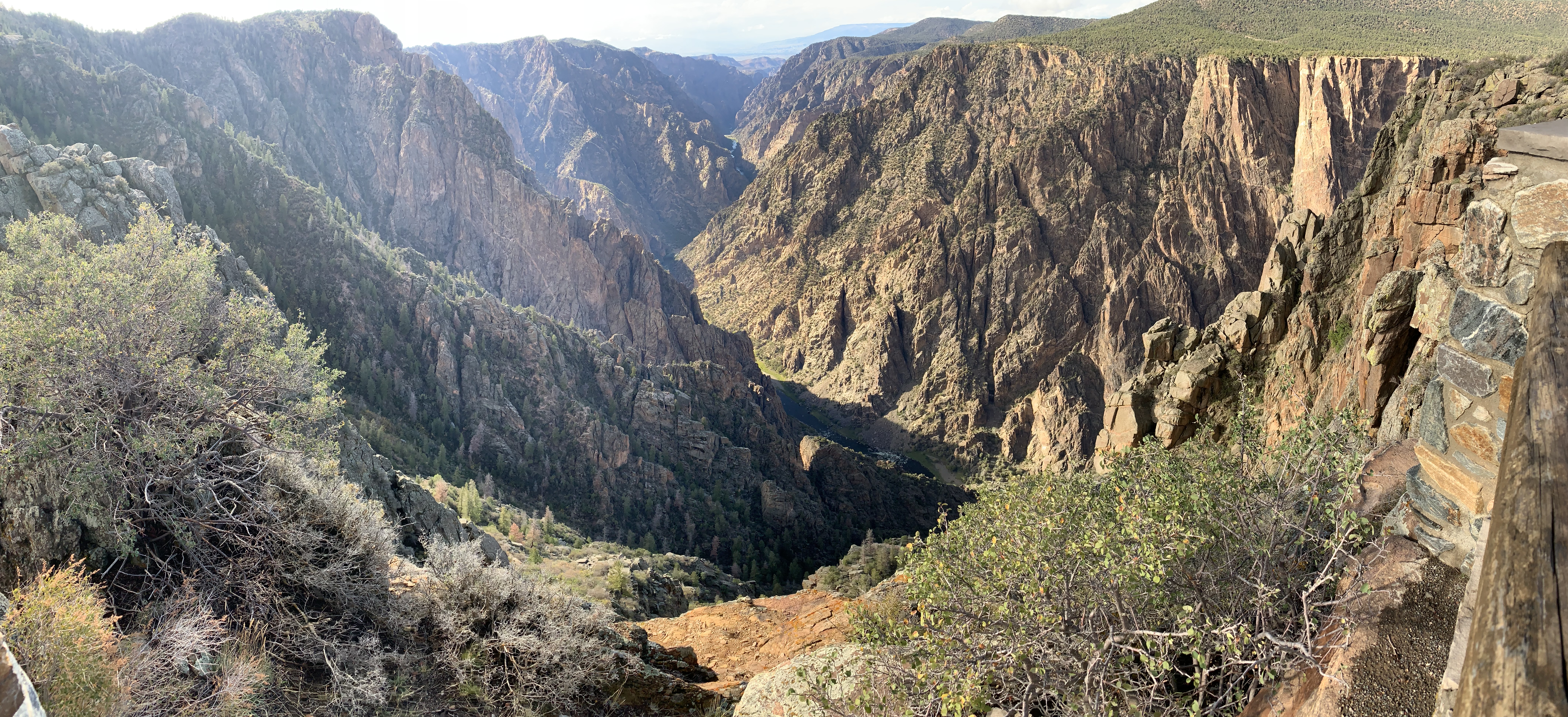
This view is looking downstream from Sunset View overlook, but the upstream view is blacker, steeper and narrower. The canyon there is over twice as deep (2250’) as it is wide at the top. The Sawatch Range, Elk Mountains and San Juan Mountains all feed into the canyon in spring. There are half a dozen good overlooks on the South Rim to peer down into the canyon, and some cause vertigo, as the cliffs are near vertical drops from the rim. The North Rim is a 2 hour remote drive, has fewer overlooks, a campground and horseback riding.

The South Rim has a campground and a visitor center, and is only steps from Gunnison Point, which may have the best view down into the canyon, although my photography skills were insufficient. The short hiking trails along the rim, down into the canyon (a little) and to the high point to the left above each provide a different view into the geologic depths.

The East Portal campground is technically in Curecanti NRA and is accessed by a steep road down to the Gunnison River (barely visible above) near the upstream dam. I’ll have to come back. Since I arrived here in October, there was already snow falling in the mountain pass on 50 to the east. The road was also being repaired after some fearsome rockslides. On the plus side, the drive through the mountains included bright fall foliage that contrasted with the black rocks. Montrose makes a convenient spot to charge, and it has two well-reviewed Himalayan restaurants.