The southern terminus (above) of the Florida Scenic Trail is in Big Cypress National Preserve on the Loop Road. One of the two barely visible signs at the virtually unmarked entrance almost apologetically notes that the trail is maintained by volunteers. 1,500 meandering, swampy miles northwest is the northwestern terminus (below) at Fort Pickens in Gulf Islands National Seashore. While I’ve been to both ends of the trail, and crossed over it a few times, I have not hiked any significant sections. It’s reportedly a rather solitary experience likely requiring significant wading.
I should mention that Fort Pickens was a Union held fort during the Civil War, protecting Pensacola Bay. The Confederates tried taking it, but the fort is on a rare bluff in the area, giving it the high ground for miles. When the Confederates took some smaller forts across the channel, the Union guns expertly demolished the smaller positions. The beginning of the trail here is beautiful, with many birds and water on both sides.
Daniel Romero marched with César Chávez back in the day, so when a nationwide protest against recent cuts to the national parks & US forest service popped up today at noon, of course, he came wearing his ‘¡Si, Se Puede!’ T-shirt. He knows from experience that predicting turnout is a fool’s game, but instead of the expected 3, there were around 20, even at a very small park in a rural area best known for a loop of track for trains to change elevation to traverse the Tehachapi pass. Another was Fernando Chávez, a grandson of César, who discussed the need for solidarity, coalition building, and activism at the base of the old oak tree next to Martyr’s Garden, where his grandparents lie at rest. “We’ve been protesting forever”, said Romero. “Even though we are sometimes excluded, we have always tried to support each others’ causes”, said Chávez, recounting how spontaneous protests recently broke out after a particularly brutal local raid by ICE. Romero listed the unions that marched with them, describing diverse families and even weddings during the boycott and strike.
This was an early park visit for me, as it’s local. Unlike my quiet visit 3 years ago, folks here today were sad, angry and surprised by the chaotic decisions to cut 1,000 NPS staff and 10% of the USFS. One employee here had just transferred from New Mexico when his job was axed by Elon Musk. Many of those affected were young, promising staffers, full of optimism. Supposedly he is scrambling to get the transfer reversed to stay employed. While there may be some cost savings, in the long run, the work these folks do protects and adds a lot of value to our country, so cutting when hiring is needed is counterproductive. I felt the need to apologize for still driving a Tesla, but folks understood, knowing others who are now trying to unload theirs. I’m keeping mine, as the climate crisis is going to get worse, despite efforts to delete the word climate from government documents.
I know Saturdays are supposed to alternate state photos, so I’ll add another and a video below. But I thought you might like this real time update from a very appropriate park for a protest, with people whose lives were defined by the proud history of protesting in America. Next week will return with another western state. Thanks for reading!
As we prepare to cross into a new year, take a moment to think about the high ground that divides the west from the east. Rivers, agriculture, ports and cities all are shaped and developed by changing elevation across the land. Watersheds support different species and define much of our history. Colonial America is set east of the Appalachians, along rivers like the Savannah, Susquehanna and Hudson that flow into the Atlantic, while the Ohio and Tennessee Rivers flow down the western slopes on their way to the Mississippi and Gulf of Mexico. But from Alaska to Tierra del Fuego, all of the Americas are divided by one great line of mountains and high elevations.
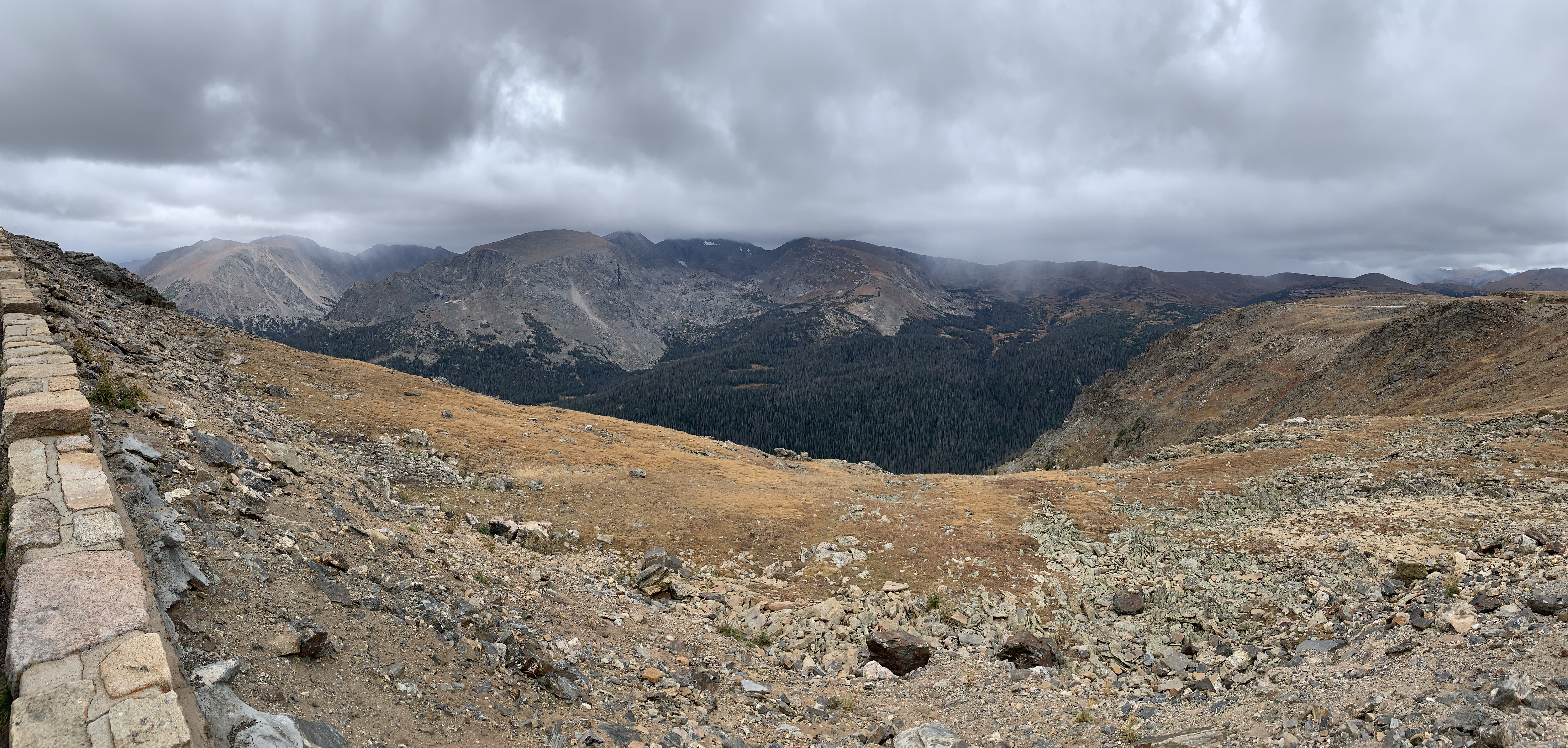
In the US, the 3,100 mile Forest Service managed trail starts at the New Mexico border, runs up near the Gila Cliff Dwellings, through El Malpais, cuts up west above Taos into Colorado, winds high through the Rockies, near Camp Hale, reaching its highest point at 14,270 feet on Gray’s Peak and then crosses through Rocky Mountain park (see photo). Here are the headwaters of both the North Platte River that flows east to the Mississippi and the Colorado River that flows west to the Sea of Cortez.
The trail continues north into Wyoming, where it crosses the Pioneer trails, through Yellowstone, where it crosses the Lewis & Clark trail, near the headwaters of both the Snake River which flows west to the Pacific and the Missouri River which flows east to the Mississippi. The mountainous divide continues up into Idaho and Montana, above Big Hole and Grant-Kohrs, connects with the Pacific Northwest trail and crosses through Glacier to Waterton in Canada. In Glacier, the epic trail summits Triple Divide Peak, which marks the hydrological apex of North America, where the Atlantic, Pacific and Arctic watersheds meet. Hope you have a happy new year!
The Forest Service managed trail runs through Glacier in Montana, just below the Canadian border to the north end of Lake Roosevelt in Washington, to Lake Ross, through the north part of the North Cascades, past Ebey’s Landing (see photo) near where it connects to Port Townsend by ferry, and through Olympic to the Pacific. I’ve hiked short sections and roughly driven the length of this 1,200 mile, wild, rugged and beautiful trail.
The first troops to join the war from Colorado’s Camp Hale were the Viking Battalion, comprised of Norwegian exiles and Norwegian Americans, who joined the war in Europe in 1943, most fighting in uniform, but some as spies for Wild Bill Donovan’s OSS, the pre-cursor of the CIA. By 1944, the Allies had liberated Paris & Rome, but the Germans stubbornly held the mountains north of Rome and Florence, despite numerous assaults. That winter, the 10th Mountain Division, specially selected for mountaineering, having completed months of rigorous high altitude training, including mountain climbing and skiing among the 12,000 foot peaks behind Camp Hale above, arrived in Italy to take over the assault. Despite heavy casualties, they pushed the Germans out of the mountains, across the next valley, and up into the Alps, before the Germans surrendered. One of the young 10th Mountain soldiers left for dead after terrible injuries in Italy was Bob Dole, who survived and served as US Senator for Kansas from ‘69 to ‘96.
President Biden recently made this area and some of the mountains beyond a national monument, managed by the forest service. At this point, there’s not a lot to see and the roads are in poor condition, but it’s easy to feel the altitude when walking around, even without 90 pounds of military gear. There are still alpine huts between the trails up on Machine Gun Ridge above, and after the war, many 10th Mountain Veterans helped start a boom in recreational skiing nearby in Vail and Aspen Colorado. Today, the 10th Mountain operates out of New York and is frequently deployed on dangerous missions abroad.




 Zero Carbon Travel