Biospheres of the Southwest

This is a photo of a photo of a Texas Horned Lizard in the arid Chihuahuan Desert scrubland, from a roadside plaque near Las Cruces, New Mexico. The actual habitat is within the White Sands Missile Range and is off limits to the public. This UNESCO recognized special biosphere, Jornada—meaning day’s journey without water—, is open to scientific researchers from USDA, USFWS and NMSU, with limited school trips to the Chihuahuan Desert Nature Park in the southernmost corner. For many decades, the Department of Agriculture has been studying the climate here, gathering useful data about the fragile desert ecosystem. The Fish and Wildlife Service mostly focuses on the Bighorn Sheep and other species in the adjacent San Andres Mountains. New Mexico State University organizes research efforts and assists student scientists. 

While you can’t visit the Jornada biosphere or disturb the wildlife, these scientific research zones are extremely important for understanding global climate change and the ecosystems that support unique species. But the southwest region has two internationally recognized biospheres that you can visit: Big Bend and Big Thicket. Big Bend, like Jornada, is part of the Chihuahua Desert, and it also includes a biodiverse riverine ecosystem. Big Thicket is one of the most biodiverse places in the US, where the bayous, leafy forests, pine forests, plains and sand hills intersect and provide habitat for thousands of species. While these areas provide enjoyable excursions for Americans, they are also important beyond our borders. Scientists from all over the world actively support protecting and studying these areas to ensure the survival of species globally.

Monasteries on the slopes of Popocatépetl

The volcano Popocatépetl was active, unleashing a huge cloud of smoke and ash, so the view of that Biosphere was not clear. I kept my distance. In the 16th century, the Franciscans built massive fortified monasteries below the volcanoes, and now 14 are recognized as a World Heritage Site. This one, named San Miguel Arcángel, is in the center of the small city of Huejotzingo, about 45 minutes from Puebla. This area is famous for carnival festivals, celebrating various conflicts and stories from before the Spanish arrived through the French invasion in the 18th century.

One use of the monasteries was for defense, and some played important roles in battles. This large monastery is an oasis behind high thick crenelated walls, enclosing an open plaza with beautiful old trees and behind more walls, a couple of lovely cloisters with fruit trees (above). There are renovations underway, due to seismic activity, but much can still be seen inside on a 75 peso ($4.50) tour. Just off the kitchen, there is a macabre holy relic display of skeletal, partly mummified remains in glass cases. Sundays the museum closes to accommodate services.

Aqueduct of Padre Tembleque

OK, it’s not a solar eclipse, but this 450+ year old World Heritage Site is impressive. Only about 25 miles from the pyramids of Teotihuacán, this 16th century Franciscan Aqueduct carried fresh water from a volcano 30 miles over the countryside, underground and over the Papalote (kite) ravine above, with 120+ arches overall. If you approach from Mex 88 outside Santiago Tepeyahualco, there’s a short gravel drive to a parking area watched by local police, where the aqueduct begins. It’s easy to walk down to see the 125’+ high arch in the center, and it’s cooler if you stay in the shade of the Roman design. I wouldn’t recommend trying to drive further on the “roads” nearby, which are more like cow paths. There is a small rail line and a creek flowing under at the bottom, with a footpath built into the bottom of the arch for hikers to cross. There are a few other sections, but this is the most impressive.

Teotihuacán

Feathered and fire serpents adorn the steps of the Quetzalcóatl Pyramid. Some weathering has occurred in the past 17 centuries, but once the eye sockets held black obsidian volcanic glass, the flames were painted bright red and feathers adorned with green jade. The museum (show your gate ticket for admission) near the Sun Pyramid shows murals, artifacts and has a large model of the site, which helps add details to the huge structures outside. None of the three pyramids can be climbed now, but I still walked a couple miles round trip, including the Moon Pyramid near where I started. I arrived early at 9 am, just as the hot air balloons were descending after their dawn tours. It’s an awesome place, but it can get hot and crowded by midday. I recommend staying nearby the night before.

At its peak, Teotihuacán was the largest city in the Americas, 6th largest in the world. Roughly, the city began sometime around 200 BC and fell around 550 CE. Much of their wealth came from obsidian tools, weapons and art, mined from local volcanoes and expertly knapped. The pyramids and related buildings show an elaborate religious class, but few signs of military or monarchs. The pyramids are designed to make observations for the Mesoamerican calendar, so the priests likely derived their power by determining the seasons. Best guess is that their civilization’s collapse was internal, with signs of drought and starvation, before simultaneous fires burned out the elites. The priests essentially had one job—to monitor the climate—, and they failed. Human success, growth, unsustainable use of natural resources, crop failure, and collapse, is a common pattern in ancient civilizations, and we are likely on a similar path due to carbon pollution.

Querétaro

UNESCO recognizes this colorful, artistic city for its historic zone reflecting its native and colonial combined roots. Otomi musicians and doll vendors walked in the narrow alleyways winding around grand churches, much as they have for hundreds of years. Beautiful public plazas with historic groves of trees, Baroque churches, vibrant architecture, and galleries fill the spaces. And art flows into the streets, with public displays of famous paintings, both local and international exhibited outside. While I intended to focus on the history of revolutionary conspirators, the trial of Maximillian and the drafting of the Mexican constitution, the fascinating streets pulled me away from the Teatro de la República and had me wandering around in circles taking in the atmosphere amazed. This is a cultural feast!

Guanajuato

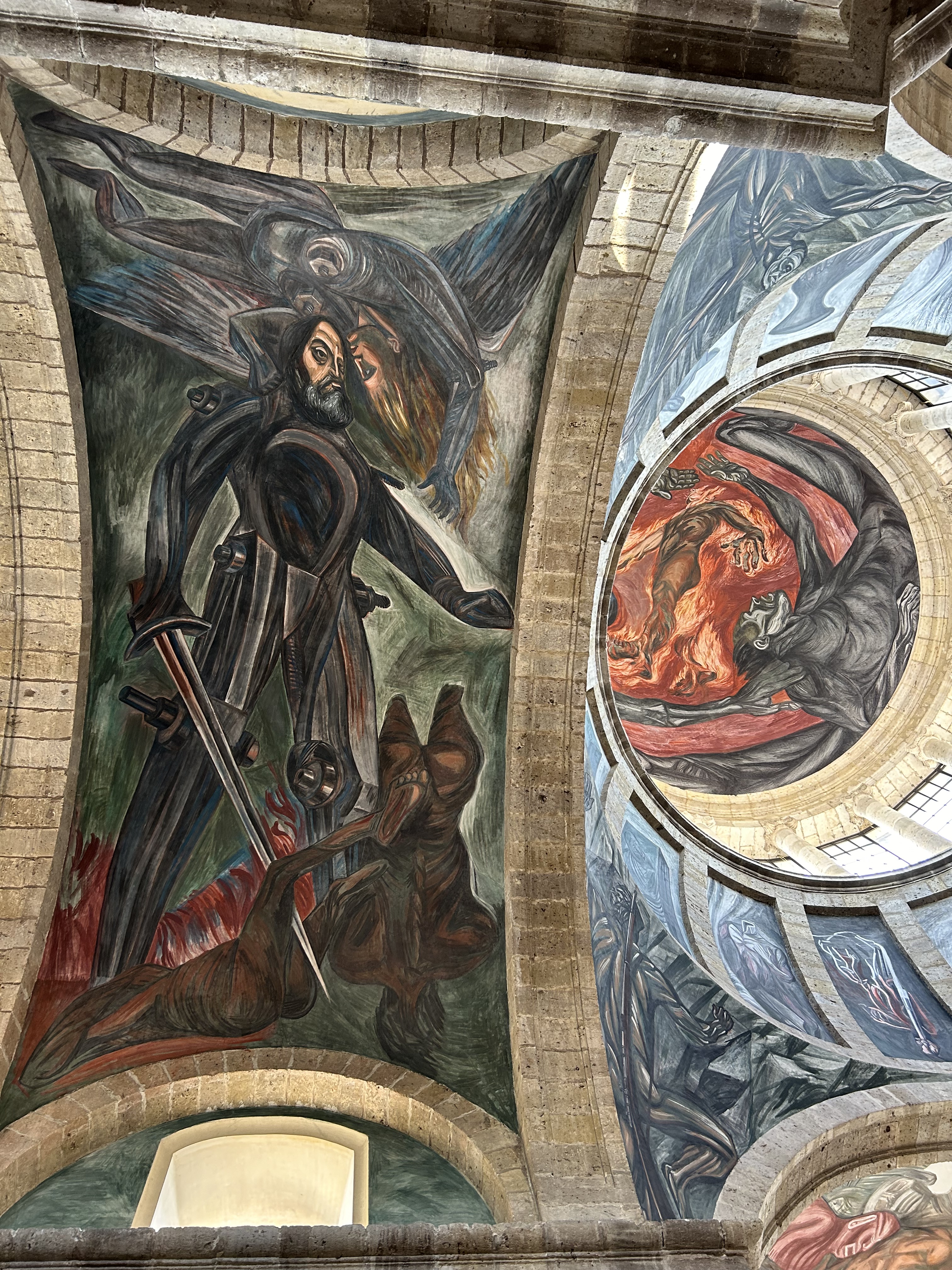
On the right is the Alhóndiga, an old grain exchange, which houses a history museum, has a stunning Morado mural, was stormed by Hidalgo during the Independence War, and was where the heads of Hidalgo, Allende, Aldama & Jiménez were later hung, one from each corner, including above, top right.

The old town center and churches are part of the UNESCO World Heritage Site, and the churches are particularly lavish, due to the rich silver mines in the hills around the city. There’s also a decadent theatre, built for the dictator Porfirio Díaz, who impoverished millions. The independence leaders would have been furious with the ostentatiously royal display.

I love the town, climbed the narrow alley stairs to see from above and also walked through a long dark tunnel to loop back to my car. Diego Rivera’s childhood home has been extended upwards to become an exceptional museum of his life and art. Highly recommended.

San Miguel de Allende

Santuario de Atotonilco

Above is one of a half dozen side chapels in the UNESCO World Heritage Site of Atotonilco which includes nearby San Miguel de Allende. While most tourists luxuriate in the colorful town, this whole area is historic, beautiful and fascinating!

By all means, visit Ignacio Allende’s house next to the church founded by San Juan de Miguel, who founded the town. You will learn how Allende, the hero of Mexican Independence, lost his eldest son in battle defending his father and see how the Creole elite lived when the Spanish King decided to take the lion’s share of the treasure in silver from the mountains. The mixed race locals were furious that some overseas French-backed King was against the Jesuits educating them, and they rebelled.

Was Allende the mastermind or the Priest Hidalgo, who cried for independence? The smart money is on Allende, but the poor must have listened to Hidalgo. Either way, they were captured and executed, both becoming martyrs. And the people rose up and won their independence from Spain. There’s much to explore!

Yellowstone National Park

Clockwise from top: Morning Glory pool, Daisy, Grand and Old Faithful geysers.

Most of the world’s geysers are here, near the country’s largest high elevation lake and the headwaters of the longest free-flowing river in the lower 48, in a park bigger than some states. For wildlife alone, this is my favorite park. There’s a lot to see and do, but I’m not going to write more about it. Come see for yourself.

Waterton Glacier International Peace Park

Canada is to the left of the mountain with the historic Prince of Wales chalet on the far left bluff, and to the right is Glacier National Park in the US. This World Heritage Site includes both parks. Waterton village is accessed from Canada, uses Canadian dollars, but is mostly on US soil. Not that it matters. I saw no border officials here, and it indeed very peaceful. There’s a classy old tour boat which runs down into Montana, as well as camping and lots of interesting trails.

Unfortunately, there was a terrible forest fire here in 2017, and the only glacier above is far off in the distance to the right, a shadow of its former self and a reminder that we all must reduce our carbon footprint. I was happy to spend several hours charging my car at the marina’s destination charger, walking the shoreline, eating, trying the local beer and just soaking in the view above. I enjoyed my detour to Alberta’s five world heritage sites very much, and I didn’t have any trouble charging in Canada. The Tesla even converts the speed limit to mph, so you don’t need to do any math.

Dinosaur

This is the Canadian World Heritage Site in Alberta, not the American Dinosaur National Monument.

Josh guided us into the restricted area, explained how to look for fossils and we sat down on a bone bed to look. I saw something with a pretty pattern, picked it up and showed it to Josh. He confirmed that it was part of a T-Rex—Gorgosaurus libratus—tooth, roughly 75 million years old. I just sat there for a while, stunned to be holding a real fossil like that in my hand after picking it up off the ground.

The park is the most productive dinosaur fossil ground on earth. And it’s also very beautiful, with camping and hiking along the river among the Cottonwood trees, some 200 years old. I saw a family of deer on the trail. Even the Badlands in Canada are nicer than the US.

It’s definitely worth signing up for a guided tour, although there’s also a drive with exhibits and places to look for fossils on your own. The above diorama is in the visitor center. Most of the assembled skeletons are at the Royal Terrell Museum a couple hours drive north, but the field work takes place here, especially in summer. Josh even stopped to mark and protect a new find from another group a week before. Impressive!