Dry Tortugas National Park

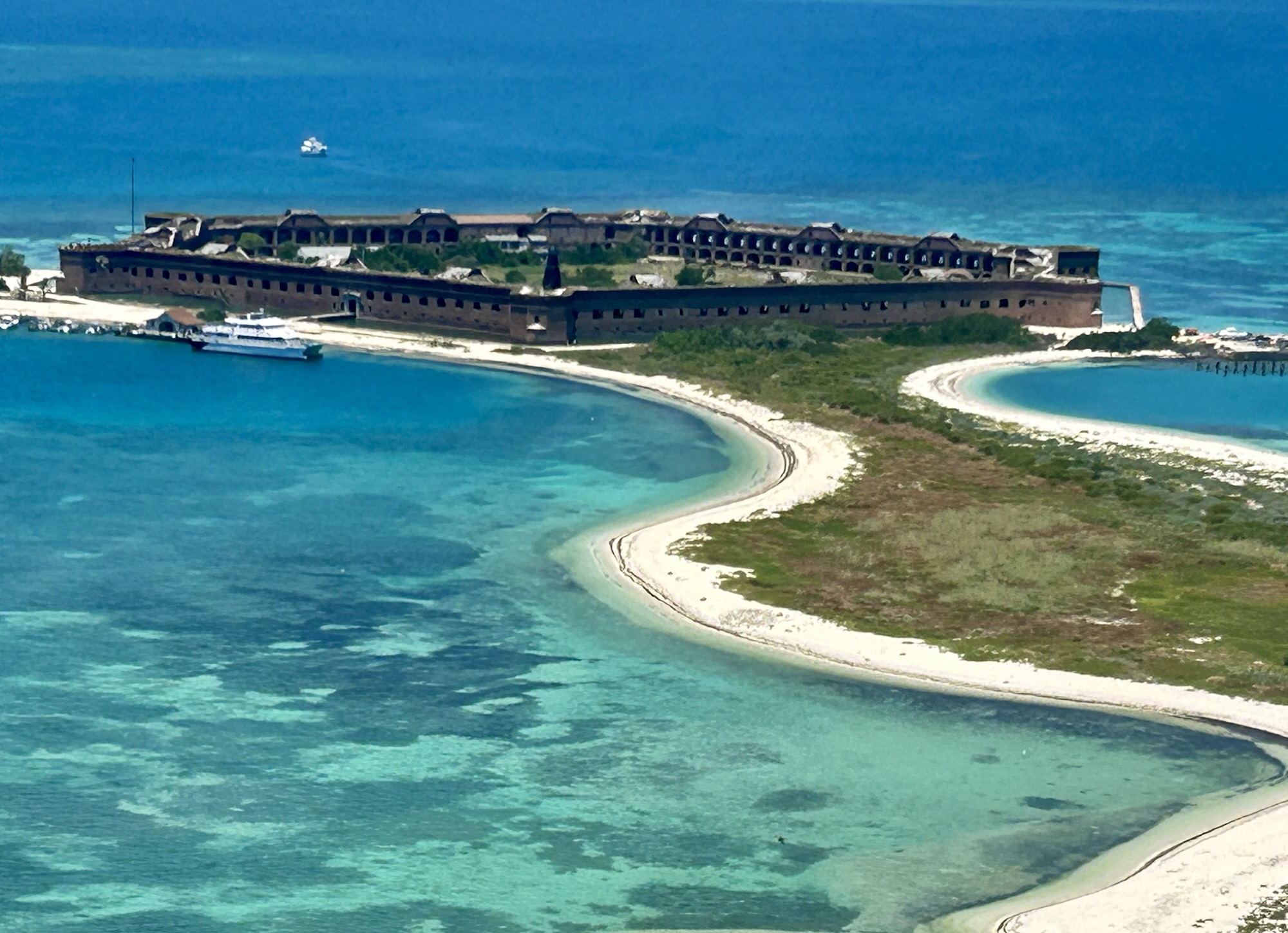
Fort Jefferson is an impressive 19th century structure, used to police ship traffic between Florida and Cuba. The island was named for the sea turtles that still nest here, and there are many seabirds too. There are lovely views of the courtyard above and all around the small island from the top of the walls. I was pleased to see a goliath grouper near the ferry dock, and despite the poor coral condition, the snorkeling was very good among the old dock pilings near the south beach. Together with the Everglades, Dry Tortugas is a large UNESCO Biosphere. I saw hundreds of fish and birds. This is one of my favorite national parks.

The flight is much more expensive than the ferry, but there are some benefits. I was kicking myself for not reserving ferry tickets enough months in advance, but when I realized that the seaplane only flies a hundred and fifty feet or so over the shallow waters, I decided the short flight was worthwhile for the views. From the air, we saw two shipwrecks, one a navy boat used for target practice and the other a famous treasure hunter’s floating guard shack, plus many sea turtles, some sharks, maybe a stingray, a pod of dolphin, and flying fish scattering over the surface. First time for me to see all that from the air. Also, the flight saved me a lot of time. If you’re just visiting Key West—I took the Conch Tour decades ago—to get to the Dry Tortugas, then you can drive in, catch a 10 am flight, and be on your way, saving two very expensive hotel nights on Key West. Plus, it’s less crowded when you first arrive, they include snorkel gear—definitely snorkel—, and you get the view of the fort below.
Virginia Coast Reserve Biosphere

This is one of two UNESCO Biospheres in the Mid Atlantic region; the other is Pine Barrens in New Jersey. Dedicated to scientific research, protected for decades by dedicated environmentalists and locals, including Federal, State and Local lands, and managed by the Nature Conservancy, this UNESCO Biosphere protects much of the Virginia part of the Delmarva Peninsula, including its fragile barrier islands. It’s a crucial stop for birds on the Atlantic flyway from the Yucatán, over Florida and up the coast to Canada. And of course, studying these coastal wetlands is critical for combating the effects of the climate crisis.

There’s a nice trail next to the Brownsville HQ with boardwalks out to the Atlantic view below and a similar one facing the inland wetlands. I saw a great blue heron, two large turtles, and many butterflies, spiders and frogs. Frogs were much more common in my youth, so it was a delight to see so many hopping across the trail or grass in front of me.

Padre Island National Seashore

I joined a few kayakers at Bird Island Basin to explore the Laguna Madre on the calm inland side of Padre Island in perfect conditions and enjoyed close up views of well over a dozen bird species fishing in the murky salty water, resting on the muddy beach and hopping around in the low grasses & brush. As usual, I wasn’t able to take good photos while bobbing along in my kayak, so here’s one I took from my car window of a Laughing Gull. With a number of birders in my family, I tried to identify at least a few of the endangered species: Reddish Egret, Least Tern, Brown Pelican, White Tailed Hawk, and at least two of their three endangered Plovers. Including the ocean side and sprawling grassland, there were Ruddy Turnstones, Curlews, Willets, a Tricolored Heron, and various ducks, sparrows, and raptors, and who knew there were so many different types of terns?

After the birds, Padre Island belonged to Native Americans first, and the visitor center and beach nearby are named after the Malaquite. The Spanish claimed it next, and silver treasure was found from one of their shipwrecks. Then the Republic of Texas claimed it, and finally the US won it in the Mexican American War. A Padre who collected funds for Rio Grande missions built a home here, prompting the name as well as the companion name for the lagoon. The Laguna Madre stretches into Tamaulipas Mexico and is the largest hypersaline coastal lagoon in the world, a critical stop on the flyways for many migratory birds in the Americas.

Prior ranching, military use and driving on the beach make the island less than pristine, but the park service has helped recover Ridley and other sea turtle populations here. There are specially adapted birds, fish, crabs, shellfish, reptiles, bugs, and other animals here, some of which live nowhere else. Unfortunately, fossil fuel drilling is still allowed in this area, which threatens all species in many ways, especially by climate change and rising seas.