In 2024, my total reached 400 *including 3 extra types*—affiliates, heritage areas and trails—even though they aren’t official national park units. My official total is 385 (out of 433).
My earlier favorites mostly hold, with several important changes.
Pick the best in each of the six regions completed
Visit Canada and Mexico again to see more world heritage sites and biospheres
So I plan to cross the country again this year in my electric car, seeing National Parks from California to Florida, World Heritage Sites from Canada to Mexico, and various lesser known but still important small sites. Logistical challenges or new park designations (thanks Joe) may thwart my plans, but I resolve to do my best.
The posting schedule should continue unchanged all year. Mondays are site visits. Thursdays are typically viewpoints and summaries. And every other Saturday I plan to post a state photo summary. Thanks for following along!
There are five NHAs in the Rocky Mountain Region: three in Colorado, one in North Dakota and one in Utah. I’ve visited all of them (plus the Great Basin that extends into Utah), and I encourage you to visit too. As befits the region, they are areas of great natural beauty, but each differs distinctly.
Cache La Poudre(Buried Gunpowder) River National Heritage Area follows the river through Fort Collins, a fair sized city north of Denver. The headwaters of the river begin in Rocky Mountain National Park, outside the NHA, and the beautiful upper portion is a popular rafting Wild & Scenic River run by the Forest Service. I love the naturally-flowing sections of the river, which are remarkable, even in a state known for whitewater rafting. The NHA includes historic water works, irrigation canals, a bridge for sugar beet effluent, picnic areas, lakes & reservoirs, bluffs, wildlife areas and a whitewater practice area. The cooperative water district is considered a model for preserving early water rights, although it diverts water through tunnels that would otherwise flow west or north to drier states. Water policies need to be decided nationally, even if it means changing water rights established over 100 years ago. While I’m impressed with how industrious people have been making money with the river, the Climate Crisis is affecting the snow-pack, causing wildfires, and threatening species that depend on the river. So, I believe there’s still much work to be done.
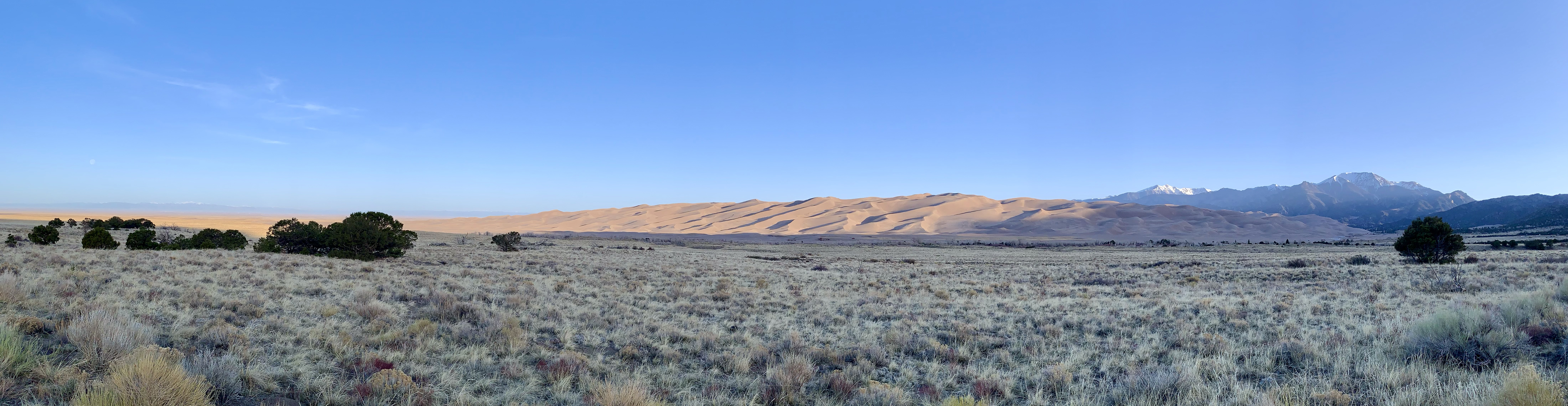
Sangre de Cristo—Blood of Christ, referring to color of the mountains at sunset—National Heritage Area includes Great Sand Dunes National Park & Preserve (above) and many forests and wildlife areas in southern Colorado. The area figures often in the novels of Louis L’Amour, loved by my grandfather, and there are still stark stretches of remote beauty along the Old Spanish Trails below and among the towering mountains. This NHA borders the Northern Rio Grande NHA in New Mexico, and the headwaters of that river begin here. Some of the oldest settlements and churches in Colorado were built here by Spanish-speaking settlers, following the Rio Grande up from Santa Fe, as I did, enjoying the scenery.
I drove through South Park National Heritage Area looking for a scenic route from Florissant Fossil Beds to the Black Canyon of the Gunnison, and there are half a dozen scenic historic auto tours here, amidst many wildlife refuges, historic ranches, canyons and old mining outfits. I spent my time gawking at the peaks, vistas and fall colors, without taking photos. Colorado has that kind of indescribably rugged beauty that makes you want to change your life, sell your belongings and move into the mountains, although I admit I haven’t spent winter there.
The Northern Plains National Heritage Area in North Dakota is also ruggedly beautiful. I remember driving great distances to see Knife River Indian Villages NHS before it closed, and I stayed at several state parks to charge. Maybe half a dozen state parks are in the NHA, and they have good facilities, are uncrowded, and are in beautiful spots, often near lakes or rivers. Several of the state parks are stops on the Lewis & Clark NHT. The Native American tribes who assisted them on their journey were later described and painted by European artists and authors, fulfilling great curiosity across the Atlantic and inspiring many Europeans to immigrate to the New World. As with other NHAs, there is a unique sense of place, fleeting historic moments and cultural details that enrich the land with atmosphere, and of course, great natural beauty. But you have to drive, stop, pay attention, keep your eyes open, read, try to understand and make connections, or the whole country just appears to be empty space that you fly over, recklessly burning carbon.
The Mormon Pioneer National Heritage Area includes Bryce, Canyonlands, Capitol Reef, Cedar Breaks and Zion. But besides those geologic wonders, the idea is to encourage more travel on routes 89, 12 and 24. There’s a Scandinavian community around Ephraim in the pretty Sevier Valley on 89. There’s Grand Staircase-Escalante, Goblin Valley, outlaw hideouts, ghost towns, old theaters, and more. I’ve traveled through the NHA in every season taking different routes, and I don’t remember any ugly or boring scenery. Utah is an extremely beautiful state. I occasionally wish it were easier to get something stronger to drink, get a table at a decent restaurant for dinner, or find out more about the Native Americans who used to live there, but it’s unquestionably easy on the eyes.
There are only three NHAs in the Southwest Region, two in Louisiana and one in New Mexico. While not official park units, they are uniquely interesting and beautiful areas to visit.
Atchafalaya National Heritage Area in Louisiana runs from the Natchez NHP and Natchez Trace NST, down past Lafayette and Baton Rouge, to the Gulf Coast west of New Orleans. Culturally, the focus is on the Acadians or Cajuns. 150 years after settling Acadie, now Nova Scotia, the French speaking Acadians were expelled by the British beginning in 1755. Longfellow wrote his epic poem Evangeline about the tragedy. Skilled fishermen and wetland farmers, many settled in French Louisiana, growing rice, beans and catching crawfish. They mixed with Native Americans, slaves, freed blacks and other immigrants, but kept their French roots. The French pirate Jean Lafitte, a successful smuggler in the area, was captured, but offered to help the Americans in the War of 1812 in return for his freedom. Lafitte knew the swamps (waterlogged land) and the bayous (shallow waterways through the swamps) expertly, and Andrew Jackson employed him as his aide-de-camp. Lafitte also provided troops, cannon and ammunition. The Battle for New Orleans was won, and Jackson was credited as the hero. Lafitte was likely responsible for defeating the superior British forces, but he received no credit from the US military, just a pardon. But the Cajuns still thrive here, and their history and culture is preserved at the Jean Lafitte NHP & Preserve, which includes three different Cajun Cultural Centers in the NHA. Their music, Zydeco, is from the French word for beans, “Les Haricots” (say it fast). And Breaux Bridge, of course, is La Capitale Mondiale de l’Écrevisse, or the Crawfish Capital of the World.
Cane River National Heritage Area is the other NHA in Louisiana, and it is best known for the well preserved plantations of the Cane River Creole NHP. However, the whole river area from Natchitoches between the national forests, down past the plantations is fascinating. This is the northern terminus of El Camino Real de Los Tejas, one of the Old Spanish Trails that runs through Texas, and there are state historic parks highlighting the forts and cultural sites that predate the Louisiana Purchase. I try to get lost at least a few times every visit to Louisiana, as there’s always something surprising to find and plenty of delicious food!
The Northern Rio Grande National Heritage Area in New Mexico is at the crossroads of both the ancient and old west. El Camino Real de Tierra Adentro connects Santa Fe to Mexico City. The Old Spanish Trails connect Santa Fe to Los Angeles, and the Santa Fe Trail connects Santa Fe to St Louis. Route 66 goes right through town. And before they were Spanish, they were all Native American trading routes. The natives once expelled the Spanish during the Pueblo Revolt, planned at Pecos. There are caves and Petroglyphs showing where people camped. Bandelier with its tall ladders to cliff dwellings is also in the NHA. But it’s not just history. Taos Pueblo (above) is still occupied today, continuously for over 1,000 years. All this I had seen, but then I got lost again, taking an improbable route through the mountains towards the headwaters of the Rio Grande in Colorado. And there are canyons, gorges, wild and scenic rivers, Georgia O’Keefe’s ranch, more cliff dwellings & petroglyphs, and even more storied trails. Some of my most memorable scenes of America are on the drives between official sites, intangible culture, storied heritage, true wildlife, and sheer beauty on the road not often taken.
One popular question is itinerary planning, which is essential, although my plans never survive contact with the road. The same trails must be picked up again in different seasons, and inevitably, they retrace the steps of early Americans. The old hunting grounds, early trade routes, forts and battlegrounds often overlap in places like this, and, especially when they’re preserved in a more natural state, it’s easier to imagine those who came this way before us.
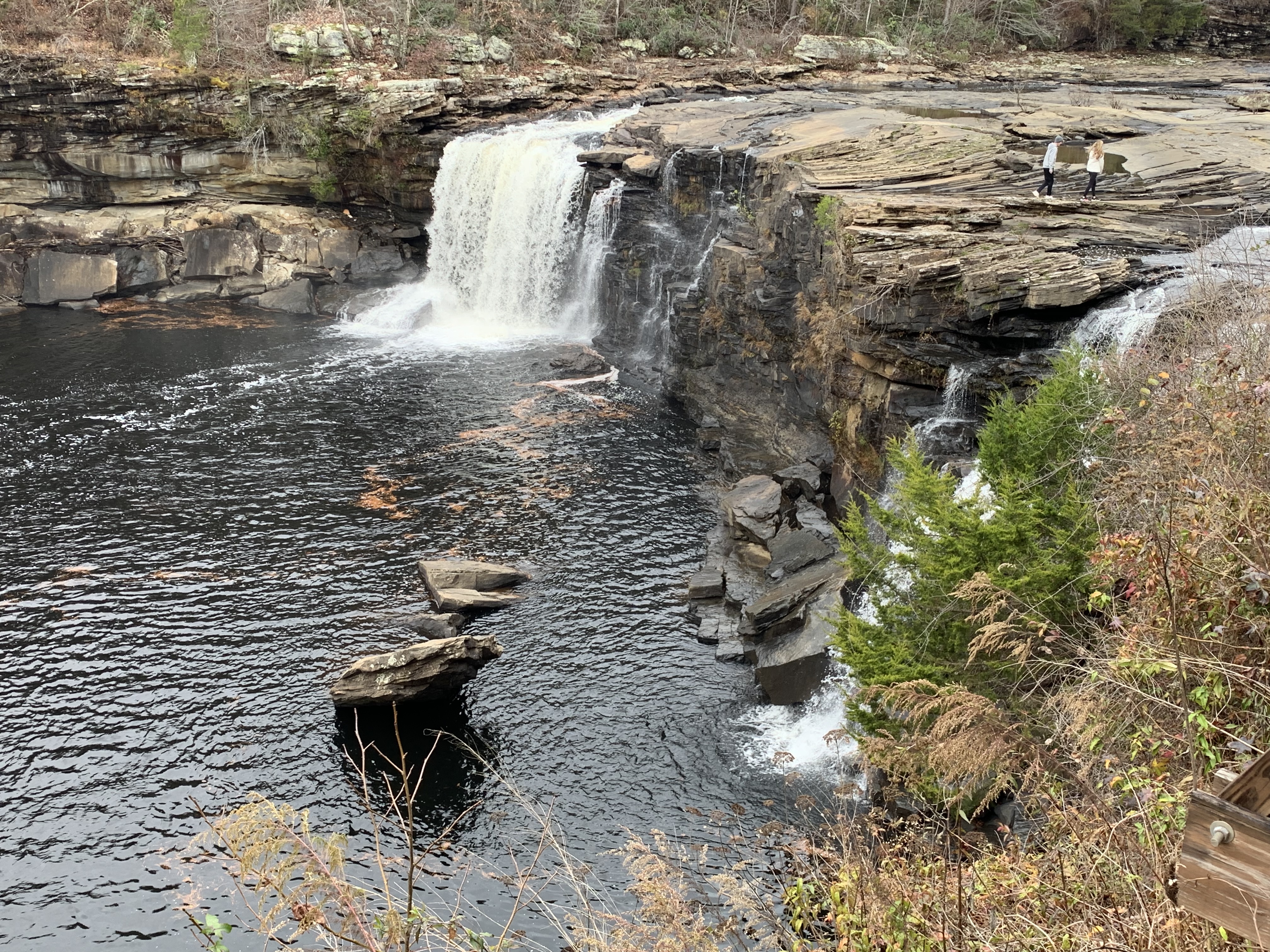
After their long history of interacting with the Spanish, French and British in the southeast, five tribes had become accustomed to European ways enough to be called “civilized”: the Choctaw, Chickasaw, Creek, Seminole and Cherokee. But the US government forcibly removed them to Oklahoma anyway. Most crossed the Mississippi near Memphis, as I did. The Cherokee were split into three groups: the old settlers who moved west before the removal, those forced to walk the Trail of Tears, and those who escaped removal and still live east of Great Smoky. Here, at a natural crossing point through the canyon palisades, the couple in the photo above walk on the Trail of Tears, near where Cherokee families were rounded up into a wooden palisade known as Fort Payne.
The park helps preserve that history, although the primary mission is to protect the many species that live in this important nature sanctuary. The canyon is known among rock climbers for the challenging cliffs, and if you hike downstream there’s a swimming hole near Martha’s Falls. The river isn’t runnable by amateurs, so stick to the scenic drive along the rim, admire the views from a half dozen overlooks and try not to miss the peak foliage like I did. The road isn’t wide enough for both bikes and cars, and, as usual, the former lose out. There’s a park film at the friendly visitor center and an Ol’ Tymer’s BBQ nearby.
Time for me to get back on the road. I passed through Muscle Shoals on my way here, but now I have Georgia on my mind. Places like this are bittersweet, when you reflect on the past or consider the future, but that’s what enriches travel. And our choices make a difference too. Supporting Native American businesses, for example, seems the least we should do to recognize past wrongs. And unless we stop our carbon pollution, these small sanctuaries will prove insufficient to preserve diverse species for any who may follow us.










 Zero Carbon Travel