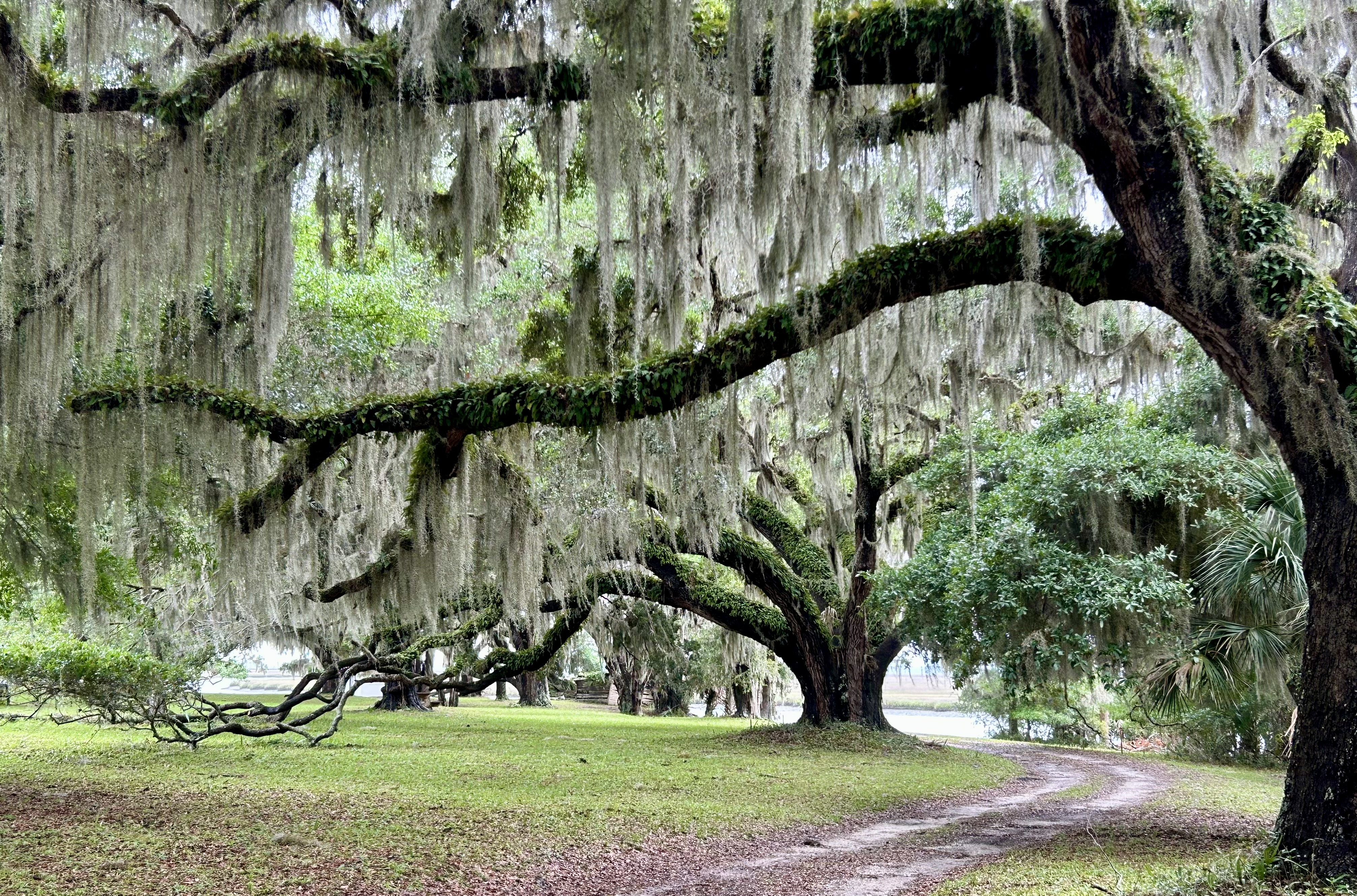
Decades later, I returned to see the southern live oaks that have haunted my dreams. Now I know the ferns that grow on the tops of their branches are called resurrection ferns, since they revive to a bright green after it rains. As a teen, I was told that humans could eat the Spanish Moss that hangs down from their branches, but returning as a tourist I was told that no humans ever did, only horses. I was too ashamed to admit I ate some long ago and thought it tasted OK.
Since I had been to the island before, I knew the only way to get to the north end on a day trip was to take a tour, so I joined the NPS recommended van tour and got to see everything from the settlements at the north to the Dungeness ruins in the south. The photo above is behind the Plum Orchard mansion, one of a few Carnegie family homes built on the island. The Carnegies were excluded by the other billionaires on neighboring Jekyll Island, so many of them settled here. Plum Orchard is beautiful and has interesting innovations, but plantation style troubles me. The center of the island is protected wilderness, and it feels like an ancient forest or overgrown jungle. Along the way we saw wild boar, wild horses, an alligator, several armadillos, and many beautiful birds.
I don’t always try to draw historic connections between parks, but bear with me this once. The natives here were related to the Timucuan. The Gullah Geechee (next week’s post) descendants of slaves are related to those all along the coast up to Reconstruction Era and down into Florida. The southern live oaks from this island were used to build the “iron sides” of the USS Constitution in Boston. Nathaniel Greene, commanding general of the Southern Campaign of the Revolutionary War, died shortly after retiring near Savannah Georgia, and his wife remarried and moved to Cumberland Island. There, Greene’s daughter Louisa cared for one of his cavalry officers, Henry Lee—veteran of Eutaw Springs—, before his death and burial at Dungeness mansion. Lee’s son was Robert E. Lee of Arlington House. And, if you want one more parks connection, the Carnegie’s innovative household DC power was likely overseen by Thomas Edison.
When I first arrived on the island several decades ago, I was invited as a guest of someone who knew the owners into a grand old home under the oaks for a meal, stories on the porch and an after dinner cognac, my first. As I recall, there was some discussion about whether the home would have to become an inn to survive, and we all agreed that it was important for beautiful old historic places to be preserved. (It later became the exclusive Greyfield Inn of Kennedy wedding fame). Folks need to come to places like Cumberland Island to try to imagine what it was like all those years ago, to walk along the barrier island beaches, to see the wild horses, to learn about dugout canoes, see photos of Primus and Amanda Mitchell who went from slaves to church and settlement founders, to learn about sea island cotton, and especially to feel the special old grandeur under those southern live oak trees.
 Zero Carbon Travel