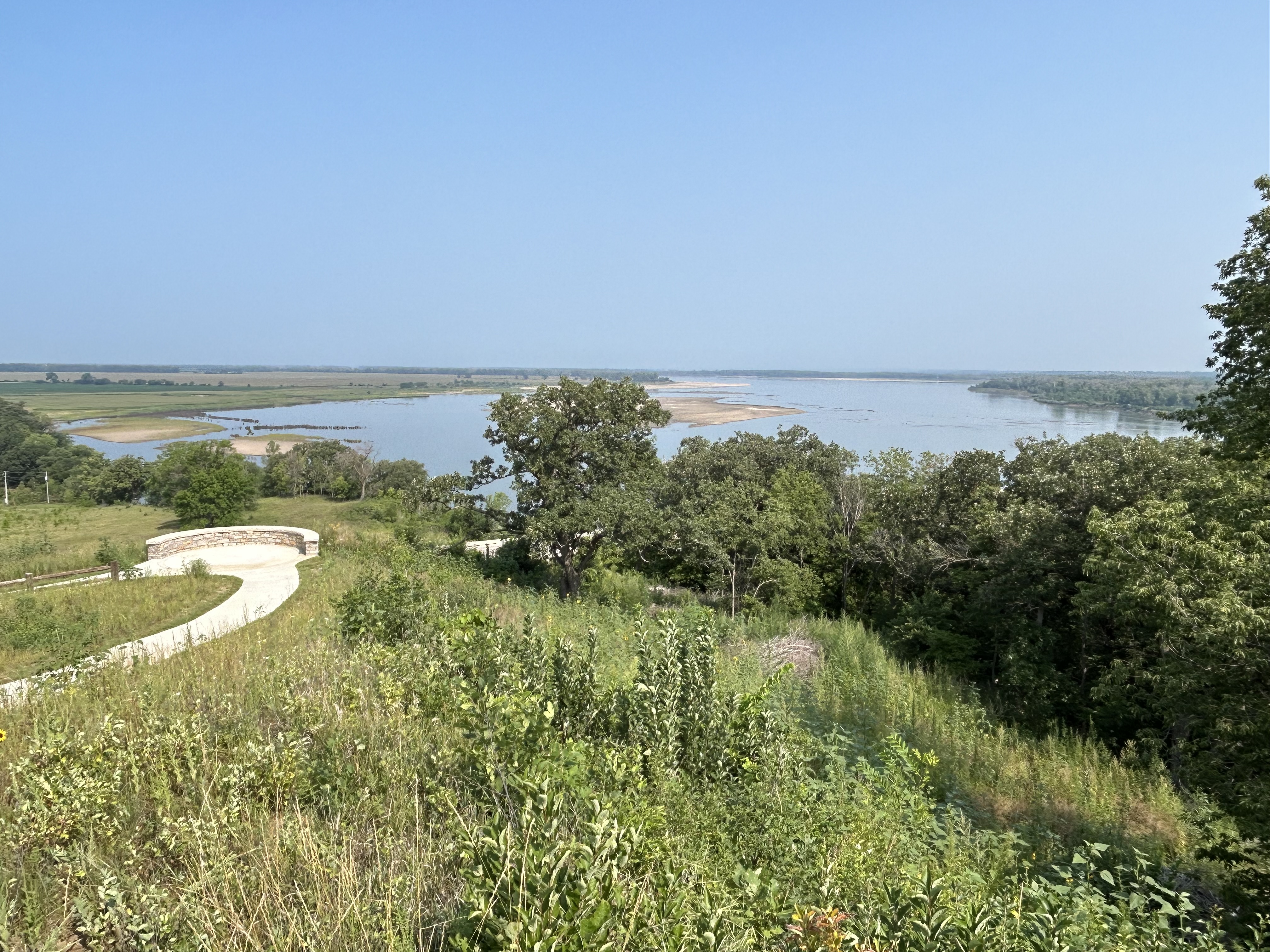
The trail is not straight. It meanders through Michigan’s wooded hills, green valleys and along its rivers and lakes. The trail begins along the Niagara Escarpment that separates Green Bay from Lake Michigan, then south below Madison, before crossing the Wisconsin River at Lake Wisconsin. Then it passes up across the bluff on the right with its characteristic rough rock glacial remnants on the steep slope to the north beach of Devil’s Lake above before continuing north to the Wisconsin Dells with iconic eroded rocks. Eventually it crosses the state to end at the St Croix River.
President Biden elevated the trail to a full national park unit, but many of the most scenic sections are in state parks or affiliated scientific reserves. Wisconsin Dells itself is quite commercialized, with water parks and pricey tours, even though the layered rock can be seen in several different places along the Wisconsin River. State parks like above or Mirror Lake have fine scenery, camping and miles of maintained trails. I tend to rush around and then spend too much time at supper clubs, but it’s worth slowing down a bit here to enjoy the natural beauty. For more, read my earlier post about the Ice Age Trails.
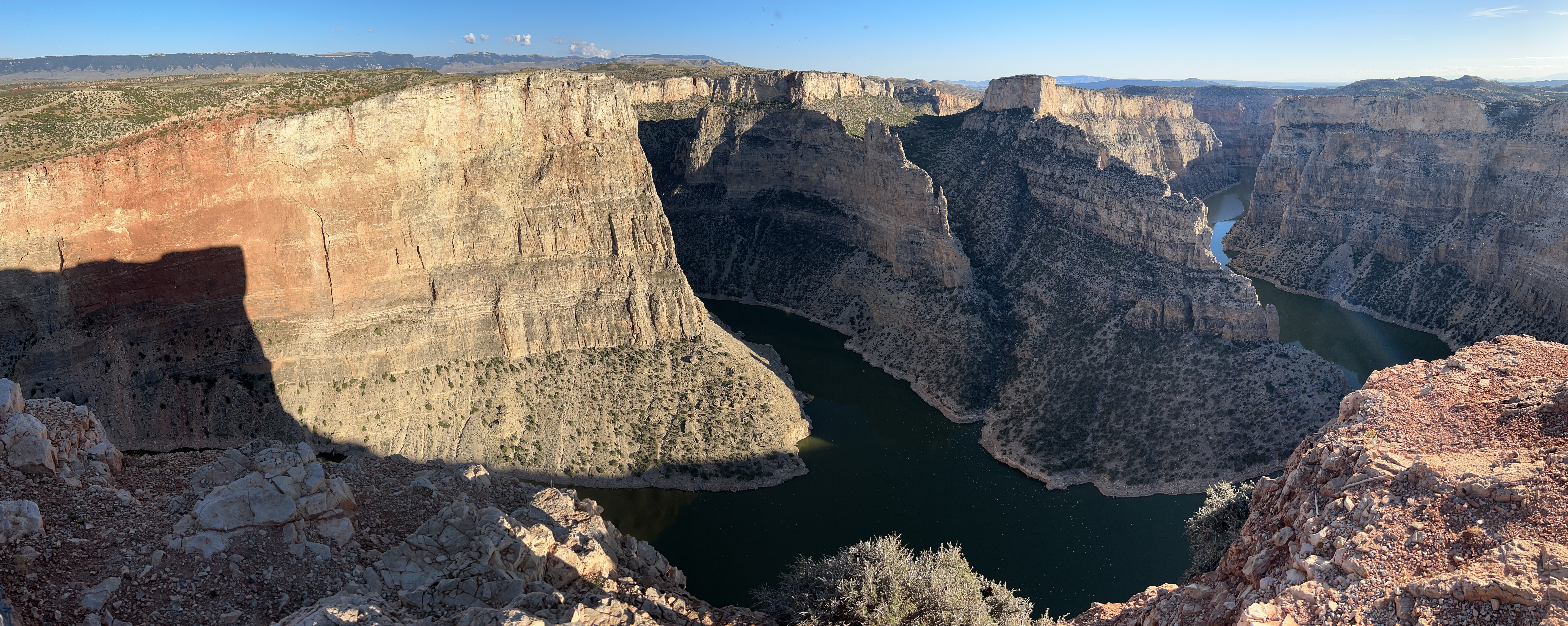
The choice is either to start at the dam in Montana and go up the canyon by boat or to start in Wyoming and take in the views from the rim. It was a long way for me to dodge power boats without easy stopping points, and the water level is obviously artificial. So, I chose to admire the views from above, passing through the wild horse refuge area and finding Devils Canyon Overlook above. I didn’t see any horses, but a turkey vulture flew right by my head so close the loud whoosh and sudden breeze startled me. Maybe he was hoping I’d fall over the extremely steep edge.
The topography of the area is disconcerting, as you see mountains & high ground and assume the Bighorn River would run south, but for all the uplift, the river has just carved its way deeper through the partially flooded canyon. Far upriver further south, it does the same thing, but there it’s called Wind River and cuts through Wind River Canyon. Ultimately, the basins and lesser mountain ranges in Wyoming matter far less to the river direction than the Rocky Mountains, which on this side of the Continental Divide cause the rivers like the Shoshone and Bighorn to flow east and north, joining here before flowing into the Yellowstone River on its way to the Missouri River. In the photo above, that flow is from the upper right to lower left, below the large shadow on the cliff across the canyon. The stretch of water in the upper middle, below the fans is Devil’s Canyon, partly filled by the dam’s backwash and sometimes fed by Porcupine Creek. The foreboding names match the inhospitable scenery. This is a rough and remote area, but it’s also starkly beautiful and dramatic.
Santa Elena Canyon, like many of the sights here, is majestic with 1500’ cliffs, with Canyon Wren staccato song echoing back and forth, and elusive beavers hiding along the banks. The Rio Grande enters the park through here, departing through Boquillas Canyon. They don’t make it easy to get a river pass, apparently preferring guides. I wasn’t allowed to kayak without two PFD’s?!? But the views from the trail are spectacular.
The middle of the park is dominated by the chiseled Chisos Mountains which have impressive wildlife including bears, mountain lions and rare birds, challenging hikes and a good restaurant. And the views stretch for miles in all directions across desert, scrub, dry creeks, gullies, plateaus and rocky outcroppings of all shapes to more distant hills, mountains, mesas and empty space. Sunset is best from up here, and the lodge has a bar and large patio with a great view of the basin. There are some ranger activities each week, but mostly you’re on your own out here, with terrain, heat, wildlife and distances that make hiking potentially dangerous. So take care.
A trip here needs 3 days just to visit all four corners, and there’s only one electric campground (Rio Grande Village RV) which was booked solid. Still, I was determined to avoid burning carbon, so no guided tours. I charged outside the park at the classy Gage Hotel and in Terlingua, at a Juicebox behind a brick wall in a construction site that rents Jeeps. I spotted three other Teslas and a Volt in the park, but you need to be thoughtful about charging (and not forget your hotel key and have to drive back to return it). I needn’t have worried. Since the park speed limit is 45, my range was better than expected, especially after turning off the climate control and opening my windows.
People are seriously damaging nature, as seen in both the devastating 2019 Castalon Wildfire, which destroyed the historic visitor center and store, and the drastically reduced water volume of the Rio Grande. Large gas vehicles with bad mpg should be named “Chevy Smoker” or “Ford Smog” and their drivers need bumper stickers like “I ❤️ Wildfires” & “I ❤️ Hurricanes”, because that’s what they’re exacerbating. Folks who live in western communities with golf courses, water features and ornamental plants, should name their neighborhoods “Wildlife’s End” or “Extinction Junction”, because they’re diverting rivers from our public parks, destroying ecosystems. Too many folks live in denial of the Climate Crisis, while driving a ‘Denali’ and living in ‘Ocotillo’. If you’re still using wasting gas and water in the west, then you shouldn’t pretend you like nature. You obviously don’t care enough.
“In 1753 a young George Washington crossed the Allegheny Mountains on missions he hoped would lead to a career as a British Officer and land holdings that would make him wealthy. He was unsuccessful in both goals and his actions sparked a war that spread across the globe.”
— National Park Service
We really need a better name than the “French & Indian War”. It sounds like some colonial conflict in South Asia. Indians Native Americans were only reluctantly drawn into fighting on both sides. I suggest the “Colonial Rivers War”, because that explains who, why and where. British and French colonial forces fought over control of rivers, portages and passes linking the St. Lawrence Seaway, the Gulf of Mexico and the Mid-Atlantic Eastern Seaboard.
At the beginning, the French & British were building roads, riverside forts and sending small armed groups into the passes to scout. Washington was in charge of a British force, found a French force, and someone fired a shot precipitating a slaughter that killed the French leader named Jumonville. Jumonville’s brother, Captain Villiers, then led a much larger force seeking revenge.
So Washington’s necessity was to defend his camp, which had been chosen in a pleasant, open meadow, good for grazing animals. As you can see in the photo, the fort was built under a hill, so Washington lost quickly and badly. (Fortunately, he improved tactics later). The French accepted his surrender, but the war over the colonial rivers continued for years, as part of a broader Seven Years’ War between the French and British globally.





 Zero Carbon Travel