Improving Moral Thinking

[Apologies for the long post. My next on this topic will be much shorter.]

Perhaps the most woefully neglected aspect of our thinking trouble is our moral thinking. Most often we begin thinking about the morality of an issue with our minds already made up.  Our gut may have decided on the issue instantly.  Your boss may have already told you that the project is good, and that if you do not see it that way, you can look for employment elsewhere.  As Upton Sinclair wrote, “It is difficult to get a man to understand something, when his salary depends on his not understanding it.”

Of course, most believe ourselves moral—even some professional criminals claim to follow a code. Some instinctual thinkers follow their hearts, making moral choices based on sympathy or disgust. Some follow the crowd, believing that their church provides sufficient moral guidance, that the path they were taught years ago is righteous, and even that everyone should follow that path as they assume the beliefs of others are wrong. Rational thinkers learned that rational, self-interested choices benefit society optimally and that all problems have rational solutions. A few believe that their worldview justifies acts that others believe are abominations.

All of those folks are wrong, at least in part. It is not moral to pick and choose which rules to follow, according to your convenience. Instincts are often deeply biased and can result in ugly vigilantism. While many religious traditions are filled with valuable moral lessons, blindly following one faith while denying all others has resulted in centuries of bloody religious wars. Rational government scientists conducted an unethical experiment for 40 years until 1972, and rational pursuit of profit has caused pollution killing many humans and other species. Any act of terror is unfair to the innocent victims, and as a rule they do not achieve any positive goal.

Many lazy, soft-headed ‘thinkers’ have given up on moral thinking, using excuses that there are no universally agreed upon moral facts and that all morality is relative. Some self-serving cynics use these excuses as permission to do whatever they want, consequences be damned. Nonsense. I already presented an incontrovertible moral baseline for humanity, the side of life, and next I explained it’s logical corollary, that life requires diversity and that the purpose of knowledge is to pursue the same universal moral objective to further life. This simple moral framework, based on the Golden Rule, makes many moral choices obvious.

No other way of thinking is disqualified before it can defend itself.  I see no perfect rational utopia, yet people still try to think rationally.  Instinctual thought is riven with conflict, yet people still make gut decisions.  Dismissing the reality of moral thinking appears to be an instinct-driven defense, by people who do not want to feel guilty or who want their self-interested way of thinking to prevail.   

Real moral thinking requires making moral determinations for moral reasons. If a culture has a traditional practice that causes severe pain to children with long-term suffering as adults, solely in order to enhance the power and control of one gender over another, then it is morally wrong, on the basis that it destroys much of the enjoyment of life from one group without improving life significantly for others. It does not matter how many people support the practice, what the laws or government say, or what the cultural or religious tradition of the country has been for however many centuries. The practice fails the basic premise of allowing life to thrive fully and joyously without unnecessary cruelty.

Simply because a cultural practice exists, does not mean that it has a moral right to continue. Our country has a long history of racism, including genocidal war and slavery. Many books and laws were written in the past attempting to justify these official policies, and the policies were popular in (unfair) elections. The cultural heritage of slavery does not, in any way, justify its existence morally. When foreigners complained that our institution of slavery was barbarically inhuman, they were not culturally insensitive, they were correct. The purpose of moral thinking is to challenge all policies on moral grounds and to change immoral policies, no matter how popular or profitable.

Once we view moral thinking as independent from other ways of thinking, such as instinctual or rational, then we can separate those feelings or arguments when making moral decisions. We can recognize an argument as being based on a common human desire and judge the morality of that desire as we judge the morality of the issue. Perhaps a common human behavior is no longer useful in modern society, is obsolete and deserves to be forgotten. We can recognize a rational argument for profitability or efficiency and still dismiss it as not relevant to the moral choice. Once extraneous ways of thinking are identified and treated separately, then moral thinking becomes clearer.

The primary problem with moral thinking is that people begin with the wrong type of thinking. If you try to make moral decisions with rational thinking, your decisions will be cold, profit-seeking and cruel, even if you use euphemistic terms such as acceptable collateral damage, euthanasia or eugenics. If you try to make moral decisions with the instinctual goal of reinforcing your own power or that of your group, then your decisions will be self-serving, not moral. Such mixed-motive thinking is confusing and often wrong.

Moral thinking should take into consideration human needs and desires, without allowing them to drive the decision, and it must often overrule short-run wants for long-term good. Moral thinking should be driven by the broadest love of life and humanity, while firmly able to deny base instinctual desires or herd behavior. Moral thinking should be as critical of bias and skeptical of ulterior motive as any scientist, while having the courage to defend the powerless few against the powerful majority.

Moral thinking should understand relevant rational assessments such as numbers of people involved and economic costs, without allowing strictly rational analysis to drive the decision, and must often overrule short-run profits for long-term good. Moral thinking must be as adept at analysis as rational thinking, but use that analysis to achieve a moral result, not the most efficient solution.

Moral thinking must learn the lessons of the past to avoid repeating those mistakes in the future. Most mistakes are not original. We have a long history of human error to teach us. Many old texts have profound moral lessons that only require some effort to apply to current problems. Each generation needs to go back to historic and even religious texts to reinterpret the old lessons for their new problems.

Religious beliefs may vary or be relative, but they are not the same as moral thinking.  Some religious texts reflect centuries of accumulated moral thinking, worded by our inspired ancestors for future generations to make better choices.  Just as engineers don’t reinvent the wheel, moral thinkers use the best tools they have.  Sometimes a moral decision is as simple as recalling a dictum and applying it.  But usually moral thinking requires more than looking up the answer in a book.  If you begin with a commandment already chosen, then you are simply applying a religious rule, not necessarily thinking extensively about the morality of the situation.  Your religion may require unquestioning obedience, but moral thinking requires more.  

Morality requires both flexibility to respond to new situations and backbone to stand on principle. One way to achieve this is to use techniques which were designed to facilitate good moral decisions. You might put yourself in each position and imagine how you would feel. You might ask whether one side would be equally happy to switch sides with the opposing party or if that would seem unfair then. You should prefer to take the long view and be the voice of silent future generations.

To summarize the key take-away, clear moral thinking should begin with a quick check that none of the other ways of thinking are driving it.  The method will almost certainly require a review of the facts, an exploration of the possibilities, and an understanding of what people want.  You need an open mind, not an empty one.  But the moral intent needs to be pure.  If you start with the belief that economics must decide the outcome, then that may be rational but not moral.  If you start with the belief that what pleases the most people will be best, then that may be popular but not moral.  If you start with your own idea in mind, then no matter how much you like it, it may not be the best solution for others.  You must commit to find the best long-term outcome in the most important respects, without regard to greed, fantasy, pride or other vices.  Well begun is half done, but moral thinking requires discipline, honesty, and may require significant time and effort, before you are prepared to make the best choice possible.

Affiliated Sites in North Atlantic

There are five affiliated sites in the North Atlantic region: Kate Mullany NHS, Lower East Side Tenement NHS, Roosevelt Campobello IP, Thomas Cole NHS and Touro Synagogue NHS. Campobello (above) is actually in New Brunswick Canada, just across the Maine border. Touro is in Newport Rhode Island. And the others are in the Empire State.

All five are among my favorite sites in the country.

  • The congregation at Touro predates our country, and they have the promise of religious equality made by George Washington in writing.
    • Take the tour, sit in the pews, and listen to the stories of freedom to believe.
  • In the early 1800s, Cole painted romantic landscapes and historical scenes, inspiring a school of painters.
    • Tour his house and studio, see the exhibits and listen to the stories behind his work.
  • From the late 1800s to early 1900s, the garment district immigrants toiled in sweaty tenement buildings and built futures in their new country.
    • Go to a neighborhood deli, tour the tiny rooms, and listen to the stories of strikes and hope.
  • FDR’s summer home in Canada immaculately preserves over 100 years of precious memories.
    • Tour the estate, have a cookie at Eleanor’s tea, and listen to the stories of recovery and advocacy.
  • The newly open Mullany house tells the little known story of the woman who started the first official female union in the country.
    • Make a reservation for a tour, see the history of American labor on the walls, and listen to the stories of the workers who built our country.

Teotihuacán

Feathered and fire serpents adorn the steps of the Quetzalcóatl Pyramid. Some weathering has occurred in the past 17 centuries, but once the eye sockets held black obsidian volcanic glass, the flames were painted bright red and feathers adorned with green jade. The museum (show your gate ticket for admission) near the Sun Pyramid shows murals, artifacts and has a large model of the site, which helps add details to the huge structures outside. None of the three pyramids can be climbed now, but I still walked a couple miles round trip, including the Moon Pyramid near where I started. I arrived early at 9 am, just as the hot air balloons were descending after their dawn tours. It’s an awesome place, but it can get hot and crowded by midday. I recommend staying nearby the night before.

At its peak, Teotihuacán was the largest city in the Americas, 6th largest in the world. Roughly, the city began sometime around 200 BC and fell around 550 CE. Much of their wealth came from obsidian tools, weapons and art, mined from local volcanoes and expertly knapped. The pyramids and related buildings show an elaborate religious class, but few signs of military or monarchs. The pyramids are designed to make observations for the Mesoamerican calendar, so the priests likely derived their power by determining the seasons. Best guess is that their civilization’s collapse was internal, with signs of drought and starvation, before simultaneous fires burned out the elites. The priests essentially had one job—to monitor the climate—, and they failed. Human success, growth, unsustainable use of natural resources, crop failure, and collapse, is a common pattern in ancient civilizations, and we are likely on a similar path due to carbon pollution.

Thomas Jefferson Memorial

The memorial is open & under maintenance with climate driven flooding at the Tidal Basin. Tom’s face has some cobwebs, and his reputation is also ebbing, as the stain of his slave exploitation will never wash. So, let’s clear up why he has a monument. Among other things, Jefferson was Governor of Virginia, Ambassador to France, codifier of religious freedom, the primary author of the Declaration of Independence, proposer of the Bill of Rights, Washington’s Secretary of State, John Adams’ Vice President, 3rd President, purchaser of the Louisiana Territory, appointer of Lewis & Clark, President of the American Philosophical Society, founder of the University of Virginia, and classical architect whose memorial resembles his own work, Monticello.

Jefferson was also a racist who owned hundreds of slaves in his lifetime, fathered children with one beginning when Sally Hemmings was a teenager, and sold over 100 slaves at auction through his will. He opposed slavery in theory and condemned it in his original draft of the Declaration (edited out to placate Georgia and South Carolina). But despite his ideals, Jefferson feared a Haitian-style rebellion and believed there was too much animosity between people of different races to reconcile and live together in peace. As President, Jefferson began removing Native Americans from the southeast in return for “new” land around Oklahoma (which was already populated with Native Americans).

Recognizing what he did that was wrong, we need to imagine what he could have done better, beyond freeing all his slaves, and not just Sally and her children. Nationally he should done more to end slavery, As a slave-owning President who added the Louisiana Territory to our country, Jefferson was uniquely suited to end slavery and offer reparations to slaves by setting aside a significant portion of that territory for ex-slaves to homestead. Similarly, instead of removing Native Americans from their sacred homelands, Jefferson should have honored and signed more treaties protecting their land and culture, especially in the “new” territory.

I view Jefferson as having missed his opportunity to solve those great moral challenges. But I have little patience for people who criticize Jefferson for his moral failings, without considering whether they themselves are doing enough about the greatest moral challenge of our time. Jefferson hated the idea that people would live “under the barbarism of their ancestors”. Jefferson was a student of science who loved nature, so he would be appalled by our lack of action in stopping the climate crisis.

“I like the dreams of the future better than the history of the past.”

Thomas Jefferson

St. Paul’s Church National Historic Site

The New York Royal Governor Crosby’s allies tried to disenfranchise the Quakers by requiring them to swear an oath on the Bible, which violates their beliefs. In response, the colonial assembly voted in favor of religious freedom and protecting voting rights. The press coverage so annoyed the Governor, that he had the publisher arrested and tried at Federal Hall. But the publisher (Zenger) was acquitted in the case, resulting in expansion of freedom of the press.

The original church here was established by the British to impose the Church of England on the heretical Puritans and Quakers and others who lived here, including people like Anne Hutchinson, who fled both Boston and Rhode Island to avoid harassment over her belief that women could interpret scripture too. (The Hutchinson River Parkway is named after her). As the revolution approached, the people here split into factions of loyalists and patriots, and the graveyard contains families who fought on both sides, as well as Hessian mercenaries, slaves and free African Americans. There was some fighting nearby at Pell’s Point which helped Washington retreat to White Plains, and the church was used as a military hospital.

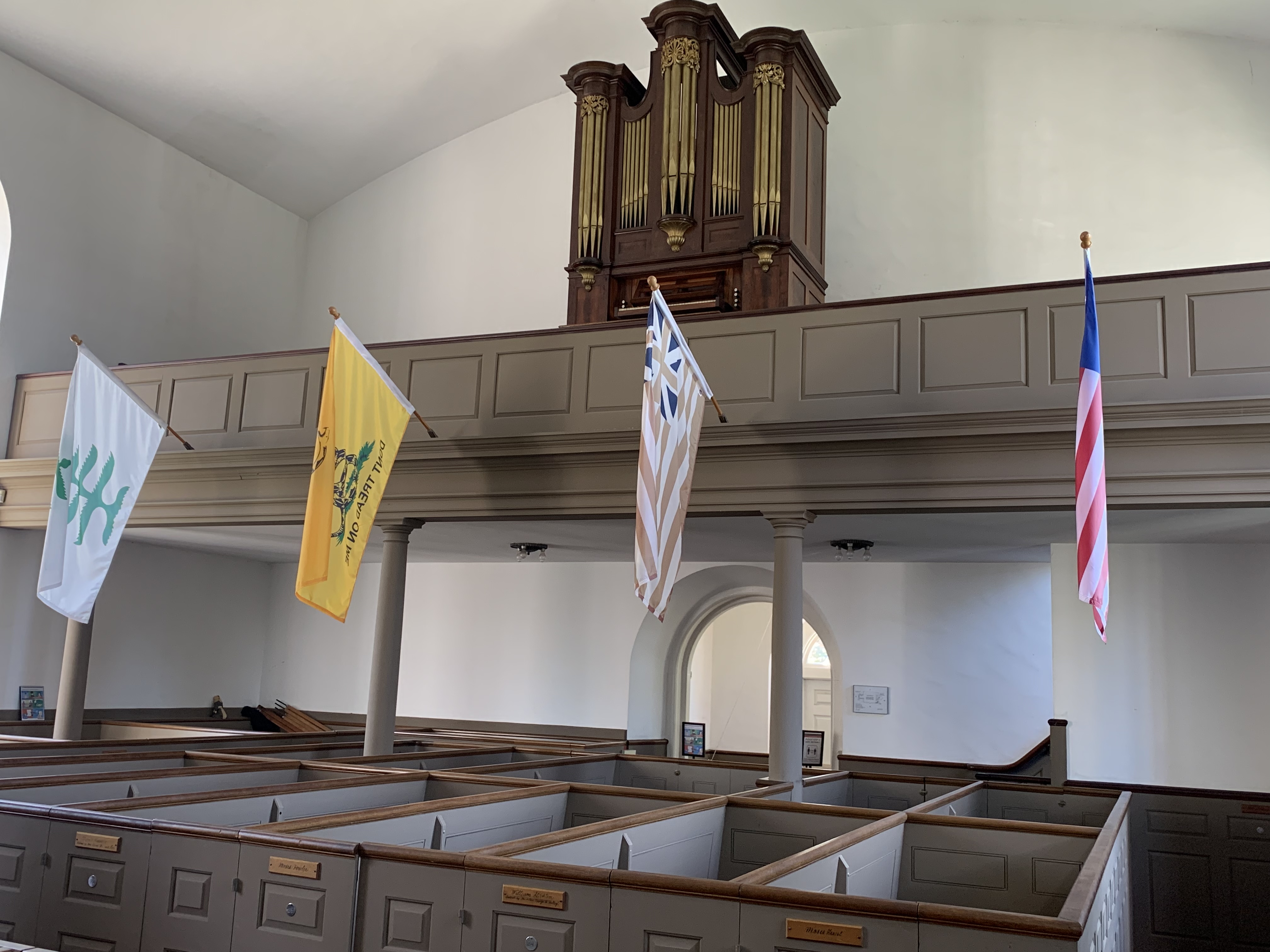
In addition to the fine old organ, family box-pews and flags pictured above, there’s also a bell cast in London in 1758 and a stained glass window. Much of the restoration work was done around WWII with fundraising led by FDR’s mother. But the surrounding neighborhood at the northeast border of the Bronx is now heavily industrial, not residential. (I walked from the Eastchester-Dyer Av station). The Episcopal church, which is related with yet independent from the Anglican Church, was deconsecrated around 1978 and is cooperatively managed with the parks service as a (secular) national historic site. Take some time to walk around the evocative colonial and early American graveyard.

Roger Williams National Memorial

Those ignorant people who claim that America was founded as a Christian nation need to visit this site in Rhode Island. Disgusted with the forced religious conformity in England (including burning heretics), Williams moves to Boston in 1631, where the Puritans had moved to escape persecution.

“… that no civil magistrate, no King, nor Caesar, have any power over the souls or consciences of their subjects, in the matters of God and the crown of Jesus …”

Roger Williams

Williams’ idea, that the government should not control citizens’ spiritual lives, made him flee the Massachusetts Bay Colony and live with the Native Americans, learning their languages and becoming an advocate for their rights and separate beliefs. Eventually, they deeded him land and he founded “Provident’s Plantation”, now Providence, and Rhode Island became a haven of religious tolerance, for Jews, Baptists, Quakers and even atheists. It is no accident that the country’s oldest synagogue is in Rhode Island. King Charles II granted a charter to Rhode Island, fulfilling Williams’ wish, that no one would be “molested, punished or called into question” for different beliefs in 1663 over 100 years before America became a country. Other colonies copied his charter’s separation of church and state and Jefferson enshrined the concept in our Constitution’s 1st Amendment.

“Congress shall make no law respecting an establishment of religion, or prohibiting the free exercise thereof.”

The First Amendment to the US Constitution

We live in a precarious time, where a single conservative Catholic sect, Opus Dei, has used its influence to place a majority of Justices on our Supreme Court, and that Supreme Court majority has limited an established right based on their particular religious objections to abortion, ruled in favor of Christian prayer at school events, and ruled in favor of using taxpayer funds for Christian schools. This country has avoided the religious and sectarian violence and oppression common elsewhere, by granting the right to freedom of conscience, and it is a frightening step backwards almost 500 years for the court to grant favored treatment to one religion. We have never been a Christian nation, and voters are wrong to vote for one.