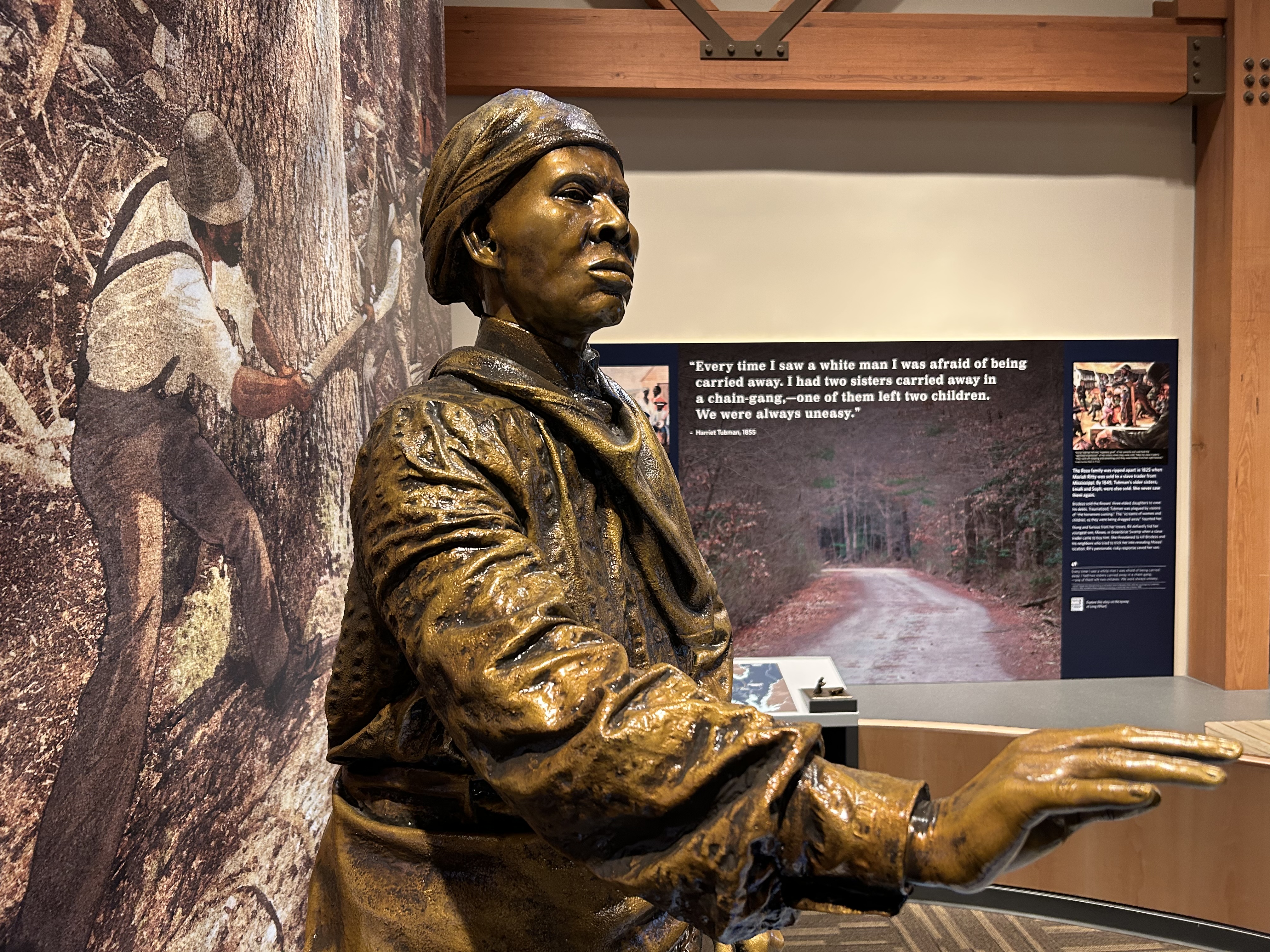
Harriet Tubman Underground Railroad National Historical Park

Harriet was born in remote southeastern Maryland, and her knowledge of survival skills in the marshy fields and forests of the area helped her free 70 slaves directly and many more indirectly through her instructions. Now, the NPS NHP, Maryland State Park, and National Monument within the Blackwater National Wildlife Refuge are managed jointly. Unlike her home site in Auburn NY, there are no structures from her time here, but the visitor center has exhibits telling her story and busting many of the myths about her, such as the ‘secret messages’ in quilts. The brochure further explains that she could not have sung “Swing Low, Sweet Chariot”, since it was written by an Oklahoma Cherokee after the Civil War. But she did sing “Go Down Moses” and “Bound for the Promised Land”.

“I had reasoned this out in my mind;
there was one of two things I had a right to, liberty or death;
if I could not have one, I would have the other,
for no man should take me alive.”

Harriet Tubman

The stories of her childhood, her Underground Railroad missions and of the Combahee River raid are all told here, as is the story of her friendship with the Abolitionist Thomas Garrett. While he did not risk his life as Harriet did, he was involved in almost three thousand escapes over four decades, at considerable personal financial cost. His partnership with Harriet must have felt serendipitous to both. She was a natural, simple, pure person of faith, from childhood, but especially since her injury-caused epilepsy. The Quakers held strong convictions of faith, even over the law, and prized simplicity, humility and doing good deeds. Each was exactly what the other needed, a Moses leading her people out of the wilderness into the promised land, and a network of believers willing to contribute time, money and help to end the abomination of slavery. Yet despite their acts, millions remained enslaved.

First State National Historical Park

One of the prettiest partner sites in the park, the Old Swedes Church dates back to 1698 when the King of Sweden funded it to support his small community. (If you do the tour, take the stories about the ghosts and the character who requested the funds with a grain of salt—there are a number of hoaxes out there). The Swedes arrived here in a Dutch ship, the Kalmar Nyckel in 1638, traded with the Native Americans for beaver pelts, and they built a fort named after their progressive young Princess Christina. Eventually, the British took over the area, but there’s now a fabulous recreation of the 17th century tall ship—which does day sails in summer—next to the site of the fort.

Delaware was spared most of the battles of the Revolution, besides a skirmish at a bridge and a naval engagement in the river, and also had no Civil War battles, but its history is nonetheless fascinating. The name comes from Baron De La Warr, the first Governor of the Virginia colony. The land was part of the King’s grant to William Penn—on the condition he take his Quaker friends with him—and was technically part of Pennsylvania until 1787. At the south end of the park, John Dickinson’s plantation holds tours about his writings in favor of independence, his signing of the Constitution and his decision to free his slaves by 1786. Delaware was a key vote during the decision to issue the Declaration of Independence. Two of its three delegates split, and the third, who was ill, rode overnight to cast his vote in favor and to exhort the other state delegates to join. The first state ratification of the Constitution was done in Dover, near the Green, but the tavern were it took place is gone.

Delaware Quakers were active in the Underground Railroad, and there’s a statue of Harriet Tubman and Thomas Garrett in Wilmington. One African American conductor was arrested, jailed, and auctioned off in front of the old State House in 1848. As Samuel Burris was being carted off into slavery, his purchaser whispered to him, “not to fear, you have been purchased with abolitionist gold and I will spirit you away to Philadelphia”.

Due to the main visitor center behind the Old Court House in New Castle still being under construction, and due to the plethora of partner organizations, the sites and tours may seem a bit disorganized or amateurish, but the locals know their history and are proud of it. The Old Court House has many original artifacts, portraits and exhibits to see on the interesting tour. Try eating at one of the old Colonial Era taverns or tea rooms, and you’ll likely learn more lore from the locals.