Mainers are tough. While other Americans talk incessantly, wear flashy clothes, and spend every day seeking attention, folks here say little, dress simple and get stuff done. It’s a pleasant sail from Boston to coastal Maine in the summer, downwind and northeasterly or ‘down east’ as the area became known. But the coast is rugged and dramatic, with rocky beaches, serious storms, cold winters and endless forests. Not the place for overly dramatic flights of fancy.
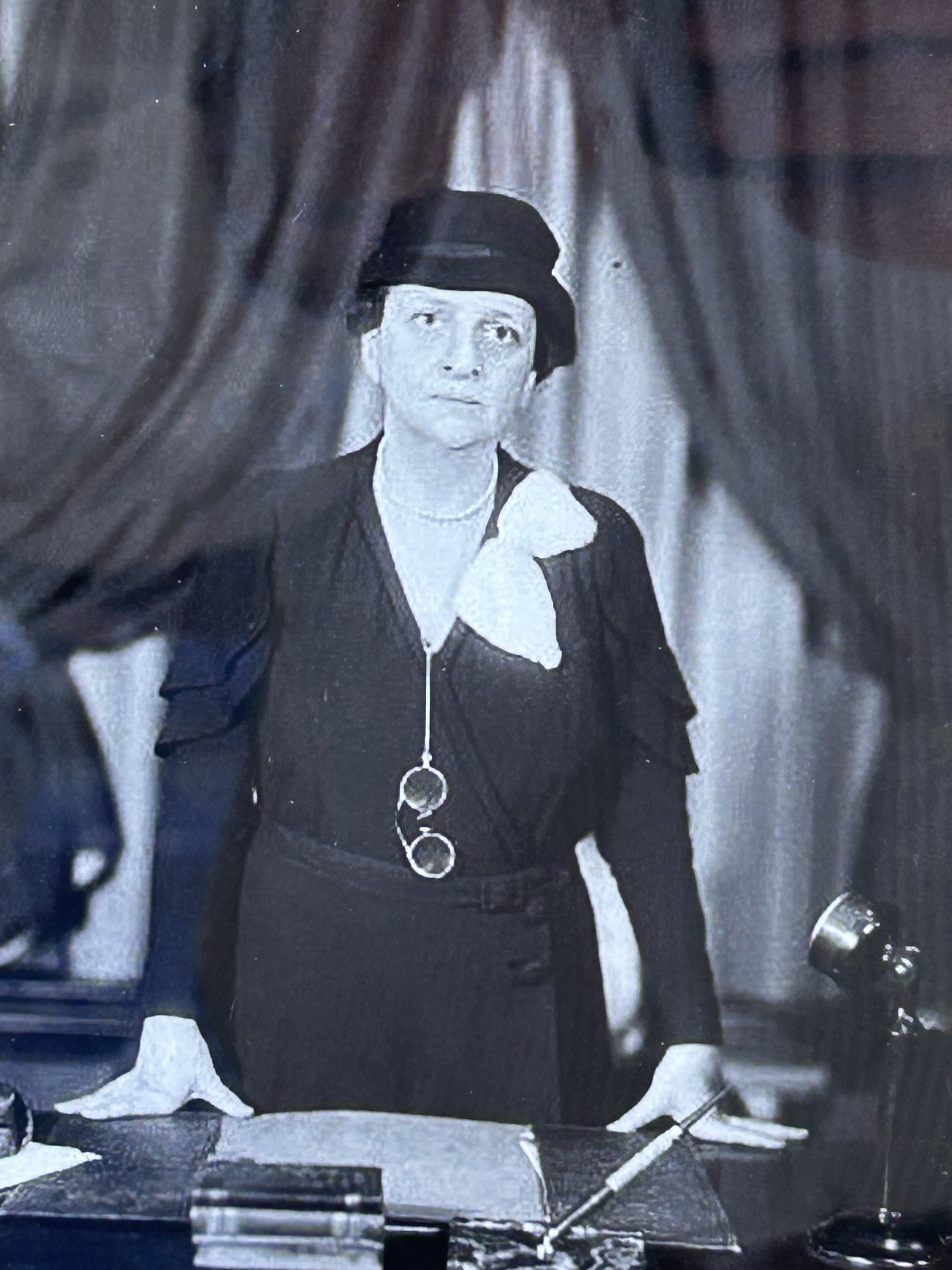
Perkins was tough too. Her family made bricks on their large piece of land overlooking the oyster farms on the Damariscotta River south of Newcastle—a “Slow Village” warns a road sign. An ancestor protested ‘taxation without representation’ and survived having his skull cracked by a ‘lobster back’ redcoat in return. Frances got an exceptional education, saw firsthand the social problems of her time, and buckled down to do the hard work of solving them.
She found social worker allies in alleys, witnessed the Triangle Shirtwaist Fire, learned the tough politics of Tammany Hall, reinvented herself to join the powerful and got stuff done. She worked on worker safety, health and poverty with two Governors of New York, and was singularly qualified when FDR asked her to be his Secretary of Labor. Frances Perkins was the architect and driving force behind his New Deal, including minimum wage and social security.
Perkins had practical training, the courage of her convictions and a moral authority to improve the lives of those in need, especially during the Great Depression. She did not seek the spotlight, but she wielded more power than any other woman in US history. Have you benefited from having drinking water & clean restrooms at work, a sprinkler system & fire escape, unemployment insurance, or not having to work weekends? Then you should remember and thank Frances Perkins.
Her Brick House family home isn’t open yet, but there are photos & exhibits in the barn. And the walk through the woods and meadow to the river is lovely. With this new park unit I re-complete the North Atlantic region and finish all park units the contiguous 48 states, until the next one is designated.
Butler Flats Light (above) has marked the entrance to New Bedford Harbor in Massachusetts since 1898. It was a clever bit of engineering by a marine architect using a caisson or box to pump out the water for construction, and every day it’s used for navigation by the famed scallop fleet, ferries, the occasional tall ship, and many other boats passing through the hurricane barrier. When the light was built, New Bedford still dominated the whaling industry, sending ships on long voyages to harpoon whales, melt their blubber into oil and return to fuel America.
Behind the light are two wind turbines, which provide electricity today without extinguishing any species. Despite the preposterous claims of fossil fuel industry funded politicians, there is no such thing as ‘windmill cancer’ and bird strikes are rare. But folks who live near the turbines complain that they cast shadows, are noisy or are ugly, so new wind turbines are now built far offshore, south of Martha’s Vineyard. The current project is known as Vineyard Wind, with 62 turbines each generating 13 megawatts when complete. Currently, there’s a pause after a blade broke, requiring inspections and clean up. Massachusetts recently committed to roughly quadrupling wind projects in the area.
The turbine assembly is based in New Bedford, with final installation of the towers at sea. Interestingly, to protect whales from construction noise, they create a circular curtain of bubbles rising up from around the foundation on the seabed. They got the idea from whales, who create a circular curtain of bubbles underneath schools of fish to herd them together into a bite sized meal. Thousands of locals work on the project, in a boon to the economy, and the first project will provide relatively cheap, green energy to 400,000 homes. I’ve observed the gimbaled tower segments and long blades being transported out to sea by huge construction ships on the same routes once used by whaling ships.
Progress is beautiful, especially when it helps save so many different species on earth from extinction. Back in the day, whalers would have argued that smelly whale oil was ‘indispensable’ and ‘higher quality’ than alternative fuels, and they resisted progress. Today, that seems absurd, although now the fossil fuel industry lies routinely to protect its profits. Ironically, during the Civil War, the US government helped launch the fossil fuel industry by buying their new fuel and taxing alternatives to save the Union. Now we need the government to help us transition quickly to green energy to save life on Earth and leave the smelly old fuels unburned.
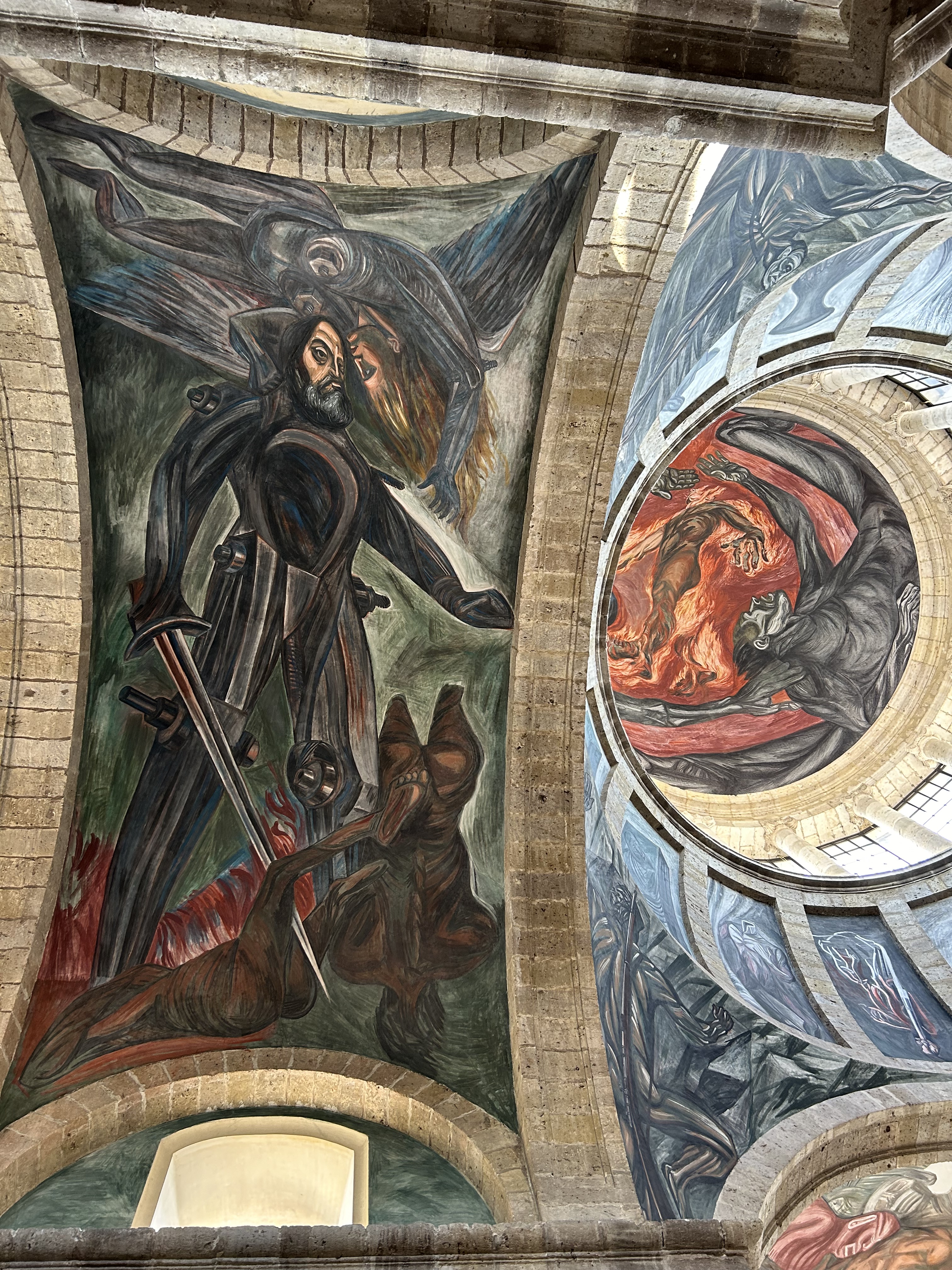
Originally designed to be a hospital, like Les Invalides in Paris, and named after the bishop, today the World Heritage Site in the historic heart of Guadalajara is a museum, with modern art outside and exceptional murals by Orozco inside. The central masterpiece on the ceiling of the rotunda is ‘The Man of Fire’, a modern version of the myth of Prometheus (in photo on right). I had seen Orozco’s earlier version in the Pomona dining hall in California, considered “the greatest painting in America” by Jackson Pollack. Orozco lost his left hand making fireworks at 21, and he was fascinated by the story of a man who risked his life and suffered to expand human knowledge and civilization, only to be punished by the Gods. He felt the myth was an allegory for artists, explorers and reformers who were punished by conservatives for their efforts to bring enlightened change to the people. Every alcove and wall tells a story of both progress and betrayal, of historic accomplishments and dark consequences.
Prometheus stole fire from the Gods, but today we struggle with the consequences of burning carbon. Fossil fuels helped us achieve great things, but there are always consequences. Struck by the inescapable conclusions of the art here, we see that conflict over ‘progress’ often results in suffering, especially among the poor. Murals require us to step back, to try to see the bigger picture. We can build hospitals, and we can also destroy whole cultures. We can choose sustainable fuels, or we can let powerful men perpetuate destructive fuels. We may believe ourselves invincible and deserving of the powers of the Gods, but our actions come with destructive consequences that we must try to see, understand and prevent. We must give up fossil fuels, or our world will burn.
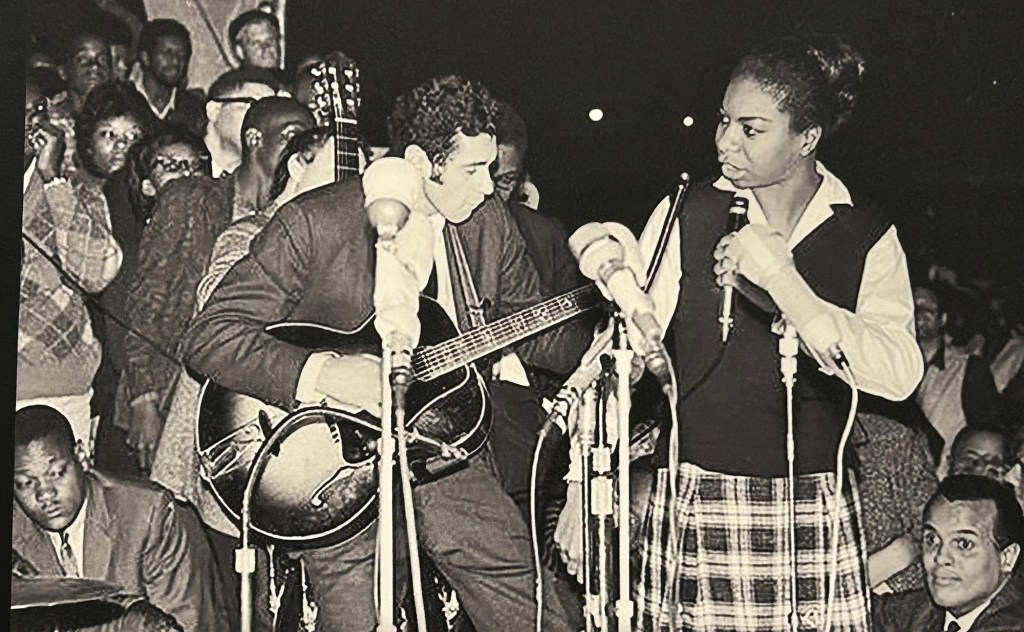
Nina Simone on the march from Selma to Montgomery, with Harry Belafonte lower right.
Black History is about much more than emancipation and education. Beyond the basic rights to liberty and literacy, Americans have a right to pursue happiness. All year long, the national park service celebrates those who broke the barriers that denied black people their full rights as citizens.
The African Burial Ground predates our country, includes both free and slave, and is today a powerful symbol of the right to belong, be recognized and be remembered. New Philadelphia, Illinois, was the first town in American officially founded by an ex-slave in 1836. Camp Nelson became a focal point for escaped slaves during the Civil War, both as refugees deserving help and as soldiers with a right to fight in uniform. Nicodemus, Kansas, 1877, is the oldest black settlement west of the Mississippi, and it still lives. Jazz began before the turn of the century in New Orleans. In 1903, Charles Young, born a slave, became the first black national park superintendent, and in 1917 became the first black Army Colonel (surpassing Dr Alexander Augusta, Bvt. Lt. Col. during the Civil War).
The Springfield Race Riot of 1908 sparked the creation of the NAACP, illustrating both the danger of race hatred and the need for African American advancement. In 1911, Maggie Walker, daughter of a slave, became the first African American woman to found and run a bank, among her many civic accomplishments in Richmond, Virginia, and nationally. In April 1939 after being refused the right to sing elsewhere, Marion Anderson made national news singing at the Lincoln Memorial.
WWII brought new opportunities, including employment for African American women among the Rosie the Riveters who built our fleets and the Tuskegee Airmen who helped turn around the war by defending our bombers over Germany. Tragically, segregation in the military led to the Port Chicago disaster in 1944, which in turn led to desegregation in the military.
Eisenhower was President in 1955, and America was a very conservative, 88% white, 95% Christian country. Still, when Mamie Till-Mobley’s boy was brutally murdered in Mississippi, she shocked the conscience of the nation with his open casket, sparking the Civil Rights Movement. In 1961, black and white Freedom Riders rode buses to integrate interstate travel, lunch counters and restrooms, but were attacked by “Citizens Councils for Racial Integrity”: the KKK. Despite school desegregation, Normandy Veteran Medgar Evers was denied law school admittance due to his race, so he worked with the NAACP on desegregation, civil rights protests and an investigation into Till’s murder. Returning home the morning after listening to JFK (below) promising to desegregate “hotels, restaurants, theaters, retail stores, and similar establishments”, Evers found his FBI protection detail had been suddenly withdrawn, and he was shot in his driveway, unintentionally desegregating the white hospitals of Mississippi shortly before dying.
That September, the KKK killed four young black girls by bombing a church in Birmingham. In November, JFK was assassinated. But the movement did not stop; it grew. In 1965, in Selma, Alabama, three times residents marched towards Montgomery to try to register to vote and to protest. First, they were beaten bloody and unconscious on the street by police on horseback. Second, they were stopped by legal action. And Third, they marched 54 miles to the capitol in Montgomery, joined by people from across the country, 25,000 strong, ultimately securing the Voting Rights Act a few months later.
The Reverend Dr Martin Luther King, Jr, who led that march and many others, gave his life for Civil Rights, along with many others. On 28 August 1963 in front of the Lincoln Memorial, he said, “I have a dream that my four little children will one day live in a nation where they will not be judged by the color of their skin but by the content of their character.” Well, two of his children are now dead, and his youngest is 60. I believe we failed to achieve his dream in his timeframe. But we must not stop trying.
”One hundred years of delay have passed since President Lincoln freed the slaves, yet their heirs, their grandsons, are not fully free. They are not yet freed from the bonds of injustice. They are not yet freed from social and economic oppression. And this Nation, for all its hopes and all its boasts, will not be fully free until all its citizens are free.”
President John F. Kennedy, Televised Address to the Nation on Civil Rights, 11 June 1963

 Zero Carbon Travel