Climate Consequences

The consequences of our carbon pollution provoke an instinctual reaction, but we must consider them rationally. Let’s clearly understand the cause, consider the consequences, and evaluate our options.

Humans have a history of damaging our environment, including driving many species to extinction, from the Wooly Mammoth to the Passenger Pigeon, last observed by Teddy Roosevelt. We have leached deadly chemicals into water supplies, released clouds of cyanide, bleached corals, created toxic fog and smog over cities, poisoned people with mercury, introduced microplastics into most living creatures, burned holes in the ozone, leaked radiation, made rivers burst into flames, filled oceans with garbage, and spilled oil, leaving dead zones. And that’s just pollution, excluding environments and species destroyed by development, drilling, farming, fishing, hunting, logging, mining, ranching, and war.

But our most continuous and consequential pollution is carbon. Especially since Drake’s Well began modern oil drilling, we have extracted fossil fuels of ancient forests that grew 300 million years ago and burned them into our atmosphere, changing our environment into something of which our species has zero survival experience. The last time we had this much carbon in our atmosphere was twice as long ago as when our most primitive ancestors split off from chimpanzees.

  • Heat has been increasing, contributing to fires and killing more people every year.
  • Droughts have been getting worse, contributing to fires and killing more people every year.
  • Glaciers and snowpack have been shrinking, contributing to late season fires and killing vulnerable species.
  • Storms have been getting worse, contributing to fires, floods and tornadoes, killing more people every year.
  • Sea levels have been rising, threatening to flood low lying cities and coasts.
  • Corals have been bleaching—dying en masse—and oceans have been acidifying, killing marine species.
  • Diseases have been increasing, killing more people and species every year.
  • Soil is becoming less healthy, due to erosion, salinization, loss of micro biodiversity and more.
  • Deforestation, melting permafrost and changing water chemistry are reducing carbon sinks and in many cases releasing carbon pollution, like methane, into the atmosphere at increasing rates.
  • Species are going extinct at an increasing rate.
  • Ecosystems are being damaged, where problems with one or more species affect other species, often in unforeseen ways.

These carbon pollution problems are deadly, unprecedented since humans evolved, are synergistic—meaning that they combine and multiply effects—and will affect everyone negatively, at least economically.

We have alternatives to fossil fuel that cause far less damage and risks to life on earth, especially solar and wind power. In many cases, these alternatives are also cheaper.

Hoping that someone will invent some unknown solution that’s cheap, effective and has no side effects is not rational, given how simple and cheap it is to burn carbon fuel. Carbon capture devices are expensive, especially at the scale needed to shrink total carbon in the atmosphere. Geoengineering is unproven, expensive, and will bring unexpected negative consequences. We do not have any inexpensive, reliable way to mitigate the damage of carbon pollution, apart from reducing carbon pollution.

Rationally, the choice to stop burning so much carbon and convert to renewable energy in order to avoid these ill effects is clear and simple. Dishonesty about the causes, effects, alternatives and consequences is part of the problem. Science, including economics, supports reducing carbon emissions before damage and costs worsen. History shows that violent conflicts arise when living conditions deteriorate and governments struggle to feed and house people.

Instinctually, our fear of death should motivate us to stop burning so much carbon. In future posts, I will discuss other ways of thinking about our climate crisis, but I suspect the problem may not simply be how we think. The basic problem may simply be that we aren’t thinking at all.
Which Side Are You On?

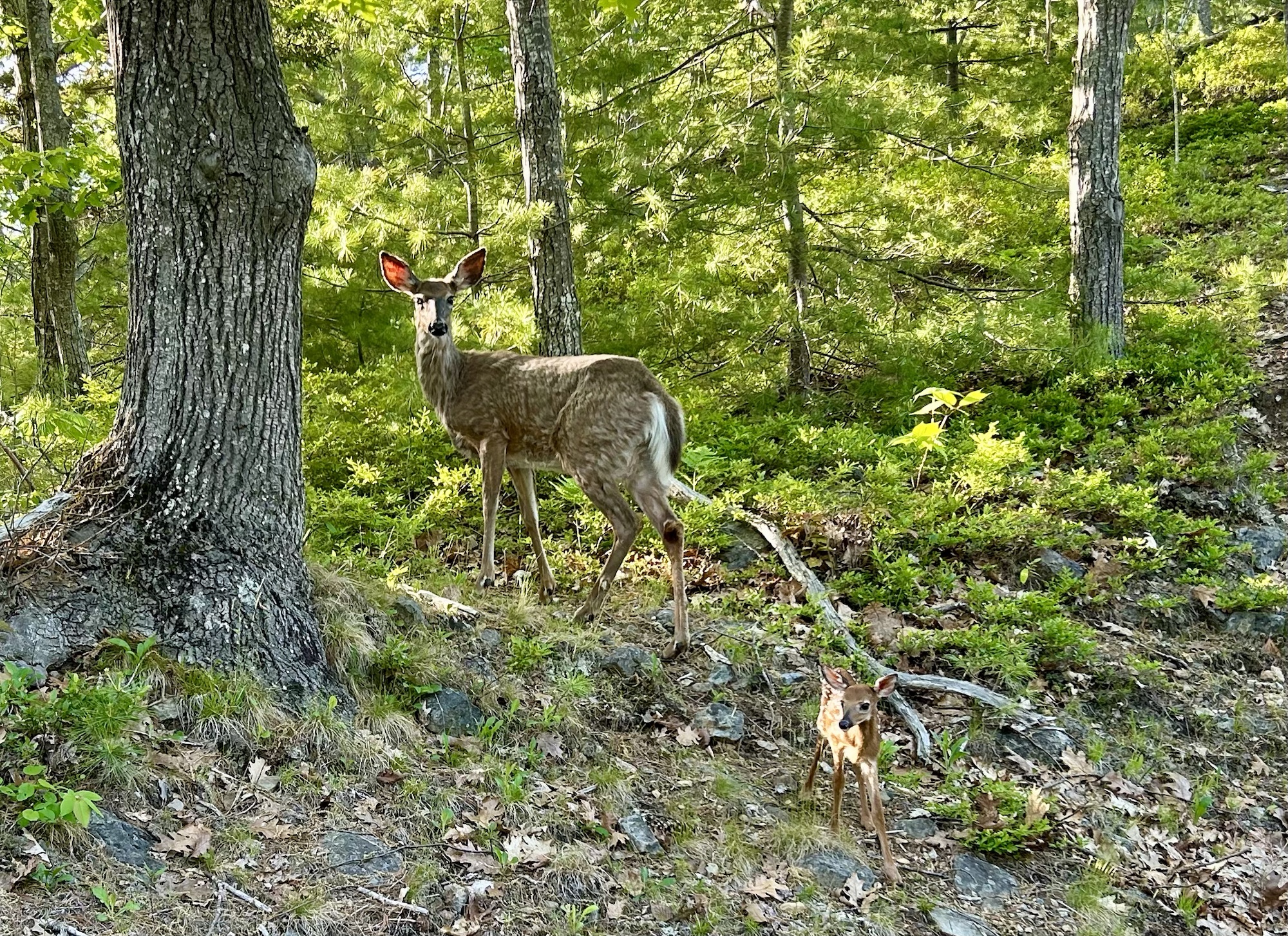
We are all on the side of the living. I am as I write this, and you are as you read it. We eat, breathe and have a pulse, and we have a common enemy: death. When we are in nature, we feel an affinity with the living creatures around us. When I was a boy, a large deer jumped out of the brush, stopped on the trail in front and looked, silently assessing me for a few seconds. As I looked into his large brown eyes and listened to his breath, I recognized our shared experience in being alive. We eat, breathe and have a pulse, and we have a common enemy: death. 

When we encounter other forms of life, we share a living affinity, and perhaps we curiously wonder about our differences. Lichen also photosynthesizes, respirates and circulates nutrients, and it constantly clings to life and struggles to survive. Even predators and prey are on the same side, ultimately. The prey understands the predator’s hunger, even as they evade it. The predator benefits when their prey thrives and multiplies. Both are trying to live and avoid death. Even a parasite or pathogen fights to stay alive in a living host. Every living thing contains within it a recipe, the ingredients and the drive to cheat death and stay alive, even if only for a brief time.

Recognition that all living things are ultimately on the same side is a revelation, a comfort and an inspiration. We are alive, akin to all living creatures who eat, breathe and have a pulse. We are human—all of us the same species, fundamentally members of the same tribe and all on the same team—, so we must want humanity to succeed. We may be a newer species, but we, like all living creatures, evolved in a diverse natural world. Nature sustains us, and our future is inextricably linked to how well we sustain nature.

And yet, somehow, we have chosen to stay on a path that will lead to mass extinctions. Many of us now fail to feel a part of the living world. A few of us are broken, fearful, violent and incapable of empathy, even with our fellow humans. Some are greedy, and selfishly don’t care that they are causing the natural world to become unbalanced. Many deny the need to change sufficiently to stop excess carbon pollution, irrationally believing we can ‘adapt’ to a climate in continuous, precipitous decline. Too many just give up, not bothering to make an effort, which perpetuates the problem. These unnatural views are myopic, and the path we are on leads only to regrets.

Each of us wants to live in a better world, with more life and less death. We don’t want more droughts, floods, hurricanes or wildfires. Our human conflicts are transitory tragedies, that we should try to resolve as a family, however distant or estranged we may feel. But our conflict with nature is existential, with consequences that will last forever.

Each one of us should reduce our carbon footprint, saving both money and life on earth. My car costs less to operate than any internal combustion car. Even when I charge in a state that still burns some coal for electricity, it still produces less carbon overall. Every switch to renewable electricity further simplifies our global task of replacing the fossil fuel infrastructure. And yet, people still resist making any effort to change, even though delay only makes the future worse.

So what madness has tricked us into extinguishing most life on earth? Were the coral reefs not beautiful when they still brimmed with colorful creatures? What temporary insanity has convinced us that making our only world uninhabitable for most forms of life is somehow desirable for us? Have we forgotten that we are part of the natural world we evolved within, inhabit and that sustains us? Do we no longer recognize the beauty of trees? Are we now cruel to animals?

As living beings, we eat, breathe and have a pulse, and our common enemy is death. Why are we allying ourselves with our common enemy against life on earth? When did we switch sides? 

”Our survival is affected as the abundance of life is diminished.” 

Unknown

Forest Wildfires

I know it’s winter, but we need to talk about wildfires. There is a common, simple-minded view—popular among those who deny climate change—that overzealous park employees unnaturally suppressed fires, causing wildfires today. End of story. Once we ‘catch up’ on the ‘fire deficit’ everything will be fine. This is bunk.

Last year Canada had a record-smashing year of wildfires, and the frequency of wildfires far exceeds what is normal, considering the naturally slow growth rate of trees in boreal forests. Most of these fires were in remote northern Canada, where historic fires were not even reported, let alone suppressed. The estimated number of fires was not too high, but many of the fires were mega fires, burning over seven times as many acres as the modern historic average. There is only one explanation for the scale of the wildfires last year, and it isn’t Smokey the Bear. The primary cause of increasingly severe forest fires is carbon pollution. 

The first humans to change natural fire ecology in North America were natives who for centuries used fires in the valley for agriculture and to attract game with new grass. The most destructive humans by far were loggers who clear cut whole forests. During the Great Depression, roads and campgrounds were developed in both old and regrown forests, bringing millions of visitors who parked their hot cars on dry grass, dropped their cigarettes on pine needles and left their campfires unattended, causing a dramatic increase in forest fires. Firefighters responded by putting out fires when they threatened nearby communities.

We changed forest fire ecology in complex ways over centuries, so the simple ‘fire suppression’ explanation is false. We don’t know exactly what the forest’s natural ecology was like before man started playing with fire here, but man’s brief experiments for a few decades last century—causing wildfires due to camping and suppressing some fires at the edges—all account for maybe 2% of the life of a Giant Sequoia. Yosemite park rangers tracked all fires within the park since the 1930’s, and for decades none of the fires were large enough to matter to the overall health of the forests until recently. Past fires were often 100 or maybe 1000 acres, but recent forest fires are 100,000 or 1,000,000 acres. Our hotter climate has changed everything. Now we need to change our perspective from our recent past to the consequences of our carbon pollution on the future. Extinction is not a mistake we can correct later. 

California has the most national parks with 28 park units, and about 12 of them have some type of large forest, often wilderness. I’ve been in all of those forest parks in the past year or so, and 9 now have huge swaths of dead trees from recent wildfires. 

Only Muir Woods, a small coastal redwood forest park along a creek surrounded by wealthy suburbs, has been spared. Pinnacles has had multiple wildfires in the past three years, but firefighters managed to contain them quickly. Even foggy Redwood park lost 11,000 acres in 2003 due to the Canoe Fire. 

This level of wildfire is not normal; it is out of control, and it is getting worse. Discussing past firefighting efforts and increasing the rate of manmade fires is not going to fix the problem. If we do not stop our carbon pollution, then 100 years of environmentalists’ efforts to save these forests for future generations will be wasted. 

Buffalo National River

[Sorry to hop around so much, but I want to wrap up a region]. Last year folks celebrated the 50th anniversary of the river’s designation, but somehow Arkansas allowed a concentrated 6,000 hog feeding operation on Big Creek to pollute the Buffalo River with runoff from tons of pig crap. The resulting increase in algae and e-coli bacteria was damaging water quality in the park significantly. After protests, the hog operation was halted (and paid off handsomely), but local politicians have not been willing to make the ban permanent.

I woke in Tyler Bend Campground all ready to paddle 10 miles of the middle section from Baker Ford to Gilbert (where someone from the General Store would leave my car), but a sudden line of thunderstorms dissuaded me. That storm system killed three people in Texas with tornadoes and brought lots of lightning to this river in Arkansas, so I was glad to hit the road early instead. Pollution from either industrial ranching or fossil fuel burning is taking the fun out of some of my best trips.

Despite rural development—like Branson—, the Ozarks are still very beautiful, and the river is 135 miles of free-flowing nature. Nearby there’s a 100 foot wide natural bridge, one of many alcoves and interesting geologic features in the area that likely caused the French trappers to describe the area as having arches or “aux arcs” (say it out loud).

Americans, being poor linguists and unaware of the remote arches and bridges upstream, have long been confused about the origin of the name “Ozarks”, speculating that the French were talking about natives with curved bows or some bend in the river. This is moronic, as all bows and rivers are curved, so the French explorers would have no reason to use such a useless description. Americans had similar problems in understanding the French name for the Canadian River, which obviously derived from the Spanish word cañada, as the river passes Texas’ Palo Duro, the second largest US canyon. Rather than try to understand foreign languages, Americans assumed the French explorers did not know how to Canada by river.

Cuyahoga Valley National Park

Cleveland’s mayor, the first African American elected mayor of a major city, Carl Stokes, faced an environmental crisis. The Cuyahoga River, above, caught fire in 1969. And it wasn’t the first time. Mayor Stokes led journalists on a pollution tour and tied the issue to poor and underserved communities, many of color, which often suffered most. He led the fight for change.

In many ways, this park is a great example of what can be done, when we make the effort to restore nature. While interstate highways still cross over the park, they do so from extremely high bridges, separate from the deep valley below. Many tributary watersheds are protected by municipal and state parks and other reserves. Instead of removing the old railroad line along the river, there’s a classic old train line with restored historic whistle stops for hikers, bikers, and even kayakers to return after traveling through the park one way. An old inn on the canal has been repurposed as a museum. An old mill village is now a visitor center with a store selling drinks, sandwiches and ice cream (black raspberry chocolate chip is the best). The tow path, which both separated the canal from the river and provided a walkway for teams of oxen to pull barges, makes a perfect, nearly level, dry, packed gravel path for bikers, hikers and equestrians to travel for miles through the woods, admiring both wildlife and the beautiful scenery.

This is my favorite park for bicycling. I biked from Frazee House to Peninsula, above, about 20 miles round trip, in order to see some of the northern and middle sections where the path runs close to the river and far from the road. I saw both a Bald and a Golden Eagle, the first with the help of a park volunteer who let me look through his telescope. Brandywine Falls also surprised me by being larger than expected in Ohio, and the Ledges is another popular hike. I also hiked through Beaver Marsh at the southern end to look for more birds and watched a Great Blue Heron fishing for about an hour, among the geese, various ducks, redwing blackbirds, giant snapping turtles and other wildlife. Wonderful!

John Muir National Historic Site

The view from the cupola of Muir’s father-in-law’s orchard estate upsets me. Between the palm trees, you can see smoke rising from the refineries in Martinez, and to the right across the street is a gas station. Muir never rode in cars, took horse carriages and preferred walking. In the house, there’s a print of the Muir Glacier in Alaska, now the Muir Inlet. He lived just long enough to lose the battle to prevent Hetch Hetchy Dam at Yosemite. Many of the giant sequoia groves at Sequoia have been destroyed by wildfires. And all his work with Teddy Roosevelt and the Sierra Club he helped found to protect millions of acres of wilderness is failing to protect nature from the man made climate crisis.

The battle for conservation will go on endlessly.
It is the universal warfare between right and wrong.

John Muir, 1896

At least he was happy in this house. Muir visited the owner, a Polish botanist who introduced varieties of fruit trees to the valley, and fell in love with his daughter, Louie. They married, settled here and inherited the orchards. They had children and also invited some of Muir’s siblings to join them, allowing John time to write. One of the oldest buildings in the area is the Martinez Adobe in the back of the property, which gave room for the Muir clan to stay and take care of the orchards. Influenced by Emerson, who he met later in life, Thoreau and Marsh, Muir continued traveling and became the most influential conservationist in the world, writing books, articles and letters to protect Yosemite, sequoia groves, glaciers and other natural wonders from human consumption. He would not forgive us for our fossil fuel pollution.