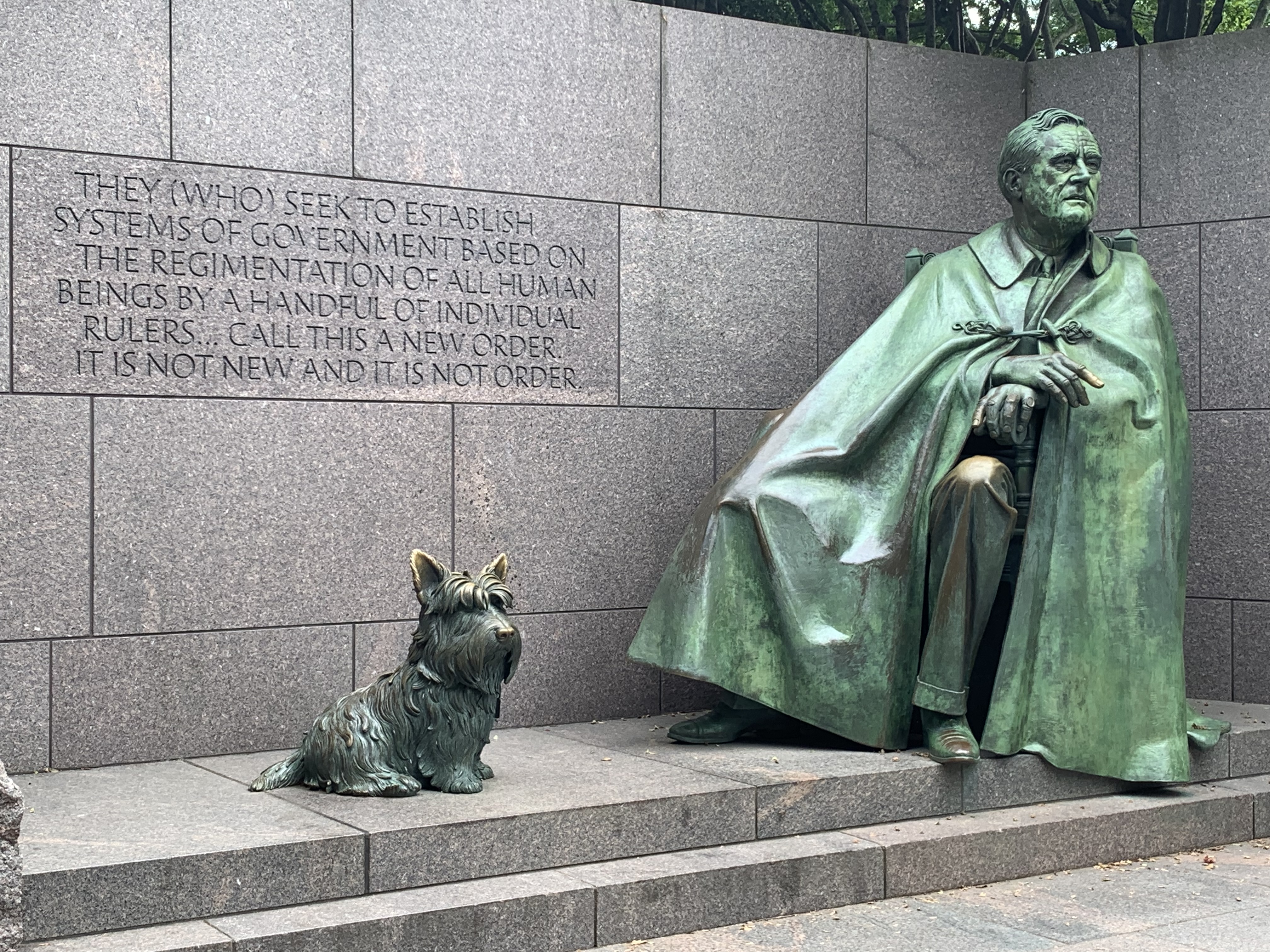
Franklin Delano Roosevelt Memorial

“We have faith that future generations will know here, in the middle of the twentieth century,
there came a time when men of good will found a way to unite, and produce,
and fight to destroy the forces of ignorance, and intolerance, and slavery, and war.”

FDR in 1943

Wander through the FDR memorial amid the waterfalls and trees, reading his words and reflecting on his extraordinary life, and feel the impact his leadership had upon the world. He struggled against being defined by polio, against the Great Depression, to bring a new deal to Americans, through WWII and for peace, until his wife Eleanor took up his torch at the UN. In speaking plainly with people FDR became the lightning rod that harnessed the energy of everyone’s dashed dreams and fearful hopes to make the world better. The desperation of the times brought Americans “a rendezvous with destiny” and required more of FDR than any other President: putting 1/4 of the country back to work, creating a new social contract with a safety net, becoming “the great arsenal of Democracy”, and fighting for a dream of world peace.

“Unless the peace that follows recognizes that the whole world is one neighborhood
and does justice to the whole human race,
the germs of another world war will remain as a constant threat to mankind.”

FDR in 1943

World War II Memorial

Each of the 4,048 stars on the wall represent 100 American military deaths. 16 million served in the US Armed Forces, and many millions more supported the war effort directly. Appropriately, this classical memorial occupies center ground in the National Mall next to the Washington Monument. There were many veterans (of more recent wars) visiting, as well as international visitors and families all admiring the fountains, statues, monuments and inscriptions.

There are many detailed tributes, especially the bas-relief sculptures of both Atlantic and Pacific theaters. In the Atlantic, the memorial illustrates the Lend-Lease program that supported our allies before we entered the war, the military contributions of women, the industrial contributions of women, the code-breakers, the flying fortresses (later protected by the Tuskegee Airmen), the paratroopers, Normandy, Sherman tanks, medics, the Battle of the Bulge where the allies stopped Hitler’s last gasp advance, and meeting the Russians at the Elbe River as the allies stormed into Germany. In the Pacific, the memorial sculptures show Pearl Harbor, the massive enlistment and mobilization for war, battleships, submarines, aircraft carriers, amphibious assaults, jungle warfare, prison camps, and V-J Day.

“Today the guns are silent. A great tragedy has ended. A great victory has been won.
The skies no longer rain death – the seas bear only commerce –
men everywhere walk upright in the sunlight.
The entire world is quietly at peace.”

General Douglas MacArthur