Chaco Culture National Historical Park

This site, one of my favorites for native ruins, is also a UNESCO World Heritage Site. There are numerous pueblos located in the park, and the largest one pictured is actually missing a few rooms due to a rockslide from the cliff above. These great houses were several stories tall, including storerooms for trade and many ceremonial kivas. Due to the well preserved nature of the site, it’s easier to get a sense of the scale of human activity a thousand years or so ago. At other more degraded sites, you’re really looking at the small basement room foundations. Here, you can see that some of the rooms above were much larger with windows and wider passages. The road out here is miles of washboard dirt, which helps reduce human impact.

There’s an interesting display at the visitor center showing several of the other great builder civilizations around the world at the time Chaco thrived. For me the comparison that comes to mind is Rapa Nui, or Easter Island. They were also a civilization of great travelers and explorers who build large stone markers and then move on to other locations. Manmade ecological collapse contributed to the rapid population declines at these sites. Chaco no doubt boomed when it improved its agricultural yields by building a vast network of canals, but natural systems have natural limits that can break when pushed too far. Obviously, when the natural limits are pushed too far globally, the problem is that there will be nowhere to move that’s unaffected. And the crisis part of climate change is that we won’t have enough time to respond. For those unable to think more than a year or two into the future, it’s worth looking back over centuries since Chaco’s population collapsed due to over exploitation. We may think of ourselves as advanced, but we’re not (and won’t be) if we can’t avoid the coming climate catastrophe we created.

Aztec Ruins National Monument

Again, we keep using the wrong name for a national park site (like Montezuma’s Castle). The Aztecs had nothing to do with building this pueblo or reducing it to ruins. By now, I’ve had it. Even the park service uses the term “Indians”. Well, Indians are from India, and we’ve known for centuries that Columbus was wrong to believe the natives he encountered were from the Indies. Geographically, it’s difficult to find two places more diametrically opposed on our globe than India and New Mexico. It’s frankly insulting to keep referring to people by using a mistaken term for centuries. And it shows a profound and reckless disregard for addressing past mistakes and thinking about how to correct them, when we continue making the mistake every day. I’ve been using the term “Native Americans” to discuss the people who still live here and still practice their religion at sites like these. In Canada, the official term is “First People”, which is certainly an improvement in accuracy. Navajo use the term “Diné”. Unless we’re referring to the south Asian country of India, we need to stop saying “Indian” now.

Rant over. The ruins are primarily worth visiting in my opinion to see the spectacularly restored Kiva pictured above, as well as to duck through a long row of low doorways to explore the many rooms along the longest wall here. If you have time to visit a number of these native cultural sites in one trip, then you begin to get a fuller picture of the various migrations, trade routes and pueblos along the river valleys. Each park visit helps open my eyes to both the ancient people and their living descendants.

Canyon de Chelly National Monument

The canyon is sacred to the Navajo. As is too often the case with Native American places, the name is confusing. De Chelly (pronounced ‘du Shay’) is from a Spanish borrowing of a Navajo word meaning “canyon”. So, many people out there are mispronouncing a word in two languages in order to try to say “Canyon Canyon”. This is my favorite canyon.

I only made a brief stop at Antelope House Overlook on the north rim to get a photo of this spectacular canyon. Fortunately, I toured the canyon a few years ago with my kids. That’s really required to experience the history, culture and beauty. Our guide was a Navajo who explained some of the history and beliefs of her people who still live in the canyon. Although Kit Carson’s troops cut down the peach orchards and modern people have diverted water, the bottom of the canyon is still both productive land and a protected ecosystem. If you have the time and money, a horseback tour would be incomparable.

I don’t normally talk about traveling between park units, but the drive from the canyon to Farmington was spectacular. The combination of green forests, snow, and red & tan rock formations in the winding mountain pass is stunning, as was the view of Shiprock on the other side. I feel some sense of culture shock when passing through Navajo Nation, accentuated by the stark differences between communities on each side, and this time felt acute.

Hubbell Trading Post National Historic Site

The post is still in use today, selling jewelry, blankets and other handcrafted goods. Navajo Nation spans a large part of northeast Arizona, and its border extends into Utah and New Mexico. Note well that they follow daylight savings time (unlike the rest of Arizona).

In the 1860’s, US troops under Kit Carson “burned villages, slaughtered livestock, destroyed water sources” and force marched thousands of Navajo to internment camps in New Mexico. The Long Walk and subsequent re-education programs damaged Navajo culture, breaking ancient familial bonds of language and traditions.

America has not dealt with this tragic history nor its consequences. And I’m not talking about Kit Carson’s legacy or that his name is ubiquitous in the west. I mean the US government’s responsibility for ordering people like Carson to execute this atrocity, against his personal views. We need to understand the mistakes of the past, atone and choose more wisely in the future.

César E. Chávez National Monument

I returned here today to see the exhibits, as they were closed when I visited last year. The black & white photos of the Delano grape strike and Chávez’s hunger strike remarks are particularly moving. Pesticides were not regulated at all then, and labor was denied rights by growers. Chávez’s national boycott of grapes helped change both.

Today, growers drain rivers, lakes, wetlands and water tables, even as the western half of the country suffers in drought. In Kern County, where the Monument is, the Kern River no longer flows to the Kern Lake, due to diversion for agriculture. In order to sell more produce, growers are ruining the environment for fish, animals and people. Climate change and some farming practices also exacerbate Valley Fever, a deadly fungal infection spreading in California & Arizona.

Agriculture is a trillion dollar industry in the US, with $150 billion in exports. But Big Ag prefers to blame Democrats, rather than face the fundamental challenge of the climate crisis. Big Ag needs to convert farm equipment to electric, and they need to stop using fossil fuel to ship their produce around the world. They also need to cooperate to restore wetlands to sequester carbon.

César Chávez devoted his life to raise awareness and lead civil disobedience to make change. He acknowledged that in the struggle against the rich and powerful, poor people only have their lives “and the justice of our cause” on their side. Today, we need more people to be just as devoted to stop the climate crisis.

Wisteria, photographed in my previous visit in 2021.

Click to see my photos of all national park units in California, or click to read an updated site visit here.

Chiricahua National Monument

This hiking paradise of rocks left me feeling inadequate. Something about the vast number of enormous towering spires of hard rock made me feel like a tired old man. Sure, the view of any one of these mighty columns pointing skyward for ages is impressive, and the variety of sizes, shapes and textures of these huge protruding knobs is remarkable, but the well-endowed phallus-shaped columns left me feeling cold and small by comparison. On the other hand, a bevy of older ladies were very excited and pleased to view the tall and stout structures from Massai Point Nature Trail, as they laughed and reminisced about their youth.

One would be remiss for not explaining that the Chiricahua are the tribe of the Apache Chief Cochise and the feared raider Geronimo, who conducted guerrilla warfare against the US in this territory. For 24 years, the Apache skirmished with and hid from the US Cavalry, attacking stagecoaches, wagons, Mexico and even Union troops in 1862. The rugged and remote territory (below) shows the difficulty the US had in tracking them down. Eventually both were forced onto reservations. 

Click to see my photos of all national park units in Arizona.

Fort Bowie National Historic Site

Three of the graves in the fort’s cemetery are of captured Native American children. The center one belongs to a three-year-old Apache girl, buried under a Christian name given to her by her captors. The one on the right is of an Apache child unnamed with no age, buried like the others in the manner of his or her captors. And the left grave belongs to the two-year-old son of Chief Geronimo, Little Robe, who likely died of a disease spread by his captors, and whose father’s name will be remembered as synonymous with bravery, long after everyone else here is long-forgotten.

Click to see my photos of all national park units in Arizona.

Gila Cliff Dwellings National Monument

This park is surrounded by real wilderness, and any intelligent visitor would plan on camping overnight to take a longer hike or maybe even a trail ride on horseback. Of course, I drove through on my way back to Arizona, practicing my hairpin turns on mountain switchback roads. Well, at least I didn’t burn any species-ending fossil fuels on the drive.

The cliff dwellings are spectacular, with details like a wall mural and a pictogram, well worth the brief hike along the pretty creek and up the cliff side. Unlike Montezuma Castle NM, I was able to climb right into the main room and climb ladders to peer into the past. There was even a volunteer there who reminded me that pictograms are painted and petroglyphs are carved.

Click to see my photos of all national park units in New Mexico.

White Sands National Park

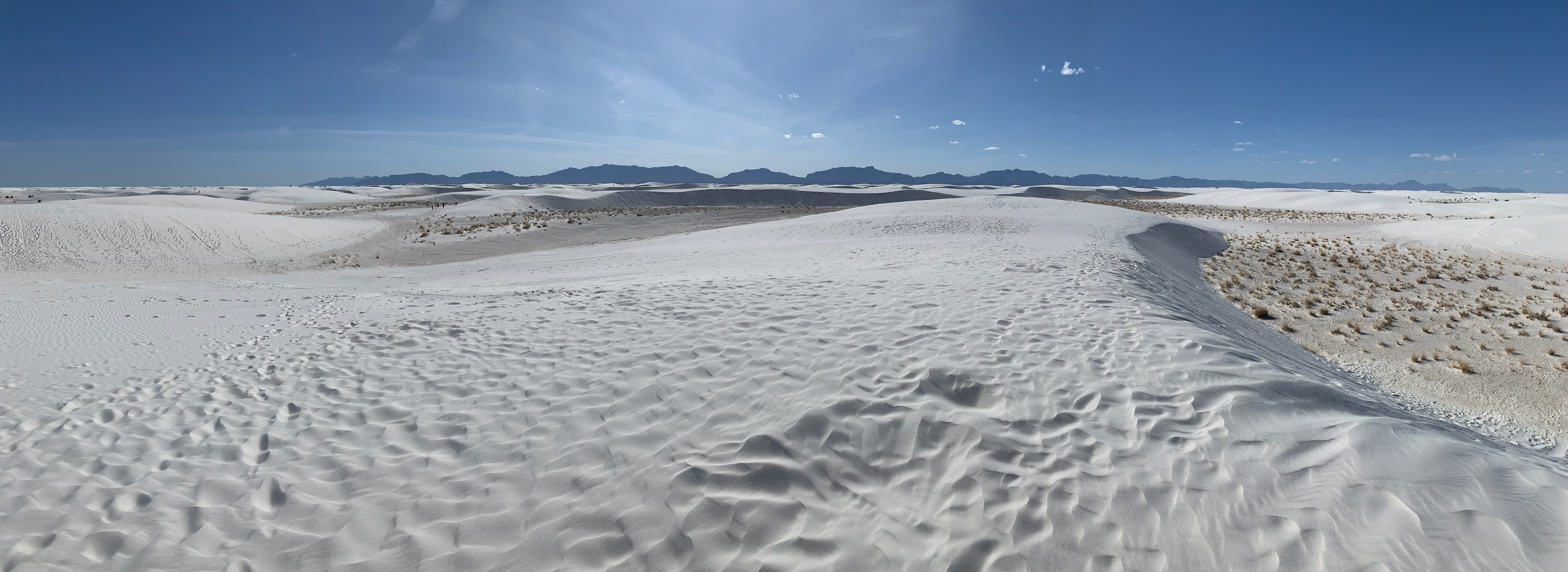
One of only three large gypsum sand dunes on earth, the others being nearby in Guadalupe Mountains NP and in Coahuila Mexico. If I had more time, I would have enjoyed camping overnight in the “back country” away from the road or a ranger lead evening program. But I enjoyed the nature hike and the otherworldly views. I was glad to have the long-range version of the Tesla Model 3, since the round trip distances to charging stations cross the vast missile range and mountains you can see in the distance.

Click to see my photos of all national park units in New Mexico.

Petroglyph National Monument

Worth going to the visitor center first. They directed me to the trail with the most petroglyphs (400+) and no parking fee. Fascinating to see the signs those travelers left so long ago, preserved by the city of Albuquerque, right behind a residential neighborhood.

Another hiker pointed out a coyote, probably chasing the road-runner I saw too. I heard the distinctive “beep-beep”. They should make a cartoon about that.

Click to see my photos of all national park units in New Mexico.