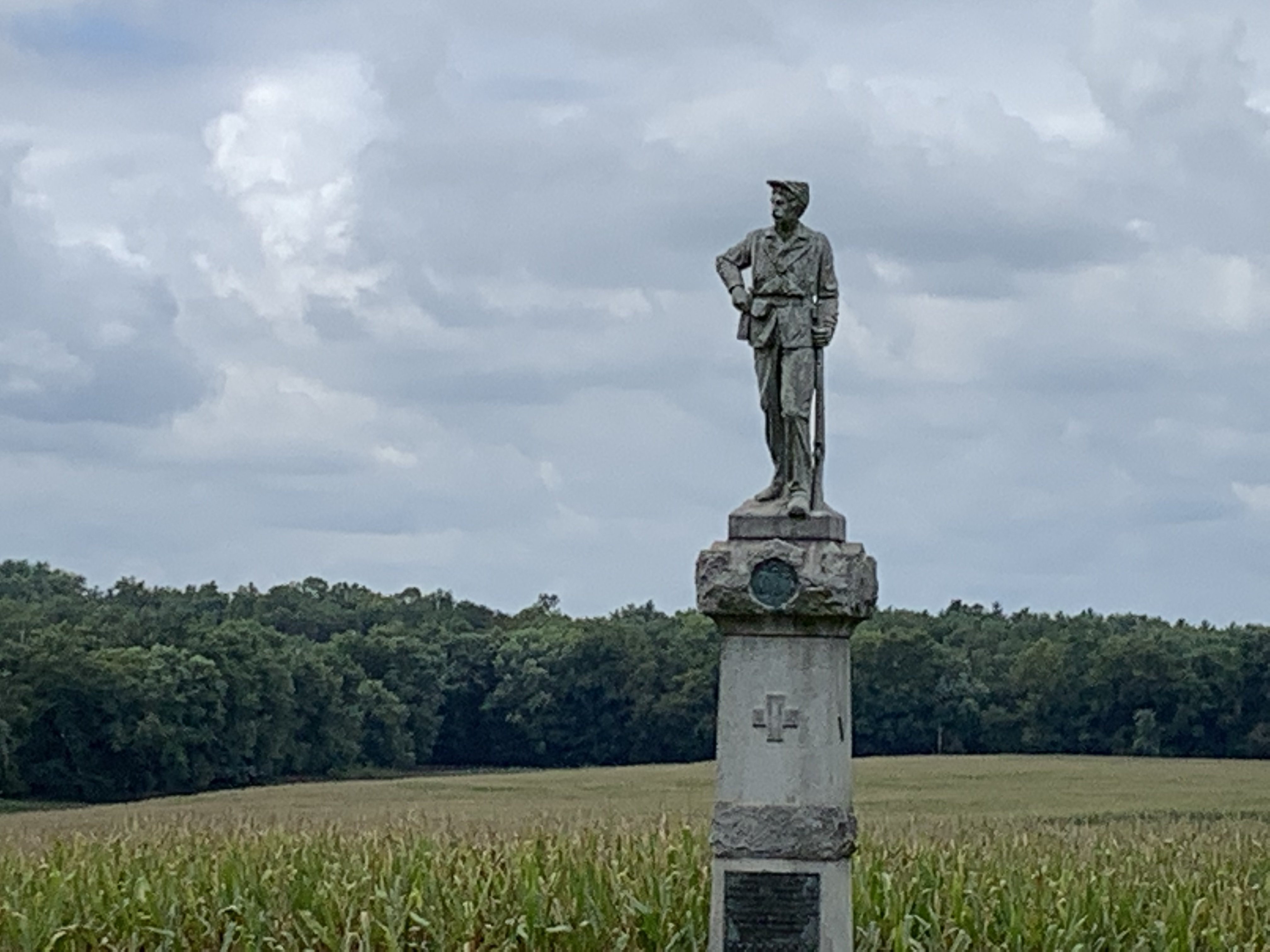
This affiliate site memorializes a key Revolutionary War battle in Georgia in mid February 1779. The British had been moving freely through Georgia with some 600 loyal colonial forces, until 350 Patriots came across them west of Augusta at Kettle Creek. The smaller force of Georgians and South Carolinians had the element of surprise and attacked, under the command of Andrew Pickens. The British quickly climbed a hill and sought cover, but their leader was shot and mortally wounded. Fearing they were being surrounded, the British retreated back across the creek in some disorder and most escaped. This battle was a significant defeat for the British who lost 3 times as many men, including their Colonel Boyd. The markers above are cenotaphs, placed about 60 years ago, in memory of American veterans of the battle who are buried elsewhere. There are several hiking loops in the woods to give you a sense of the hilly, difficult terrain, with crosses marking actual graves.
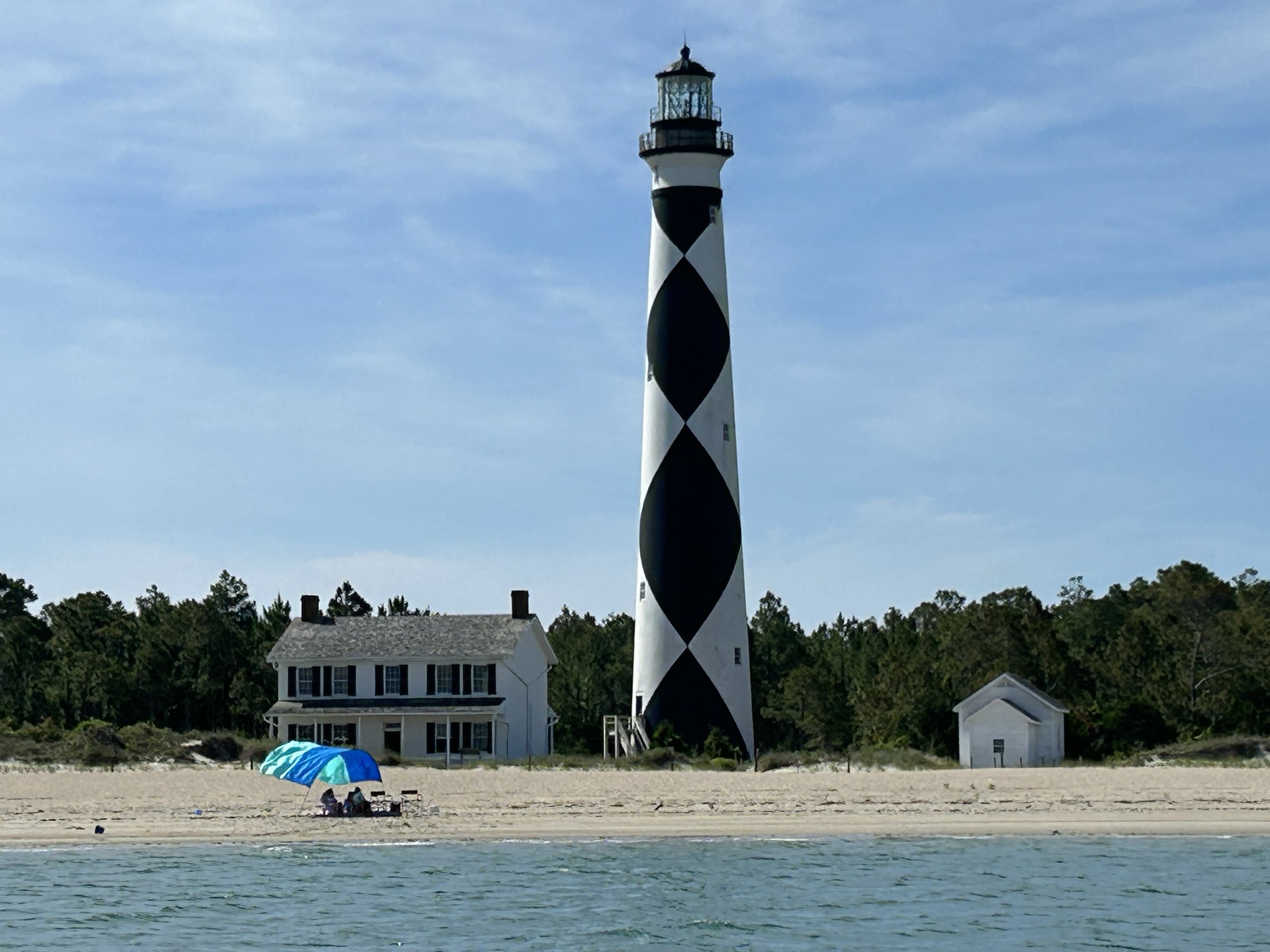
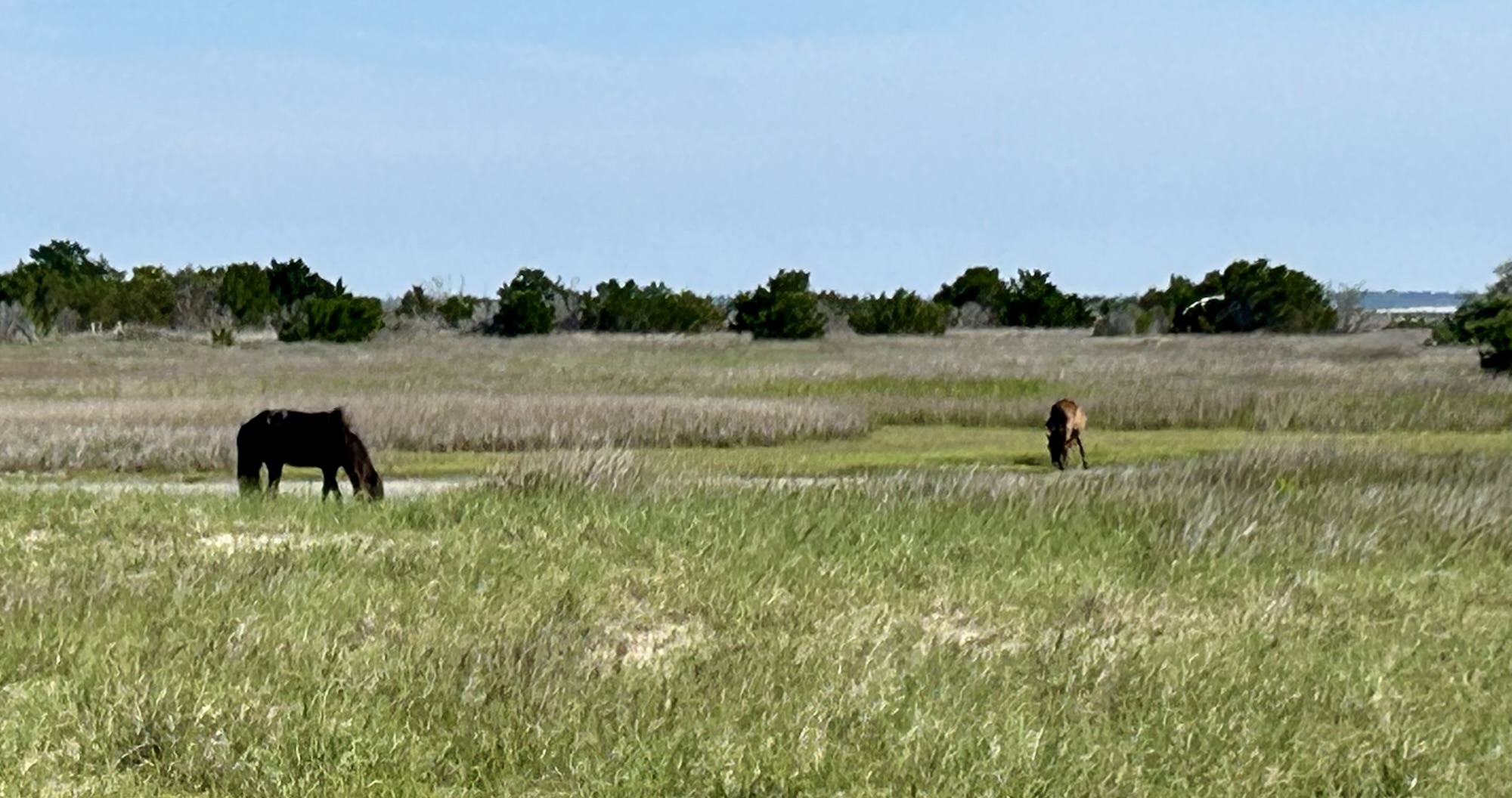
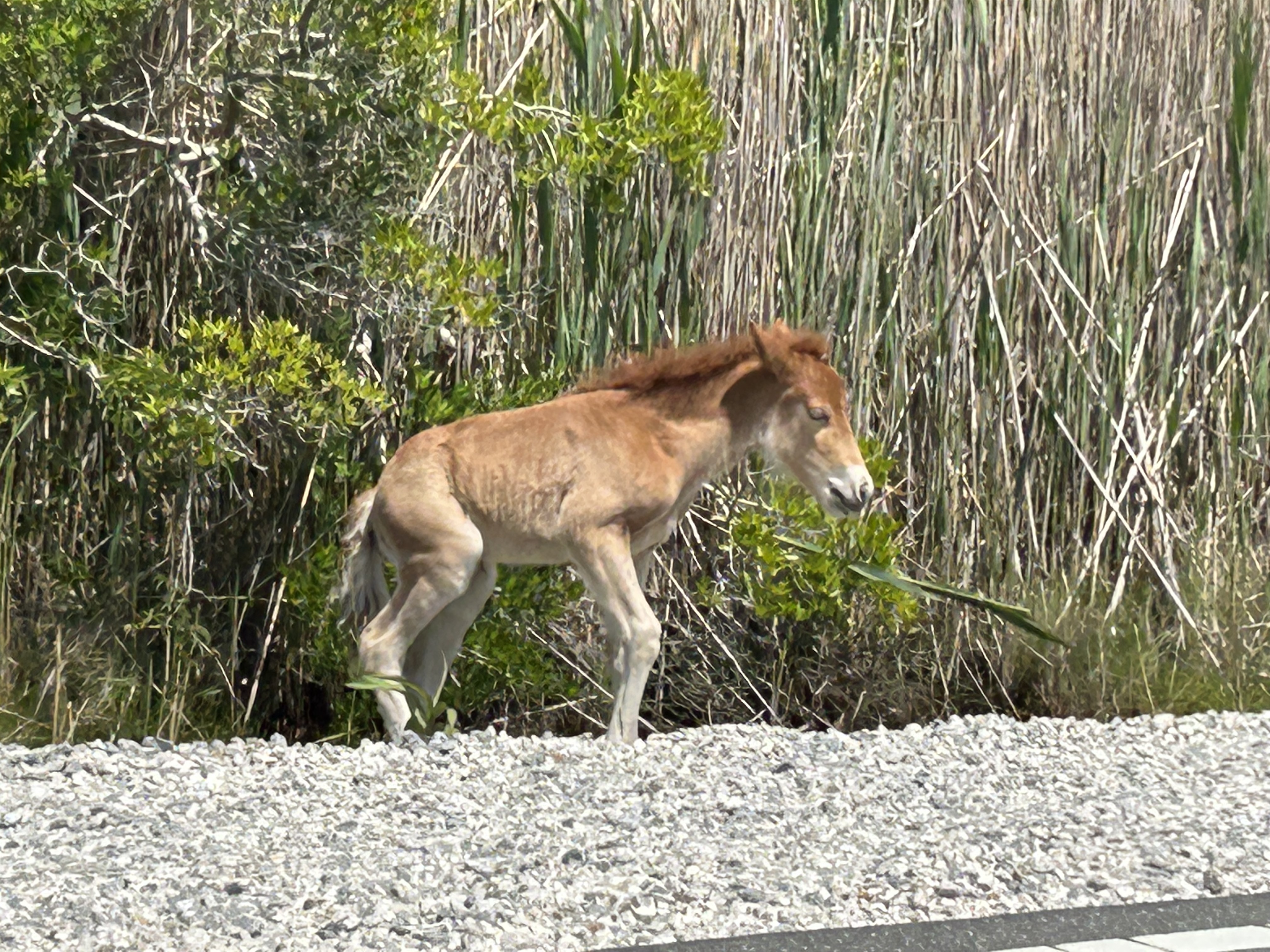
The ferry pilot told me that this is the best view of the Cape Lookout Lighthouse, so there you go. Seeing wild horses was quite simple at Shackleford Banks, as there aren’t many places to hide. And the horses don’t seem to mind photos while they’re grazing.
A few decades ago, I came through the Beaufort Inlet on a boat to resupply. The docks and front street of Beaufort NC—not to be confused with Beaufort SC—haven’t changed much, although everything is quite a bit busier and pricier now. I don’t remember seeing any horses, although we knew they were there.
Unlike the rest of the Outer Banks to the north, Cape Lookout’s barrier islands have no paved roads. A few fishermen and visitors bring cars over on a vehicle ferry from Davis to Great Island Bay, and there’s another vehicle ferry from Atlantic to beach camping on North Core Banks. There’s also a passenger ferry from Ocracoke to the north end of this seashore at Portsmouth Village. And concessionaires run ferries both from Beaufort to Shackleford Banks and from Harkers Island—where I left from—to both Shackleford and the lighthouse. Yes, that’s five different ferries from five separate locations to five disconnected destinations, depending on your plan.
The seashore is quite casual, parents with babies, school groups, many folks bringing their dogs, tourists looking in the light keeper’s house, campers, sporty teens, and some older folks appreciating the natural beauty while reminiscing. The beaches have many shells, and you are allowed to take a few home. Many boats cruise around the bays from nearby marinas tucked into the coast’s rivers, and I heard several small planes going overhead. I drove up when the Harkers Island visitor center opened, got a ticket, hopped off on Shackleford, hopped on the next boat for the lighthouse, hiked around a bit and returned to find some seafood. Of course there are miles of beach to walk. Very pleasant.
So, a couple years ago, I visited Old Swedes church, the oldest original Swedish church in the new world dating back to 1698, and I confirmed that it was a national park site before taking the interesting tour complete with silly ghost stories. And I checked it off my list and posted it on this website. But I was wrong. A careful reader messaged me—to avoid public humiliation—and explained that I had the wrong Old Swedes church.
So, last month, I went to Philadelphia and finally visited the Old Swedes church above, built in 1700. I spoke with the pastor, and he explained that this is the oldest Gloria Dei Lutheran church in America and the oldest surviving church in Philadelphia (not Delaware where I foolishly was before). The pastor forgave me, and I hereby offer my humble public confession.
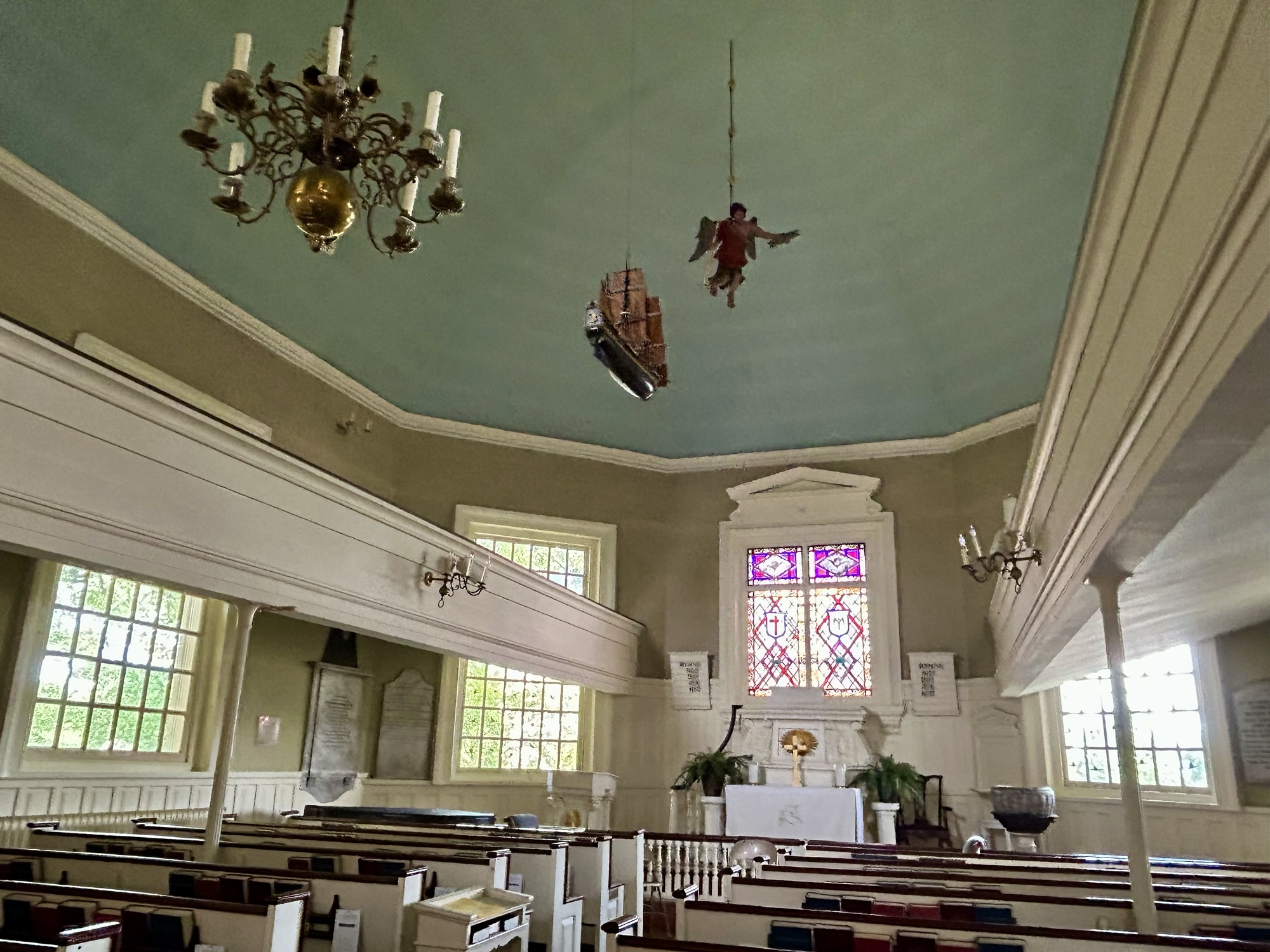
The moral of the story is that if you look up NPS Old Swedes church, you are likely to get the one in Delaware, which is an affiliated part of the First State NHP, but if you look up NPS Gloria Dei church, you are likely to get the affiliate NHS church above in Philadelphia. Also, the stone and brick work on the two facades are obviously different. As an act of contrition, I offer the following photo of the inside of the Philadelphia Old Swedes, complete with the Kalmar Nyckel sailing above the congregation.
This is a new national monument on the 18th century Carlisle Army Barracks in Pennsylvania, which also hosts the Army War College and the Army Heritage and Education Center. The base is currently open to visitors on weekdays, but there are no park site visitor services yet.
“All the Indian there is in the race should be dead. Kill the Indian in him, and save the man.”
Richard Pratt, founder & superintendent
From 1879 to 1918, towards the end of its War on Native America, the US Army established a boarding school here, a re-education camp far from native reservations. There are only a few Native American graves left on base, as many were repatriated by law after 1990, but otherwise, not much remains of the school that once set the standard for ‘assimilation’. Around 8,000 children from 150 tribes were taken from their parents and shipped off to this school—as happened at other schools across the country—for the expressed purpose of ending their culture. Considered a step forward from massacres, forcing natives to become white was the primary goal from day one. While today, many such students might gain PhDs in Native American studies in recognition of the value of their cultural contributions to our civilization, prejudice meant there was practically only one way for these students to excel: on the field.
Unlike college admissions or job hiring, there is no effective way to cheat by race in sports like track & field. Once allowed to compete, the results are judged fairly, regardless of color. The field above is still known as ‘Indian Field’, but officially it is named after Frank MT Pleasant Jr, a student—and member of the Tuscarora Nation—here for 12 years around 1900, known for his prowess in football and track. In 1908, he placed 6th in two events at the Olympics in London. He earned his degree in 1910 at the neighboring Dickinson College, the first native to do so. He served honorably in WWI and later played semi-pro football. While he and other athletes like baseball hall of famer ‘Chief’ Bender are remembered here, they’re all overshadowed by another classmate.
In 1907, a Sac & Fox youth was walking by the track above when he stopped to watch the high jumpers. He had been to many different schools growing up, and he had run away from most. This was his second time here; the first cut short by the death of his father. Jim Thorpe walked up to the bar and jumped 5’9”—a school record—in his street clothes. He would excel at virtually every sport he tried: ballroom dancing, baseball, boxing, handball, lacrosse—a native sport—, and tennis. The football coach, ‘Pop’ Warner, didn’t want his school’s track star injured, but Jim asked for a chance to play. He ran through the opposing team back and forth, and then said, “coach, nobody is going to tackle Jim”. And nobody did. Jim set all kinds of college football records, rushing almost 2,000 yards a season, scoring hundreds of points with over 25 touchdowns a year, according to incomplete records.
At the Stockholm Olympics in 1912, Jim Thorpe competed in the two most challenging competitions, the pentathlon and the decathlon, which require mastery of 5 and 10 different events respectively: 100 m, 400 m, long jump, high jump and shot put for the pentathlon and the same five plus the discus, javelin, 110 hurdles, pole vault and 1500 m for the decathlon. Despite someone stealing his shoes before the competition, Thorpe found two mismatched shoes and still won 8 of 15 events outright, winning the gold medal in both combined events. Later, Thorpe would go on to play professional baseball, basketball and football. Considering how well-rounded he was, in my opinion, Jim Thorpe is the greatest athlete in history.
So, if you want to take a lap on the same track where Jim Thorpe began his athletic career, bring a map and your real id and go to the base visitor center between 10 am and 3 pm on a weekday—not a Federal holiday—and get your criminal background check. But consider the cultural cost of Indian schools, the families broken, the languages silenced, the oral histories lost, the natural and medicinal secrets forgotten, and the songs and dances not taught, just so white people would feel more comfortable with Native Americans. Fortunately, the Sac and Fox Nation survives in Oklahoma—they were removed from the Great Lakes region in the 1870s—and many other tribes still thrive today as well.
I don’t expect every site to be Yellowstone, but this one is very disappointing.
In 1935 the NPS acquired development rights to the land from property owners in this historic area of Piedmont in Virginia, making this an affiliate site. Green Springs is known for a healthy mineral spring, for some horses bred 200 years ago, and 3 dozen historic farms and other buildings dating from 1735 to 1920. The oldest is Boswell’s Tavern, frequented by Jefferson, Madison and Patrick Henry. Lt Col Banastre Tarleton raided the county with his cavalry in 1781 during the Revolution.
However, the historic properties are all owned privately and are not open to tourists. So there’s nothing for visitors to see now. Boswell’s Tavern now looks like an unremarkable, updated private residence with an old chimney. There’s no museum or guide, and many of the houses, like the one above, are behind fences, hedges and hills, to be invisible from the public roads. Someday, perhaps, this will be a worthwhile place to visit, but for now, there’s no point.

























 Zero Carbon Travel