I had forgotten that it was a children’s march on Palm Sunday that was assaulted by dogs and water cannon. Under city ordinance, it was illegal for children of different races to play together. In my view, the longer a system of injustice is allowed to stand, the more deeply engrained it becomes. The Civil Rights Institute does a powerful job of setting the scene, where African Americans worked in the steel mills and mines and lived in the city behind a color line. People like Bull Connor and the mayor grew up believing that segregation was normal, right and beneficial. They didn’t play with African American children as kids, and as adults they attacked them, peacefully assembled, wearing Sunday clothes, in a park, outside the 16th St Baptist Church, singing songs. The children had learned from Dr King not to fear jail when doing no wrong, but the assault against them was brutal, and televised.
At the time, America was shocked and voiced outrage. This week children were slaughtered in yet another episode of gun violence. I wonder if we’re sufficiently outraged to change the system as those kids in Birmingham did.
“A man dies when he doesn’t stand up for injustice.”
If I were to choose one turning point in American history, I would choose what happened here in March of 1814. After many consecutive treaties with the Creek were broken and great parts of their land were taken, some Creek warriors tried to defend their nation, which had survived contact with the Spanish, French & British. Andrew Jackson invaded the heart of the Creek Nation, surrounded 1000 warriors armed with 300 guns with 3000 soldiers in the bend of the river here. 800 of the Creek warriors were killed, 300 while trying to swim to safety. The village was burned and the women and children with them were captured. By any fair accounting, a ten to one advantage that results in 80% killed is a slaughter, and shooting swimmers is particularly cruel.
But Jackson used the victory to steal more land for white settlers, so he was treated as a hero, instead of a liar, thief and atrocious killer. Jackson even betrayed the Creeks who fought side by side with him in battle, taking their land too. Jackson would go on to become the only President to openly defy the Supreme Court, by not only refusing to return land but by forcibly removing Native Americans to reservations in the west, along the Trail of Tears. A popular President among whites who could vote, he perpetuated racist stereotypes about Native American “savages”, which continued past the Civil War when 750,000 mostly white Americans slaughtered each other over the right keep slaves.
Most Americans won’t admit it, but our ancestors wanted our government to slaughter Native Americans and take their land for our benefit. Racism has been used as official policy for killing, removing, and exploiting non-whites for centuries. By ignoring, denying and lying about this fact, many of us have chosen to live our lives without a moral compass. The first step is to admit the truth, then figure out what to do about it, and finally to teach our kids to be better.
[Updated after 3rd visit, including Oaks tour and Carver Museum.] I admit I was frustrated the first two times I drove here from California, unable to access either Booker T. Washington’s house or George Washington Carver’s Museum and finding incorrect information on the website and app. And I might have ranted about how other sites appear to be better funded. But all is now forgiven.
Like many emancipated slaves, Booker had no surname. When he showed up at school, he just said his last name was Washington. After walking across much of Virginia to go to school near Hampton Roads, he became a teacher at Hampton University, before being hired to run the Tuskegee Institute, now University. Ever hard-working, practical and focused on improvement, his students developed many valuable skills to support their families, including brick making. His students built his impressive mansion, The Oaks, across the street from Tuskegee University, using the design by our nation’s first African American architect, Robert Taylor, who trained at MIT as its first black student. Booker T., ever persuasive, recruited Taylor, who designed many buildings that are now part of both this national historic site and the university.
It is difficult to overestimate the importance Booker T. Washington had in advancing the lives of people who for centuries were not allowed to learn how to read. An advisor to US Presidents, world traveling speaker, practical educator, builder, mentor, and author, his practical focus drew criticism from WEB Du Bois and Frederick Douglass, who focused on ‘higher achievements’, but ultimately, they all worked towards the same goal of progress. All continue to inspire generations to learn, grow and excel. Inside the house on tour, I learned about Booker T’s wives, who also contributed to education. By necessity, black women have often had to assume a role as matriarch, when it was difficult or even impossible to keep families together.
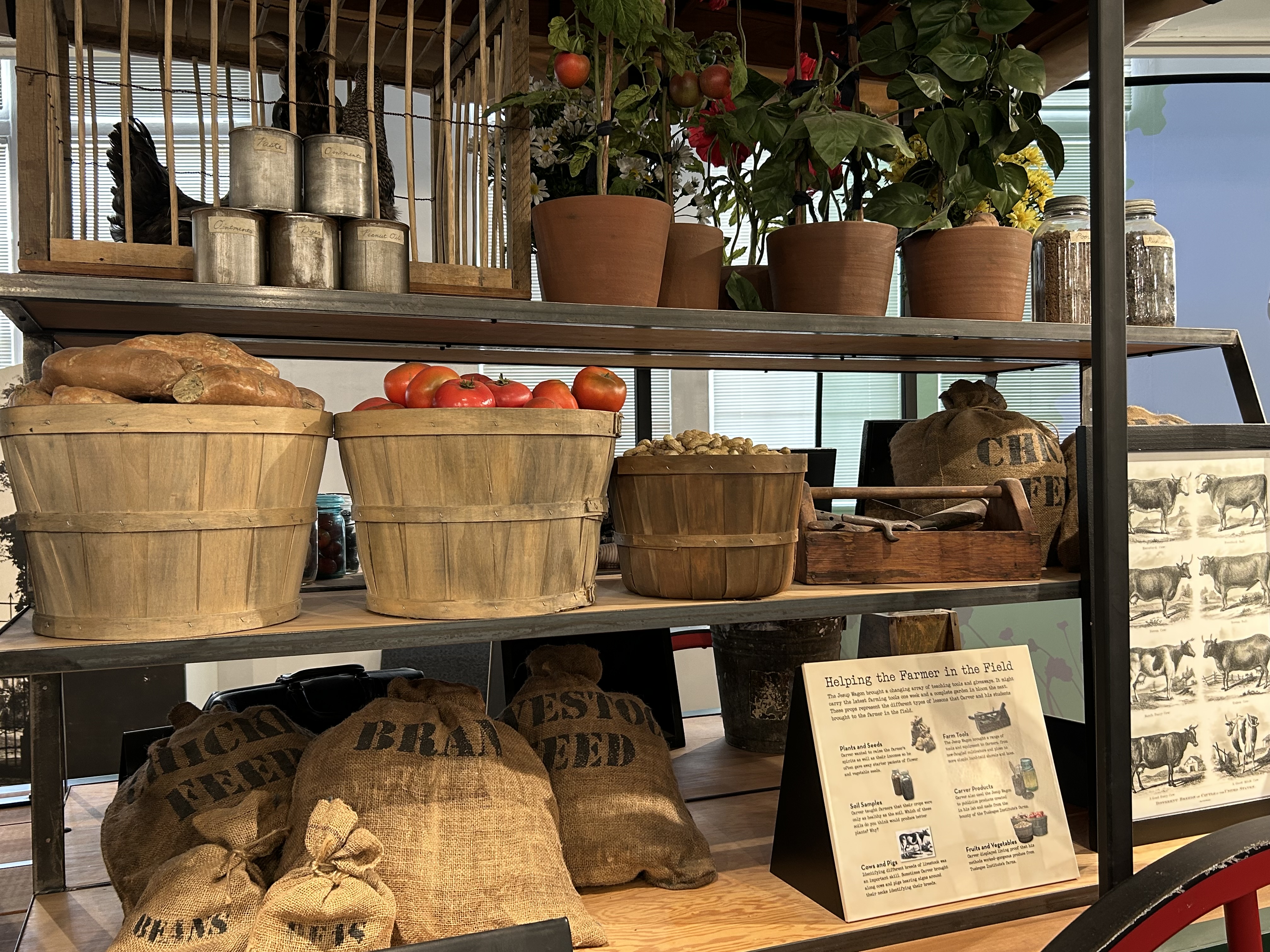
Booker T. Washington also hired George Washington Carver to teach and help improve the lives of African Americans, and the Carver’s museum on campus (see photo below) reveals his broad scientific interests beyond the peanut. Carver was an ecologist, who focused on profitable uses for peanuts in order to improve soil health, a forward-looking view that has only become more important over time. But following Washington’s practical focus, Carver spent much of his time in direct outreach to rural communities, bringing solutions and advice out in wagons.
I’m sure Washington could not have imagined that his institute would have been used by the US government to run a 40 year ”experiment” on black men, neither treating nor disclosing their diagnosis of syphilis. (See ”Miss Evers’ Boys” also set in Tuskegee & starring Laurence Fishburne). He might be pleased to know that there’s a private museum on campus dedicated to teaching the history of that infamous experiment as well as the genetic legacy of Henrietta Lacks. But doubtless Washington would have been out fundraising to develop the broader community of Tuskegee, which shows signs of economic neglect.
[Updated after touring the hangars.] Like at Tuskegee Institute, I admit to being frustrated by not being able to tour inside earlier and ranting about unequal funding. But all is forgiven now.
The P-51 Mustang above, known as Duchess Arlene, is just one of the planes on display, along with training planes. The first Tuskegee Airmen fighter group sent to North Africa was the 99th, which proved itself with a record-breaking number of air combat kills in short order. Later, additional units were combined into the 332nd Fighter Group, the famed Red Tails that protected the Flying Fortress bombers to help win the war in Europe. I recommend watching the Tuskegee Airmen movie, starring Laurence Fishburne, to learn more. (For the record, although Fishburne also starred in Miss Evers Boys, none of the Tuskegee airmen were involved in the Tuskegee experiment.)
The park film and exhibits also tell another important story about the Tuskegee Airmen: the Double V. Victory was needed both abroad against Hitler and at home against discrimination. When the decorated pilots and experienced mechanics returned after the war, they were not allowed jobs at US airline companies, despite their proven qualifications, nor were they allowed to vote in many states. Even during the war, a group of over 100 airmen were denied admission to an officer’s club on the basis of their race in direct contradiction with US military regulations against segregated facilities. They refused a direct order to sign away their rights, which, during wartime, potentially risked their execution. The Black Press, a group of newspapers and newsletters that closely followed the Tuskegee Airmen, broke the story of the Tuskegee officers being held prisoner and given less rights than Nazi prisoners of war at the same base. The Freeman Field ‘Mutiny’ became a national scandal, and the commanding officer was eventually removed and the officers freed. Truman eventually ordered complete desegregation of the military. We owe a great debt to these brave men, who fought for our country, despite the discrimination they faced.
Not far from the profoundly disturbing Andersonville site, is the very pleasant town of Plains, Georgia, where the Carters still reside. There’s a giant peanut, a store selling Billy Beer cans, the campaign depot and the delightful boyhood farm home of Jimmy Carter. The site and the town have a wholesome feeling that feels like stepping back in time. The farm still seemed active, with crops, goats, bees and mules (donkeys?), and everyone was very welcoming and friendly. The Carter compound is strictly guarded by the Secret Service and off limits, but I enjoyed fried peanuts and peanut flavored ice cream and peeking in store windows and chatting with the locals.
Young Jimmy’s playmates were mostly African American, so it was natural for him to oppose segregation and become an activist. He saw poverty just down the street, so his work with Habitat for Humanity was also natural for him. As President he negotiated the Camp David Peace Accords and later earned the Nobel Peace Prize for his Carter center. He did well by doing good, and he’s still making an effort at 97. We could all try to learn something from that.
Roughly the same number of Union soldiers died in this prisoner of war camp as died in battle at Shiloh: over 13,000. The conditions were horrifying. Disease, vermin, starvation, dehydration, exposure and brutality killed hundreds by the day. Only a small portion of the stockade has been reconstructed, including the north entry gate pictured above, through which about one in three did not come out alive. There is an illustration drawn from the memory of Thomas O’Dea that is absolutely haunting in both its scale and detail. The Union refused a prisoner swap out of concern the confederates would return to battle. One 19 year old prisoner had the job of numbering the dead, and he secretly kept a list of names, regiments and causes of death. Eventually he brought it to the attention of the “angel of the battlefield”, nurse Clara Barton who had petitioned Lincoln to track down missing soldiers. They toured the site and marked over 12,000 graves. Barton went on to found the American Red Cross, and the US ratified the Geneva Conventions the next year. The man in charge of the camp was hung for war crimes. Flags were flying over the National Cemetery before Memorial Day, and burials are still occurring frequently. The visitor center also serves as a memorial and museum to all prisoners of war.
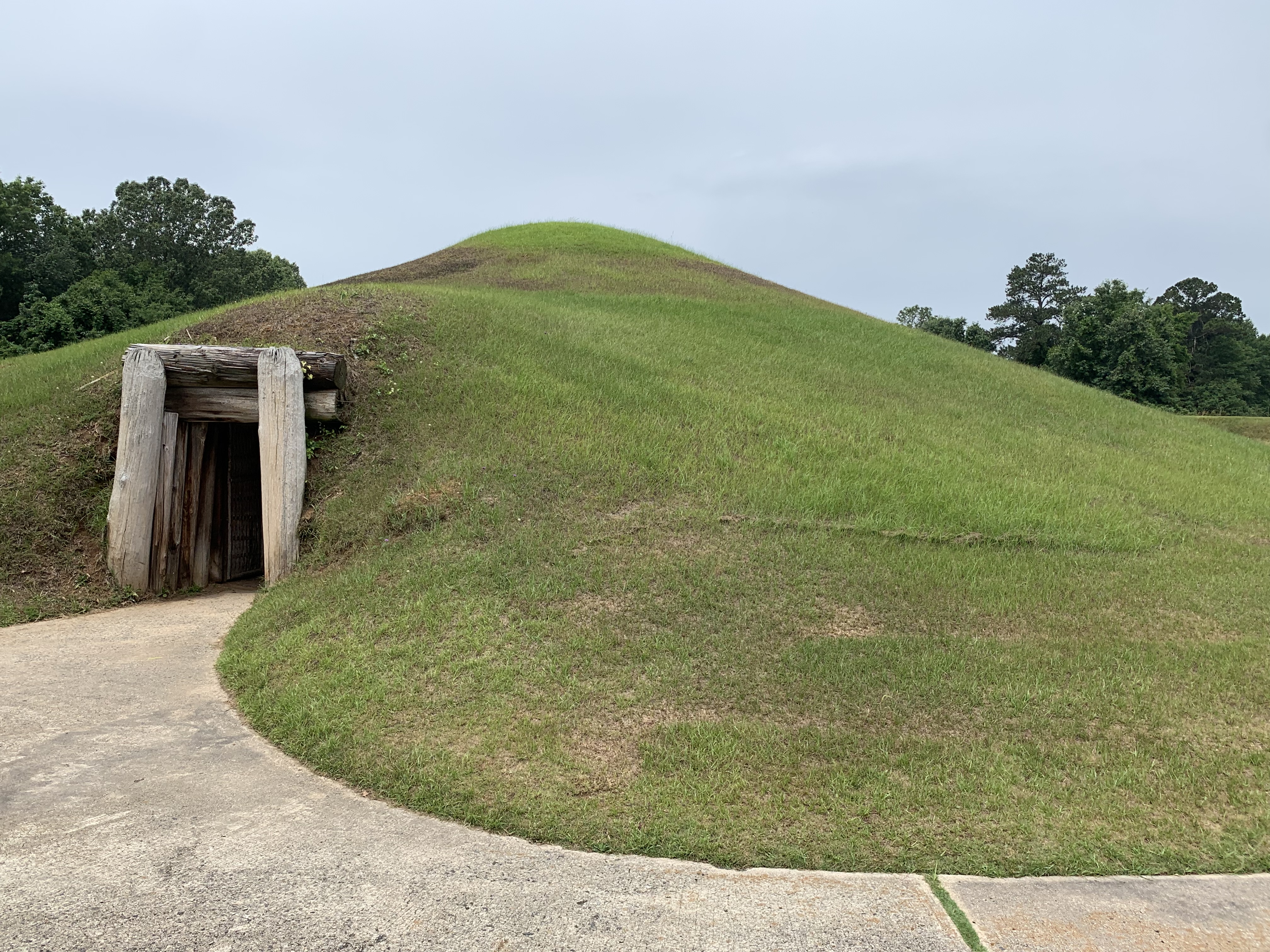
The large mounds here date back over 1,000 years, and include the reconstructed earth mound above, temples and funeral mounds of the ancestors of the Creek people. Despite tremendous challenges, the culture continues today, as seen in the Creek Nation Supreme Court Building in Ocmulgee Oklahoma, which is patterned after this mound. The ground inside dates to 1015, and appears similar to kiva I’ve seen in the west. During the Depression the Civilian Conservation Corps reconstructed the roof and built an Art Deco style visitor center. The entrance tunnel is low, carpeted and well ventilated, and it opens into a glassed-in viewing area. Despite not being half as old as Poverty Point, the mounds here also have bird symbols and other similarities. The Creek Nation farmed corn, squash, beans, pumpkin and tobacco here, fished and traded deer skins with the Spanish, French, British and Americans. They largely westernized and had multiple treaty rights to their lands, but they were nevertheless forced to abandon their homeland by Andrew Jackson.
Driving through the southeast, especially in rural areas, you see a great many churches. I’m no expert on the Bible, but I’m pretty sure the ”thou shalt not steal” is in there (Exodus 20:15). Almost all of the land was stolen from the Native Americans, yet I don’t often hear people expressing any regret for the sins of our ancestors, even in church. Obviously, it’s not God’s will that his commandment be broken. I’ve been to church services from coast to coast, and I’ve never heard a sermon about how we live on stolen property, how that was a sin and how we should try to make amends. Seems like that would be the proper Christian attitude. Of course, the church has been wrong on this issue for centuries, but reflecting on our sins and seeking forgiveness are supposed to be core values of Christianity. Why not start reflecting on this sin and our responsibilities today?
Every year winning poems are chosen from children around the world for visitors to admire along with the roses. The sentiments are moving testimonials to his life, ideals and inspiration, expressed with the moral clarity and unbridled hope of children. This is my favorite Civil Rights site.
The short films & exhibits in the visitor center capture Dr King’s life as the heart and soul of the Civil Rights movement, as well as his wish that we continue. His birthplace, church, center for non-violence and grave are overwhelming, but I was struck by how the community continues to gather here daily for many different events and causes. His passion for justice and righteousness inspire action every day.
Today I’m inspired by one of his thoughts in his letter from a Birmingham jail, about how difficult it is to be told to wait after enduring centuries of suffering. Earth has suffered centuries of pollution, and always the message to environmentalists is to wait. Wait for new technologies, wait for laws, people and society to change, and wait until the polluters have made more money, and then, maybe…. But now we have no more time to wait. We’re moving quickly to catastrophe, wasting precious time on inaction, and extinguishing species without pause. Unless we act to stop burning fossil fuels now, we condemn much life on earth to end.
Union forces fought for weeks to break the long line of confederate fortifications northwest of Atlanta, but were unable to climb the steep hills under heavy fire. There was one “dead angle” or blindspot at Cheatham near the photo where soldiers climbed all the way up the hill and over the earthen walls only to be repelled in hand to hand combat.
5,300 soldiers died in a few weeks of fighting here in the summer of 1864, before the war moved to Atlanta.
Like several of the Revolutionary War sites in the south, the park is closed Sunday through Tuesday, but I was able to enter the reconstructed stockade above. The patriots briefly captured it in 1775 but failed to take the star shaped fort nearby. The earthwork remains are still preserved after centuries. The star fort design was used by the Spanish in St Augustine, the British here and by both the Union and the confederates. With just a few troops needed to defend it, the design provides overlapping fields of fire protected by crossfire gauntlets.








 Zero Carbon Travel