This is a great place to learn about earthlodges due to the continuous maintenance of traditional culture here. Videos tours are available online too. Clearly the lodges were multi-use, serving both daily needs and special ceremonies. Having seen various ruins of similar structures around the country, it is informative to view such a complete exhibit.
The other reason these particular villages are important is that Lewis & Clark landed here and added a few folks to their expedition, including a French trapper named Toussaint Charbonneau and his wife and their infant son. Since she acted as interpreter and guide, Sakakawea became the expedition’s most valuable player and is memorialized on a US $1 coin first minted in 2000. A hike down to the river is worth the short walk.
This diorama is one of the best I’ve seen, and it showcases all the major finds discovered here to date. The first fossil was found by James Cook on his ranch here at the headwaters of the Niobrara, but his collection of Native American art & artifacts rivals the attraction of the fossils. He was a great friend of Chief Red Cloud, and, unlike many of the original fossils which have gone on for display and study elsewhere, Cook insisted his gifts remain here. If that weren’t enough, there’s a lovely creek with wildlife on the trail up to where most of the fossils were found. This is one of my favorite fossil sites, although Dinosaur is better.
Like many folks, I grew up watching Westerns, so when I think of wagon trains of pioneers, I think of circling the wagons to defend against native attacks. But that’s another myth. More pioneers were killed by gun accidents than native raids. Pioneers traded peacefully with Native Americans as a rule. There was another school shooting recently, and the myth that guns make us safer is still being repeated today.
Of course, the main cause of death for the pioneers was cholera, so what actually protected them was coffee. Folks who drank “cowboy coffee” (strong enough to float a horseshoe) were saved by boiling water. I knew there was a reason I love espresso.
The park is beautiful, and many of our ancestors in the west walked (“prairie schooners” or wagons were for supplies) through the pass above. The rangers are both informative and engaging, and as always I learned more in a brief conversation than from any other source. Since I arrived early, I hiked up the Saddle Rock trail, but you can also drive up. The bluffs aren’t the highest or most brightly colored in the whole country, but they offer pleasant views of the historic trail.
Thanksgiving celebrates when Native American generosity saved the first settlers in New England. Natives taught settlers about native crops and game, they traded peacefully with the British, Spanish, French, Russians, mountain men, and pioneers, and they guided Lewis & Clark across the country. Many early Americans married natives and lived happily.
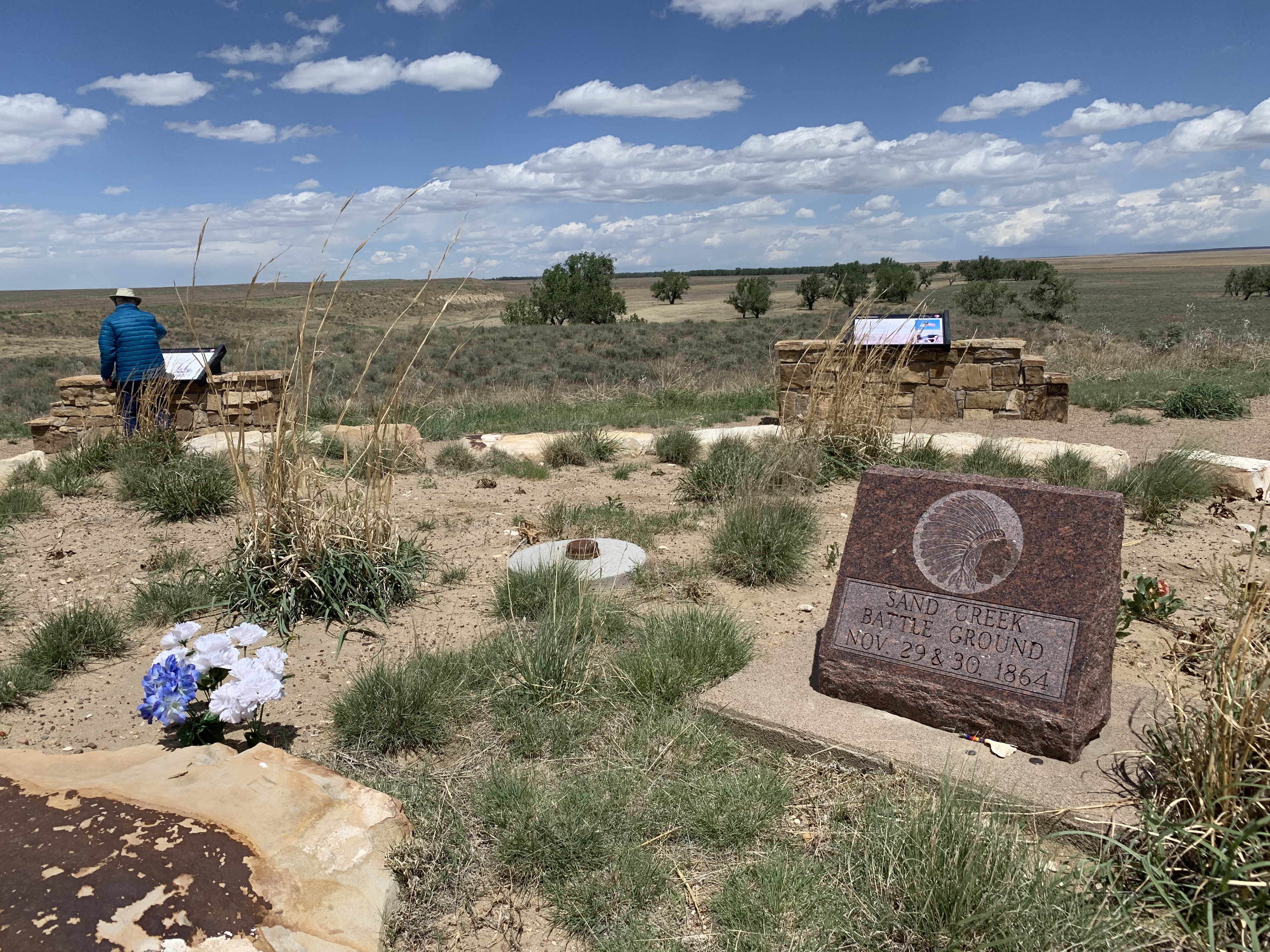
Somewhere along the line, these same natives were portrayed as bloodthirsty savages, and that racist portrait continues today. I have not yet had time to fix it, but Wikipedia’s entry on this site has extensive quotes from a 19th century book in an apparent effort to justify the massacre here, pointing to another ”massacre” by natives that provoked this military action. But that was a family of four killed ”supposedly” by natives, and other events described as native ”attacks” were actually thefts, robberies and destruction of property.
The natives were the victims, both here and elsewhere. They lost their bison, their land, their freedom and their way of life. Many of their sacred lands were stolen by illegal acts of the US government, and many lost their lives to settlers and soldiers. Yes, some Native Americans fought back, following repeated provocations. I read of one chief who, after working his whole life for peace, returned home to find his family slaughtered, and he turned to war. But it is dishonest to confuse the aggressor with the victim. Most Americans live in states or places originally named by natives, but there continues to be a desire to honor those ancestors who participated in the land theft, forced removals and slaughters of Native Americans. Only some Utes remain on tribal lands in Colorado. The town immediately south of the park is named Chivington, but when you learn what he did, you will find that honor to be a disgrace.
According to witness accounts of soldiers under his command, Colonel Chivington, who helped win the Battle of Glorietta Pass, was a politically ambitious man who wanted to add more victories to his resume. Peaceful native chiefs gathered here to continue peace negotiations under the protection of the local US military fort. Chivington knew that, and two days after the local commander transferred east, he attacked the village with 675 cavalry and 4 mountain howitzers. Two of his officers refused to follow orders, reported the massacre, and testified to investigators. They saw women and children bludgeoned to death while begging for their lives. Over 230 natives were massacred, including around 150 women, children and elderly. The details are horrific. Many bodies were mutilated post-mortem, and soldiers took ”trophies” including scalps, fingers, etc. to display in public. Fueled by greed and paranoid racist hatred, the townspeople treated the soldiers as heroes. But the government investigated and determined that it was an unjust, brutal “massacre”, ordering reparations (unpaid) and the removal of the governor for his involvement. Chivington, once a minister, escaped justice by resigning (loophole later closed) and the two men from a related military unit who murdered one of the witnesses also escaped justice. The other witness became a local sheriff.
As tragic as this story is, there was another similar massacre by US soldiers with a higher death toll at Bear River in Idaho. It also is tragic that many people even today, such as the Wiki liar, refuse to acknowledge the massacre as criminal and morally indefensible. At least the National Park Service is doing its job and preserving the site and the truth.
A promised utopia for ex-slaves, this remarkable small town has also, like my last stop, preserved its cultural heritage. Named for both Nicodemus who asked Jesus the price of rebirth and for the old spiritual ”Wake Nicodemus” who asked to be awakened for the Jubilee, perhaps the best preserved and restored building is the AME Church above. But in the visitor center I met the living exhibits: the 5th, 6th and 7th generation descendants of those resilient settlers who survived in the remote prairie. They explained to me that while the town is extremely small today, every year in the last full week of July, many more descendants return for a reunion and keep the unbroken traditions thriving.
Beautiful new park with many buildings dating back to 1785, and an active community of French cultural preservationists. There even seems to be a bit of friendly rivalry between the park service and the French living history museum folks. As the economy moved elsewhere, the town avoided development and kept their unique culture intact. There are three tours: a tavern, a French Don American (long story) governor’s house and a former slave’s house. Together they weave a fascinating story of a French settlement halfway between Quebec City and New Orleans.
Grant was a quiet, thoughtful man who was sometimes taken advantage of by others, developed strong moral convictions and enjoyed travel. He was also the leader who saved the Union in battle and in his Presidency. This is one of my favorite presidential homes, next to Sagamore Hill.
While he served in the war with Mexico, he correctly deduced that it was “a wicked war” waged to expand slavery by taking territory from a neighbor in the midst of internal conflicts. After leaving the military to be with wife and kids, he somehow wound up owning a slave, most likely received from his father-in-law, and Grant freed him. His father-in-law kept his other slaves, until they escaped during the Civil War. Unlike some Union generals, Grant advanced African American units as key to victory.
I have now visited a number of his battlefields, but here at his (and his in-laws’) home his views are made clear. Grant clearly attributed the cause of the Civil War to slavery, and as President he fought hard for African American rights, establishing the precedent of sending in troops to protect African Americans being terrorized by racists including the KKK. Grant was often underestimated, even by historians, but in life he counter-attacked aggressively, and in history his core views have proven to be right.
Local archaeologists started digging here under the overhang, but soon the Smithsonian took over, finding evidence of over ten thousand years of continuous use by Native Americans. There’s a particular style of stone spear point found here that old and named after the site. There’s a also a nature trail along the creek that flows from underground, with birds and lush vegetation.
I wonder how our country could have evolved more peacefully, with more respect of different cultures and more generous sharing of technology. If not expelled from this place, perhaps Native American guides could be teaching stories from their oral traditions here and could be conducting their own research, instead of having their culture irrevocably damaged and their societies misunderstood.
Isolation and homogenization slow the progress of new ideas and retard civilization. Many of the towns I drive through appear almost identical, with people wearing the same clothes from the same chain stores and eating at the same restaurants. A few corporations own the most popular national brands. The sameness isn’t strength; it’s weakness. Diversity and integration take more effort, but they pay off in vibrancy, new ideas, and healthier, more resilient communities. We impoverish ourselves by rejecting differences.
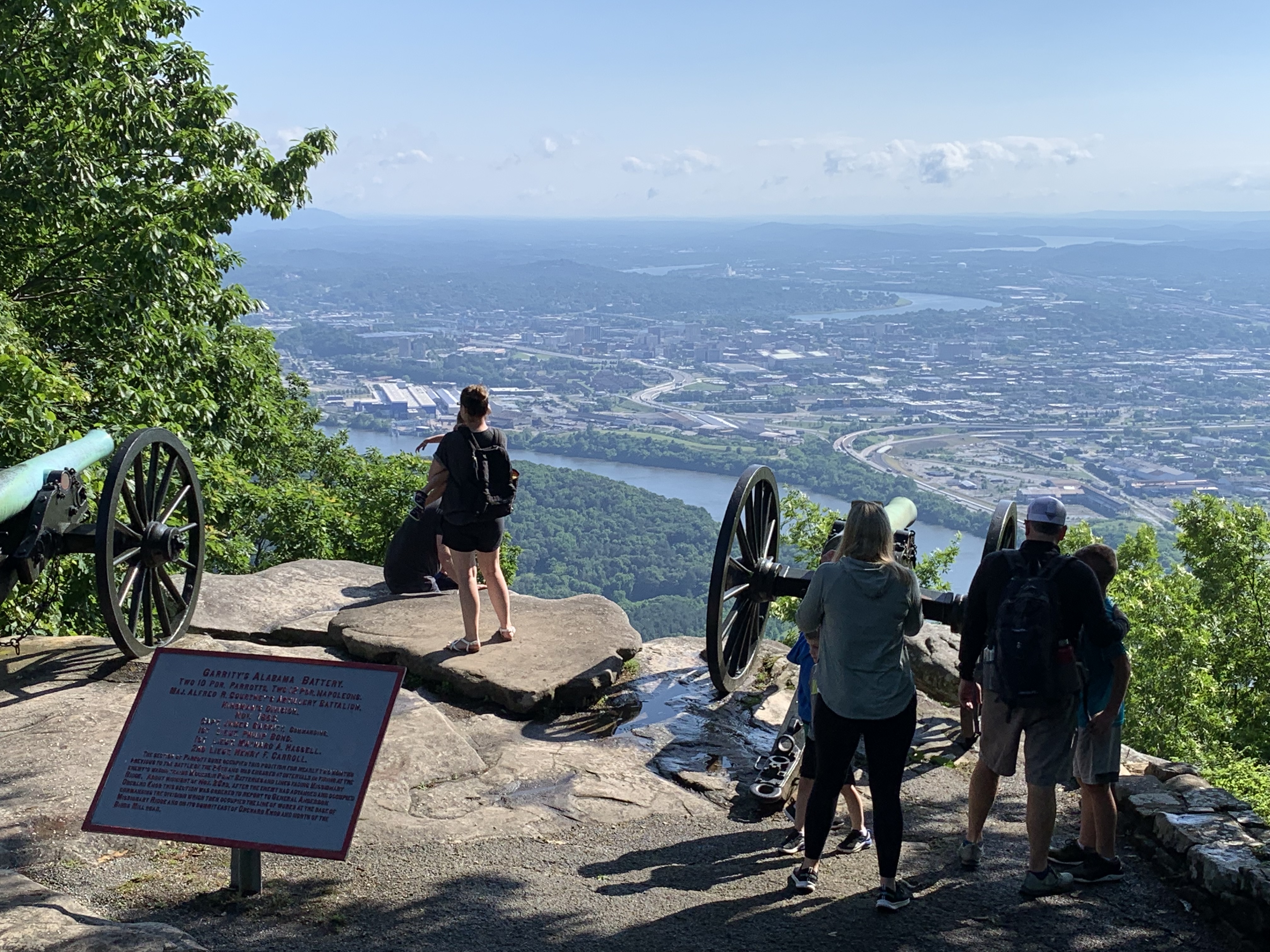
Before I rant again, let me just acknowledge that there’s a dramatically beautiful view on Lookout Mountain. Chattanooga below is in a strategic location at the bend of the river below. Long before the Civil War battles, the last overland battle of the Revolution was fought here. There’s even a steep funicular line to enjoy the view.
Militarily, controlling the high ground has always been the key. Grant used it to capture Chattanooga, and the confederates used it to try to recapture the city, unsuccessfully. Chickamauga nearby in Georgia is much flatter and covered with monuments to both sides. Which brings me to my brief rant. If even a fraction of the money and effort spent on monuments for both sides were used to explain the cause of the war, slavery, then maybe we wouldn’t have some politicians today still trying to claim that there are “very fine people on both sides” of racial prejudice. No. Racism was wrong both then and now, and the longer that we evade the obvious moral judgements here, the harder it will be to remove the poison.
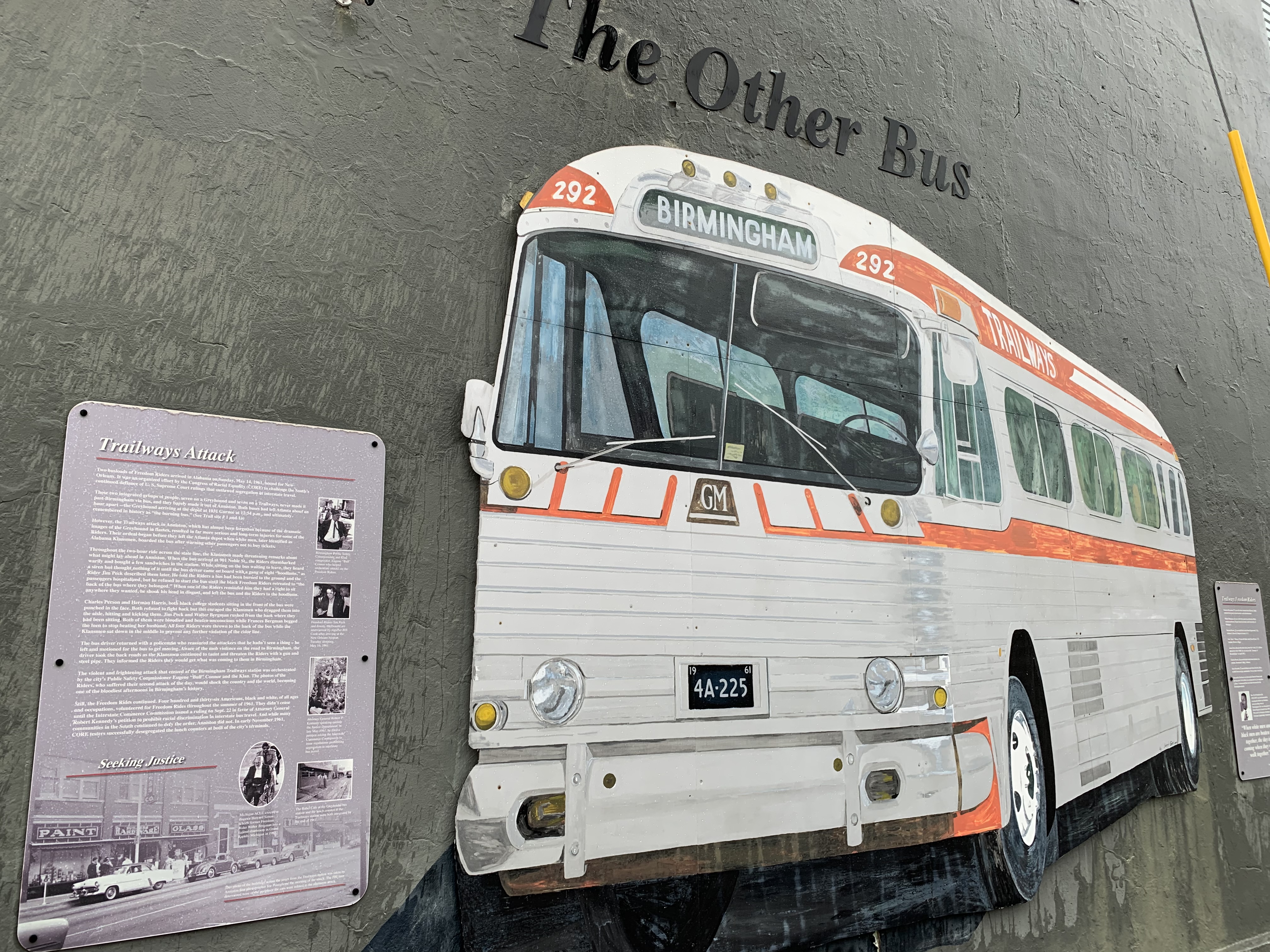
This is another underfunded Civil Rights site. The mural above is one of the few sights I found to see. As part of a systematic campaign to dismantle segregation, a small group of regular people rode buses between states in the south, where race mixing was not allowed under local laws. Since the federal government regulates interstate commerce and travel, they had jurisdiction. The activists exposed the racism, the NAACP lawyers brought cases to court, and eventually the Supreme Court outlawed segregation. Rosa Parks may have started the bus strikes, but it was the Court that integrated buses legally. The freedom riders were brutalized by the Klan, but their cause eventually won.
This may be the worst transition ever, but RV’s get about the same mileage as buses and some are even bus conversions. At a campsite near here, I was asked whether I was afraid of running out of electricity. We compared ”range anxiety” and realized that even with large fuel tanks, the rigs in the campground have less range than my long range model 3 Tesla’s 350 miles. Once loaded, they simply get such bad mileage that they have to go to gas stations more often than I need to charge.




 Zero Carbon Travel