Effigy Mounds National Monument

On the Iowa side of the Mississippi River looking across from the high bluffs toward Wisconsin, there are over 200 hundred mounds, round, linear, bird and bear shaped. They are in clear lines straight out from the river, and they date back roughly 1,000 years, evidence of cultural traditions that continued for hundreds of years. Although these sites typically do not make the connection, there are similar sites along the Mississippi and other rivers at overlapping time periods with evidence of trade between them. Bird symbols in particular are found in both modern and ancient Native American culture. Many similar mounds were flattened and plowed under after the land was stolen.

The hiking here is excellent, with many overlooks, including Fire Point above and Third View which looks upriver. The hillock to the right of the path is one of the mounds, first in a long line into the woods. A pair of hawks soared high above. If you can make it a few miles, your chances of seeing deer and other wildlife improve. Since it is a sacred site, please stay on the trails and do not walk over the mounds.

Cahokia Mounds

Tens of thousands of Native Americans lived in this city 1,000 years ago, and it was the center of the Mississippian culture that thrived in the valley and as far as Ocmulgee in Georgia. In the distance from atop 100′ high Monks Mound (named for French Trappist Monk settlers), you can see Gateway Arch. This is the largest Native American mound north of Mexico, and it is still an impressive, tiered, geometric structure surrounded by 50 other smaller mounds of different shapes and sizes, for burials and as foundations for public buildings. There’s also an astrological calendar circle with wooden post markers, called “Woodhenge”.

Cahokia is actually both a state park and a UNESCO World Heritage Site but not a national park site. However, it is on the Lewis & Clark National Historic Trail, and Illinois’ Senators have asked President Biden to make it an official national park site. It’s simply too big to ignore, so, I stopped and climbed, even though the visitor center is closed.

Herbert Hoover National Historic Site

Hoover may have been a Stanford graduate who made his fortune working on foreign mine extraction projects, but he grew up poor in this tiny house in a rural Iowa Quaker village. Note the outhouse in back and his father’s blacksmith shop on the right. His hardworking father died of heart failure and his even harder working mother later died of typhoid and pneumonia. Herbert’s relatives took him and his two siblings in, and he grew up in a school principal uncle’s house in Oregon.

I also visited his Presidential Library & Museum next door, run by the National Archives. They go to great lengths to rehabilitate Hoover’s reputation, since he was widely blamed for the Great Depression. They point to his conservation efforts for example, but neglect to mention that his 5 million acres are not as much as Teddy Roosevelt’s 150 million acres. The museum helped convince me that Hoover was a generous humanitarian who saved many lives in Belgium, Russia and elsewhere by running food aid programs, who was elected with extremely high expectations, and who implemented a variety of positive programs (not just the dam). I genuinely think he was a smart and nice guy.

But, Hoover was an ardent believer in solving social problems with volunteerism and without government intervention. Even though he had warned Coolidge about the dangers of stock speculation, Hoover was all about efficiency, not reform. Hoover had seen massive, desperate social failure all around the world, including being trapped in the foreign enclave during the Boxer Rebellion with his wife (see movie, ’55 Days at Peking’). But he still believed that if government supported business leaders and capitalists, then everything could be solved with goodwill and determination.

He was wrong. FDR crushed him and immediately implemented massive social programs including unemployment payments, government work programs, and Social Security. In retrospect, Hoover should have been able to look at his own family’s struggle with poverty and the tragedies of his parents’ deaths and consider that maybe government intervention would have helped them in their hour of need. Instead, he shared the common views among the ruling elites, that government programs like military protection for foreign business interests in China are good but that government programs like unemployment relief are bad.

Lincoln Home National Historic Site

It’s not his hat, but the small desk is where Lincoln wrote his early speeches. In the parlor downstairs, he held the funeral service for his son, Edward, and years later was invited to be the Republican nominee for President. In this house, he refined his political views and his arguments against slavery. Lincoln drew from his early childhood and boyhood experiences to become the most powerful advocate for freedom.

“As I would not be a slave, so I would not be a master. This expresses my idea of democracy. Whatever differs from this, to the extent of the difference, is no democracy.”

Abraham Lincoln in 1858

Lincoln understood the fundamental flaw in our country, that the ideal of equality did not apply to all and that Democracy and slavery are absolutely incompatible. He knew that most voters held racist views and did not want war to bring about immediate equality. So he was careful, not always the loudest abolitionist, and he opposed John Brown’s raid. But Lincoln was determined to end slavery, crafted a greater variety of effective, convincing arguments against slavery, introduced legislation and used his arguments in debates against Douglas.

“That is the real issue. That is the issue that will continue in this country when these poor tongues of Judge Douglas and myself shall be silent. It is the eternal struggle between these two principles — right and wrong — throughout the world. They are the two principles that have stood face to face from the beginning of time; and will ever continue to struggle. The one is the common right of humanity and the other the divine right of kings. It is the same principle in whatever shape it develops itself. It is the same spirit that says, “You work and toil and earn bread, and I’ll eat it.” No matter in what shape it comes, whether from the mouth of a king who seeks to bestride the people of his own nation and live by the fruit of their labor, or from one race of men as an apology for enslaving another race, it is the same tyrannical principle.”

Final Lincoln-Douglas debate

Beyond the home tour, I found the neighborhood fascinating. One of the neighbors was a conductor on the Underground Railroad who gave the President-elect his inaugural ride to the depot. One was a Jewish family whose son helped build 5,000 Rosenwald schools to educate African Americans across the south. And one is currently being used as a local office for Senator Dick Durban. Springfield is all about Lincoln, and they have set aside 4 surrounding blocks of period houses, a short walk from the his Presidential Library and Museum. The museum there is modern, multi-media and includes an excellent map visualization of Civil War casualties over time. Explore the neighborhood, stay in an atmospheric B&B and eat at a fine restaurant. I did, at reasonable cost, and learned Springfield is on Route 66.

Dayton Aviation Heritage National Historical Park

Sorry for the lengthy post, but here’s a summary for those short on time. Watch the ‘On Great White Wings’ park film online, skip both interpretive centers and spend time at the Carillon Historical Park, where you can see the first practical airplane and other fascinating original Wright Brothers’ artifacts.

The Wright-Dunbar interpretive center is in the Wright Brothers print shop building, shows the park film and has exhibits about the print and bicycle businesses that funded the brothers’ aviation experiments. The poet Dunbar is not related to aviation, but he was an internationally acclaimed African American writer.

The Huffman Prairie interpretive center also shows the film, has exhibits about the Wright Brothers grand tour in Europe and has a nicely landscaped monument, but it’s also not essential.

If you want to walk on the field where the first practical airplane first flew, you need to find gate 16A at H Road on route 444, drive out past the shooting range and park in the woods behind Huffman Prairie Field. (Don’t let the sounds of shotguns spook you, as they’re probably out of range). Do not take Kauffman Avenue or 844 to the Wright-Patterson Air Force Base main gate and parking lot, since they won’t let you in. The brochure map will help, but the other maps were wrong.

As a private partner site included in the enacting legislation, the Carillon Historical Park is extraordinary. The park was funded by a local inventor whose wife liked the bells she heard in Europe, and in addition to holding Wright Brothers artifacts, the park has collections showing the varied inventive history of Dayton, including historic trains, bicycles and cars, historic buildings, exhibits and many helpful people. The museum of local inventions takes you from the cash register and electric starter to the space age. Best of all, the park runs a brewery, Carillon Brewing circa 1850, which uses traditional wooden equipment, old recipes and fire to make beer. If every historical park did that, there would be a million more visitors interested in history. This site is one of my favorites.

Friendship Hill National Historic Site

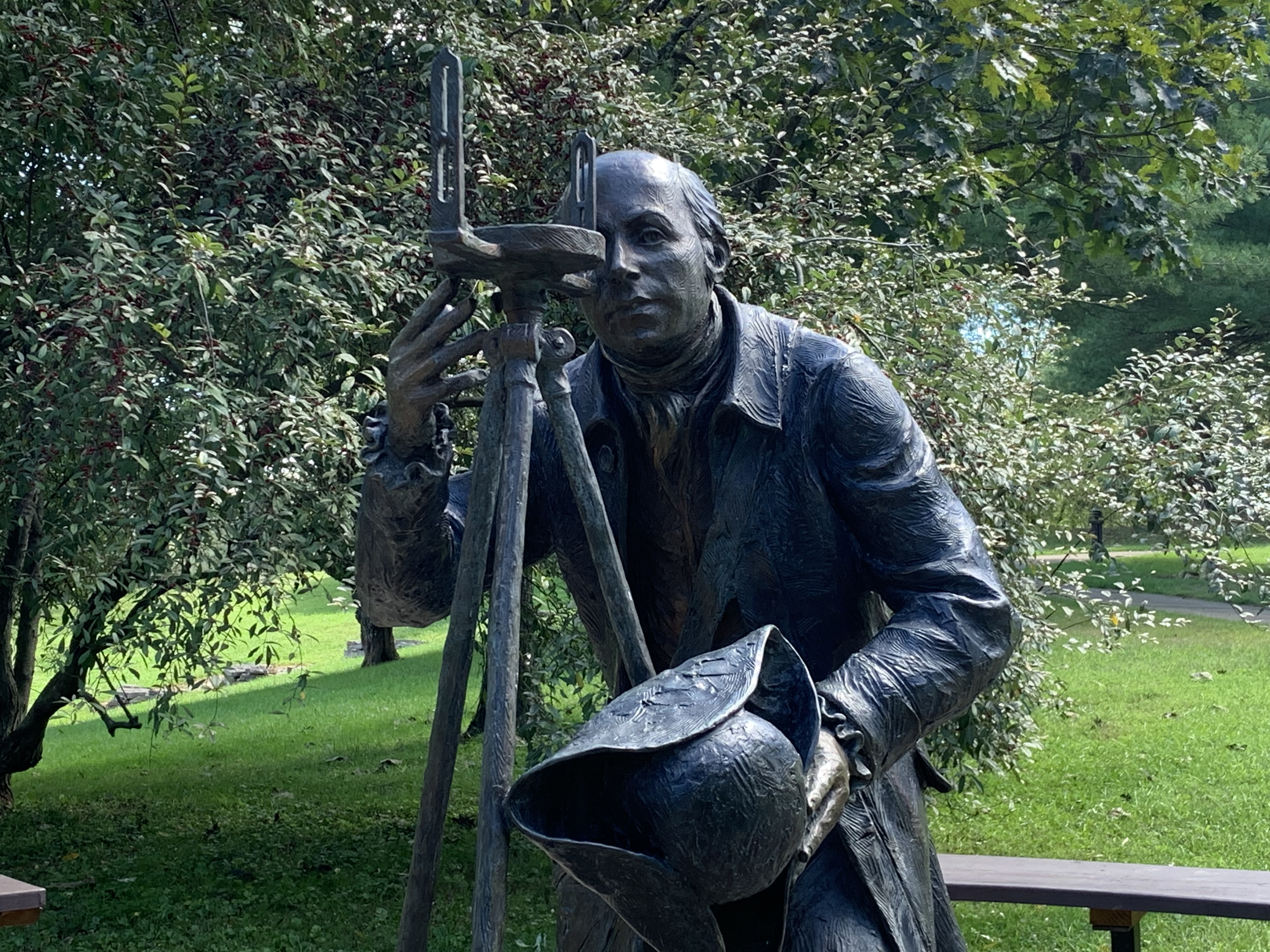
The National Road, now US 40, was our first federal highway. Washington started it when he cut a road up to Fort Necessity, and he later bought property there for a tavern. But the surveyor above, Albert Gallatin, is known as the road’s father. He met Washington and suggested a straighter route, and Washington agreed, encouraging the young man to work on it.

Swiss born Gallatin bought 400 acres here on the hill near the Monongahela River and soon became Senator. Gallatin tried to moderate the local Whiskey Rebellion, but Washington still sent in troops. After criticizing Hamilton’s financial plans, Jefferson made him Secretary of the Treasury, where he reduced the national debt and finance the Louisiana Purchase, Lewis & Clark and the National Road. Gallatin and Lafayette were friends and helped bring French pressure to help settle the multi-year War of 1812 at Ghent.

Gallatin’s bucolic country estate, 10 miles of forested trails and well maintained mansion behind the statue is well worth a stop along the historic highway.

Fort Necessity National Battlefield

“In 1753 a young George Washington crossed the Allegheny Mountains on missions he hoped would lead to a career as a British Officer and land holdings that would make him wealthy. He was unsuccessful in both goals and his actions sparked a war that spread across the globe.”

— National Park Service

We really need a better name than the “French & Indian War”. It sounds like some colonial conflict in South Asia. Indians Native Americans were only reluctantly drawn into fighting on both sides. I suggest the “Colonial Rivers War”, because that explains who, why and where. British and French colonial forces fought over control of rivers, portages and passes linking the St. Lawrence Seaway, the Gulf of Mexico and the Mid-Atlantic Eastern Seaboard.

At the beginning, the French & British were building roads, riverside forts and sending small armed groups into the passes to scout. Washington was in charge of a British force, found a French force, and someone fired a shot precipitating a slaughter that killed the French leader named Jumonville. Jumonville’s brother, Captain Villiers, then led a much larger force seeking revenge.

So Washington’s necessity was to defend his camp, which had been chosen in a pleasant, open meadow, good for grazing animals. As you can see in the photo, the fort was built under a hill, so Washington lost quickly and badly. (Fortunately, he improved tactics later). The French accepted his surrender, but the war over the colonial rivers continued for years, as part of a broader Seven Years’ War between the French and British globally.

Harpers Ferry National Historical Park

Since each park is unique, I would never be able to say which is my favorite. But this one is.

Here, at the confluence of the Shenandoah and Potomac Rivers, in 1859 the abolitionist John Brown led 18 men to capture the armory, arsenal, and rifle factory here, killing three men, freeing slaves and taking the town’s leaders captive, before being captured by Col. Robert E. Lee and martyred after a brief trial, becoming the first person executed for treason in America. Brown believed he was right, did not intend for anyone to die and argued at trial that “had I interfered on behalf of the rich, the powerful… or any of that class… this court would have deemed it an act worthy of reward.”

Native Americans lost this land to European settlers during the 16th and 17th centuries. Washington explored the area for his canal project and recommended an armory be built here. The armory supplied Lewis & Clark’s expedition, and the arsenal supplied weapons for the Civil War. During which the town changed hands eight times including the destruction of the arsenal, the capture of 12,500 Union soldiers by Stonewall Jackson and the critical resistance to the confederate army marching on DC. Major Delaney, the only African American field officer in that war, came from here, alongside many USCT recruits. Frederick Douglass and W.E.B. DuBois organized and lectured here, where the Freedman’s School and Storer College educated the descendants of slaves.

Thomas Jefferson stood on a rocky overlook and said “this scene is worth a voyage across the Atlantic.” The mountains, rocky cliffs, rivers, swamps, and floodplains here support diverse wildlife, including three species of hawk, a harrier and the bald eagle. There are over 20 miles of hiking trails in the park, including part of the Appalachian Trail (park & hike). And the tavern in town serves a draft amber ale called Almost Heaven.

“Almost heaven, West Virginia
Blue Ridge Mountains, Shenandoah River”

John Denver

Appalachian National Scenic Trail

It was hiking on the trail in New England as a boy that I got the idea to visit as many national parks as I could. Some of the counselors were discussing their trail names and talking about the best natural places to visit in the country. I never forgot that feeling of walking deep into nature, exploring, seeing wildlife, jumping into a swimming hole and imagining traveling to even more beautiful places. It took a long time, but I’m finally fulfilling part of that dream.

I don’t know if I have it in me anymore to hike the whole trail, but I would love to try. The relief map (above) in the park-partner Appalachian Trail Conservancy visitor center in Harpers Ferry gives you a sense of both the distance and the many mountains that must be summited. But I wasn’t about to take a gas-polluting bus to get from the Harpers Ferry visitor center parking lot into town, especially when I could walk a couple miles of the AT to get there. And I would recommend hiking the trail, even just a small section, if you can. For the adventurous, the expert suggested thru-hiking the trail in two sections, from Harper’s Ferry in the spring north to Katahdin in Maine and then from Harper’s Ferry south to Springer in Georgia in the fall.

Below, I’ve listed the units either on or next to the trail.

Chesapeake and Ohio Canal National Historical Park

The highlight of the canal has to be the tavern, lock and boat in Maryland across from the Great Falls Park in Virginia. It’s only a short walk here to a view of the falls from the ecologically important Olmsted Island, which was preserved by the son of the famous landscape architect. There are limited boat rides on Saturdays until mid October. Williamsport has a much more elaborate and functioning canal boat exhibit, but their rides are currently suspended. If time allows, I would like to come back next year to bike along the multi-state canal route.