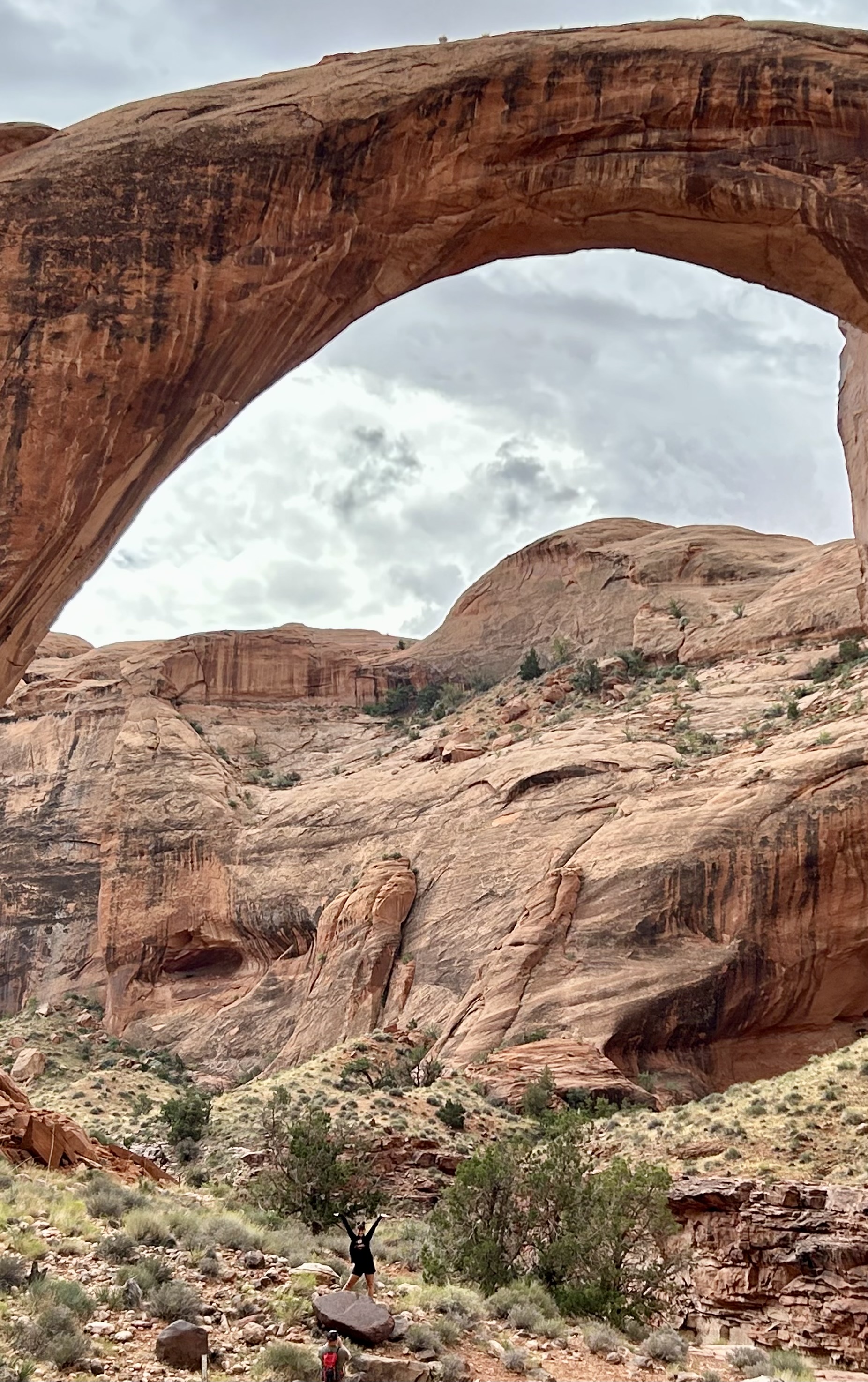
Luckily Lake Powell is high enough for the boat tour, which cost $145 and took 7 hours, including an hour hike, 30 minutes at the bridge above (see people bottom right for scale) and a beautiful song sung at the site by our Navajo guide. That’s far better than hiking overland for at least two days. At least Zane Grey (below left) had the sense to ride a horse. This is my favorite park to follow in his footsteps. The boat trip alone is marvelous, as Glen Canyon just gets more stunning the deeper you explore into Utah. But the canyon up to the monument is a delight too, with wildflowers, echoing cliffs & alcoves and a spring, allowing you a glimpse of a glen before the dam tragically flooded most of them. Before our Navajo captain navigated the twisting channel for the return trip, a brief shower brought at least half a dozen waterfalls down the towering rock walls. Spectacular!
Below Glen Canyon‘s Horseshoe Bend, there’s a low point at Lee’s Ferry where rafters put in to run the rapids down into the Grand Canyon. First they go under Navajo Bridge and through Marble Canyon. The Colorado River and cliffs here are still part of Glen Canyon, but there’s a large, ecologically important shelf or rim under the Vermilion Cliffs (distant above right) that was weakly protected. A few clever folks figured you could camp out right on the rim above and watch the rafts and stars go by.
I found this place above on the map, but it’s not well known. It’s called Rapids or Beaver Creek Overlook, and there’s a 2 mile dirt road from 89A not far from Cliff Dwellers & their destination charger and tasty restaurant. I asked a local Navajo woman about the road, and she described it as ‘nice and flat’. Which is true, because the views are lovely and the wide rim is basically flat. But it would have been easier in a high clearance vehicle. I guess she has a different standard for ‘nice and flat’. Still, my car is visible on the rim above to the right, so I can’t complain. If you go, please stay on the road or in one of the very primitive camping areas as the small cacti and desert soils are fragile.
Navajo and other tribes petitioned for better federal protection of such lands all around the Grand Canyon to prevent uranium mining and other damage. President Biden agreed. The park name means ‘where tribes roam’ and ‘our ancestral footprints’ in Havasupai & Hopi respectively. Even larger areas are now better protected in the west and south, including a large chunk of the Kaibab National Forest below the south rim. The new park is managed by the US Forest Service, so like Avi Kwa Ame it won’t count as one of the 425 official NPS units. Still, it’s new, important and on my way.
The canyon is sacred to the Navajo. As is too often the case with Native American places, the name is confusing. De Chelly (pronounced ‘du Shay’) is from a Spanish borrowing of a Navajo word meaning “canyon”. So, many people out there are mispronouncing a word in two languages in order to try to say “Canyon Canyon”. This is my favorite canyon.
I only made a brief stop at Antelope House Overlook on the north rim to get a photo of this spectacular canyon. Fortunately, I toured the canyon a few years ago with my kids. That’s really required to experience the history, culture and beauty. Our guide was a Navajo who explained some of the history and beliefs of her people who still live in the canyon. Although Kit Carson’s troops cut down the peach orchards and modern people have diverted water, the bottom of the canyon is still both productive land and a protected ecosystem. If you have the time and money, a horseback tour would be incomparable.
I don’t normally talk about traveling between park units, but the drive from the canyon to Farmington was spectacular. The combination of green forests, snow, and red & tan rock formations in the winding mountain pass is stunning, as was the view of Shiprock on the other side. I feel some sense of culture shock when passing through Navajo Nation, accentuated by the stark differences between communities on each side, and this time felt acute.
The post is still in use today, selling jewelry, blankets and other handcrafted goods. Navajo Nation spans a large part of northeast Arizona, and its border extends into Utah and New Mexico. Note well that they follow daylight savings time (unlike the rest of Arizona).
In the 1860’s, US troops under Kit Carson “burned villages, slaughtered livestock, destroyed water sources” and force marched thousands of Navajo to internment camps in New Mexico. The Long Walk and subsequent re-education programs damaged Navajo culture, breaking ancient familial bonds of language and traditions.
America has not dealt with this tragic history nor its consequences. And I’m not talking about Kit Carson’s legacy or that his name is ubiquitous in the west. I mean the US government’s responsibility for ordering people like Carson to execute this atrocity, against his personal views. We need to understand the mistakes of the past, atone and choose more wisely in the future.




 Zero Carbon Travel