Traditional historians have generally argued that the War of 1812 was about defending US maritime rights, especially of US citizens who were involuntarily ‘impressed’ into the British Navy. Jefferson had certainly left some trade issues with Britain, but such disputes rarely go to war. During the war, the northeastern states continued trading with Britain, and the treaty at the end of the war did not change the maritime rights status quo legally. Americans worked harder at getting compensation for slave owners whose slaves were freed by the British than for US citizens impressed into the British Navy. So that whole explanation for the war is obviously wrong.
More enlightened historians have argued that the War of 1812 was about expanding US territory at a time when the British were busy fighting Napoleon, as stated by the dominant party in Congress and President Madison, who called acquiring Canada “a collateral benefit”. During the war the US invaded Canada 10 times, took land in the southeast including in Alabama, Florida, Georgia, Louisiana and Mississippi, and took land in the then northwest including Indiana, Illinois, Michigan, Ohio and Wisconsin. Most of the US territorial expansion around the time of the war was from Native American lands, regardless of whether they fought for the British or the Americans. So that whole ‘expansion’ explanation checks out.
If we think about the war at all, most Americans view the War of 1812-1815 as about nationalism, patriotism and rallying around our flag, perhaps because we did not achieve any of our objectives, failed to take Canada and had our national capital burned. Canadians tend to view the war more as a heroic defense against our ill-conceived and unpopular aggression, as after all, the Americans burned York—their capital of ‘Upper Canada’ in Ontario province—first. The truth is always more complicated, as you can see comparing the capital burnings. After the British general retreated from York, local militia started fires to prevent the Americans from seizing their supplies, and the resulting gunpowder magazine explosion killed the American general along with ~200 other casualties. The American troops, not under official orders, burned public buildings and businesses. When the British seized Washington DC, they burned most public buildings, including the White House, under orders. Which gives you a sense of the animosity at the time.
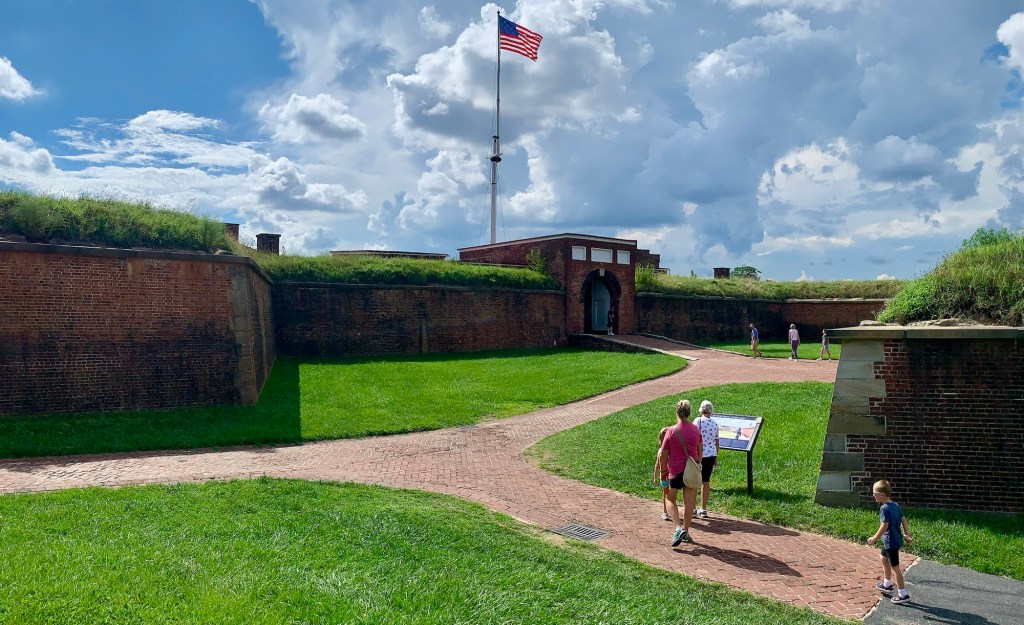
Fort McHenry, Fort Washington and the Star Spangled Banner trail focus on the dramatic events around DC and Baltimore, but there are other US park sites that tell more of the story. Along with failing to continue Washington’s peaceful tactics and trade agreements with Britain, the expansionist Jefferson hired Albert Gallatin to reduce the national debt, and Gallatin cut the military budget, leaving successor Madison the contradictory problems of war and a weak military. The US could not match the British Navy in the Atlantic, except for the USS Constitution: Old Ironsides. So the British blockaded the US ships along the eastern seaboard, except for smugglers in New England. So, technically port forts like Monroe and those guarding Mobile Bay had roles in this war, but their primary historical importance is based on events of other times.
The old Northwest Territories around the Great Lakes were long contested by the Americans, British, Native Americans, French and Spanish. River Raisin, near Detroit, is a good place to learn how we provoked the War of 1812 to take native lands. The Americans had two great naval victories during the war, first in 1813 on Lake Erie, where Perry broke the British inland fleet and cut off their supply lines to their western forts, and second in 1814 on Lake Champlain, where Macdonough thwarted a British invasion via the Hudson. The Americans made several incursions into Canada, but were unable to hold territory north of the Great Lakes and even lost their poorly manned Old Fort Niagara in New York, returned by treaty. The war encouraged the French and British in Canada to join together for common defense, eventually forming Canada in 1867. The military stalemate clearly defined the eastern border between Canada and the US, contributing to our long peaceful history since.
In the American southeast, the more consequential war was the simultaneous Creek War and related actions. At Horseshoe Bend Andrew Jackson used Cherokee and Creek allies to defeat other Creeks, even as his allies took lands from both sides. When Napoleon abdicated, the British no longer needed to kidnap American sailors to fill their fleet, and they were able to turn their full attention to their former colony. The American diplomats, led by John Q. Adams along with Gallatin and others, wisely negotiated a peace treaty. But before the news arrived stateside, Andrew Jackson took New Orleans, with the help of the French pirate Jean Lafitte in a story told here. Jackson leveraged his victory to win the White House and used office to enforce the Trail of Tears. He also invaded Florida in 1818, convincing the Spanish to sell the territory to us in 1819. While the Native Americans lost the most in the lead up, during the war and in its aftermath, many African Americans took the opportunity to escape to Canada along the Underground Railroad.
Often overshadowed by the Revolution and the Civil War, the War of 1812 offers many lessons of popular patriotism driving greedy expansionism, reckless militarism and brutally unfair racist policies, with costly, unforeseen consequences. Rather than simply look at flags or teach our kids one heroic story, we should think critically about history so we can make better decisions in the future.

 Zero Carbon Travel