MotorCities National Heritage Area

Behind “Elizabeth” above is the secret room where Henry Ford designed and built the first Model T in his factory on Piquette Avenue on the then outskirts of Detroit. His buddy Harvey Firestone got the first ride, and then Ford road-tested the vehicle by driving through Wisconsin to the Upper Peninsula on a hunting trip. (Along with the influential naturalist John Burroughs and the inventor Thomas Edison, the four were close friends and camping buddies). Then, introduced in 1908, the Ford Model T took over the US car market.

Roughly half the price of a horse-drawn carriage (including horses, shoes and fodder), priced lower than competing cars, and offering useful attachments like truck beds, skis or tractor wheels, folks loved the rugged, practical vehicles. Ford had already built models B, C, F, K, R, N and S in this factory, but a lighter weight steel allowed him to build the vehicle he knew would be popular in rural America (Ford grew up on a 200 acre farm), the Model T, with 6 models ranging from $825 to $1100: the Roadster, Tourabout, 5-Passenger Touring Car(above), Town Car, Coupe (popular with doctors) and Landaulet (taxi). The original Model A that had been built down the road in 1903 was redesigned and reintroduced in 1927 to replace the Model T as another commercial success. Of over 100 car makers in Michigan when Ford started, his is the only original firm remaining.

By making the popular standard car, Ford determined the direction of the industry. His wife insisted the steering wheel be placed on the roadside, so that when he drove she didn’t dirty her dress while stepping to the curb. Instead of alternatives like steam-punk coal-burning vehicles or electric vehicles—several of Ford’s earliest vehicles were electric—, gasoline was readily available across the country for small machines and farm equipment. Before realizing that black paint was cheaper and dried quicker, red and green models were also sold, often with raw white rubber tires, as above. After making various improvements to the assembly process here, Ford designed his next factory with steel-reinforced concrete floors to bring parts down to the world’s first synchronized assembly line. While this fascinating heritage area includes many different car museums, the Piquette Factory tour must be considered the highlight, with two dozen early model cars built here on display over 100 years later.
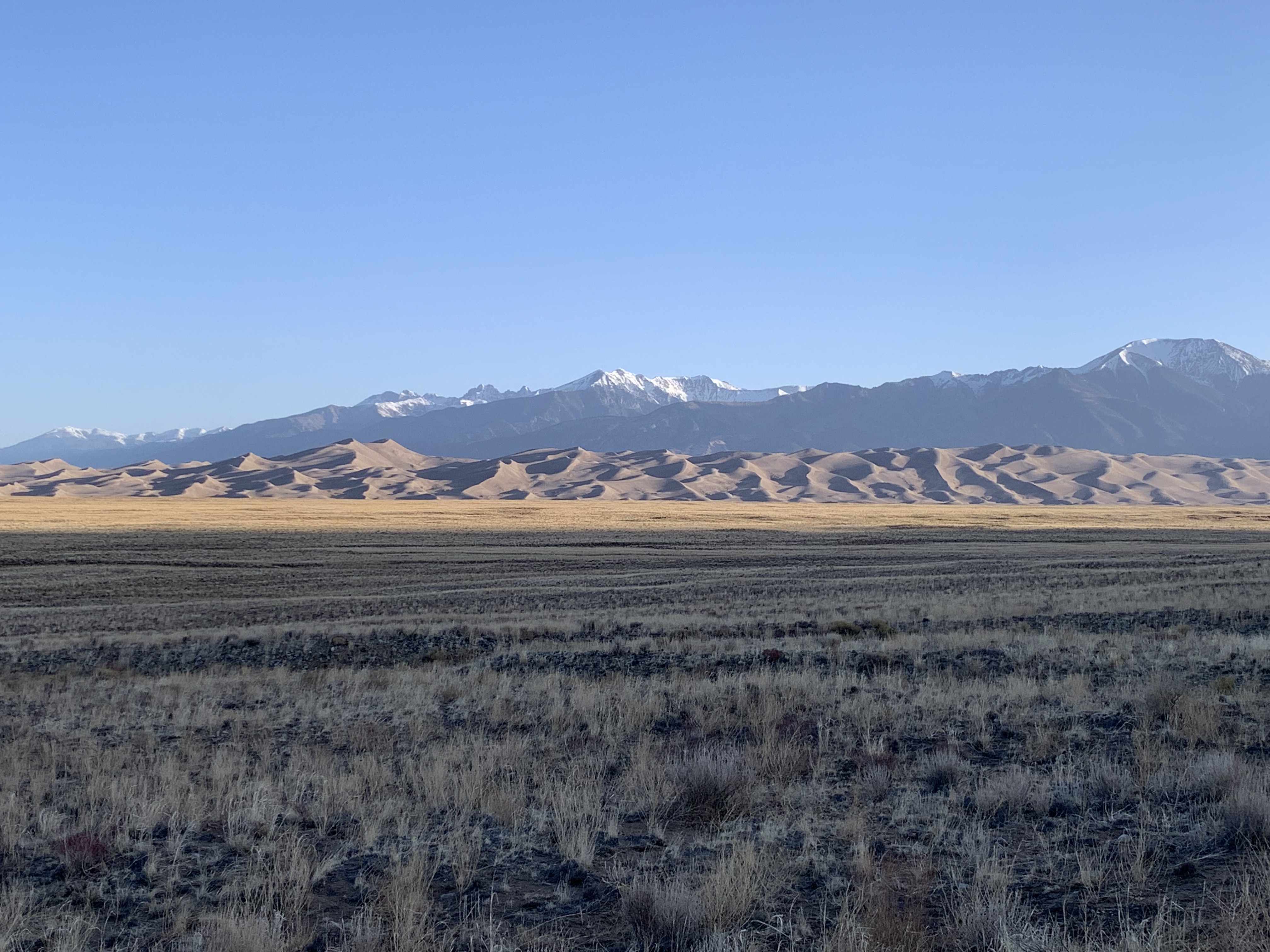
Great Sand Dunes National Park

I’m obviously not much of a photographer, but I like this one. The tallest dunes here are over 700 feet, but they’re dwarfed by the surrounding mountains. Since I camped at Piñon Flats in the park, I was able to take this just as the sun came over the mountains, which added shadows for contrast. I hiked into the dunes before dawn and along the creek, but it’s not easy to take an interesting picture of so much brown sand, even in such a beautiful, surreal landscape in the moonlight. The dunes and the neighboring preserve are basically all wilderness, easily hiked into, and our footprints quickly disappear.

Whenever I wander into any wilderness, I always wonder about what we value. I have both a BS & MBA in business, and I worked in HQ at a Fortune 100 financial firm for a couple decades. And it seems to me that capitalism is terrible at valuation. One problem is that the first business to claim a resource is often just the first idea that comes along. There may be a better and more profitable use for a resource, but the quickest way to make money is typically the one that’s chosen. Another problem is that business people aren’t very innovative. If they see one business is successful in an area, then they will often just copy that idea. Economically, we’re far better off with a diverse set of competitive products and services than with a small number, because then we’re more resilient to market changes. But short term thinking dominates, which leads to over-investment in a few businesses, rather than a broad, diverse range of businesses.

It doesn’t take any special training to see this. Drive through most towns and see the same chain restaurants everywhere. Look at how similar most vehicles are or how all the fields in an area grow the exact same crop or raise the same cattle. Business is mainly herd behavior, and few want to risk money to develop a completely new business. Capitalists need tax incentives to change. Traditional car companies killed the electric car, then ignored Tesla, and now are demanding that the government build a charging network for them to compete. Who knew America’s largest and oldest corporations were such whiny cowards who need taxpayer handouts before they will adapt?

Why do I think about valuation in the wilderness? Because if the first guy to find this place had owned a cement company, he would have started carting off these dunes to make concrete. And then other concrete material suppliers would have copied him, lowering profits to nearly zero. And the wilderness would have been gone before anyone bothered to think whether there were any other better uses. The same is true of forests, wetlands, prairies, rivers, valleys, mountains and oceans. Capitalism rewards the first, fastest, cheapest exploiter for destroying wilderness, and penalizes long term thinking. Because time is money.