Cape Cod National Seashore

The park extends from the fist to the elbow, from around proud Provincetown to historic Chatham Harbor, and there’s much to see and do. For me, the quintessential experience is to find an isolated stretch of beach and walk until the birds far outnumber the people. I saw dozens of grey seals swimming right near the shore or lying on the rocks just off the beach. It’s difficult to get to any beach without passing a lighthouse, but if you want to climb one, your best shot is Highland Light (above), the first one commissioned on the Cape by one George Washington.

There are about a dozen named trails too, and I’d recommend hiking near Fort Hill, where you can see the Penniman House, get a great view of the marsh, and spot many different birds. With the aid of a birdsong identifier, I counted 18 different species in one day, including the rare Indigo Bunting and an uncommon Willow Flycatcher.

If you have a bike, consider taking the Cape Cod Rail Trail, which is a high-quality dedicated bike trail through about 1/3 of the cape, and there are also other decent bike lanes and bike trails. My first bike trip here a few decades ago, extended the length of Cape Cod, plus the islands of Martha’s Vineyard and Nantucket, returning by ferry from Provincetown to Boston. When I last visited the lighthouse above, it stood where I stood to take the photo above, because the highland cliffs are eroding at several feet per year, forcing them to move the lighthouse in the intervening decades.

Visiting in shoulder season, rather than July-August, helps avoid miserable traffic and exorbitant hotel rates. There are also lots of good seafood shacks, still one or two cheaper motels, some campgrounds, and lots of nature. Wellfleet is well known for oysters, and the fried clams here are the best I’ve had. I’m still on a quest to find the best lobster roll, and I suspect it will be lifelong. Though speaking of seafood, I would be careful swimming around here, as great white sharks prowl along the shores.

Fire Island National Seashore

The 32 mile narrow island park is interspersed with small communities of folks who have taken responsibility for protecting their long and fragile wilderness. Around Watch Hill there’s a salt marsh, home to many birds. Near Sailors Haven, there’s a Sunken Forest of centuries old Holly trees below protected by a double row of dunes. There are beaches, boardwalks, small boat harbors and historic homes within the park too. In 2012, Hurricane Sandy temporarily breached the Fire Island Wilderness, cutting a path from the Atlantic above through the dunes to Long Island Sound. You can cross the Smith Point bridge—while its replacement is being built—at the eastern end of the park and hike in from the Wilderness Visitor Center.

If you’re driving in from NYC, navigation software might direct you across the Robert Moses Causeway to the west end where you can hike to the lighthouse. But be aware that park ‘roads’ are limited to authorized vehicles, and visitors typically arrive via passenger ferry from places like Sayville. After just such a detour, I barely caught the Sunday ferry to Sailors Haven, my last chance to see the Sunken Forest below for a week during the limited fall schedule. Besides a stand in Gateway NRA in Sandy Hook NJ, this is the only grove of its kind in the world, and there’s a lovely boardwalk nature trail to enjoy the trees, birds and scenery.

New England National Scenic Trail

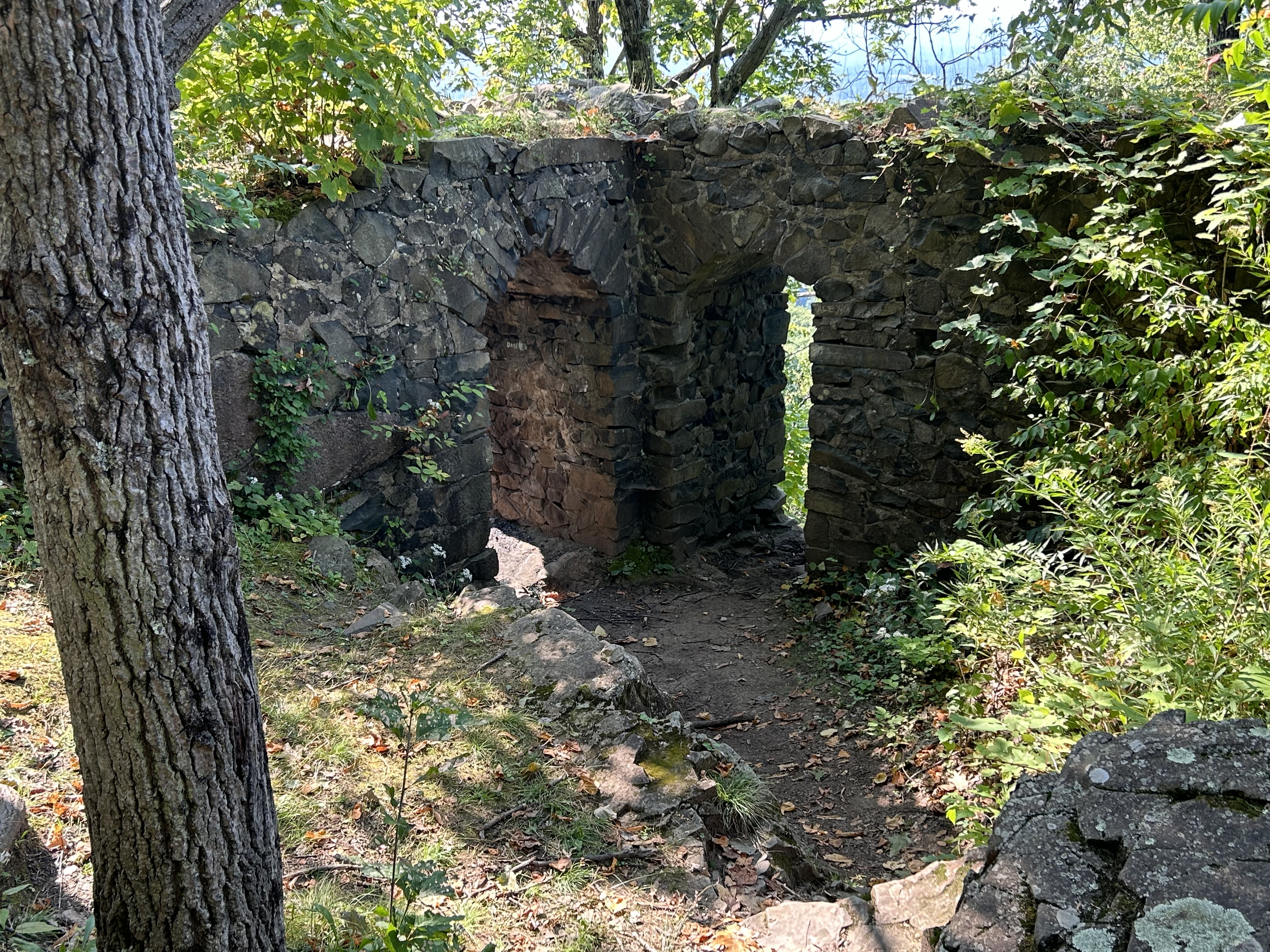
Mt Tom in Holyoke Massachusetts is a high point of the trail along the Connecticut River (although there are mountains over ten times higher in Colorado). The trail runs along a high ridge with several lookout towers to watch hawks or catch a glimpse of the river over the trees. The Eyrie House Ruins above are of a view hotel that burned down 123 years ago. As usual, I had forgotten about my childhood visit here, until I reached the ruins and climbed a rusty old tower to see the view below.

The trail is 235 miles from Long Island Sound to the New Hampshire border, through native lands, over rugged mountains, through annually brilliant foliage, past reservoirs, waterfalls and quaint New England villages. Last year, President Biden elevated the trail to a full national park unit, along with North Country and Ice Age National Scenic Trails. Hopefully, this step will encourage more people to hike and explore this lovely area of our country.

Ice Age National Scenic Trail

The trail is not straight. It meanders through Michigan’s wooded hills, green valleys and along its rivers and lakes. The trail begins along the Niagara Escarpment that separates Green Bay from Lake Michigan, then south below Madison, before crossing the Wisconsin River at Lake Wisconsin. Then it passes up across the bluff on the right with its characteristic rough rock glacial remnants on the steep slope to the north beach of Devil’s Lake above before continuing north to the Wisconsin Dells with iconic eroded rocks. Eventually it crosses the state to end at the St Croix River.

President Biden elevated the trail to a full national park unit, but many of the most scenic sections are in state parks or affiliated scientific reserves. Wisconsin Dells itself is quite commercialized, with water parks and pricey tours, even though the layered rock can be seen in several different places along the Wisconsin River. State parks like above or Mirror Lake have fine scenery, camping and miles of maintained trails. I tend to rush around and then spend too much time at supper clubs, but it’s worth slowing down a bit here to enjoy the natural beauty. For more, read my earlier post about the Ice Age Trails.

Niagara Escarpment Biosphere Reserve

Ignore the famed waterfalls and focus on Goat Island cliff in the middle. That wall is the Niagara Escarpment, caused by relatively hard rocks at the top holding the land underneath together, until it erodes away from the side. This two level land break—all erosion and not earthquake fault—is the key geologic feature to understanding the Great Lakes.

Much of the escarpment is in Canada, and even where it crosses the border to form Niagara Falls, it’s easier to see from the Canadian side as above. It runs along the south shore of Lake Ontario, across Niagara Falls (above) where it sets the level of Lake Erie, northwest through Ontario where it guides the Bruce Trail, up along the north shore of Lake Huron where it splits off Georgian Bay and shapes Lakes Huron and Michigan, along Michigan’s Upper Peninsula where it separates Lake Superior, and down the Door Peninsula past Green Bay in Wisconsin. After driving around the Great Lakes, it’s apparent how the water levels depend on the escarpment: Superior is the highest above both ends, Michigan and Huron are the same level in the middle, and shallow Erie is a little lower, held back at Niagara Falls, before that river drains into the lowest lake, Ontario.

UNESCO defines the Biosphere as the mostly forested area of Ontario between Niagara Falls and Tobermory on the tip of the Bruce Peninsula next to Georgian Bay, roughly 500 miles along the escarpment. The geologically interesting landscape holds great biodiversity in wetlands, coastline, deciduous & conifer forests, and rocky bluffs, perhaps the most in Canada. And there are many opportunities to explore, photograph wildlife, hike, drive or boat nearby. I hiked on the Cup & Saucer Trail on Manitoulin Island, the world’s largest freshwater island, when traveling around the Great Lakes. There, the escarpment is eroded on both sides, providing many views along its edge, including Lake Manitou below.

North Country National Scenic Trail

The trail runs from the Appalachian Trail in the Green Mountains of Vermont, through the Adirondacks in New York, past the old portage trail at Fort Stanwix (above), through the Allegheny Forest in Pennsylvania, south into Ohio near Fort Miamis, north through Michigan, west in the upper peninsula past Pictured Rocks, down to the upper St Croix River in Wisconsin, through Minnesota from near Grand Portage to Knife River in North Dakota.

President Biden elevated the trail to an official park unit last November, and the trail is not yet continuous. But having explored various sections at different times in all 8 states across 4 regions, it is undeniably scenic, especially along Lake Superior, in the Adirondacks and other lesser known areas. There are many quirky old rural towns along the way, atmospheric local restaurants and adventures to be found, along with thousands of miles of hiking, of course.

Pictured Rocks National Lakeshore

Superior is the biggest, deepest and cleanest of the Great Lakes, and our most scenic lakeshore park is on the north coast of the upper peninsula of Michigan. Within the park are ~10 miles of dramatic 200’ cliffs, painted by various minerals washed through the sandstone, and the best way to see is by boat. The pastels, turquoise shallow waters, green trees, blue skies and waterfalls (below) are spectacular.

Besides taking a popular commercial tour of the most scenic section of the cliffs in a couple hours, as I did, it’s possible to kayak or to hike along the edge. Lover’s Leap (above) has only 3’ of water below, so don’t take it literally. The lakeshore trail—part of North Country NST—is 40+ miles over dunes, creeks, and long beaches, with many side trails exploring forests, marshes, and lookouts. Short hikes can be done near the ends of the park, but the middle is roadless.

Sleeping Bear Dunes National Lakeshore

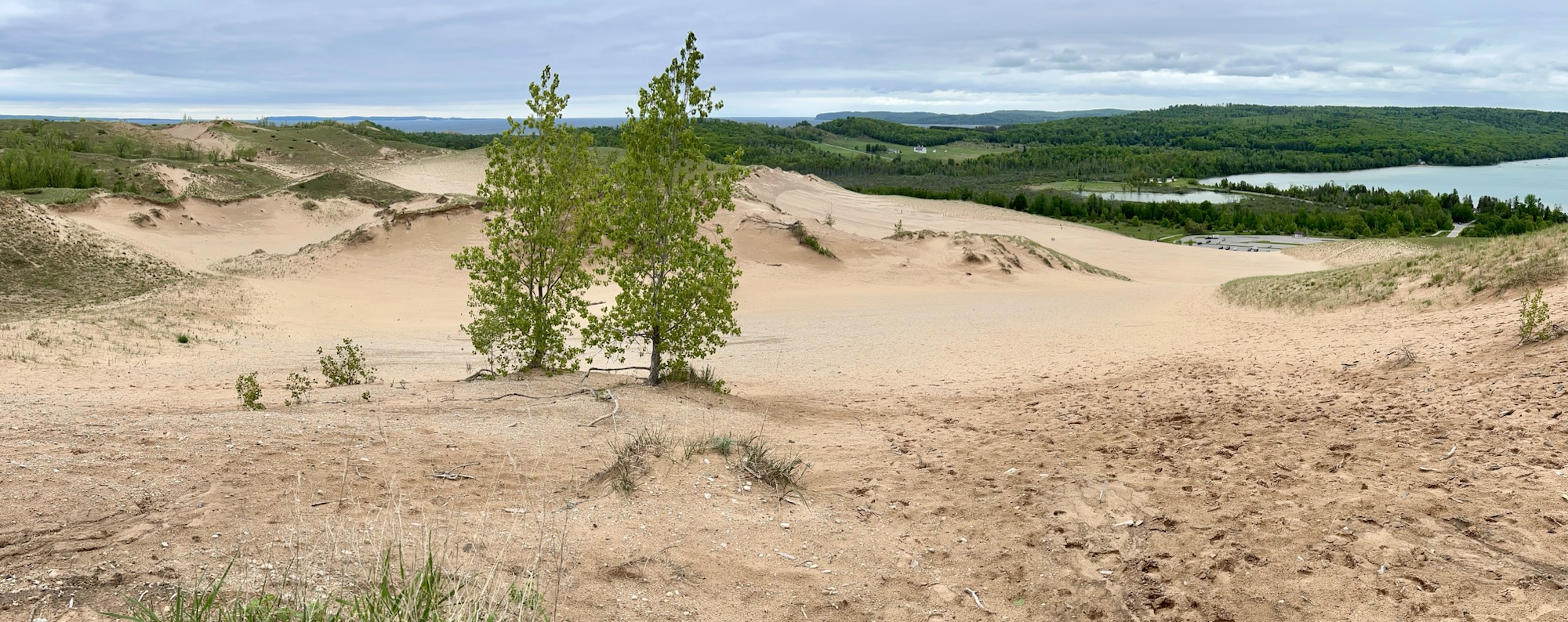
The small lake on the right is Glen Lake, and Lake Michigan is at the top left. If you zoom in to the right, you might see tiny people climbing the middle dune from the parking lot. I got up to this vast view on the pleasant Cottonwood Trail (less than 2 miles round trip) from the Pierce Stocking Scenic Drive, which also takes you to the breathtaking Lake Michigan Overlook and the splendid Sleeping Bear Overlook. Many folks seem to want to do things the hard way, but I definitely recommend hiking from the scenic drive. The impressive Sleeping Bear Dune itself is over 1000 feet high, and folks frequently need rescuing ($3,000) after climbing down to the lake and not being able to climb back up. A few extreme winter folk ski down the steep dune to the lake. Not sure how they get back up. Please stay on the trails, as past humans caused much erosion damage to the fragile ecosystem here. This is a beautiful park with wildlife, deep Native American roots, and it is part of a new UNESCO Biosphere across northern lower Michigan.

Isle Royale National Park

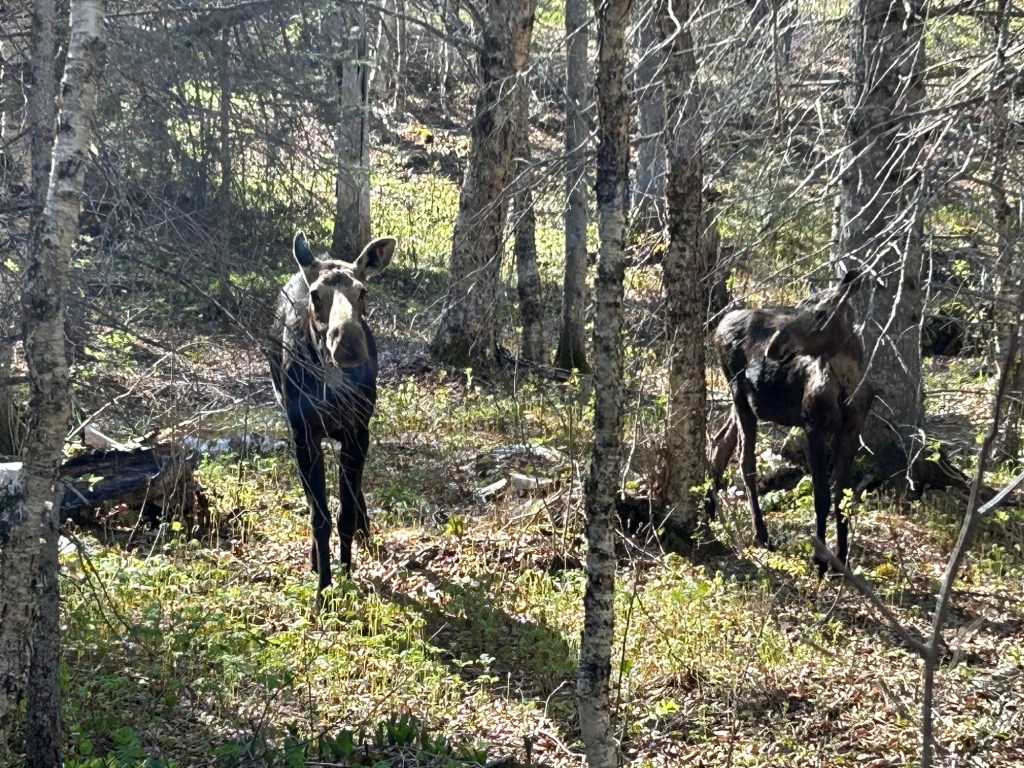
This is now my favorite park for wildlife. I was lucky to get a photo of this moose and her calf on the 1 mile Nature Trail in Windigo just before my boat left. Despite seeing loons, mergansers, swans, geese, and even a bushy tailed fox parading near my shelter on Washington Creek, I had neglected to take any decent wildlife photos, so until these two approached me, all I had was one photo of two ducks: a paradox.

I hiked a dozen miles and enjoyed the pitcher plants and boardwalks through the swampy areas and the mossy boulders on the north shore. The island is larger than I imagined, so be sure to download the park map in advance and charge your phone. This Biosphere is one of the least visited National Parks but most re-visited. Many folks hike the length over several days, and early in the season there were many volunteers hiking off-trail doing scientific research on wolf-moose predator-prey. A few were carrying a canoe for inland lakes. It’s an idyllic place, with hours of silence and solitude, a wonderful trip into the wilderness.

Isle Royale is in Lake Superior, and the shortest ferry ride is a couple hours from Minnesota to Windigo. The island is part of Michigan, and there are also ferries from the Keweenaw Peninsula in Upper Michigan to Rock Harbor. Most visitors are experienced hikers who backpack to their campgrounds, and it’s 40 miles between Windigo and Rock Harbor. Some arrive by private boat, and several campgrounds have docks. Lodgings are limited to Rock Harbor and a couple cabins in Windigo, and rooms are both very expensive and typically sold out many months in advance. The season roughly runs from early June to early September, so it’s a good idea to plan your trip a year in advance.

Aqueduct of Padre Tembleque

OK, it’s not a solar eclipse, but this 450+ year old World Heritage Site is impressive. Only about 25 miles from the pyramids of Teotihuacán, this 16th century Franciscan Aqueduct carried fresh water from a volcano 30 miles over the countryside, underground and over the Papalote (kite) ravine above, with 120+ arches overall. If you approach from Mex 88 outside Santiago Tepeyahualco, there’s a short gravel drive to a parking area watched by local police, where the aqueduct begins. It’s easy to walk down to see the 125’+ high arch in the center, and it’s cooler if you stay in the shade of the Roman design. I wouldn’t recommend trying to drive further on the “roads” nearby, which are more like cow paths. There is a small rail line and a creek flowing under at the bottom, with a footpath built into the bottom of the arch for hikers to cross. There are a few other sections, but this is the most impressive.