Upper Housatonic Valley National Heritage Area

The Housatonic River runs down the western edge of Massachusetts through Connecticut, and the heritage area is shared by both states. Connecticut gets the best natural areas—the bogs, fern filled cobbles (hills) and pine forests—and Massachusetts gets the best historic places. My childhood schooling is filled with stories from the Berkshires, so I wanted to revisit The Mount (above) in Lenox Massachusetts most of all. And how much improved it is! But that’s getting far ahead of the story.

The Mohicans lived here first, and before the Revolution, English settlers swapped land with them. Some of the first to learn to speak the native language were missionaries, and Rev John Sergeant’s house in Stockbridge can be visited during the summer. After Independence, the Shakers settled in Pittsfield, and their living history museum is recommended too. The old mill of the company that makes the paper for US currency is in Dalton. Herman Melville and Nathaniel Hawthorne lived and wrote here around 1850, and Melville’s Pittsfield home can be visited too. W.E.B. Du Bois was born and raised in Great Barrington, and there’s a walking tour in addition to his homesite, not far from Simon’s Rock, which has an excellent program dedicated to Du Bois.

Edith Wharton built the Mount in 1902 and wrote many of her most famous books there. Her maiden name was Jones—as in the phrase “keeping up with the Joneses”—and her husband was related to the business school. She had already rebuilt Lands End on the Cliff Walk in Newport RI, making Interior Design a profession when she co-wrote a book about it. Gilded Age women were not supposed to be progressive writers, but Edith Wharton was, becoming the first woman to win a Pulitzer for Fiction in 1921 with The Age of Innocence.

When I visited the Mount as a child, the girls’ equestrian school there had just closed, and the once magnificent home was falling apart. I remember adults being much concerned with marble fireplaces collapsing, whether a Shakespeare company might help save it, or whether it would be demolished for condos. I liked the formal garden but little remained of the famous author who lived there. But thanks to some devoted preservationists, including a collection saved by a book dealer in London, the home and library have been gloriously restored. Highly recommended.

Salem Maritime National Historical Park

[In July 2025 the president upgraded this park from a historic site to a historical park]. Per Tripadvisor, this site doesn’t even make the top 10 things to do in Salem Massachusetts. Honestly, I would recommend the Peabody Essex Museum, the House of Seven Gables, and a nighttime witch walking tour before I’d send someone here. Not that it isn’t an interesting site that describes the port’s peak between the Revolution and the War of 1812, it’s just that there’s a lot of fascinating history in Salem outside the park.

In the several 18th century buildings near the wharf run by the park service, you can learn about the British East India Company, trade with the West Indies, slave traders, Polish immigrants, and more than you wanted to know about how goods cleared customs and were taxed (Hawthorne worked there but spent his time thinking up The Scarlet Letter). There’s a replica tall ship, the Friendship, docked on the wharf, but it’s under restoration—looks better inside. The 19th century Derby Light Station above still functions (solar, upgraded from oil) and sits at the end of historic Derby Wharf, which is quite long and gives folks a nice view of the harbor.

Minute Man National Historical Park

OK. First thing you need to know is to avoid Lexington; nothing to see or do there. Sure, the first shot of the day (4/19/1775) may have been fired there (unknown who or why), but the untrained militia scattered immediately. Next, unless you’re interested in walking through the woods along the Battle Road and imagining the battle scenes, you can probably skip the Minute Man visitor center too. They have a film, in case you don’t know who the Minute Men were, but the action is all at the North Bridge in Concord.

“By the rude bridge that arched the flood,
Their flag to April’s breeze unfurled,
Here once the embattled farmers stood,
And fired the shot heard round the world.”

Ralph Waldo Emerson

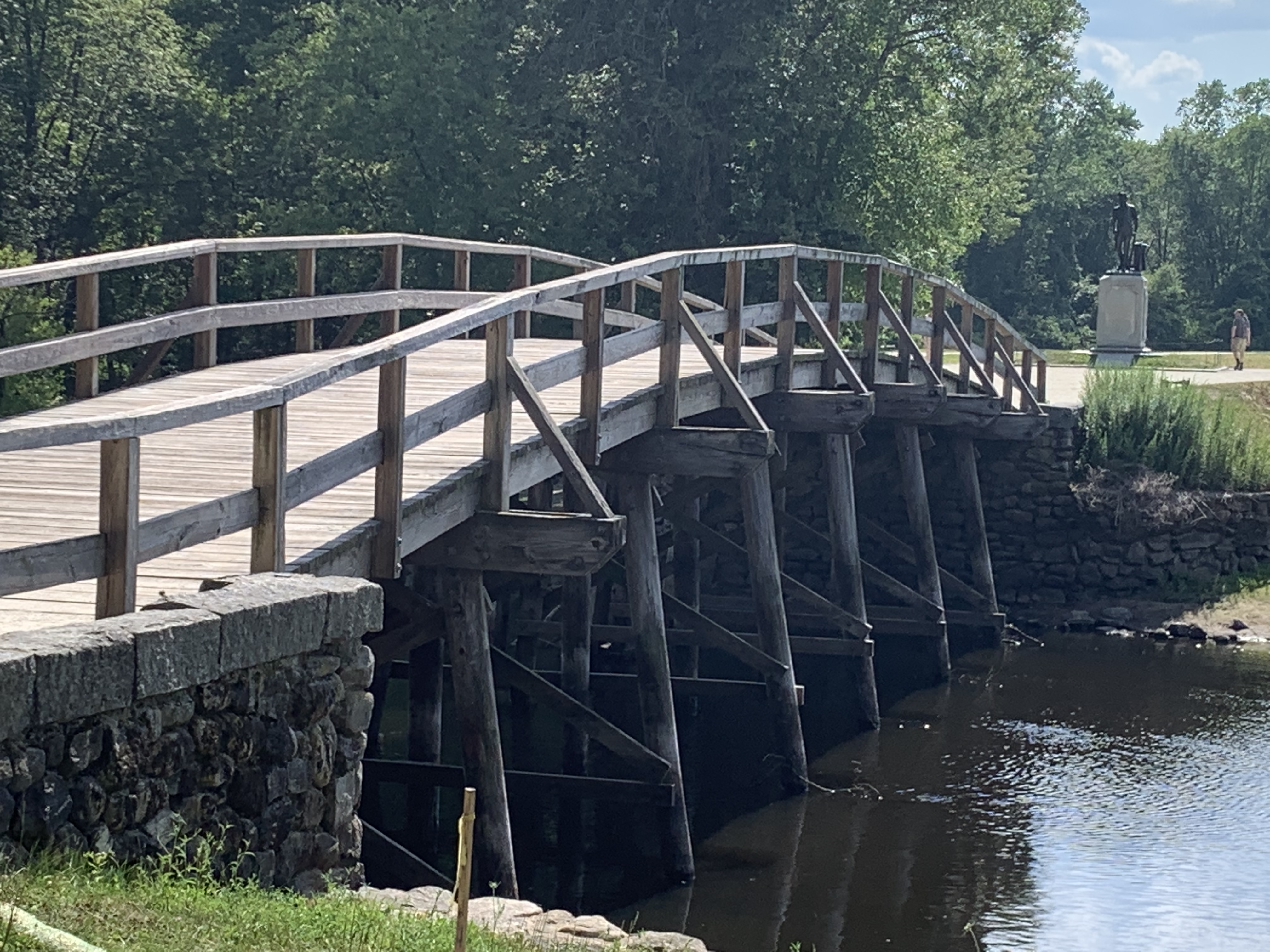
Emerson was standing at the Old North Bridge in Concord when he read that line to commemorate when the Minute Men (militia with extra training) were ordered to fire the first shots of what became the Revolutionary War. The British were thwarted from crossing the bridge and taking the arsenal on the hill behind the statue, and they were forced to retreat to Boston pursued by small groups of Minute Men engaging them in small skirmishes along the way. The quote is carved in the base of the famous Daniel Chester French statue across the bridge above.

Emerson’s grandfather witnessed the battle from The Old Manse, which is part of the site and later was home to Nathaniel Hawthorne. Emerson was also friends with the Alcott’s, and another part of the park is the Wayside where Louisa May Alcott lived. And, since you’re in Concord, you really should visit the Concord Museum, where you can see Paul Revere’s lantern, learn about Emerson’s other friend Henry David Thoreau, and see the excellent new exhibit that describes the battle in detail. All four literary luminaries are buried on Author’s Ridge in Concord.

Again, any propaganda you may have heard suggesting that Lexington was somehow historically important is nonsense. (And I should add that a group of cowardly Lexingtonians snuck into Concord to vandalize and destroy an early monument built around the 50th anniversary in a pique of petty jealousy). ‘The shot heard round the world’ was fired in Concord, likely by Minute Men from Acton, who were in the front and suffered the first casualties, because that order to fire on the British was understood to be an act of open rebellion that could lead to war. Soldiers on both sides blamed the other for firing first. There’s another visitor center over the bridge and past the statue that describes the day’s action. If you get a chance to hear the ranger talk “Monuments & Memories” about how the meaning of the battle has changed over time, I highly recommend it. Obviously, this is my favorite Revolutionary War site.