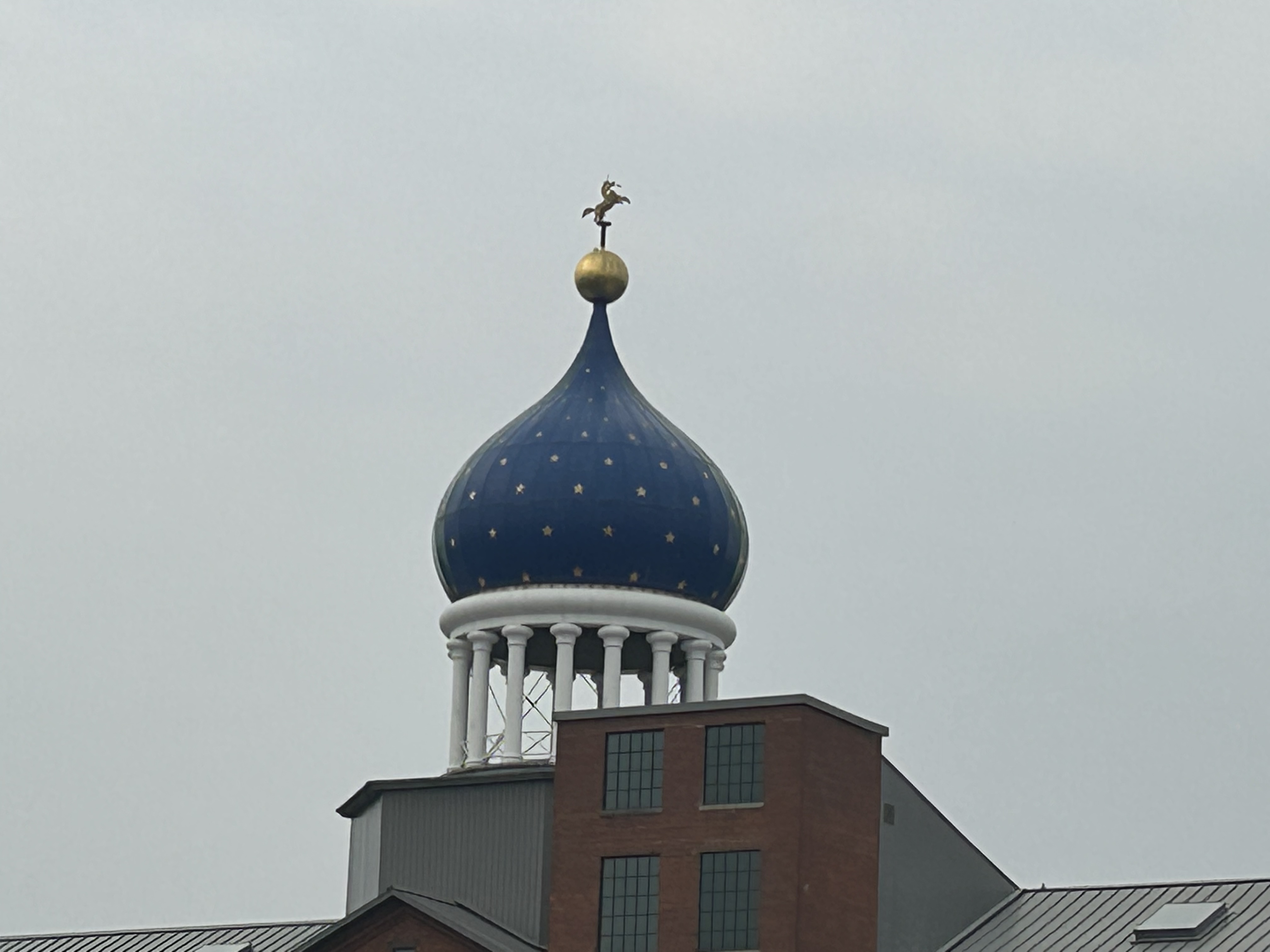
Coltsville National Historical Park

Samuel Colt sold a lot of guns to Russia, one of their first major clients, so he built the original iconic onion dome that defines the Hartford CT skyline (the one above is a replacement after a fire). You may notice the “rampant colt” on the top, which symbolizes loyalty, as the animal is breaking a lance to defend its fallen knight. The dome is actually one reason for the delay in converting the park to full status, as leaseholders control access to the dome which the park service needs. The two original brick buildings that the park service owns are in dire need of restoration too. There’s a nice walk through the large recreational Colt park to find his estranged brother’s house and through the company town to a church commissioned by the widow Elizabeth Colt, who ran the company for decades. Until this park opens officially, you may want to visit the Springfield Armory to learn more about the development of guns in the Connecticut River Valley.

Springfield Armory National Historic Site

America has a gun problem. No other country on earth has anywhere near as many gun deaths per capita as we do. Australia banned guns after a mass shooting in 1996, and they have had one mass shooting in the past 26 years. Many Americans worship guns (see “organ of muskets” above), and mass shootings are a daily occurrence.

George Washington started the Armory for the Revolutionary War, and it continued making guns until 1968. The Armory did an excellent job preserving its history, and their extensive collection covers the evolution of guns in exceptional detail. Smith (of Smith & Wesson) and his father worked here, as did William Ruger. The Colt factory was another of the precision gun manufacturers in the Connecticut River Valley, and the town of Coltsville will likely open as a new national historical park someday soon.

On this visit, I also learned that most of the ammunition for at least the Civil War was produced by women and children, and that the work was extremely dangerous. 178 women and girls were killed when the Allegheny Arsenal in Pittsburgh exploded in 1862, due to sparks from iron horseshoes & iron wheels on a flinty cobblestone road covered with sawdust and gunpowder. Actually, the lawn in the center is contaminated with lead, so kids shouldn’t play on it (like I did when I first visited decades ago).

Fort Larned National Historic Site

This large US military base was built to end “the Indian problem” permanently. How? I direct your attention to the ammunition and gunpowder in the room above. The problem that the Native Americans had was that their land was being systematically stolen, often in violation of US treaties. The “problem” the US government had was how to stop the Native Americans from defending their illegally-seized territory.

After the Civil War, the US military moved against the Native Americans. Near this fort in 1867, General Hancock’s troops massed near a large Cheyenne village, which evacuated quickly, and then, on the General’s suspicions and order, burned it to the ground, prompting a widespread escalation of conflict across Kansas that summer. Perhaps realizing his mistake, the General hired an interpreter, signed a treaty and paid several tribes to move away. The terms were unfair, but the fighting moved away from Kansas as the military fortified this base and increased troops here over the next year.

Make no mistake. The Native Americans were forced from their lands at gunpoint, while the US government repeatedly broke its own treaties.

On a completely coincidental point, today’s conservative political folks are extremely afraid of undocumented foreigners coming in with guns and taking over America. Think about that.