Mount Rainier National Park

Panorama Point above is about 1,500’ above the Paradise parking lot, halfway along the 5 mile ‘strenuous’ Skyline loop trail, just under halfway up the mountain. In July, there were waterfalls, snow on sections of the trail, wildflowers and marmots. Mts St Helens, Adams & Hood all visible in the distance. The northwest and southeast corners of the park both have old growth forests, along the Carbon River Rainforest—which is open for bicycling on the first few miles—and the Ohanapecosh River Grove of the Patriarchs Trails respectively. I understand why Muir extolled Rainier as the best of the volcanic peaks in this area.

“Of all the fire mountains which like beacons,
once blazed along the Pacific Coast,
Mount Rainier is the noblest.

John Muir

For me, it’s another return trip after several decades since my brother and sister and I took a hike and a photo up here somewhere. I was pleased to see the forest looking healthy, the clear streams near the top, the glacial gray rivers on the way down and the blue glacial lakes below, as I remember. Of course, when the rapidly receding glaciers disappear, the whole ecology will be severely disrupted. But for now, I’m happy to visit a place like this when the rest of the country is under a carbon fueled heat dome.

Fort Frederica National Monument

Upon arrival, I remembered visiting by small boat as a teen many years ago. All along the southeast coast, displaced Native Americans and escaped slaves endeavored to remain free in these low-lying delta barrier islands. Although threatened, the evocative old oaks, the Spanish Moss and the shell-filled archaeological ruins are still hauntingly beautiful.

In the 1730’s the British built a pair of forts, both named after Frederick, Prince of Wales, to develop and defend their colonies against the Spanish. Fort Frederick’s ruins are 125 miles north, next the Reconstruction Era Camp Saxton in South Carolina. Fort Frederica here in Georgia, defined the southern boundary of their colonies, north of Spanish Florida.

The British commander Oglethorpe was considered enlightened (for the time) and enthusiastic. Rather than slavery, he proposed work be done by indentured servants mostly from debtors prisons in England, making Georgia a type of penal colony where workers could gain their freedom over time. The Methodist founder John Wesley and his brother Charles first attempted a church under one of the large, mossy oaks here, and the settlement had various tradespeople, including a Native American interpreter, a blacksmith and a doctor/barkeep.

In a remarkable historical echo of the French colonial experience at Fort Catherine, Oglethorpe also tried to seize St. Augustine in Florida, besieging the Castillo de San Marco and being stopped at Matanzas. Again, the Spanish counterattacked, but faring better than the French, Oglethorpe successfully defended this fort and cleverly routed the Spanish in Bloody Marsh, despite being outnumbered. After the Spanish retreated and conceded Georgia, the British cut their military presence here and the remote island village faded away in a decade or two.

Now, while driving through these remote islands, I can’t help but be amazed by the fancy houses. Not because they’re decadently ostentatious, but because they’re so close to sea level. It is astonishing to think that many of America’s most successful retirees choose to develop luxurious estates within the zone that is most certainly going to be erased by the climate crisis. The collapse of Thwaites ‘Doomsday’ Glacier is accelerating, and rising seas will take all the land here. They may have inherited much wealth, but they won’t be leaving these houses to future generations. Apparently, you don’t need much intelligence to be rich.

Great Basin National Park

First, if you can’t get a reservation in time to visit Lehman Caves, just visit the park anyway. I took the virtual cave tour, and, I suspect that Timpanogos in Utah is better and less damaged. Besides, the park isn’t a cave park, it’s the highlight of the Great Basin area, which includes most of Nevada, western Utah and parts of three other states, and has a glacial basin of its own at the top of a 13,500 foot mountain.

Second, stop at Mather Overlook to admire the views and fall foliage of yellow and orange Aspen amid the dark green conifers. There’s a bronze model there that shows the structure of the basin, which is helpful orientation, since it is a long winding road.

Third, understand that the glacier here, “the only glacier in Nevada”, is gone. In theory, there might be some subterranean ice under some of the rocks for another couple years, but climate change has wiped this glacier off the face of the earth. The park maps showing a “rock glacier” in white are out of date. Any snow you see up there is seasonal.

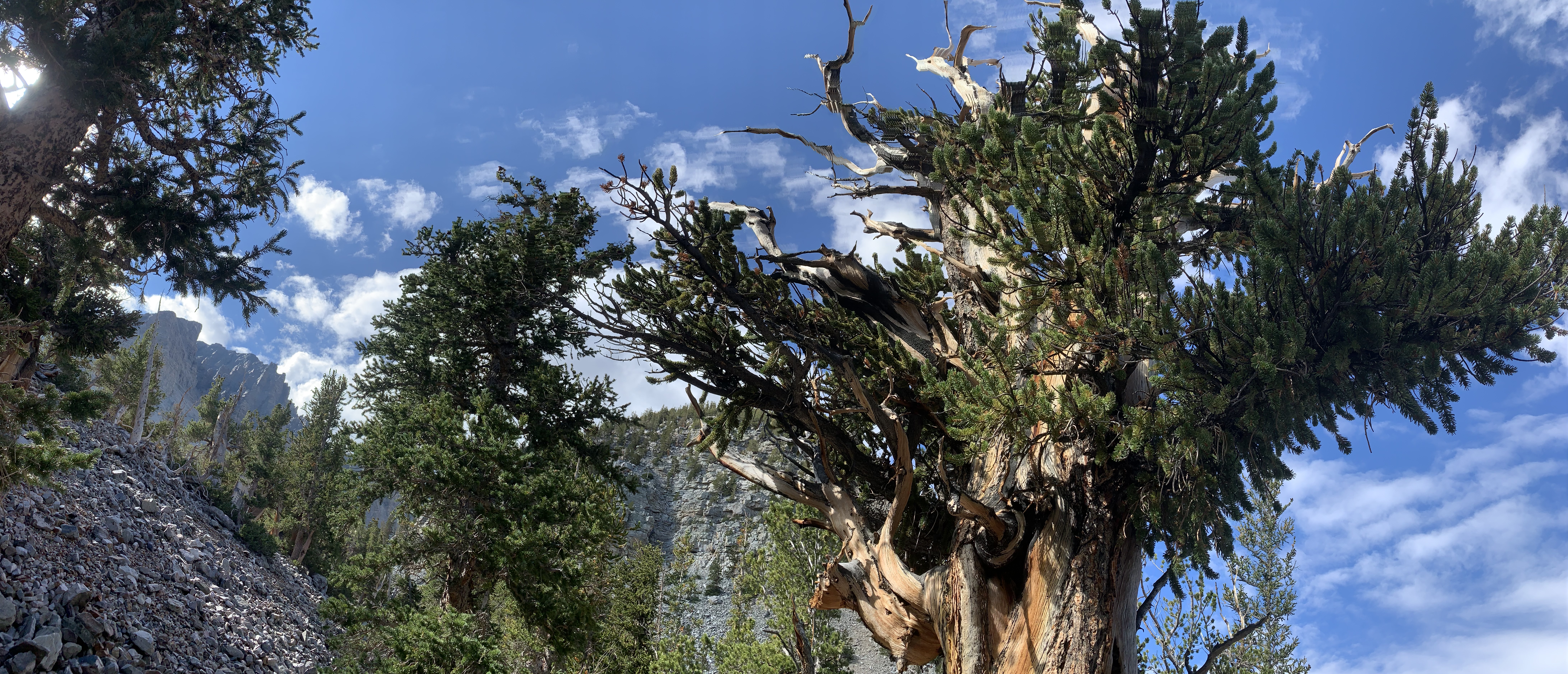
Fourth, take the Glacier Trail anyway, since it goes through the Bristlecone Pine grove and up into the basin. If you only get as far as the grove (2.8 miles roundtrip), that’s what I felt was the highlight of the park. The other two Bristlecone Pine groves are in very remote areas of the park. There are also some trails to pretty alpine lakes, but be careful, as many of the hikes are over 10,000 feet. Spending the night at altitude can help, as well as give you lovely views of the Milky Way.

Finally, this is my favorite park for old trees. The Bristlecone Pine, far from merely eking out a bleak minimal survival, is a gold resinous Adonis, shining in the bright Alpine sun, with luxurious thickly packed bright green bristles. We don’t know how long they can live. One that was removed from here in 1964 was over 4,900 years old. Unfortunately, climate change will likely make them extinct, as other trees will grow at higher elevations, crowding them and subjecting them to more wildfire damage.