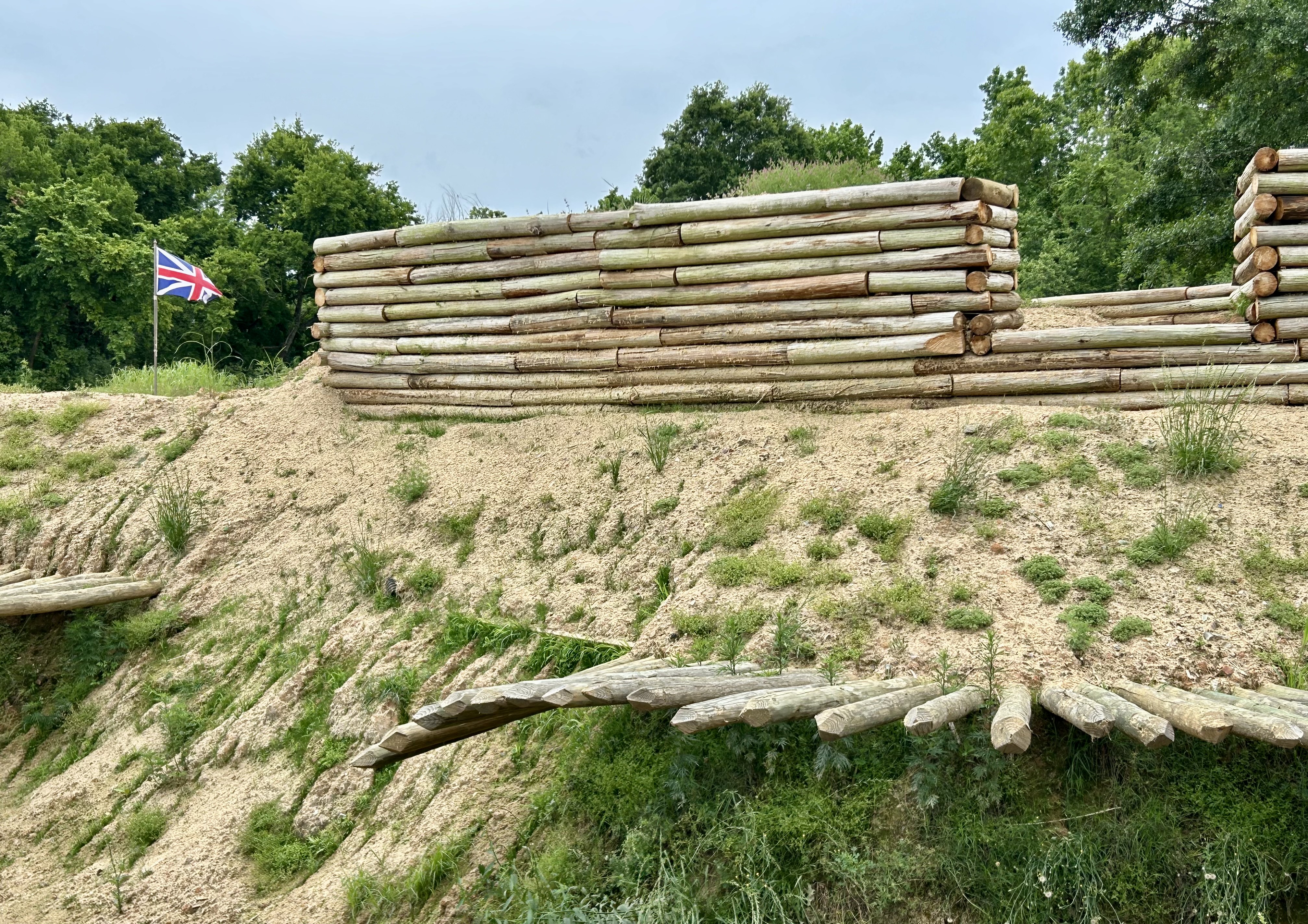
This privately managed affiliate site is one of the best revolutionary war sites in the Carolinas. On over 100 acres of battlefield and early townsite, they have reconstructed Cornwallis’ HQ, one of the redoubt forts (above), a historic tavern, and many other buildings that bring life to history. While separately managed, there’s also a visitor center next door that explains the whole course of the war in the Carolinas, which I will cover in a separate post next month.
Camden was on the Kings Road from Charleston across the low country into the back country. Here it joined with Native American trading routes and the Great Wagon Road from the northeast to Georgia. The British were determined to manage their colonies inland, and not just occupy coastal cities. They also wanted to control trade, tax the rich, hire Native Americans to fight for them, and raise militias of loyalists. Cornwallis fortified Camden as his supply hub.
General Gates, of Saratoga fame, was tasked with attacking Cornwallis. The Battle of Camden in August 1780 was a disaster for the Patriots. Gates put inexperienced troops on his left, who were wholly unprepared to meet the best British troops Cornwallis put on his right, as usual. The French General Baron de Kalb fought to his death at Camden. Gates withdrew to North Carolina. He was later replaced by Nathaniel Greene.
Many of the losses were due to diseases like dysentery, and there’s a detailed exhibit in Cornwallis’ HQ, where a docent answered my various questions. Captured prisoners from British victories in the area were often initially held in Camden and then marched to Charleston where they were imprisoned on ships in dangerously unsanitary conditions.
In 1781, Nathaniel Greene, having recruited Catawba warriors and run a cross country guerrilla campaign disrupting the British, returned to Hobkirk’s Hill near Cambden in April for a rematch. While the British won the day, they decided they could no longer defend Cambden and retreated to Charleston. Cornwallis had already moved north on his way to establish a new base at Yorktown.
 Zero Carbon Travel