Grand Portage National Monument

[Update: Blackwell National Historic Site in Texas is now officially a national park unit.]

The photo is from the moose exhibit upstairs at the visitor center. I failed to photograph a bald eagle flying right in front of the reconstructed fort, which includes a great hall, kitchen, warehouse, lookout and wooden palisade. The monument is surrounded by Anishinaabe (Ojibwe/Chippewa) land, and the tribe co-manages the unit, a first for the NPS. I stayed at the casino to catch an early ferry from Grand Portage, and I had a delicious ‘lunker’ (big fish) for dinner. From the dock, you can see Isle Royale in the distance, and there are various demonstrations of the fur trading life during the summer season.

Traders wanted access to the western rivers and lakes, and the easiest way to get there was to carry their canoes on the ~10 mile Grand Portage Trail around some impassable waterfalls (including Minnesota’s largest) on the Pigeon River at the border with Canada. At a site called Fort Charlotte, the voyageurs entered the Pigeon River—now the US-Canada border—and continued with shorter portages upstream on the Athabasca, English & Saskatchewan Rivers. They would pass through what’s now Voyageurs National Park, Rainy Lake, Lake of the Woods, and deep up into the Canadian Rockies to the Athabasca, Great Slave, and Winnipeg Lakes. The trail carried beaver and other pelts, typically trapped by natives, in 90 pound packs from inland Canada down to Montreal (skipping the polar bears around Hudson Bay), bound for global markets in Europe, Russia and China. Vast fortunes were made wiping out the abundance of our wildlife.

Fort Vancouver National Historic Site

Portland Oregon has always confused me geographically. What kind of port is over 100 miles from the coast on a tributary of a major river? The history of this site explained it. George Vancouver, a British explorer who sailed with Captain Cook, explored the Pacific Northwest coast in the 1790s, and both the both the huge natural harbor in British Columbia to the north and this deep water site to the south on the Columbia River were named after him. Vancouver Washington was perfectly located at the confluence of the Willamette River to be an inland trading post still reachable by ocean vessels. The Chinook have long lived here and traded with other tribes, regularly traveling hundreds of miles by canoe. When the Pacific Northwest was British, this was all one territory from Sitka Alaska to San Francisco. Portland was built later as Vancouver’s port. When it became US territory, Oregon and Washington states split the growing city here on the Columbia. As the Willamette (Wil-AM-it) Valley developed in Oregon, Portland became the city and Vancouver became the tax-dodging suburb (lower income taxes in Washington within easy bridge distance to lower sales taxes across the river in Portland).

The British Hudson Bay Company built its corporate territorial headquarters here in 1825 to capitalize on the fur trade with tens of thousands of local Native Americans and a great many more via their ancient trade routes along the coast, up the rivers and deep into the mountains. The British contracted with many French fur traders who typically married natives. British ships brought workers from Hawaii after rounding Cape Horn. The fort (reconstructed on location above) was the center of a thriving cultural melting pot that developed its own language and challenges. Unfortunately, many natives died of disease, particularly malaria, which the ‘gentlemen’ who lived in the fort knew could be treated with Quinine, which they had in limited quantities. The company man in charge, Dr McLoughlin, was married to a biracial woman, and he was violently furious when newly arrived missionaries spoke derogatorily of her.

McLoughlin nevertheless extended credit to the many destitute white settlers who arrived on the Oregon Trail. He lost money, was forced to retire, became a US citizen and is now considered the ‘father of Oregon’. His house is part of the site south of Portland. White settlers took over and made the state ‘whites only’ by law until 1926, prohibiting others from property ownership etc. It’s worth reflecting honestly on this history when considering the recent Supreme Court decision against affirmative action: white ‘pioneers’ gave themselves every legal and economic advantage possible, from slavery, to the Rogue River Wars against natives, to ‘whites only’, to the Chinese exclusion act, and to taking property during the Japanese internment. It’s shameful that the Court ignored the long history unfair privileges given to white people—many whose families benefited over two hundred years from stolen land, labor and opportunity from so many people of color—and decided against providing a few seats in college in order to enrich the diversity of education for all students.

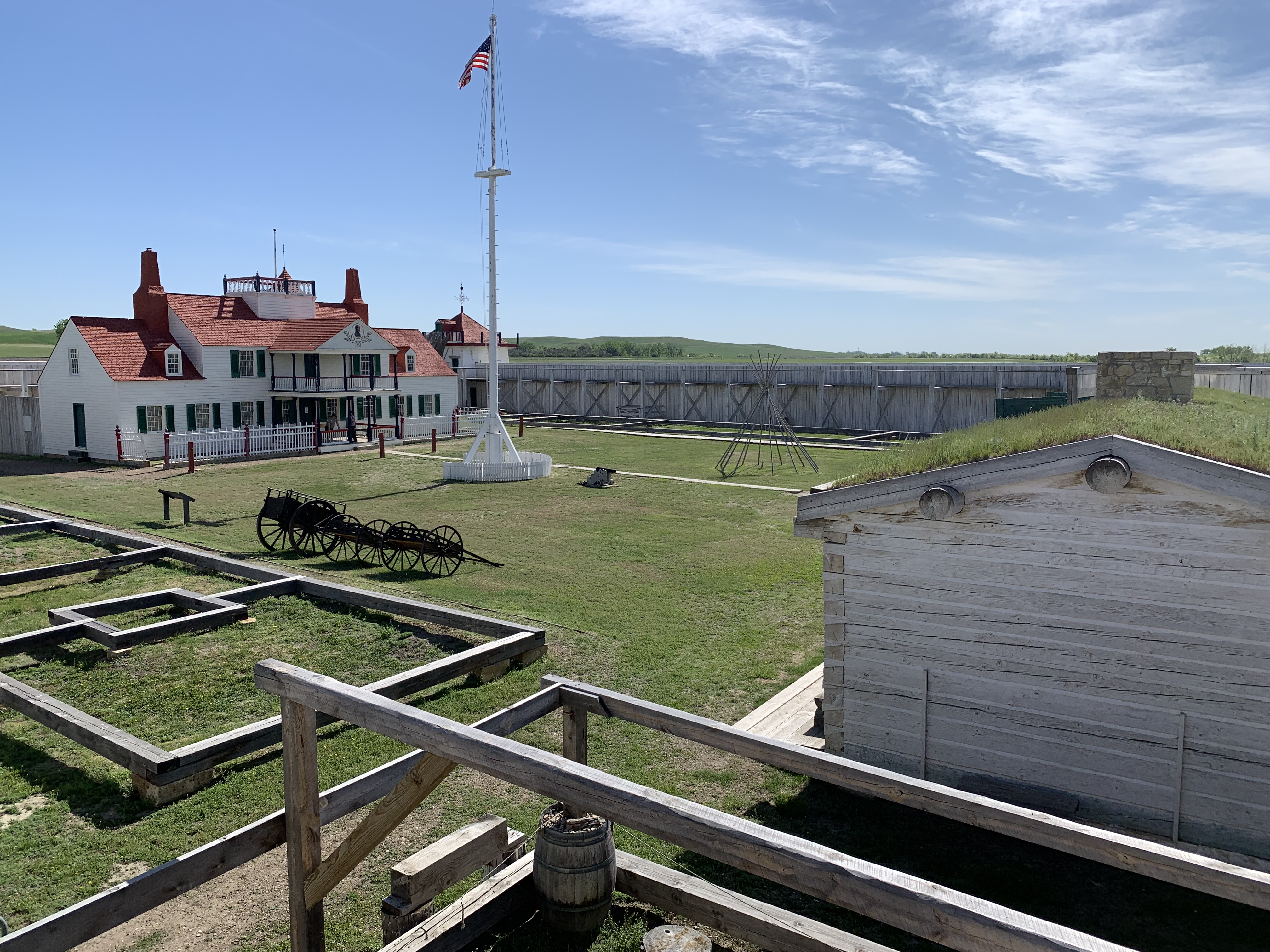
Fort Union Trading Post National Historic Site

Not to be confused by the other Fort Union, this was strictly a trading post built for the fur trade at the invitation of the Assiniboine. The post was open for 40 years, peacefully and profitably trading with the Native Americans. Large numbers of natives brought stacks of furs, which were sorted and pressed outside the fort to determine payment, and then at a window they bought various goods, especially cloth. The large fur press outside the fort is basically a long pole on a fulcrum to measure fur stack thickness. Fort Vancouver in Oregon has one too, reconstructed from photos, but the rangers didn’t know what it was. (I showed them a picture and told them to call my favorite rangers here.)

Audubon came here to study mammals after finishing his bird book. Catlin came here to paint portraits of natives and portray their lives without the hateful bias that was common at the time, and he first suggested a series of national parks to protect the beautiful, historic and vanishing way of life in the West. The rangers here were among the best I’ve heard at bringing the old fort to life with engaging stories.

There’s also a small plaque, near where Lewis & Clark must have stopped, to a national parks founder named Mather, praising him for good works that “will never come to an end”. But if we lose the climate fight, many of our national parks will fail in their mission to protect nature and fail to pass that natural world on the future generations.