Lincoln Home National Historic Site

It’s not his hat, but the small desk is where Lincoln wrote his early speeches. In the parlor downstairs, he held the funeral service for his son, Edward, and years later was invited to be the Republican nominee for President. In this house, he refined his political views and his arguments against slavery. Lincoln drew from his early childhood and boyhood experiences to become the most powerful advocate for freedom.

“As I would not be a slave, so I would not be a master. This expresses my idea of democracy. Whatever differs from this, to the extent of the difference, is no democracy.”

Abraham Lincoln in 1858

Lincoln understood the fundamental flaw in our country, that the ideal of equality did not apply to all and that Democracy and slavery are absolutely incompatible. He knew that most voters held racist views and did not want war to bring about immediate equality. So he was careful, not always the loudest abolitionist, and he opposed John Brown’s raid. But Lincoln was determined to end slavery, crafted a greater variety of effective, convincing arguments against slavery, introduced legislation and used his arguments in debates against Douglas.

“That is the real issue. That is the issue that will continue in this country when these poor tongues of Judge Douglas and myself shall be silent. It is the eternal struggle between these two principles — right and wrong — throughout the world. They are the two principles that have stood face to face from the beginning of time; and will ever continue to struggle. The one is the common right of humanity and the other the divine right of kings. It is the same principle in whatever shape it develops itself. It is the same spirit that says, “You work and toil and earn bread, and I’ll eat it.” No matter in what shape it comes, whether from the mouth of a king who seeks to bestride the people of his own nation and live by the fruit of their labor, or from one race of men as an apology for enslaving another race, it is the same tyrannical principle.”

Final Lincoln-Douglas debate

Beyond the home tour, I found the neighborhood fascinating. One of the neighbors was a conductor on the Underground Railroad who gave the President-elect his inaugural ride to the depot. One was a Jewish family whose son helped build 5,000 Rosenwald schools to educate African Americans across the south. And one is currently being used as a local office for Senator Dick Durban. Springfield is all about Lincoln, and they have set aside 4 surrounding blocks of period houses, a short walk from the his Presidential Library and Museum. The museum there is modern, multi-media and includes an excellent map visualization of Civil War casualties over time. Explore the neighborhood, stay in an atmospheric B&B and eat at a fine restaurant. I did, at reasonable cost, and learned Springfield is on Route 66.

National Mall

Yeah, I don’t make the rules. This is an official park unit like Constitution Gardens within the National Mall and Memorials, and don’t ask me where the boundaries of each are, it’s very confusing. But I’ve walked all the way up and down the mall a few times, which counts as zero carbon travel. I’ve also seen the fireworks here on the 4th of July, visited the Smithsonian museums and been here during political demonstrations. The photo is from the edge of some side edifice of the Lincoln Memorial, which I took from this angle, so that you can see the Capitol behind the Washington Monument. There’s actually another smaller reflecting pool at that far end, but it’s not easy to approach.

Anyways, the Mall is moving, no matter how many times I visit. Here, people from all over the country (and world) come to see DC, the most important city on earth. Some may be here for work, to study, to visit a memorial, to see art, learn about science, for history, to protest or to celebrate. The Mall reminds us of our ideals, teaches us something new and gives us space to be free. It’s ours, but it’s also bigger than us. It symbolizes the past, the present and future. It’s what we argue about, what we make of it, and what we love or hope it will be. As frustrating as it can be sometimes, it’s a great country, and I encourage you to get out, explore and enjoy. And dream of a better world.

Thomas Jefferson Memorial

The memorial is open & under maintenance with climate driven flooding at the Tidal Basin. Tom’s face has some cobwebs, and his reputation is also ebbing, as the stain of his slave exploitation will never wash. So, let’s clear up why he has a monument. Among other things, Jefferson was Governor of Virginia, Ambassador to France, codifier of religious freedom, the primary author of the Declaration of Independence, proposer of the Bill of Rights, Washington’s Secretary of State, John Adams’ Vice President, 3rd President, purchaser of the Louisiana Territory, appointer of Lewis & Clark, President of the American Philosophical Society, founder of the University of Virginia, and classical architect whose memorial resembles his own work, Monticello.

Jefferson was also a racist who owned hundreds of slaves in his lifetime, fathered children with one beginning when Sally Hemmings was a teenager, and sold over 100 slaves at auction through his will. He opposed slavery in theory and condemned it in his original draft of the Declaration (edited out to placate Georgia and South Carolina). But despite his ideals, Jefferson feared a Haitian-style rebellion and believed there was too much animosity between people of different races to reconcile and live together in peace. As President, Jefferson began removing Native Americans from the southeast in return for “new” land around Oklahoma (which was already populated with Native Americans).

Recognizing what he did that was wrong, we need to imagine what he could have done better, beyond freeing all his slaves, and not just Sally and her children. Nationally he should done more to end slavery, As a slave-owning President who added the Louisiana Territory to our country, Jefferson was uniquely suited to end slavery and offer reparations to slaves by setting aside a significant portion of that territory for ex-slaves to homestead. Similarly, instead of removing Native Americans from their sacred homelands, Jefferson should have honored and signed more treaties protecting their land and culture, especially in the “new” territory.

I view Jefferson as having missed his opportunity to solve those great moral challenges. But I have little patience for people who criticize Jefferson for his moral failings, without considering whether they themselves are doing enough about the greatest moral challenge of our time. Jefferson hated the idea that people would live “under the barbarism of their ancestors”. Jefferson was a student of science who loved nature, so he would be appalled by our lack of action in stopping the climate crisis.

“I like the dreams of the future better than the history of the past.”

Thomas Jefferson

St. Paul’s Church National Historic Site

The New York Royal Governor Crosby’s allies tried to disenfranchise the Quakers by requiring them to swear an oath on the Bible, which violates their beliefs. In response, the colonial assembly voted in favor of religious freedom and protecting voting rights. The press coverage so annoyed the Governor, that he had the publisher arrested and tried at Federal Hall. But the publisher (Zenger) was acquitted in the case, resulting in expansion of freedom of the press.

The original church here was established by the British to impose the Church of England on the heretical Puritans and Quakers and others who lived here, including people like Anne Hutchinson, who fled both Boston and Rhode Island to avoid harassment over her belief that women could interpret scripture too. (The Hutchinson River Parkway is named after her). As the revolution approached, the people here split into factions of loyalists and patriots, and the graveyard contains families who fought on both sides, as well as Hessian mercenaries, slaves and free African Americans. There was some fighting nearby at Pell’s Point which helped Washington retreat to White Plains, and the church was used as a military hospital.

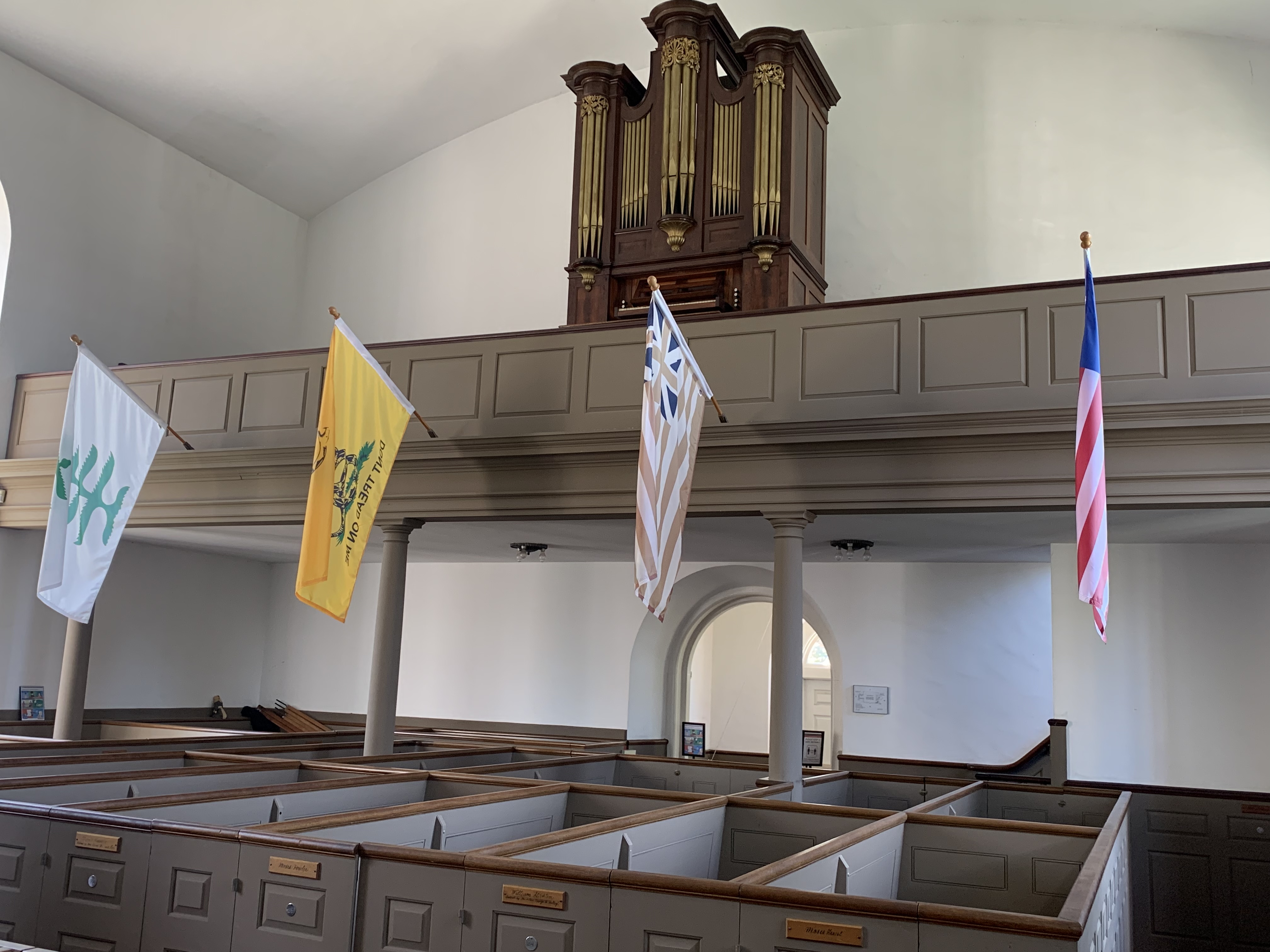
In addition to the fine old organ, family box-pews and flags pictured above, there’s also a bell cast in London in 1758 and a stained glass window. Much of the restoration work was done around WWII with fundraising led by FDR’s mother. But the surrounding neighborhood at the northeast border of the Bronx is now heavily industrial, not residential. (I walked from the Eastchester-Dyer Av station). The Episcopal church, which is related with yet independent from the Anglican Church, was deconsecrated around 1978 and is cooperatively managed with the parks service as a (secular) national historic site. Take some time to walk around the evocative colonial and early American graveyard.