My grandfather used to tell us to travel to Canada before going to any other country, because it has both wonderful nature and culture. Growing up in New England with Canadian relatives, we perhaps took Canada a bit for granted, not crossing the 500 mile border into Quebec as often as we could. Now, after having been to 6 continents and ~50 countries, I take my grandfather’s words more to heart. Quebec is Canada’s largest province and has three world heritage sites and four biospheres. The official language is French, but folks went out of their way to translate for me.
World Heritage Sites
Anticosti is a large island deer hunting reserve with many rivers and important fossils. Take the ferry and an island tour to see the many sights and wildlife.
Miguasha is an important fossil site with a very good museum and a nice hiking trail through the woods along the coastal bluff.
Old Québec is magnificent! In the largest walled city north of Mexico, explore the museums, parks and French restaurants.
Biospheres
Charlevoix is a mountainous area on the St Lawrence Seaway with great hiking. Ski in winter or take a tour boat in summer.
Lac Saint-Pierre in the St Lawrence estuary is a birding paradise. Take a boardwalk over the wetlands out to a viewing platform on the water.
Manicouagan-Uapishka has a ring lake that can be seen from space, native culture and a variety of ecotones down to the coast.
Mont Saint-Hilaire is near Montreal and preserves old growth hardwood forest. Hike through the lovely woods near McGill University.
This Canadian world heritage site reveals the age of fishes, the Devonian Period of evolution around 400 million years ago, when sharks and cod invented themselves. In 1938 in South Africa, a fishing captain showed a local museum curator a weird looking fish they caught, and it was identified as a coelacanth, despite being presumed extinct some 65 million years ago. That ‘living fossil’ also dates back to the Devonian Period, as does another fish you may have heard of, the African lungfish.
In evolution, we see the development of vertebrae and lungs as important, as we inherited them from fish. But obviously, we didn’t descend directly from cod, coelacanths, lungfish or sharks—except maybe lawyers. Paleontologists, or fossil folk, figure out such distant ancestry. And Miguasha is a good place to look for fossils, as it lies in the Canadian Appalachian Mountains. Americans may believe the trail ends in Maine, but the International Appalachian Trail continues into Canada, up to the Gaspé Peninsula and continues on Newfoundland. The Appalachians are much older than the Rockies, and they were a defining land feature during the age of fishes.
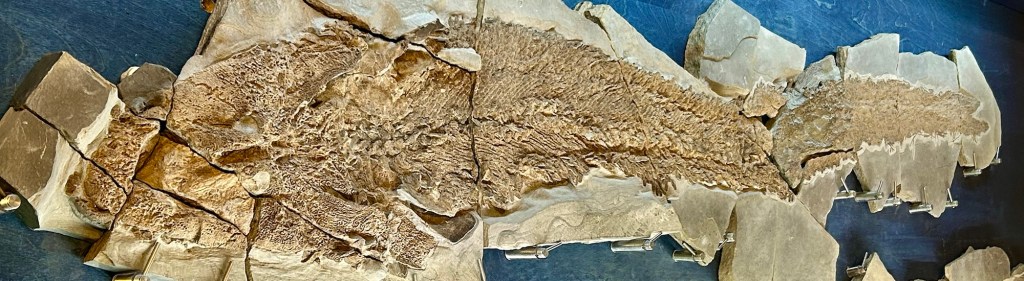
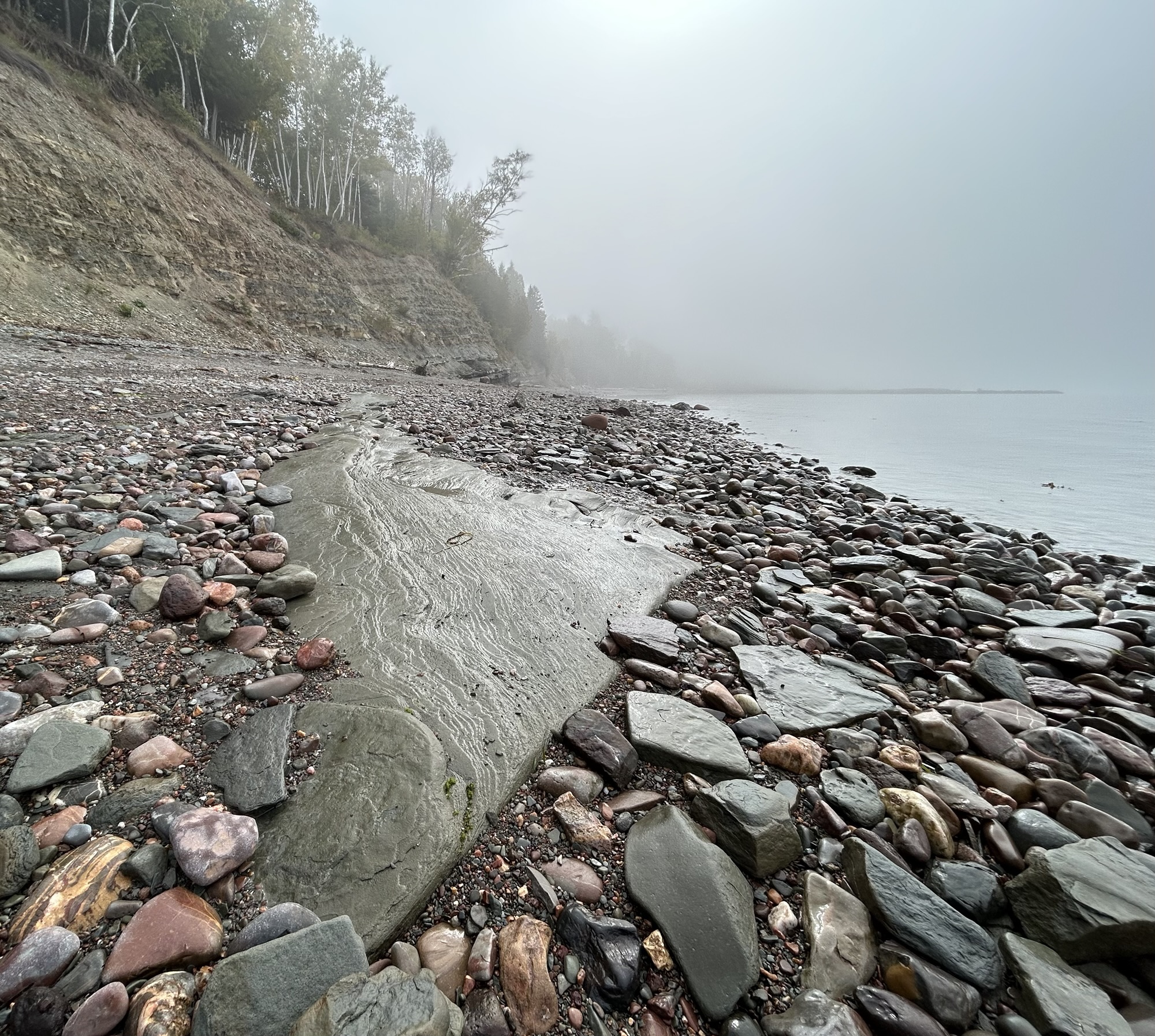
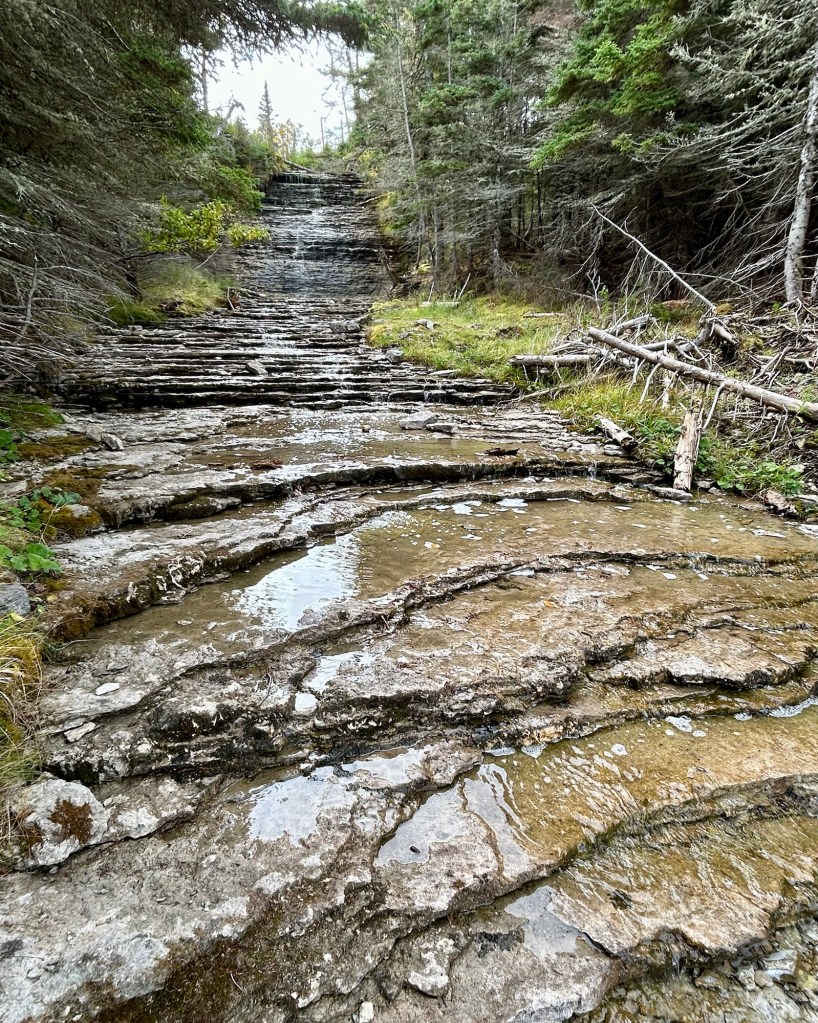
Miguasha is on the south side of the Gaspé, with high sedimentary cliffs, lots of pretty rocks, and many fossils, often well preserved in large flat layered rocks, like in the photo. Around 15 years ago, a visitor apparently found a rock at the water’s edge that had split, revealing a large fish tail. They did the right thing and left it for the local fossil experts to examine. Shortly thereafter, the experts found more pieces, fit them together with the earlier find, and put together a 5’ 3” fish fossil puzzle. While the site had been producing Devonian fossil finds for decades, this one was the King.
Not only was this a complete Epistostegalian, it also had the bone structure of a Tetrapod. In common words, that means it had vertebrae, lungs, and a bone structure resembling not just our arms, but our wrists and fingers as well. That put it within the strict definition of a tetrapod, previously believed not to include fish. This big guy used his fingery fins to climb up out of the water and breathe. Most of the animals you can think of have arms, wrists, and fingers bones, although they may appear very different on the surface: frogs, turtles, bats and horses. Oh, and whales too, although their ancestors decided life on land too hectic and returned to the sea trading in hooves for flukes. The fish fossil found here may have been our ancestor. Exciting evolution!
I learned (or relearned) a lot in the museum from the informative exhibits, and a bilingual guide was kind enough to answer a whole bunch of questions without throwing me off the cliff. Tours are mostly in French. There’s a 2 mile hiking trail on the bluff for exercise, but when the site is open, you can access the beach by stairs from the beginning of the trail. If you visit, note that the park is on Quebec time, not Atlantic, although most cell phones still show the latter. I used my unexpected extra hour to charge my car on the Flo-compatible J1772 charger, while I hiked around on my own.
Here are my visits to all UN sites in Quebec province.
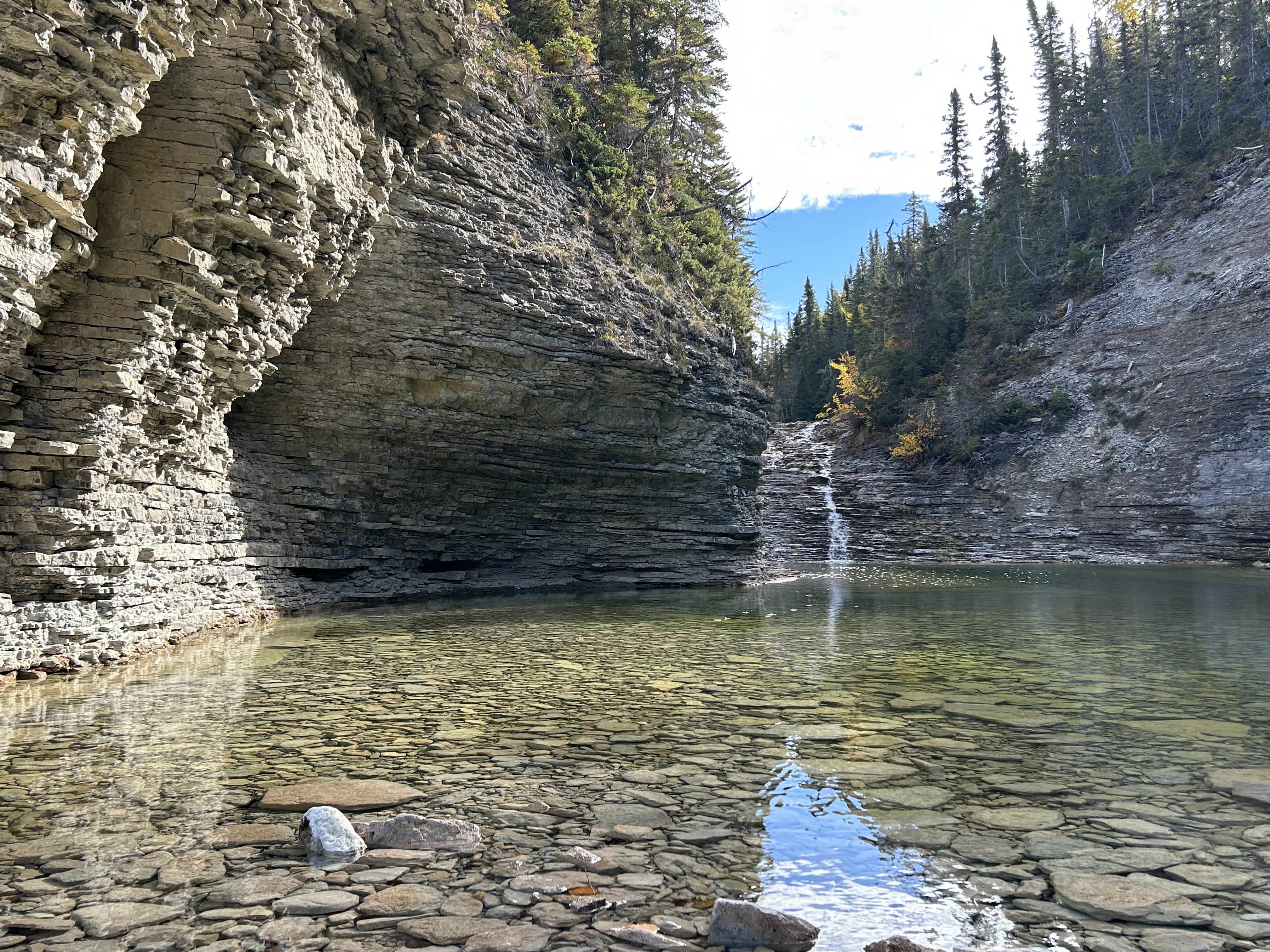
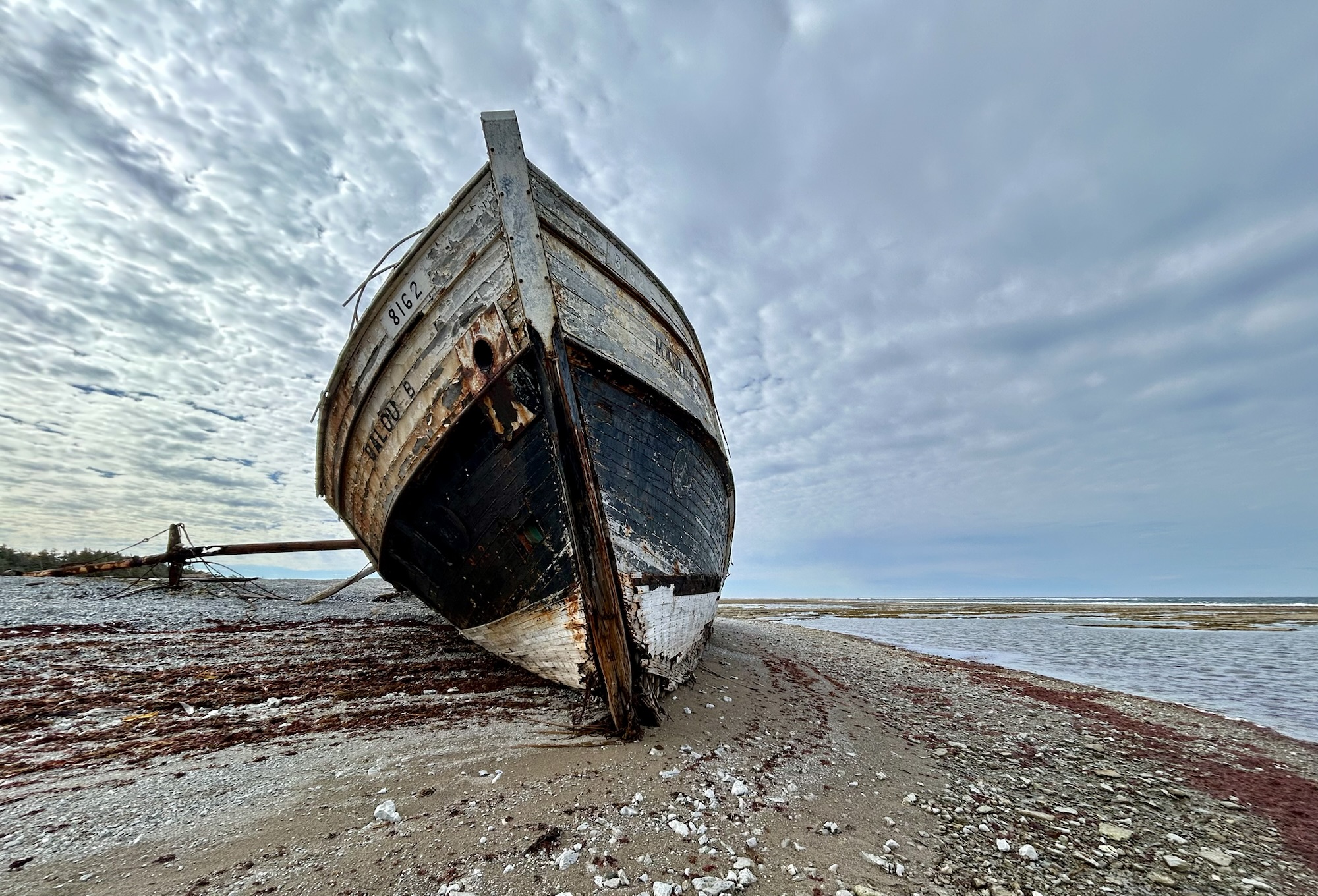
This windswept island in the Gulf of St Lawrence is larger than the state of Delaware and is now a UNESCO World Heritage Site, rich in early fossils from the Ordovician-Silurian extinction era when mollusks and arthropods thrived and land plants first emerged. With shallow shoals and terraced ledges, the island was known for shipwrecks, contributing to its isolation. In 1895, a French chocolate magnate, Henri Menier, bought the whole island as a private hunting and fishing game preserve. In 1974, Canada bought the island from loggers and set aside about 1/3 of the island for hunters, fishers and tourists. In 2023 the coastline and several deep river canyons were preserved for fossils as a WHS, with the north coast being the oldest. With 24 salmon rivers, canyons, waterfalls, fossils, shipwrecks, cliffs, an undeveloped coastline known for lobsters, and forests stocked with deer, the island is unique.
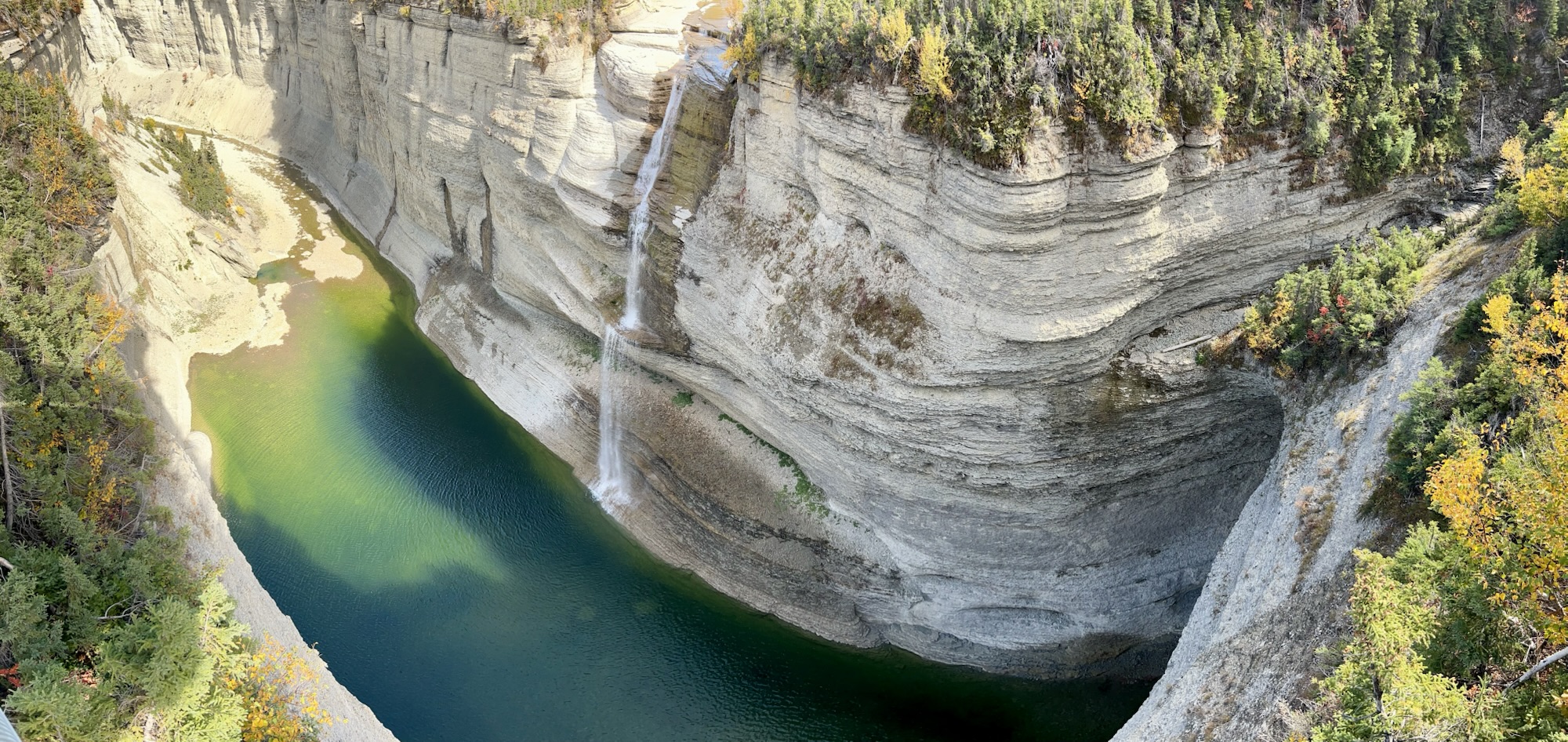
Now with a long wharf and an airport, the island is more accessible, although the most famous site, Chute Vauréal—the 250’ waterfall below—, is over 100 miles away from town over an unpaved but decent road. Most summer tourists take cruise ships or fly in on upscale package tours. Deer hunting is big business with off grid lodges; one offers a week with a personal guide, ATV driver, 3 meals per day, including a 5 course dinner of ‘renowned cuisine’, and all your game and fish packed up for you to take home. With about 1,000 deer per winter resident, it’s easy to find deer, who often show up at your door looking for handouts. And there are large, mixed-color foxes roaming around town too.
Yet Anticosti Island is so off-grid, off-radar and ‘off the beaten path’ that I couldn’t figure out how to visit, especially due to my lack of French and preferring DIY EV travel over hotel + flight package tours. But there is a boat on the north coast where roads are scarce with regularly scheduled stops at seaway ports up to Labrador. On the way upstream, the M/V Bella Descagnés goes from Havre Saint Pierre to Port-Menier on Anticosti, and it reverses the trip downstream a couple days later.
Though cabins are often booked months in advance, it occurred to me that they must take walk-on passengers between the closest two ports. Without a Canadian address, I couldn’t book my ticket online, and the hold times were depressing. So I just drove up the coast and arrived barely 10 minutes before they left. (The boat had gained almost an hour on its schedule overnight.) I parked on the wharf, walked on, paid my fare at the desk, and they welcomed me aboard! Some folks thought I was crazy and others thought I was a worker commuting cheaply to the mainland, but I had a pleasant time relaxing in the lounge and eating in both the cafeteria and the dining room. Optimistically, I had booked a B&B with an island day tour, and the everything worked out well. While the waterfall is less impressive in the autumn, it’s still taller than Niagara Falls, and the weather and foliage were lovely. On the way back, I even got a bunk for the overnight trip.
Here are my visits to all UN sites in Quebec province.
New Brunswick, Nova Scotia and Prince Edward Island, the three provinces known as the Maritimes, have three world heritage sites and three biospheres recognized by UNESCO. Well, almost all the sites are in Nova Scotia, but I enjoyed driving around all three provinces.
With plenty of great seafood, hiking, Celtic & Acadian culture, wildlife, history and miles of picturesque coastline, this region is highly rewarding for travelers, especially an electric road tripper. With a CCS adapter and the ChargeHub app, it’s not difficult to explore the entire region and well worth the drive.
World Heritage Sites
Grand Pré conveys the tragic history of the British expulsion of the Acadians. The landscape is lovely, and be sure to try the Tidal Bay local wine in a coastal town like Wolfville home to Acadia University.
Joggins Fossil Cliffs reveals an impressive geologic record of the coal age. Take a hard hat tour at low tide and find fossils.
Lunenburg is a beautiful, well-preserved seafaring and fishing port. Spend the night and eat all the local seafood you can.
Biospheres
Bras d’Or Lake is open to the sea through small channels making it an important fish and bird habitat. Try a local restaurant and maybe listen to some Cape Breton fiddle at a céilidh (kay-lee).
Fundy has the world’s largest tides with dramatic coastline, shorebirds and forests. The biosphere is on the New Brunswick side of the bay around the eponymous national park.
Southwest Nova protects many species, including the piping plover and blanding’s turtle. The biosphere has both a coastal and a forest component with plenty of hiking.
Bonus: Green Gables is home to LM Montgomery and her beloved characters. Prince Edward Island is the smallest province but very charming.
New Brunswick also has Kouchibouguac and Fundy National Parks, plus Campobello. Nova Scotia has Kejimkujik and Cape Breton Highlands National Parks. And Prince Edward Island has the new Pituamkek and Prince Edward Island National Parks.
Alaska awaits, but in the meantime, I have visited all 4 National Parks and 16 park units in the Pacific Northwest region, plus 2 heritage areas, 1 affiliate, trails and biospheres. Part of the Manhattan Project NHP is in Washington too.
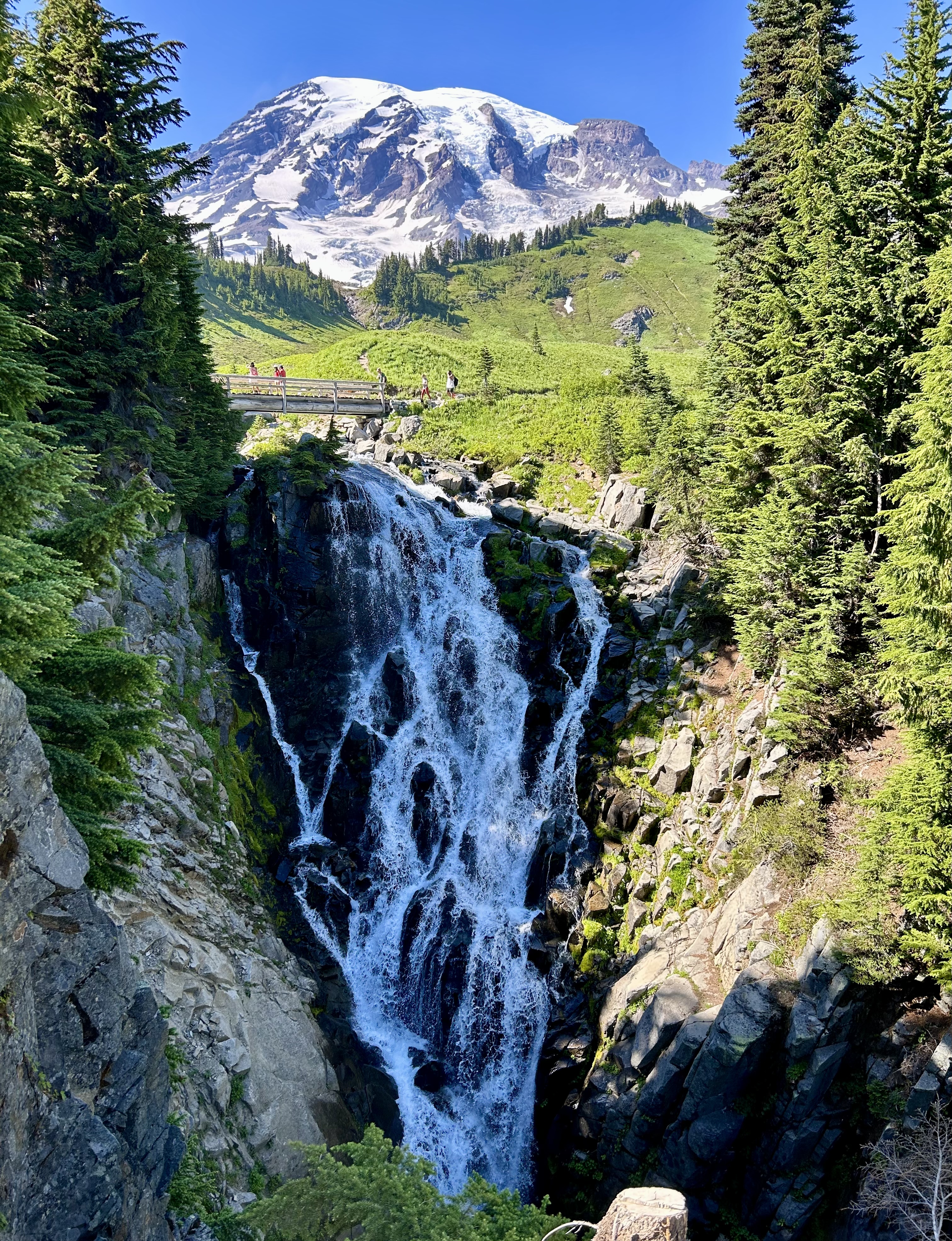
The four national parks all contain snow capped volcanoes. There are fossil, cave and geologic sites, 3 lake recreation areas, and many fascinating historic sites to enjoy. The region is beautiful, with rugged coastline, forests, mountains and wildlife.
Josh guided us into the restricted area, explained how to look for fossils and we sat down on a bone bed to look. I saw something with a pretty pattern, picked it up and showed it to Josh. He confirmed that it was part of a T-Rex—Gorgosaurus libratus—tooth, roughly 75 million years old. I just sat there for a while, stunned to be holding a real fossil like that in my hand after picking it up off the ground.
The park is the most productive dinosaur fossil ground on earth. And it’s also very beautiful, with camping and hiking along the river among the Cottonwood trees, some 200 years old. I saw a family of deer on the trail. Even the Badlands in Canada are nicer than the US.
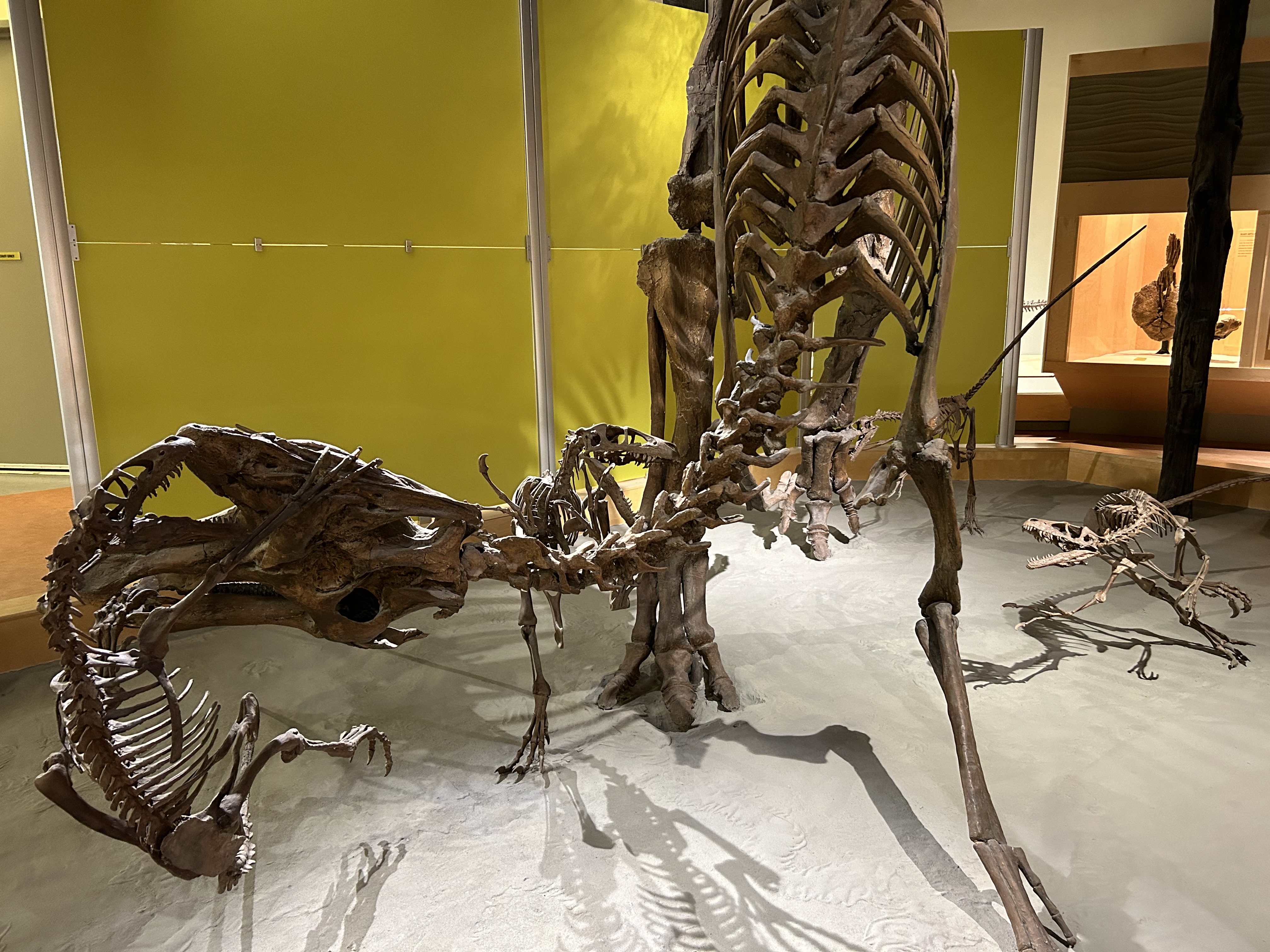
It’s definitely worth signing up for a guided tour, although there’s also a drive with exhibits and places to look for fossils on your own. The above diorama is in the visitor center. Most of the assembled skeletons are at the Royal Terrell Museum a couple hours drive north, but the field work takes place here, especially in summer. Josh even stopped to mark and protect a new find from another group a week before. Impressive!
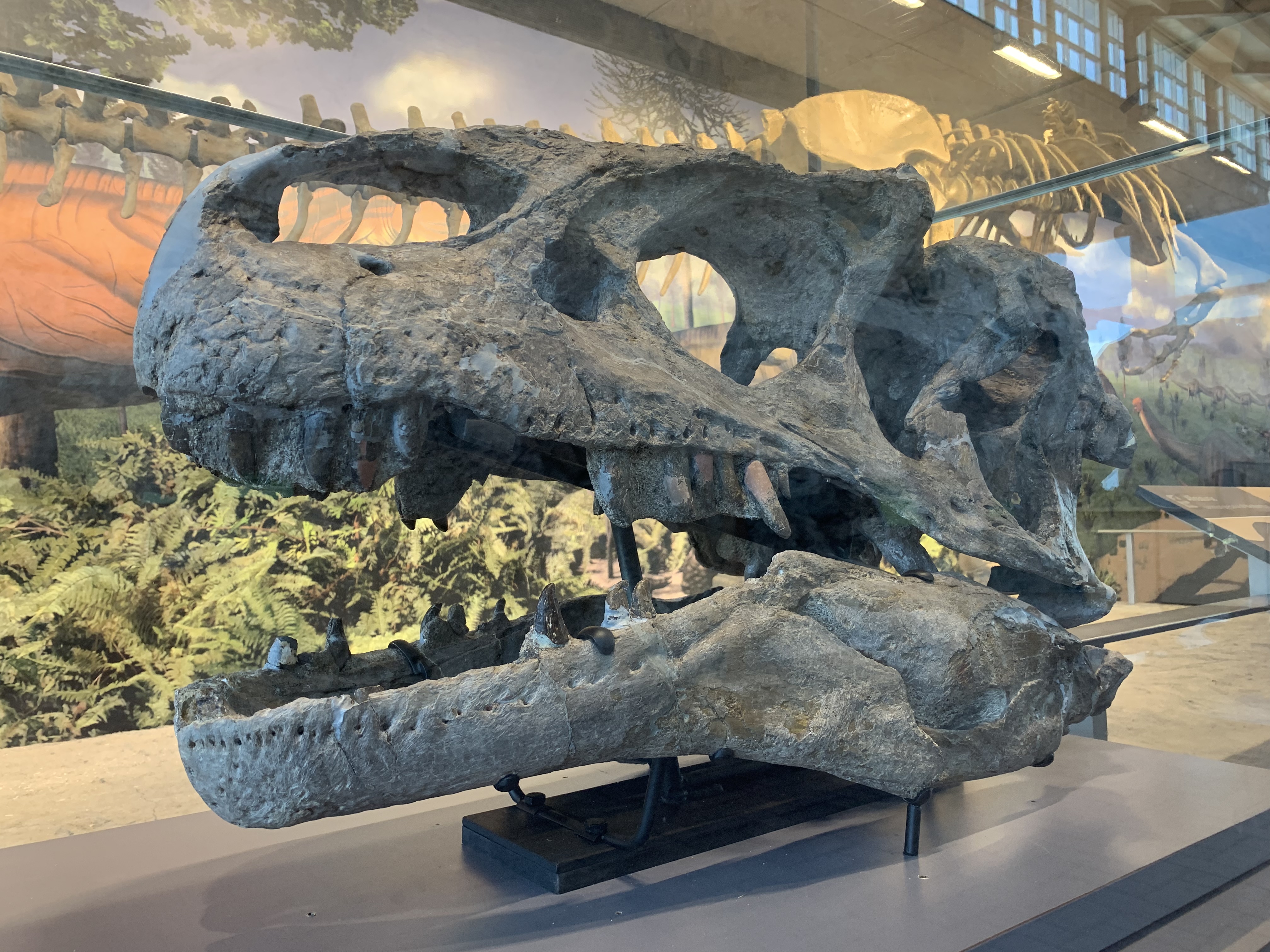
The Quarry Exhibit Hall, near Jensen Utah, has a crazy collection of large, late Jurassic dinosaur bones set in a two story high, very wide quarry wall, and you can touch them. It’s awesome. The Allosaurus skull above, a raptor talon-claw, Apatosaurus leg bones, and many Camarasaurus bones including a skull still set high in the quarry wall are all fascinating. This dinosaur exhibit is at the east end of the park after the Green River comes out of Split Mountain Canyon, and there’s a nice view, petroglyphs & pictograms.
Up the Green River is the extremely deep Canyon of Lodore, explored by John Wesley Powell, accessed from the north via permitted river trips or visible after a hike from the Gates of Lodore campground. There’s a conservation area north of the park in Utah named after Powell. Colorado’s Yampa River joins the Green from the east near Harper’s Corner, which has “the best view in the park” at the end of a hike and a 48 mile round trip drive. Unfortunately, I did not plan my charging to include either of those sections, so maybe next time.
There aren’t many good Tesla chargers around Dinosaur. Not sure why, but I noticed that some of the surrounding towns still support coal, have Halliburton operations, and have unfortunately unstable, irrational, fossil-fuel supporting representation in Congress. There’s a welcome center in Dinosaur Colorado with EV charging, but I don’t (yet) have the right kind of “combined charging system” CCS adapter. Since I’m in a hurry trying to visit high altitude parks during a short timeframe, I made due with a couple of 3rd party chargers I found using the PlugShare app, rather than stay in state park campgrounds. Especially when you get unexpected roadwork detours, being able to tap into other chargers is helpful.
Here’s the link to my visits to all parks in Utah.
I just realized that my photo is almost the same as on the NPS app, but that’s because there’s not much else to see. The fossil, a common ancestor of the horse and zebra, is actually “a Frankenstein’s monster” of bones left over from a big Smithsonian dig. On the way in, there’s an overlook where you can see the bluff on the other side of the Snake River where a herd of these guys were found. That’s about it.
The river canyon is spectacular, and I even watched base jumpers while charging my car nearby. The visitor center is jointly run with the state, so don’t drive past it like I did.
Here’s the link to my visits to all parks in Idaho.
The Triassic forests are gone, and all that remains are fossils like these. Our climate changes frequently, but extremely slowly. Sudden change is a crisis, because plants and animals lack the ability to adapt or evolve quickly. Hundreds of millions of years ago, this area was an equatorial jungle. The trees were buried by volcanic ash and sediment and soaked in mineral rich waters to fossilize, offering a rare glimpse back before the Jurassic dinosaurs.
The park film explains the distant past, the recent past and current attractions. I hope they improve their camping opportunities, so that visitors spend more time here. I enjoyed my brief time here. But it was difficult to find a car-camping campground in the area, so I moved on too quickly.
Our carbon emissions since the industrial revolution are like an asteroid strike against all life on earth. The Anthropocene, or human dominated age, has been very short, but it will be characterized by extensive global mass extinctions. And unlike a meteor, this time the devastation is entirely by choice. We know that we’re killing the plants & animals that we claim to love. But most of us apparently don’t care enough about the future to make any significant changes to save life on earth.


 Zero Carbon Travel