San Antonio Missions National Historical Park

The first and most famous mission on the San Antonio River was San Antonio de Valero, better known as the Alamo, which is owned by Texas and managed by a non-profit. I grew up thinking of the Alamo as a fort, but it was a Franciscan mission, first of a chain built along the river with irrigation aqueducts, ranches, orchards, farms and homes. The riverwalk that connects the World Heritage missions is a pleasant place to explore the architecture, history, and culture of the area that’s known as the heart of Texas. Alamo actually means ‘poplar’ and refers to the Cottonwood trees along the banks.

Unlike their experience with the Pueblo Revolt at Pecos and across what’s now New Mexico and Arizona, here the Spanish missionaries largely completed their religious conversion and integration of most local Native Americans, aided by intermarriage over time. In return for Catholicism, disease and obedience to the crown, Native Americans built these missions, worked in the fields and defended their new communities. In the early 1800’s Napoleon invaded Spain and put his brother on the throne, opening the door to the independence of Mexico. By 1824, Mexico was a federal Republic and the missions were secularized.

General Santa Anna had trouble maintaining control of Mexico’s northern states. American merchants sold guns to the Comanche, and then the American settlers blamed the Mexican government for not defending against Comanche raids. The Mexican government insisted that settlers convert to Catholicism and tried to ban slavery, but American colonizers like Stephen Austin promised 80 acres of land for each slave new settlers brought. Slavery was an underlying reason for the Texas Revolution, as the settlers could use them to grow cotton and didn’t want the Mexican government to halt the immoral practice. Texas statehood legalized slavery, which subsequently boomed, and then they seceded and joined the confederacy.

While I grew up hearing heroic stories of Davy Crockett, it’s impossible to ignore the legacy of both Native American and slave exploitation represented by the Alamo, first as a Spanish mission and then as a rallying cry for Texas and for slavery. The Alamo website portrays pro-slavery Texan founders Stephen Austin and Sam Houston as freedom fighters for liberty and ignores the people they enslaved. Lying to our children about the dark truth of the founding of Texas is deeply wrong, perpetuates the injustice of racism, and prevents atonement and reparations. I did not visit the Alamo.
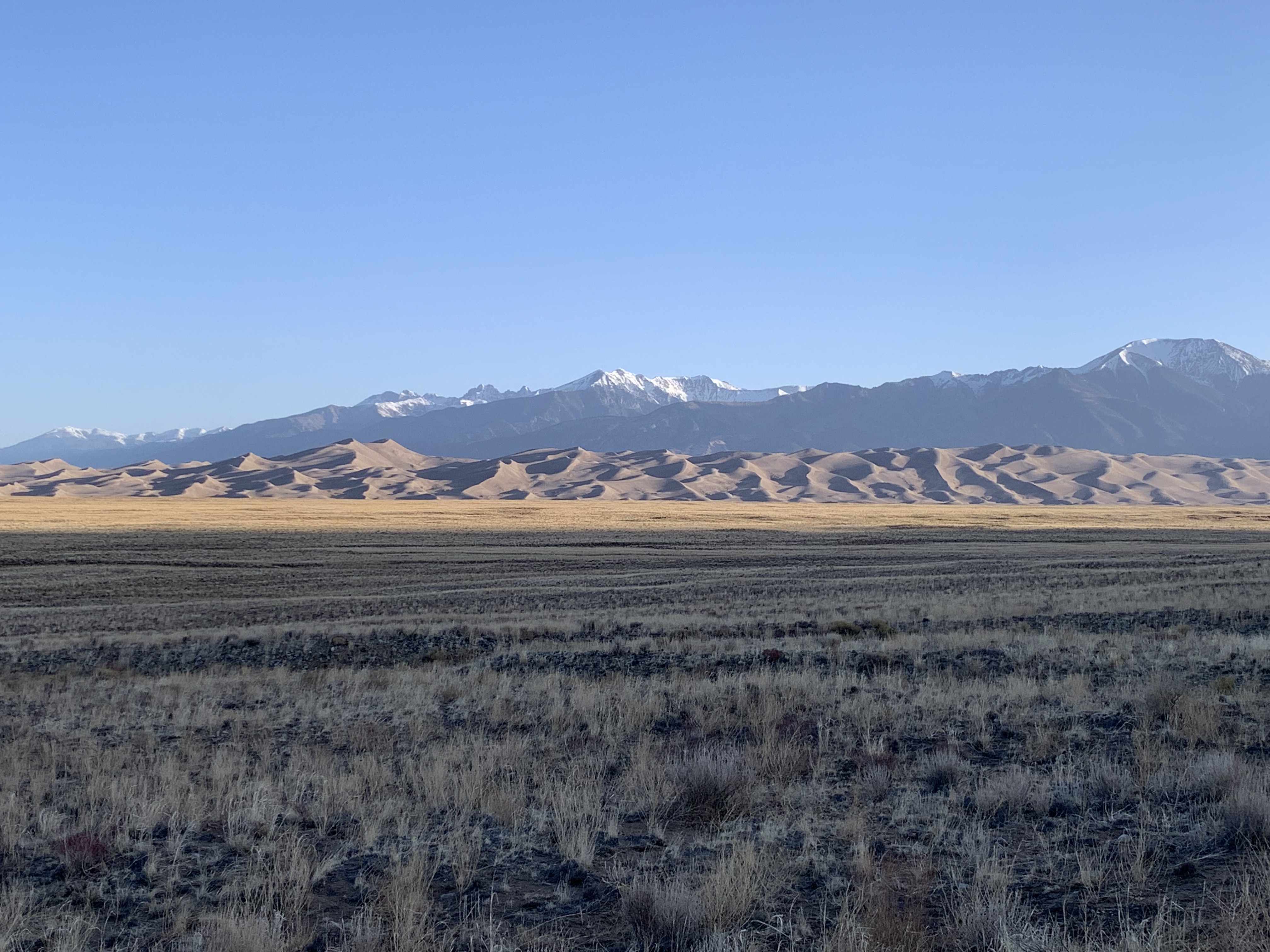
Great Sand Dunes National Park

I’m obviously not much of a photographer, but I like this one. The tallest dunes here are over 700 feet, but they’re dwarfed by the surrounding mountains. Since I camped at Piñon Flats in the park, I was able to take this just as the sun came over the mountains, which added shadows for contrast. I hiked into the dunes before dawn and along the creek, but it’s not easy to take an interesting picture of so much brown sand, even in such a beautiful, surreal landscape in the moonlight. The dunes and the neighboring preserve are basically all wilderness, easily hiked into, and our footprints quickly disappear.

Whenever I wander into any wilderness, I always wonder about what we value. I have both a BS & MBA in business, and I worked in HQ at a Fortune 100 financial firm for a couple decades. And it seems to me that capitalism is terrible at valuation. One problem is that the first business to claim a resource is often just the first idea that comes along. There may be a better and more profitable use for a resource, but the quickest way to make money is typically the one that’s chosen. Another problem is that business people aren’t very innovative. If they see one business is successful in an area, then they will often just copy that idea. Economically, we’re far better off with a diverse set of competitive products and services than with a small number, because then we’re more resilient to market changes. But short term thinking dominates, which leads to over-investment in a few businesses, rather than a broad, diverse range of businesses.

It doesn’t take any special training to see this. Drive through most towns and see the same chain restaurants everywhere. Look at how similar most vehicles are or how all the fields in an area grow the exact same crop or raise the same cattle. Business is mainly herd behavior, and few want to risk money to develop a completely new business. Capitalists need tax incentives to change. Traditional car companies killed the electric car, then ignored Tesla, and now are demanding that the government build a charging network for them to compete. Who knew America’s largest and oldest corporations were such whiny cowards who need taxpayer handouts before they will adapt?

Why do I think about valuation in the wilderness? Because if the first guy to find this place had owned a cement company, he would have started carting off these dunes to make concrete. And then other concrete material suppliers would have copied him, lowering profits to nearly zero. And the wilderness would have been gone before anyone bothered to think whether there were any other better uses. The same is true of forests, wetlands, prairies, rivers, valleys, mountains and oceans. Capitalism rewards the first, fastest, cheapest exploiter for destroying wilderness, and penalizes long term thinking. Because time is money.