San Juan Island National Historic Park

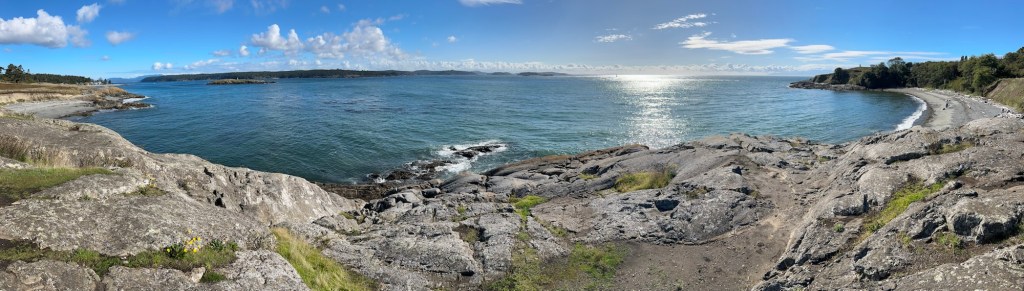
Most of our border with Canada is a straight line from Minnesota to the Pacific, except for Canada’s Vancouver Island, which dips below the line. When the border was negotiated, the treaty put the border through the “middle of the channel”, i.e. the Straits of Georgia and Juan de Fuca. Except where the San Juan Islands are in the middle, and then which is the main channel becomes a matter of interpretation. San Juan Island is much closer to Victoria Canada than to the mainland, so the British claimed it. But the Haro Strait is larger than the rest of the channel, so the Americans claimed San Juan Island too. Nobody really cared much about the sparsely populated islands, until an American squatter killed a British pig for rooting in his garden. Then, both sides prepared for war.

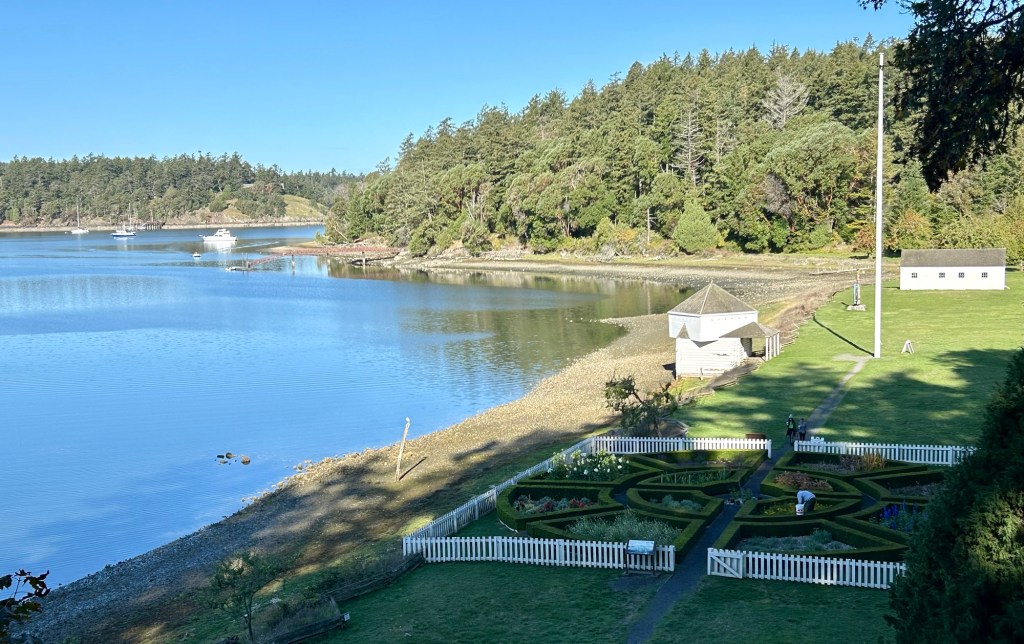
English Camp in the northwest is lovely, set on a well protected bay amidst large oaks, hemlock, and madrona trees. Well supplied from Victoria, the British created a formal garden above, kept calm and carried on. The Americans—actually the Robert’s Rules of Order writer—built a fort on the exposed southeastern point, conducted rigorous drills and maintained strict discipline. Large flag poles were erected at both camps. At the time, the US was entering the Civil War, so the government sent General Scott to negotiate peace. Fortunately, the border dispute was settled diplomatically.

There is an interpretive center at the American camp, while the English camp visitor center was closed when I visited late last September. Regular car ferries run to San Juan Island, with pleasant views along the way. Friday Harbor is between the English and American camps, 9 and 6 miles respectively, and has nice restaurants and more.

Affiliated Sites in North Atlantic

There are five affiliated sites in the North Atlantic region: Kate Mullany NHS, Lower East Side Tenement NHS, Roosevelt Campobello IP, Thomas Cole NHS and Touro Synagogue NHS. Campobello (above) is actually in New Brunswick Canada, just across the Maine border. Touro is in Newport Rhode Island. And the others are in the Empire State.

All five are among my favorite sites in the country.

  • The congregation at Touro predates our country, and they have the promise of religious equality made by George Washington in writing.
    • Take the tour, sit in the pews, and listen to the stories of freedom to believe.
  • In the early 1800s, Cole painted romantic landscapes and historical scenes, inspiring a school of painters.
    • Tour his house and studio, see the exhibits and listen to the stories behind his work.
  • From the late 1800s to early 1900s, the garment district immigrants toiled in sweaty tenement buildings and built futures in their new country.
    • Go to a neighborhood deli, tour the tiny rooms, and listen to the stories of strikes and hope.
  • FDR’s summer home in Canada immaculately preserves over 100 years of precious memories.
    • Tour the estate, have a cookie at Eleanor’s tea, and listen to the stories of recovery and advocacy.
  • The newly open Mullany house tells the little known story of the woman who started the first official female union in the country.
    • Make a reservation for a tour, see the history of American labor on the walls, and listen to the stories of the workers who built our country.

Roosevelt Campobello International Park

The park is in Canada, but the bridge to the Campobello Island is from Maine. I use my passport card for trips like this, where I just drive across the border for a few hours. I also crossed the border into Juárez in January, so this is my third country by EV. The park is an affiliated park, jointly run by both the US and Canada. Obviously, the staff are very nice, polite and helpful.

The Roosevelts used to vacation here in summer, and one of their children was born here. FDR came down with polio here in his 30s, although he likely contracted it before arriving. The house tour is fascinating with various toys and artifacts of their summers, and there’s a large nature preserve which has exceptional views at Liberty Point. However, my favorite part is the Tea with Eleanor.

At 11 and 3 (Atlantic time is 1 hour ahead of Maine), the staff give visitors free tea and cookies in one of the cottages while they present the life and achievements of Eleanor Roosevelt. They describe her trip to Tuskegee, her wartime work with the Red Cross, her friendship with Mary McLeod Bethune, her concert at the Lincoln Memorial for Marion Anderson, and here work on the UN Universal Declaration of Human Rights, to name a few. One of my favorite park experiences.

First Ladies National Historic Site

Ida Saxton McKinley’s house above is managed by the site, and was preserved by a private foundation before the park service got involved. The tour is interesting, with some original artifacts, and the ranger did a good job of comparing this famous widowed first lady with Jackie Kennedy. While times change, the political importance of presenting a positive public image remains. 

The museum and visitor center a block away has rotating exhibits of the various First Ladies, and Nancy Reagan was on display. Jackie Kennedy’s display begins on May 2nd. Not sure why Michelle Obama’s poster has to be in the most difficult to find corner of the basement, but whatever. One of the park films was on fashion and power, and it did an excellent job of explaining the political power of First Ladies like Dolly Madison and Jackie Kennedy, who used White House events, interior design, fashion and adroit diplomacy to support their husbands’ administrations, often more effectively. 

Chamizal National Memorial

Unlike any other park, Chamizal memorializes diplomacy. When the Rio Grande shifted course at the end of the 1800’s, it created an island and a seven decade long border dispute with Mexico. President Kennedy went to Mexico to finalize an agreement, and LBJ later participated in the joint ceremony at the border here. There’s a beautiful mural on the visitor’s center, and I remember from a previous visit that there’s a film that explains the importance inside.