Blue Ridge National Heritage Area & Gullah Geechee Cultural Heritage Corridor

Some Cherokee still live in the Blue Ridge Mountains, although the western North Carolina heritage area is more focused on waterfalls, sights along the Blue Ridge Parkway, bluegrass music, the Great Smoky Mountains, and more. The Cherokee, angry about their stolen lands, sided with the British during the Revolutionary War, while their Piedmont—central NC—neighbors, the Catawba, sided with the Patriots.

A particularly beautiful area in the US, the Blue Ridge includes the headwaters of the New River and the eastern states highest mountain (Mitchell), gorge (Linville) and waterfall (Whitewater Falls), plus the homes of interesting people, including the poet Carl Sandburg. There’s also rich diversity of species and frequent wildlife sightings. I love driving through, and I have to admit to bending my itinerary a few times to see something new here.

The Gullah Geechee area is much larger, stretching from North Carolina to Florida, including some great national park units, like Reconstruction Era, Cumberland Island and Timucuan Preserve. I heard Gullah spoken several times in the Carolinas, and there are numerous spots along the coast in four states to stop and learn about quilts, baskets, and other crafts. I love the food, always wanting to stop for boiled peanuts, country captain, perloo or other dishes. Gullah Geechee is a living culture, a unique community, an integral part of our history, and this distinct heritage is woven deep into our collective roots.

I understand that Gullah developed as a common dialect among slaves who had lived or passed through Angola, hence the name. A great public TV program on the English language taught me a bit about Gullah years ago. You already know some of the words that come from Gullah, like gumbo, jitters, and tote. The settlement on Cumberland and the plantation at Timucuan have clues about the Caribbean crops of indigo and sea cotton brought to grow in the barrier islands and about the enslaved people who worked the plantations. Not only did the communities survive, but they retained some of their African and Caribbean connections, linking us with living communities in other countries today.

Improving Moral Thinking

[Apologies for the long post. My next on this topic will be much shorter.]

Perhaps the most woefully neglected aspect of our thinking trouble is our moral thinking. Most often we begin thinking about the morality of an issue with our minds already made up.  Our gut may have decided on the issue instantly.  Your boss may have already told you that the project is good, and that if you do not see it that way, you can look for employment elsewhere.  As Upton Sinclair wrote, “It is difficult to get a man to understand something, when his salary depends on his not understanding it.”

Of course, most believe ourselves moral—even some professional criminals claim to follow a code. Some instinctual thinkers follow their hearts, making moral choices based on sympathy or disgust. Some follow the crowd, believing that their church provides sufficient moral guidance, that the path they were taught years ago is righteous, and even that everyone should follow that path as they assume the beliefs of others are wrong. Rational thinkers learned that rational, self-interested choices benefit society optimally and that all problems have rational solutions. A few believe that their worldview justifies acts that others believe are abominations.

All of those folks are wrong, at least in part. It is not moral to pick and choose which rules to follow, according to your convenience. Instincts are often deeply biased and can result in ugly vigilantism. While many religious traditions are filled with valuable moral lessons, blindly following one faith while denying all others has resulted in centuries of bloody religious wars. Rational government scientists conducted an unethical experiment for 40 years until 1972, and rational pursuit of profit has caused pollution killing many humans and other species. Any act of terror is unfair to the innocent victims, and as a rule they do not achieve any positive goal.

Many lazy, soft-headed ‘thinkers’ have given up on moral thinking, using excuses that there are no universally agreed upon moral facts and that all morality is relative. Some self-serving cynics use these excuses as permission to do whatever they want, consequences be damned. Nonsense. I already presented an incontrovertible moral baseline for humanity, the side of life, and next I explained it’s logical corollary, that life requires diversity and that the purpose of knowledge is to pursue the same universal moral objective to further life. This simple moral framework, based on the Golden Rule, makes many moral choices obvious.

No other way of thinking is disqualified before it can defend itself.  I see no perfect rational utopia, yet people still try to think rationally.  Instinctual thought is riven with conflict, yet people still make gut decisions.  Dismissing the reality of moral thinking appears to be an instinct-driven defense, by people who do not want to feel guilty or who want their self-interested way of thinking to prevail.   

Real moral thinking requires making moral determinations for moral reasons. If a culture has a traditional practice that causes severe pain to children with long-term suffering as adults, solely in order to enhance the power and control of one gender over another, then it is morally wrong, on the basis that it destroys much of the enjoyment of life from one group without improving life significantly for others. It does not matter how many people support the practice, what the laws or government say, or what the cultural or religious tradition of the country has been for however many centuries. The practice fails the basic premise of allowing life to thrive fully and joyously without unnecessary cruelty.

Simply because a cultural practice exists, does not mean that it has a moral right to continue. Our country has a long history of racism, including genocidal war and slavery. Many books and laws were written in the past attempting to justify these official policies, and the policies were popular in (unfair) elections. The cultural heritage of slavery does not, in any way, justify its existence morally. When foreigners complained that our institution of slavery was barbarically inhuman, they were not culturally insensitive, they were correct. The purpose of moral thinking is to challenge all policies on moral grounds and to change immoral policies, no matter how popular or profitable.

Once we view moral thinking as independent from other ways of thinking, such as instinctual or rational, then we can separate those feelings or arguments when making moral decisions. We can recognize an argument as being based on a common human desire and judge the morality of that desire as we judge the morality of the issue. Perhaps a common human behavior is no longer useful in modern society, is obsolete and deserves to be forgotten. We can recognize a rational argument for profitability or efficiency and still dismiss it as not relevant to the moral choice. Once extraneous ways of thinking are identified and treated separately, then moral thinking becomes clearer.

The primary problem with moral thinking is that people begin with the wrong type of thinking. If you try to make moral decisions with rational thinking, your decisions will be cold, profit-seeking and cruel, even if you use euphemistic terms such as acceptable collateral damage, euthanasia or eugenics. If you try to make moral decisions with the instinctual goal of reinforcing your own power or that of your group, then your decisions will be self-serving, not moral. Such mixed-motive thinking is confusing and often wrong.

Moral thinking should take into consideration human needs and desires, without allowing them to drive the decision, and it must often overrule short-run wants for long-term good. Moral thinking should be driven by the broadest love of life and humanity, while firmly able to deny base instinctual desires or herd behavior. Moral thinking should be as critical of bias and skeptical of ulterior motive as any scientist, while having the courage to defend the powerless few against the powerful majority.

Moral thinking should understand relevant rational assessments such as numbers of people involved and economic costs, without allowing strictly rational analysis to drive the decision, and must often overrule short-run profits for long-term good. Moral thinking must be as adept at analysis as rational thinking, but use that analysis to achieve a moral result, not the most efficient solution.

Moral thinking must learn the lessons of the past to avoid repeating those mistakes in the future. Most mistakes are not original. We have a long history of human error to teach us. Many old texts have profound moral lessons that only require some effort to apply to current problems. Each generation needs to go back to historic and even religious texts to reinterpret the old lessons for their new problems.

Religious beliefs may vary or be relative, but they are not the same as moral thinking.  Some religious texts reflect centuries of accumulated moral thinking, worded by our inspired ancestors for future generations to make better choices.  Just as engineers don’t reinvent the wheel, moral thinkers use the best tools they have.  Sometimes a moral decision is as simple as recalling a dictum and applying it.  But usually moral thinking requires more than looking up the answer in a book.  If you begin with a commandment already chosen, then you are simply applying a religious rule, not necessarily thinking extensively about the morality of the situation.  Your religion may require unquestioning obedience, but moral thinking requires more.  

Morality requires both flexibility to respond to new situations and backbone to stand on principle. One way to achieve this is to use techniques which were designed to facilitate good moral decisions. You might put yourself in each position and imagine how you would feel. You might ask whether one side would be equally happy to switch sides with the opposing party or if that would seem unfair then. You should prefer to take the long view and be the voice of silent future generations.

To summarize the key take-away, clear moral thinking should begin with a quick check that none of the other ways of thinking are driving it.  The method will almost certainly require a review of the facts, an exploration of the possibilities, and an understanding of what people want.  You need an open mind, not an empty one.  But the moral intent needs to be pure.  If you start with the belief that economics must decide the outcome, then that may be rational but not moral.  If you start with the belief that what pleases the most people will be best, then that may be popular but not moral.  If you start with your own idea in mind, then no matter how much you like it, it may not be the best solution for others.  You must commit to find the best long-term outcome in the most important respects, without regard to greed, fantasy, pride or other vices.  Well begun is half done, but moral thinking requires discipline, honesty, and may require significant time and effort, before you are prepared to make the best choice possible.
Midwest Region National Heritage Areas

The Midwest region has 8 NHA’s—more than most regions—ranging from industrial to pastoral, and most are devoted to travel by horse, boat, car or plane. Each heritage area provides a unique way for us to learn our history and explore our diverse culture in vibrant and interactive ways, such as riding in a Santa Fe Trail stagecoach above. Parks travelers tend to focus on the most famous iconic national parks, but I found some of my most treasured experiences below.

If you missed any of the posts above, I encourage you to click on them now, especially the last one. I’m slowly filling in the map and will continue posting Midwest state photo summaries on alternate Saturdays. I only have a few more Midwest national park units to post before I complete all sites in the region, and look for a few more New York sites. Thursdays will alternate between summaries like this one and eclectic extras like last week.

Bronzeville—Black Metropolis National Heritage Area

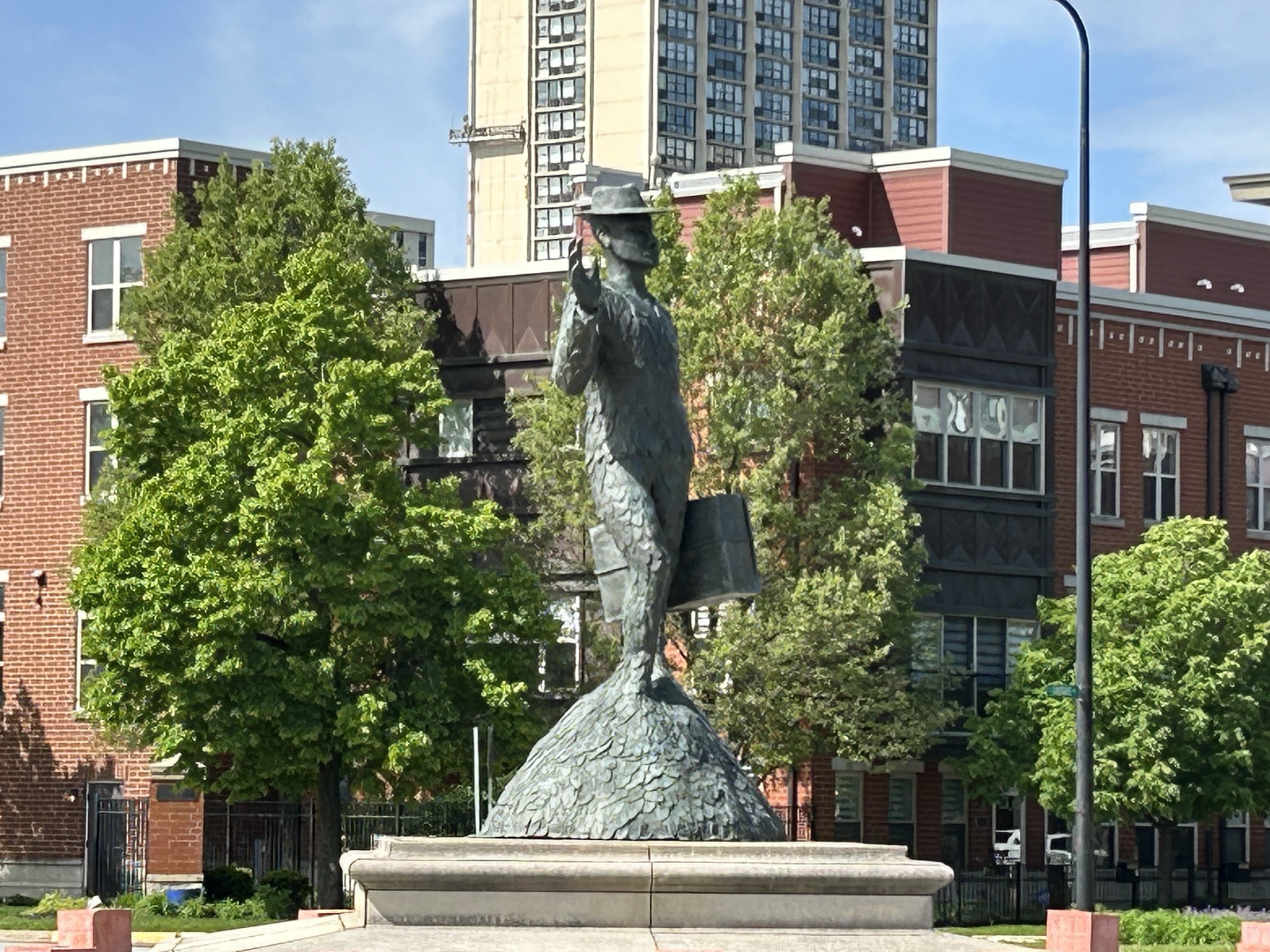
The South Side of Chicago has long been a historic district, and now it will be recognized as its own National Heritage Area. This is the neighborhood of activist Ida B. Wells, the church for Emmett Till’s funeral, of poet Gwendolyn Brooks, boxer Jack Johnson, musicians Louis Armstrong and Nat King Cole, and where a young community organizer named Barack Obama worked before law school. 1/2 a million African Americans moved to Chicago during the early 20th century. Above is the Monument to the Great Migration at MLK & 25th, welcoming people to join the community, and every so often you will find a bronze plaque recognizing accomplished residents on the walk to 35th, where there’s another statue, honoring the African American soldiers who chased the Germans at the end of WWI.

The neighborhood continues south, with many beautiful brownstone buildings and a few blues venues. Unfortunately, many historic buildings—like the Checkerboard Lounge where Muddy Waters used to play—were lost to poor government planning, an expressway that cut the neighborhood off, and expansion of the University of Chicago. Establishing a specific heritage area helps recognize the unique cultural value of a neighborhood, encouraging more visitors by promoting it. Now, I expect Black Metropolis will continue experiencing its renaissance, and I look forward to trying the food at Bronzeville Soul (closed Mondays) the next time I pass through town.

Northern Rio Grande and Sangre de Cristo National Heritage Areas

Quick logistical update: until summer, Mondays are Mexican World Heritage Sites, Thursdays are eclectic, and Saturdays are bonus park photos. I took the photos above yesterday in New Mexico and Colorado.

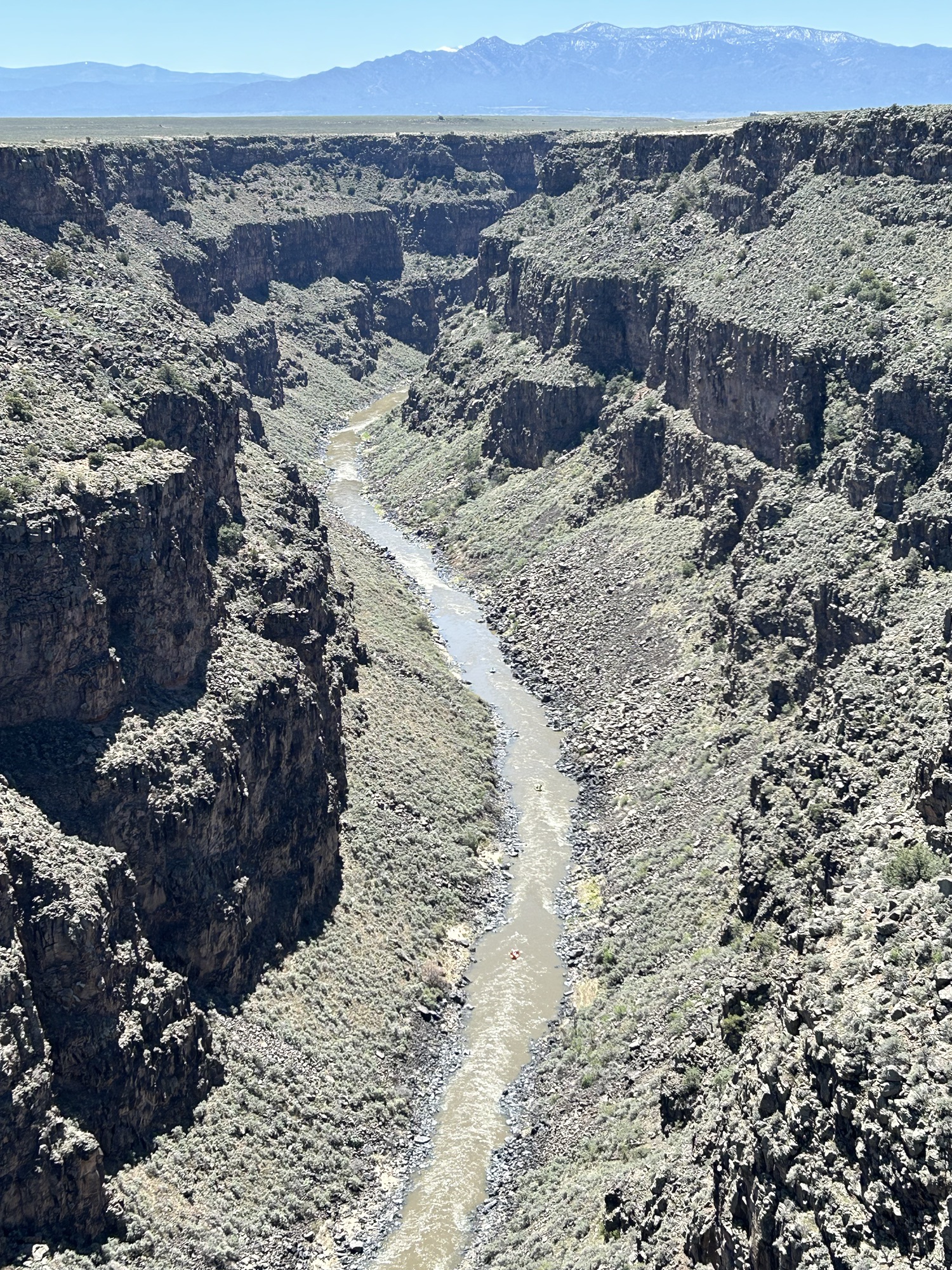
While technically in different regions, both National Heritage Areas are linked by the river, the mountains and our cultural heritage. The Rio Grande begins in the San Juan Mountains in south central Colorado and flows east through the San Luis Valley where it turns south into New Mexico. The scenic north section is called the Río Grande del Norte to distinguish it from the southern section that defines the Texas-Mexico border. The river flows through the Rio Grande Gorge and is now popular for whitewater rafting (see three rafts above left). In the distance are the Sangre de Cristo Mountains (both photos).

Native Americans and Spanish explorers traveled up and down the river, settling on the fertile valleys. The native land was claimed by the Spanish, Mexicans, and Texans, and for a dozen years, the Río Grande del Norte defined the US-Mexico border in Colorado, before the US claimed the land all the way to California by treaty in 1848. In the Civil War, Texas secessionists battled Colorado volunteers at Glorietta Pass in New Mexico to decide the war in the southwest.

The Northern Río Grande National Heritage Area in New Mexico celebrates this magnificent natural scenery and the cultural heritage it guided. It also includes Taos Pueblo, wild & scenic rivers, historic trails, scenic byways, and several cliff dwellings. The area is both beautiful and fascinating, and I was not going to miss another chance to drive through on my way northeast.

The Sangre de Cristo Mountains tower over the east side of the Río Grande del Norte from east of Santa Fe NM up into Colorado past the Great Sand Dunes. Meaning ‘blood of Christ’ in Spanish, the name likely refers to the scarlet colors of the mountains at sunset. The helpful illustration (my favorite photo above right) is on the Stations of the Cross trail up to a church that overlooks the historic San Luis Valley.

The Sangre de Cristo National Heritage Area in New Mexico borders the Northern Rio Grande National Heritage Area in Colorado, and includes the Cumbres and Toltec Scenic Railroad featured in Indiana Jones and the Last Crusade, the Monte Vista National Wildlife Refuge famed for Sandhill Cranes in March, and Fort Garland, a fine restored Kit Carson fort with an interesting museum on Buffalo Soldiers—one turned out to have been a woman who served for years as a man undetected. The area is lovely and pastoral amid snow-capped mountains, with many other worthy attractions, but I’m on the road again.

Teotihuacán

Feathered and fire serpents adorn the steps of the Quetzalcóatl Pyramid. Some weathering has occurred in the past 17 centuries, but once the eye sockets held black obsidian volcanic glass, the flames were painted bright red and feathers adorned with green jade. The museum (show your gate ticket for admission) near the Sun Pyramid shows murals, artifacts and has a large model of the site, which helps add details to the huge structures outside. None of the three pyramids can be climbed now, but I still walked a couple miles round trip, including the Moon Pyramid near where I started. I arrived early at 9 am, just as the hot air balloons were descending after their dawn tours. It’s an awesome place, but it can get hot and crowded by midday. I recommend staying nearby the night before.

At its peak, Teotihuacán was the largest city in the Americas, 6th largest in the world. Roughly, the city began sometime around 200 BC and fell around 550 CE. Much of their wealth came from obsidian tools, weapons and art, mined from local volcanoes and expertly knapped. The pyramids and related buildings show an elaborate religious class, but few signs of military or monarchs. The pyramids are designed to make observations for the Mesoamerican calendar, so the priests likely derived their power by determining the seasons. Best guess is that their civilization’s collapse was internal, with signs of drought and starvation, before simultaneous fires burned out the elites. The priests essentially had one job—to monitor the climate—, and they failed. Human success, growth, unsustainable use of natural resources, crop failure, and collapse, is a common pattern in ancient civilizations, and we are likely on a similar path due to carbon pollution.

Querétaro

UNESCO recognizes this colorful, artistic city for its historic zone reflecting its native and colonial combined roots. Otomi musicians and doll vendors walked in the narrow alleyways winding around grand churches, much as they have for hundreds of years. Beautiful public plazas with historic groves of trees, Baroque churches, vibrant architecture, and galleries fill the spaces. And art flows into the streets, with public displays of famous paintings, both local and international exhibited outside. While I intended to focus on the history of revolutionary conspirators, the trial of Maximillian and the drafting of the Mexican constitution, the fascinating streets pulled me away from the Teatro de la República and had me wandering around in circles taking in the atmosphere amazed. This is a cultural feast!

Nez Perce National Historical Park

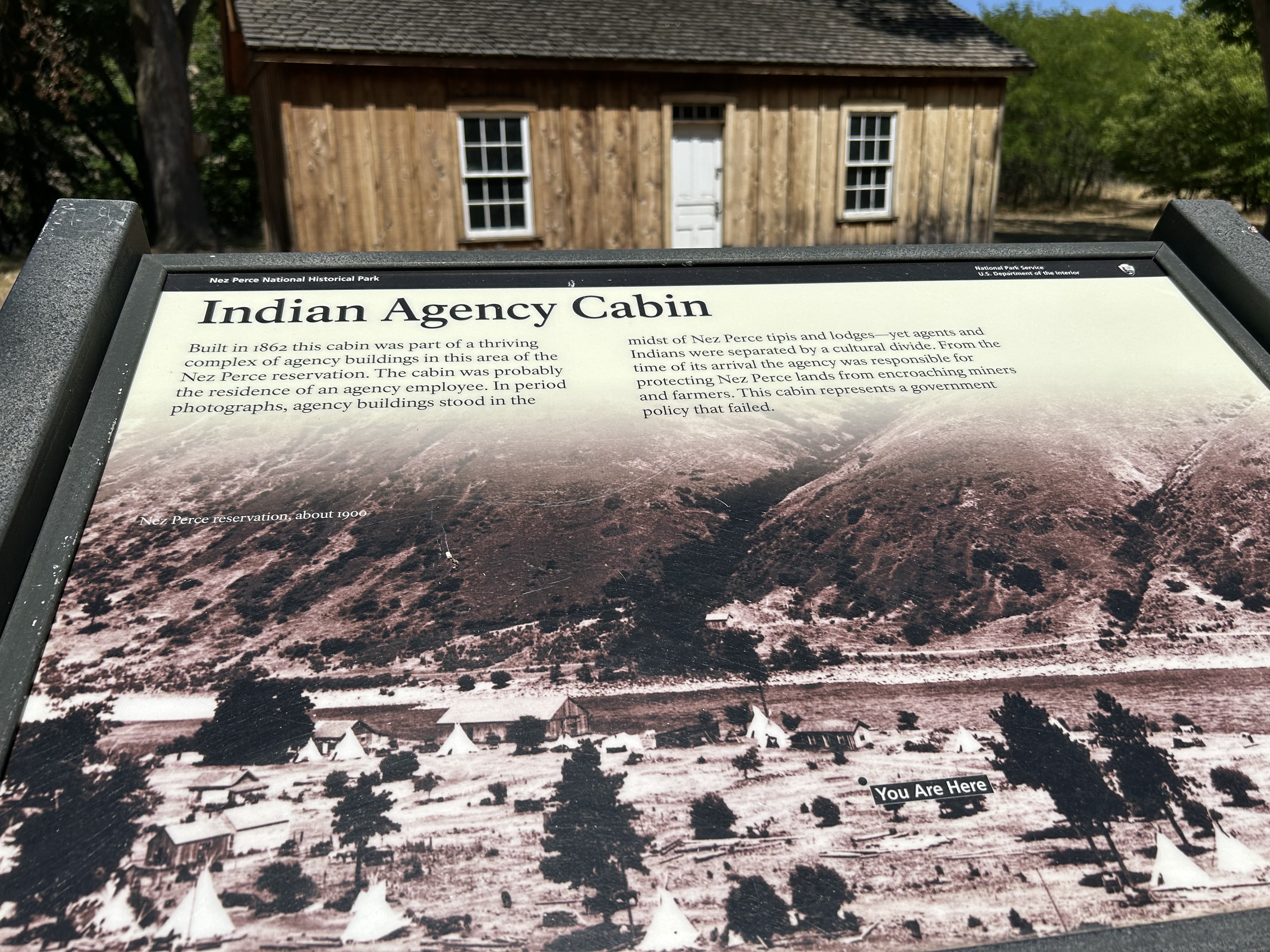
The visitor center in Idaho is on a hill above where the Lapwai Creek flows into the Clearwater River, which joins the Snake River a few miles downstream in Lewiston. The river banks were an excellent place for salmon, berries, edible flowers, and game, and the Nimiipuu used to arrive in the fall and stay through winter. By summer, they would be hunting up in the hills, forests & mountains. French trappers called the tribe Nez Perce or ‘Pierced Nose’, although that wasn’t a traditional tribal practice. When Lewis & Clark passed through, the Nimiipuu assisted the expedition and helped them make canoes. When the missionaries and other settlers arrived, they were forced to change. Many tried desperately to compromise and adapt. After the nearby Whitman mission ended in a massacre, racist demagoguery fueled far more excessive violence across the west, bringing the US military, war, exile and restricted reservation life, including here around the Spaulding mission, pictured circa 1900.

The affiliated Nez Perce National Historic Trail, which marks the flight of the tribe from the US Army, is now part of the broad official Nez Perce NHP, including Big Hole in Montana, a refuge near Lake Roosevelt, the White Bird & Clearwater Battlefields, through Lolo Pass, Yellowstone, Billings and up to Bear Paw Battlefield. Over the years, I’ve visited these places on roadtrips, read several of the books, from I Will Fight No More Forever to Chief Joseph & the Flight of the Nez Perce and pondered the mistakes and tragedy. There is simply no excuse for breaking treaties, stealing land, or killing defenseless people, including women, children, the elderly and infants. When leaders take advantage of popular anger to focus attacks against a community, the result is often far more evil than any original sins. I encourage you to learn more, since the problem of demagoguery is still with us.

But the Nez Perce tribe is still here with us, like the flowers they used to cultivate here. They are re-learning the language that they used to be punished for speaking. They self-govern, petition the US government, sing songs, dance, teach their kids to gather plants, hunt, fish and carry on their cultural traditions and exercise their treaty rights. The lessons of their forefathers and their oral traditions continue to be remembered, spoken aloud and passed down to future generations. The park preserves petroglyphs, artifacts and sites of mythology. Their culture is vibrant and contributes a valuable perspective to all of us. They are not doomed to be permanent prisoners of tragedy, and the park film here is a refreshing reminder of the resilience and life of their culture and of the human spirit.

Salinas Pueblo Missions National Monument

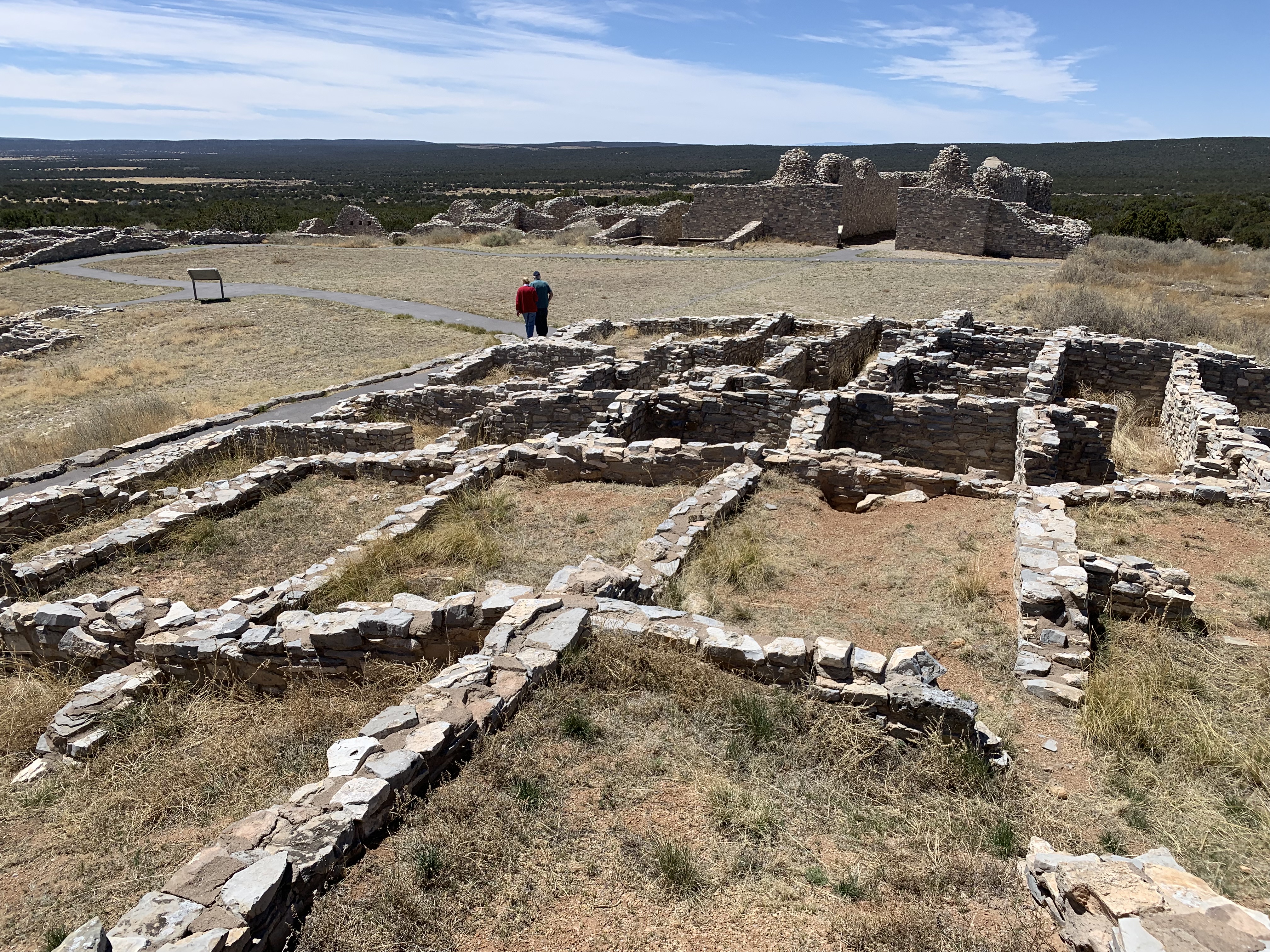
I chose to visit Gran Quivara, since it has the largest pueblo ruins of the three missions, although the churches are better preserved at the other monument sites. The original pueblo ruins are in the foreground. The Spanish claimed the land for the King and forced the people here to build two churches, first the low ruin to the left and then the taller structure in the back. Some accounts describe the relations between the natives here and the Spanish as friendly and positive. From what I can tell, it’s hardly a coincidence that the pueblo was abandoned a few years after they started constructing the larger church for the missionaries. The local people endured Spanish diseases, grew Spanish plants that were ill adapted to the drought-stricken area, and other native tribes mistreated or attacked them as collaborators. They were prohibited from practicing their own religion, including singing native songs or performing dances, due to the strict rules of the Spanish Inquisition. If I had to go through any of that, I would leave too.