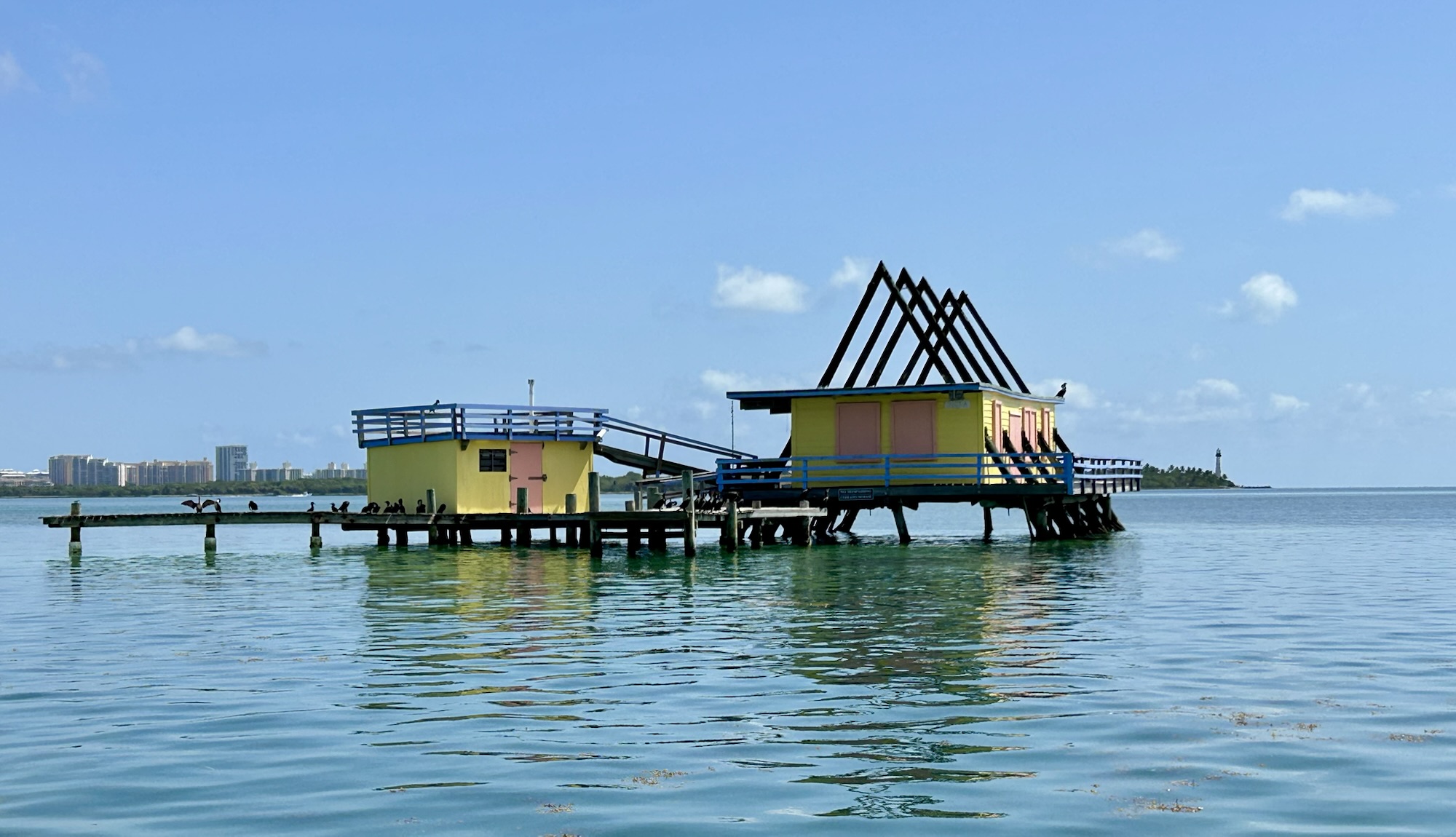
A few stilt houses have survived hurricanes and are allowed to remain in this huge marine park just outside Miami. The lighthouse in the background was once part of the Underground Railroad, as boats would risk the reefs to come here at night to pick up escaped slaves and fleeing Native Americans to live in the Bahamas, which ended slavery in 1834. While the Key Biscayne in the background above is a barrier island, the Florida Keys are part of an ancient reef that begins here, includes Key West and runs to the Dry Tortugas.
The best way to see the park is by boat. I took a very small tour from Coconut Grove out to the flats, to snorkel on both ocean and bay sides of Elliot Key, and had lunch on Boca Chica. The reef I remember from the 1980s has been devastated by carbon pollution from fossil fuels—elkhorn & staghorn corals are functionally extinct here now—with widespread coral bleaching and only a fraction of the marine life. But it still has life. I counted dozens of species including a beautiful French angelfish, various colorful parrotfish, spiny urchin and a lobster. From the surface we saw mating loggerheads, a manatee, and many birds, but the vast majority of wildlife is just below the surface. Let me show you what I mean.
From 1991 to 1993, eight people lived in this huge sealed greenhouse or giant terrarium in Arizona, growing their own food and attempting to live without outside intervention. Built at a cost of some $250 million, the complex includes the artificial ocean above, multiple tropical growing zones, industrial HVAC, and even a unique, massive ‘lung’ to equalize air pressure at different temperatures. Results were mixed, but there are important lessons to be learned.
Humans like to believe we can control our environment and that we have conquered nature. The truth is that we don’t completely understand nature, and when we try to control it, there are unintended consequences.
The most serious problem was a gradual reduction in oxygen, which threatened to kill the participants by around day 500 and required emergency intervention. Despite all the plants, overall, the system produced too much carbon dioxide. Also, the participants complained of constant hunger, unable to eat enough calories per day, which made it difficult to complete their extensive daily chores. Many plants and pollinators did not survive, but stowaways like cockroaches thrived. Still, they survived for two full years. Others later managed shorter stints, but bickering and mismanagement soon ended fully sealed living experiments.
From 1995 to 2003, Columbia University managed the site and completed groundbreaking research here scientifically proving up to 90% declines in oceanic coral due to artificially high levels of atmospheric carbon dioxide. Unfortunately, the coral later died when the site went back on the market, although there are plans to try to reintroduce it. Today the site is run by Arizona State University, which offers both a general self-guided tour and specialized guided tours, in addition to hosting students and researchers. When fully funded, the semi-tropical desert forests are very well controlled and measured, enabling many scientific experiments on micro ecosystems to be carried out under laboratory conditions. Tracers can be added to water and carbon dioxide, so researchers can figure out exactly what plants are doing in different conditions. Unfortunately, the whole complex is extremely energy intensive, and it is run on diesel and natural gas, which both contribute carbon pollution to exacerbate the climate crisis.
Some believe that technology will allow us to adapt to the worst effects of climate change. The truth is that we need to spend our time, energy and money trying to protect Biosphere 1 (Earth) from carbon pollution. This massive, extremely expensive, carefully engineered and scientifically researched project could barely take care of eight people for two years. That’s neither an efficient nor effective use of resources, but it quickly illustrates how difficult it is to scale environmental technologies to the point that they are practical. How big of a terrarium would we need to feed eight billion people? Far better to take care of the Earth, while we still have hope.

 Zero Carbon Travel