Moral Thinking

If you begin with the intention to determine whether something is right or wrong, you have begun thinking morally.  If you apply moral principles fairly to evaluate the social benefits and long-term consequences, then you are thinking morally. When you arrive at a well-justified course of action that advances the greater good, then you have achieved a moral decision. Simple.  

Moral thinking is often confused with spiritual or instinctual thinking, but it is more exacting than simply having a conscience, feeling guilty or a desiring to conform to social norms. If your conscience tells you that you have just made a moral error, then you should have thought before acting. Others confuse morality with submission, obedience and inculcation, but, if you’re letting someone else make decisions for you, then you aren’t thinking. Such herd dynamics are also instinctual, and following instincts without moral thinking causes more moral problems than it fixes.

Moral thinking is a conscious effort to decide what is right and wrong, from immediate individual choices to broad, long-term social consequences.  Moral thinking is what we should learn first at home, in pre-school and when we learn about religion.  But it is not simply learning rules; it is understanding why a choice is wrong. We must learn the lesson, extrapolate from it and then apply it well to a new situation. We take the moral of the story and use it to do good. Moral thinking is used to guide our behavior, to create fair rules and laws, and to question social problems and demand change.  

Neither should moral thinking be confused with rational thinking. Philosophers try to prove altruism logically and often decide it is a self-serving illusion. Poppycock. All day, every day, good people make moral choices to benefit others without notice or reward, including sacrificing themselves in ways small and large. Rational analysis can dissect and analyze these acts without ever being able to understand the moral motives to alleviate the suffering of others, to be kind to strangers or to lose so that unrelated others gain. Because moral thinking has different motives, uses different techniques and has different goals, it is difficult to comprehend with only logic and rational analysis.

Some argue that moral judgement is the sole province of the Divine, that humans either are incapable or have no business trying to make their own moral judgements and that humans must simply obey the Ten Commandments, the Bible or a delegated authority like the Pope. I would argue that we have been granted both the ability to think and knowledge of good and evil, so it would be a sin to carelessly or slothfully neglect our responsibility to use those talents to do good.

Some argue that moral thinking is hopeless, that there is no single source that everyone recognizes as being the correct answer.  Nonsense.  Even if there is no single divine rule for every issue, nor a utopian moral code hidden in the ether, it matters not.  Whether all the religious texts and great philosophers are in contradiction or not, matters not.  What matters is that humans make an effort to decide whether something is good or evil.  This way of thinking matters, perhaps more than any other.  The debate matters, getting it correct matters, and the consequences matter.  

If you and I disagree on what is good or evil, then we should have that argument.  As long as we are arguing in good faith, without being influenced by money, status, or fantasies, then we are trying to think morally.  Moral thinking is persuasive, has its own inexorable logic and its own authority, distinct from popular mob instincts.  What is good or evil may be debated, but an answer can be achieved, at least for specific topics in specific instances.  

Since we are all on the same side, we share the same fundamental, universal moral imperative: to sustain life. Since life requires diversity, we must choose to coexist and to balance competing objectives. Since each individual life is limited, we must work together to share our knowledge to pursue our joint mission and to improve not only our own lives but each other’s and also future lives.

From that simple moral framework, based on the golden rule, many moral choices become obvious. Just as your life may be important to you, others believe their lives equally important. Selfishness is being unfair to others, instead of treating people with equal respect. Our responsibility to future generations is greater than our responsibility to our own generation. Despite short run pressures, we must act for the long run good.

The purpose of moral thinking is to make a good decision or judgement to improve individual lives or society.  Whether we are thinking for ourselves or others, or about specific policies or abstract principles, moral thinking is needed to avoid making a bad choice or the wrong recommendation, or to fail to see the consequences or the underlying flaw in an idea.  We do not go through the effort of thinking morally in order to stand by and do nothing or to hurt people.  That would be immoral.  Morality requires a bias towards action, determination and courage.

We think morally in order to be good, do good and promote what is good.  We also think morally to oppose evil, fight injustice and make our world a better place.  After thinking morally, we may speak out more clearly, confidently and persuasively, and our actions may have more positive impact.   That is why we study ethics, justice, honesty, altruism and responsibility.  

Moral thinking begins with a moral objective to arrive at a moral decision using problem-solving methods designed to achieve moral results. Moral thinking takes a long, broad and deep perspective, weighs consequences fairly, has a bias towards action, is courageous in the face of popular or powerful opposition, is driven by love of life and humanity, abhors needless cruelty and suffering and sets bold, well-justified priorities that convince people to take the correct path forward.

Moral thinkers view their way as correct and believe that the world would be better off if more people thought morally.  

The Trouble with Thinking

The trouble with thinking these days is that few do it correctly. First, most Americans are chemically impaired, irrational or misinformed. Second, modern conveniences help us do many things every day without thinking. We act habitually, instinctively and follow others, and when nothing goes wrong, we declare ourselves ‘smart’. Third, we don’t know what real thinking requires. For most, ‘thinking’ starts with an unconscious desire, is validated by a childhood belief and is rationalized by something we once heard somewhere. However common, that’s mush.

Don’t feel bad. Few, if any, were taught how to think both methodically and comprehensively in school. Even well-trained academics are often either one-dimensional thinkers or at best employ self-developed, mismatched thinking techniques. After obsessing over mistakes for years, I finally recognized how haphazard and contradictory our way of thinking has become. So, on alternate Thursdays, I’m going to write about thinking: how to do it better, how to make fewer mistakes, and how better thinking is the way to a better future.

[That’s it really, but, if you want to read more, I belabor the point below.]

Most Americans are exposed to chemicals that reduce our cognitive skills. Self medication with products containing THC, the active ingredient in marijuana, is even higher than prescription antidepressants which have also soared, with over 20% of seniors consuming cannabis and 60+ million Americans consuming CBD. Long term exposure to THC can cause problems with memory, concentration, IQ, and ability to make decisions. 1/2 of American adults today were exposed to unhealthy amounts of lead as children, from leaded gas fumes and leaded drinking water pipes, lowering IQ a few points. And 2/3 of American adults drink alcohol regularly. Obviously all that presents an obstacle to thinking clearly.

But, even if folks got off dope and booze, most would still do the bare minimum of thinking. Our modern convenient lives are filled with routines, absorbing views from others and our habitual responses. Like Forrest Gump in the Army, not thinking is the path of least resistance. The Age of Reason lacks followers. We have returned to an age of Mob Rule, where illusions and emotions drive society. It’s very easy to become deluded today, surrounding yourself with whatever views you like: most Americans believe in aliens or ghosts, many believe in conspiracy theories, and unrealistic expectations are common. Critical thinking, weighing evidence and predicting consequences are ignored, and instead decisions are made by general feelings.

The climate crisis is a good example. Scientists agree that humans burned so much fossilized carbon from eons before we evolved, that we have caused global average temperatures to rise to levels that drive and will continue to drive mass extinctions for long beyond our lives, leaving our descendants to face unprecedented challenges to life on earth. That’s a fact. But even people who claim to be rational, logical thinkers find ways to downplay that threat and avoid taking action to help solve the problem. ‘Alternative facts’ are available online, you can simply refuse to believe evidence, or you can just ignore it and distract yourself with entertainment.

It’s easy and fair to blame politicians, biased media, hostile foreign governments and corporate lobbyists for lying to us. But how did we get to the point where most adults can’t tell fact from fiction, can’t see obvious consequences ahead, and can’t imagine how to solve basic problems like reducing carbon pollution? We can no longer simply raise a problem, discuss honestly, brainstorm and agree on the best solution. Sure, it’s a failure of leadership, but we’re all failing to face the truth and act appropriately. At this point we must admit we all have trouble thinking.

I will tell you the truth.  I am neither an expert in human psychology nor intelligence.  But I have way too much experience making and struggling with mistakes.  Determined to understand what went wrong, I obsessively analyze my own mistakes, specific historic mistakes and the broader, general mistakes humans make.  Frustrated, I travel, visiting sites of beauty and pain, of conflict and success, and of nature and destruction.  Each day trying to see a better way.  Isolated both by choice and by my own mistakes, eventually my view became as clear and honest as a distant peak on the horizon, emerging from the mist and hit by the sun above the wilderness.  

So now I have a few worthwhile thoughts about thinking. Unfortunately, my realizations come a bit too late for me.  Too late to save friendships, my first degree, marriage or my career.  Too late to discuss with my father.  But not too late for you to benefit, if you continue to read this blog.

We do not think how we think we think. Because we think wrongly, we make predictable mistakes. And we become depressed, which also decreases our cognition. But we could change how we think. We can become aware of how we really think and exercise more control over unhelpful ways of thinking. Better thinking could solve problems, help us make better choices, and help us come up with better ideas.  Then we would all feel better about ourselves and our future, instead of medicating ourselves into false comfort in an increasingly troubled world.

While we quickly agree that others need to learn how to think better, our vanity makes us reluctant to believe that our own way of thinking could possibly be improved. I challenge you to read my insights about thinking on alternate Thursdays. Why do I care? I believe we’re on the same side, and I want us to stop making so many mistakes. So I will write for you, so you will think better.  Thanks.

Hospicio Cabañas

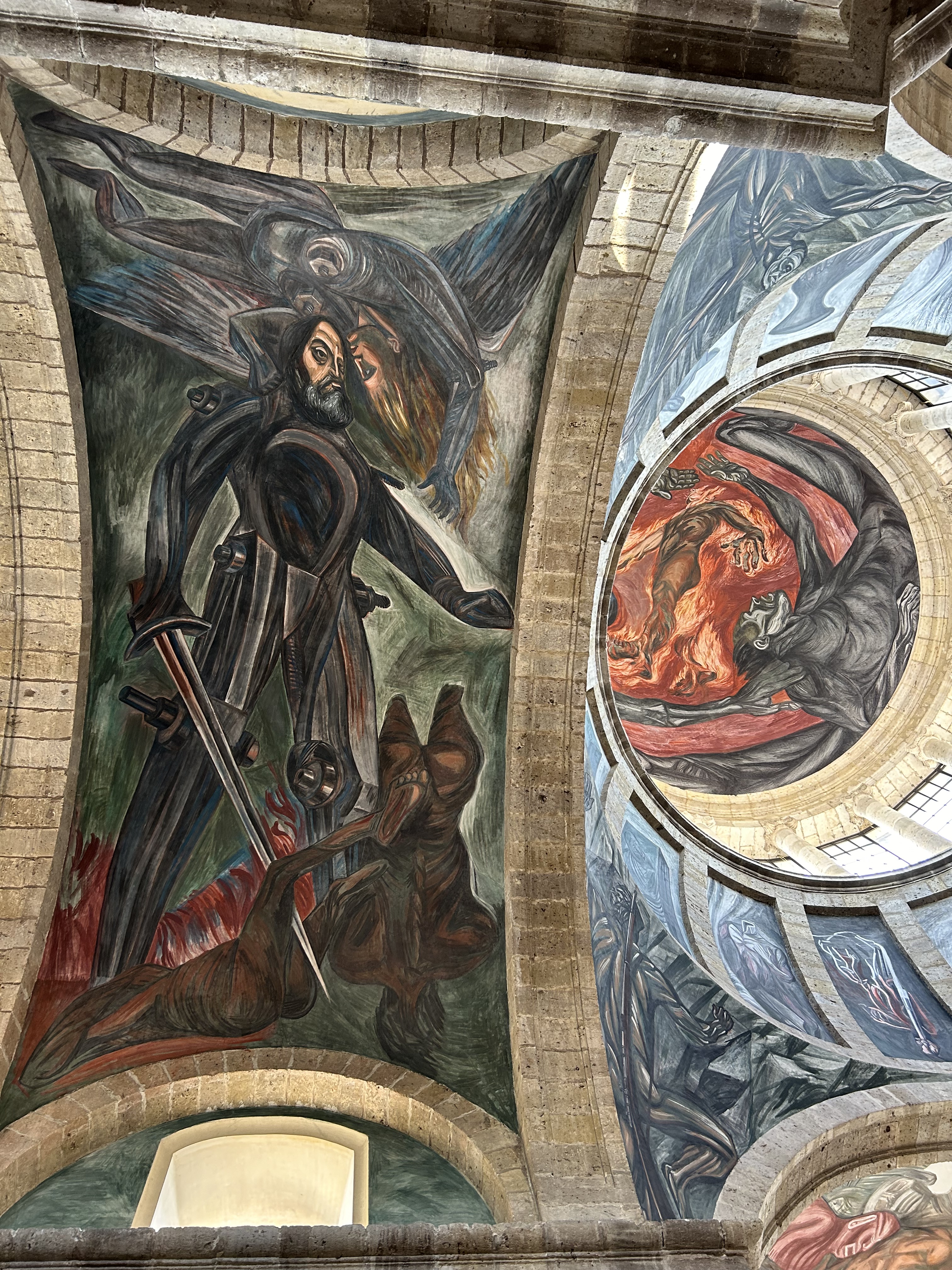
Originally designed to be a hospital, like Les Invalides in Paris, and named after the bishop, today the World Heritage Site in the historic heart of Guadalajara is a museum, with modern art outside and exceptional murals by Orozco inside. The central masterpiece on the ceiling of the rotunda is ‘The Man of Fire’, a modern version of the myth of Prometheus (in photo on right). I had seen Orozco’s earlier version in the Pomona dining hall in California, considered “the greatest painting in America” by Jackson Pollack. Orozco lost his left hand making fireworks at 21, and he was fascinated by the story of a man who risked his life and suffered to expand human knowledge and civilization, only to be punished by the Gods. He felt the myth was an allegory for artists, explorers and reformers who were punished by conservatives for their efforts to bring enlightened change to the people. Every alcove and wall tells a story of both progress and betrayal, of historic accomplishments and dark consequences.

Prometheus stole fire from the Gods, but today we struggle with the consequences of burning carbon. Fossil fuels helped us achieve great things, but there are always consequences. Struck by the inescapable conclusions of the art here, we see that conflict over ‘progress’ often results in suffering, especially among the poor. Murals require us to step back, to try to see the bigger picture. We can build hospitals, and we can also destroy whole cultures. We can choose sustainable fuels, or we can let powerful men perpetuate destructive fuels. We may believe ourselves invincible and deserving of the powers of the Gods, but our actions come with destructive consequences that we must try to see, understand and prevent. We must give up fossil fuels, or our world will burn.

Manassas National Battlefield Park

Both the first and second battles here (aka Bull Run) were severe losses for the Union ending in retreats to DC. In the first, Stonewall Jackson above got his nickname, and in the second, Robert E. Lee took command. 900 dead first, and 3,300 dead second.

The ranger is giving a tour of Henry Hill, explaining how Jackson’s forces were expertly positioned and how the Union artillery were stupidly placed in front of them, in range, without infantry support, ahead of their line, without scouting the area. A counter-attack was readied, countermanded and overrun, revealing the lack of infantry. Jackson’s troops attacked with ‘a rebel yell’, and the Union retreated in panic. Which also sums up the rest of the battle.

There’s a driving tour for the second battle, where again the Union forces were incompetently led into rash attacks, poorly executed. In contrast, Lee’s army executed maneuvers, defended and counter-attacked well, with good timing, and Jackson even captured supplies behind lines. Again on this hill, faced with defeat, the Union forces defended before retreating at night.

From a military perspective, the Confederate generals here fought admirably. The hero worship can be excessive (Ranger: ‘neither Jackson nor his horse took steroids’) and misplaced (we have no monuments to Yamashita, Tojo or Rommel). The Confederate victories prolonged the war—in defense of slavery—and increased the cost in American lives.