Rocky Mountain Region National Heritage Areas

There are five NHAs in the Rocky Mountain Region: three in Colorado, one in North Dakota and one in Utah. I’ve visited all of them (plus the Great Basin that extends into Utah), and I encourage you to visit too. As befits the region, they are areas of great natural beauty, but each differs distinctly.

Cache La Poudre (Buried Gunpowder) River National Heritage Area follows the river through Fort Collins, a fair sized city north of Denver. The headwaters of the river begin in Rocky Mountain National Park, outside the NHA, and the beautiful upper portion is a popular rafting Wild & Scenic River run by the Forest Service. I love the naturally-flowing sections of the river, which are remarkable, even in a state known for whitewater rafting. The NHA includes historic water works, irrigation canals, a bridge for sugar beet effluent, picnic areas, lakes & reservoirs, bluffs, wildlife areas and a whitewater practice area. The cooperative water district is considered a model for preserving early water rights, although it diverts water through tunnels that would otherwise flow west or north to drier states. Water policies need to be decided nationally, even if it means changing water rights established over 100 years ago. While I’m impressed with how industrious people have been making money with the river, the Climate Crisis is affecting the snow-pack, causing wildfires, and threatening species that depend on the river. So, I believe there’s still much work to be done.

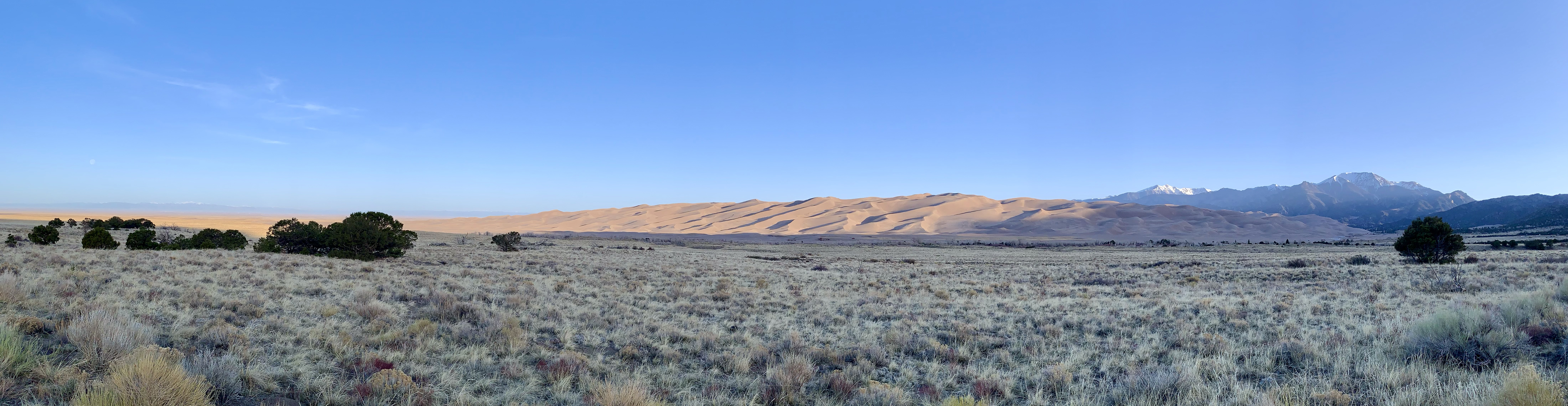
Sangre de Cristo—Blood of Christ, referring to color of the mountains at sunset—National Heritage Area includes Great Sand Dunes National Park & Preserve (above) and many forests and wildlife areas in southern Colorado. The area figures often in the novels of Louis L’Amour, loved by my grandfather, and there are still stark stretches of remote beauty along the Old Spanish Trails below and among the towering mountains. This NHA borders the Northern Rio Grande NHA in New Mexico, and the headwaters of that river begin here. Some of the oldest settlements and churches in Colorado were built here by Spanish-speaking settlers, following the Rio Grande up from Santa Fe, as I did, enjoying the scenery.

I drove through South Park National Heritage Area looking for a scenic route from Florissant Fossil Beds to the Black Canyon of the Gunnison, and there are half a dozen scenic historic auto tours here, amidst many wildlife refuges, historic ranches, canyons and old mining outfits. I spent my time gawking at the peaks, vistas and fall colors, without taking photos. Colorado has that kind of indescribably rugged beauty that makes you want to change your life, sell your belongings and move into the mountains, although I admit I haven’t spent winter there.

The Northern Plains National Heritage Area in North Dakota is also ruggedly beautiful. I remember driving great distances to see Knife River Indian Villages NHS before it closed, and I stayed at several state parks to charge. Maybe half a dozen state parks are in the NHA, and they have good facilities, are uncrowded, and are in beautiful spots, often near lakes or rivers. Several of the state parks are stops on the Lewis & Clark NHT. The Native American tribes who assisted them on their journey were later described and painted by European artists and authors, fulfilling great curiosity across the Atlantic and inspiring many Europeans to immigrate to the New World. As with other NHAs, there is a unique sense of place, fleeting historic moments and cultural details that enrich the land with atmosphere, and of course, great natural beauty. But you have to drive, stop, pay attention, keep your eyes open, read, try to understand and make connections, or the whole country just appears to be empty space that you fly over, recklessly burning carbon.

The Mormon Pioneer National Heritage Area includes Bryce, Canyonlands, Capitol Reef, Cedar Breaks and Zion. But besides those geologic wonders, the idea is to encourage more travel on routes 89, 12 and 24. There’s a Scandinavian community around Ephraim in the pretty Sevier Valley on 89. There’s Grand Staircase-Escalante, Goblin Valley, outlaw hideouts, ghost towns, old theaters, and more. I’ve traveled through the NHA in every season taking different routes, and I don’t remember any ugly or boring scenery. Utah is an extremely beautiful state. I occasionally wish it were easier to get something stronger to drink, get a table at a decent restaurant for dinner, or find out more about the Native Americans who used to live there, but it’s unquestionably easy on the eyes.

Monarch Butterfly Biosphere Reserve

Be cool for the butterflies on Earth Day!

Butterflies are free. Monarchs may arrive at their winter home late, be choosy about where to land, and may leave early. At around 10,000 feet, the dormant volcanic peaks are covered in trees and flowers, with the specific temperatures the Monarchs need. Despite the distance and dangers, the fragile butterflies still manage to fly from Canada to Mexico every year in an extraordinary migration, one of the coolest natural events on earth.

Everyone loves the monarchs, and between the states of Mexico and Michoacán the reserve is both a UNESCO Biosphere and a World Heritage Site. During the November to March season, crowds of locals take bus day trips to see them fly, cluster, feed, mate and fly again. Since the flighty monarchs are unpredictable, day trips can visit their chosen forest at the best times. Overseas visitors often stay for a few days in lovely spots—like Cerro Pelón B&B run by a family of original butterfly rangers—to enjoy the picturesque villages and relaxing environment while recovering from high altitude hiking, as I did.

Humans can impact these glorious butterflies in many ways, both positively and negatively, and we need to be much smarter about making small changes that can help: reduce pesticides, grow butterfly friendly plants and drive slower when butterflies are present. But also, we need to make big, global changes to reduce our carbon emissions, so that this species can survive.

Which brings me to an Earth Day question. Is it worth flying and driving here to see the butterflies, knowing that your carbon pollution will contribute to their extinction? Better to drive an electric car.

Biospheres of the Southwest

This is a photo of a photo of a Texas Horned Lizard in the arid Chihuahuan Desert scrubland, from a roadside plaque near Las Cruces, New Mexico. The actual habitat is within the White Sands Missile Range and is off limits to the public. This UNESCO recognized special biosphere, Jornada—meaning day’s journey without water—, is open to scientific researchers from USDA, USFWS and NMSU, with limited school trips to the Chihuahuan Desert Nature Park in the southernmost corner. For many decades, the Department of Agriculture has been studying the climate here, gathering useful data about the fragile desert ecosystem. The Fish and Wildlife Service mostly focuses on the Bighorn Sheep and other species in the adjacent San Andres Mountains. New Mexico State University organizes research efforts and assists student scientists. 

While you can’t visit the Jornada biosphere or disturb the wildlife, these scientific research zones are extremely important for understanding global climate change and the ecosystems that support unique species. But the southwest region has two internationally recognized biospheres that you can visit: Big Bend and Big Thicket. Big Bend, like Jornada, is part of the Chihuahua Desert, and it also includes a biodiverse riverine ecosystem. Big Thicket is one of the most biodiverse places in the US, where the bayous, leafy forests, pine forests, plains and sand hills intersect and provide habitat for thousands of species. While these areas provide enjoyable excursions for Americans, they are also important beyond our borders. Scientists from all over the world actively support protecting and studying these areas to ensure the survival of species globally.

Teotihuacán

Feathered and fire serpents adorn the steps of the Quetzalcóatl Pyramid. Some weathering has occurred in the past 17 centuries, but once the eye sockets held black obsidian volcanic glass, the flames were painted bright red and feathers adorned with green jade. The museum (show your gate ticket for admission) near the Sun Pyramid shows murals, artifacts and has a large model of the site, which helps add details to the huge structures outside. None of the three pyramids can be climbed now, but I still walked a couple miles round trip, including the Moon Pyramid near where I started. I arrived early at 9 am, just as the hot air balloons were descending after their dawn tours. It’s an awesome place, but it can get hot and crowded by midday. I recommend staying nearby the night before.

At its peak, Teotihuacán was the largest city in the Americas, 6th largest in the world. Roughly, the city began sometime around 200 BC and fell around 550 CE. Much of their wealth came from obsidian tools, weapons and art, mined from local volcanoes and expertly knapped. The pyramids and related buildings show an elaborate religious class, but few signs of military or monarchs. The pyramids are designed to make observations for the Mesoamerican calendar, so the priests likely derived their power by determining the seasons. Best guess is that their civilization’s collapse was internal, with signs of drought and starvation, before simultaneous fires burned out the elites. The priests essentially had one job—to monitor the climate—, and they failed. Human success, growth, unsustainable use of natural resources, crop failure, and collapse, is a common pattern in ancient civilizations, and we are likely on a similar path due to carbon pollution.

Biosphere 2

From 1991 to 1993, eight people lived in this huge sealed greenhouse or giant terrarium in Arizona, growing their own food and attempting to live without outside intervention. Built at a cost of some $250 million, the complex includes the artificial ocean above, multiple tropical growing zones, industrial HVAC, and even a unique, massive ‘lung’ to equalize air pressure at different temperatures. Results were mixed, but there are important lessons to be learned.

Humans like to believe we can control our environment and that we have conquered nature. The truth is that we don’t completely understand nature, and when we try to control it, there are unintended consequences.

The most serious problem was a gradual reduction in oxygen, which threatened to kill the participants by around day 500 and required emergency intervention. Despite all the plants, overall, the system produced too much carbon dioxide. Also, the participants complained of constant hunger, unable to eat enough calories per day, which made it difficult to complete their extensive daily chores. Many plants and pollinators did not survive, but stowaways like cockroaches thrived. Still, they survived for two full years. Others later managed shorter stints, but bickering and mismanagement soon ended fully sealed living experiments.

From 1995 to 2003, Columbia University managed the site and completed groundbreaking research here scientifically proving up to 90% declines in oceanic coral due to artificially high levels of atmospheric carbon dioxide. Unfortunately, the coral later died when the site went back on the market, although there are plans to try to reintroduce it. Today the site is run by Arizona State University, which offers both a general self-guided tour and specialized guided tours, in addition to hosting students and researchers. When fully funded, the semi-tropical desert forests are very well controlled and measured, enabling many scientific experiments on micro ecosystems to be carried out under laboratory conditions. Tracers can be added to water and carbon dioxide, so researchers can figure out exactly what plants are doing in different conditions. Unfortunately, the whole complex is extremely energy intensive, and it is run on diesel and natural gas, which both contribute carbon pollution to exacerbate the climate crisis.

Some believe that technology will allow us to adapt to the worst effects of climate change. The truth is that we need to spend our time, energy and money trying to protect Biosphere 1 (Earth) from carbon pollution. This massive, extremely expensive, carefully engineered and scientifically researched project could barely take care of eight people for two years. That’s neither an efficient nor effective use of resources, but it quickly illustrates how difficult it is to scale environmental technologies to the point that they are practical. How big of a terrarium would we need to feed eight billion people? Far better to take care of the Earth, while we still have hope.

Forest Wildfires

I know it’s winter, but we need to talk about wildfires. There is a common, simple-minded view—popular among those who deny climate change—that overzealous park employees unnaturally suppressed fires, causing wildfires today. End of story. Once we ‘catch up’ on the ‘fire deficit’ everything will be fine. This is bunk.

Last year Canada had a record-smashing year of wildfires, and the frequency of wildfires far exceeds what is normal, considering the naturally slow growth rate of trees in boreal forests. Most of these fires were in remote northern Canada, where historic fires were not even reported, let alone suppressed. The estimated number of fires was not too high, but many of the fires were mega fires, burning over seven times as many acres as the modern historic average. There is only one explanation for the scale of the wildfires last year, and it isn’t Smokey the Bear. The primary cause of increasingly severe forest fires is carbon pollution. 

The first humans to change natural fire ecology in North America were natives who for centuries used fires in the valley for agriculture and to attract game with new grass. The most destructive humans by far were loggers who clear cut whole forests. During the Great Depression, roads and campgrounds were developed in both old and regrown forests, bringing millions of visitors who parked their hot cars on dry grass, dropped their cigarettes on pine needles and left their campfires unattended, causing a dramatic increase in forest fires. Firefighters responded by putting out fires when they threatened nearby communities.

We changed forest fire ecology in complex ways over centuries, so the simple ‘fire suppression’ explanation is false. We don’t know exactly what the forest’s natural ecology was like before man started playing with fire here, but man’s brief experiments for a few decades last century—causing wildfires due to camping and suppressing some fires at the edges—all account for maybe 2% of the life of a Giant Sequoia. Yosemite park rangers tracked all fires within the park since the 1930’s, and for decades none of the fires were large enough to matter to the overall health of the forests until recently. Past fires were often 100 or maybe 1000 acres, but recent forest fires are 100,000 or 1,000,000 acres. Our hotter climate has changed everything. Now we need to change our perspective from our recent past to the consequences of our carbon pollution on the future. Extinction is not a mistake we can correct later. 

California has the most national parks with 28 park units, and about 12 of them have some type of large forest, often wilderness. I’ve been in all of those forest parks in the past year or so, and 9 now have huge swaths of dead trees from recent wildfires. 

Only Muir Woods, a small coastal redwood forest park along a creek surrounded by wealthy suburbs, has been spared. Pinnacles has had multiple wildfires in the past three years, but firefighters managed to contain them quickly. Even foggy Redwood park lost 11,000 acres in 2003 due to the Canoe Fire. 

This level of wildfire is not normal; it is out of control, and it is getting worse. Discussing past firefighting efforts and increasing the rate of manmade fires is not going to fix the problem. If we do not stop our carbon pollution, then 100 years of environmentalists’ efforts to save these forests for future generations will be wasted. 

No Time To Wait

The warmest time of the day is from 3-5 pm, not noon when the sun peaks. The warmest week of the year is between mid July and mid August, not the summer solstice in June. Similarly, the peak year of manmade global warming will come years after we stop increasing carbon pollution. The delay in feeling the full effects means, if we wait until the climate gets intolerable before acting, then we will have to endure many years beyond that intolerable level before our actions take effect. 

We know we are abruptly shifting our climate out of the comfortable zone that enabled human evolution, and we don’t know how bad it will get. We only know that we must act long before the climate becomes intolerable, in order to avoid catastrophe. 

Some say we should wait for more evidence about global warming before acting, such as scientific proof showing the damage caused by carbon pollution. This is like refusing to stop smoking and start taking medicine, until after the disease kills you. Climate scientists have already diagnosed the problem and prescribed the solution, but too many of us are unwilling to face the truth, change our behavior and take our medicine. 

Sequoia National Park

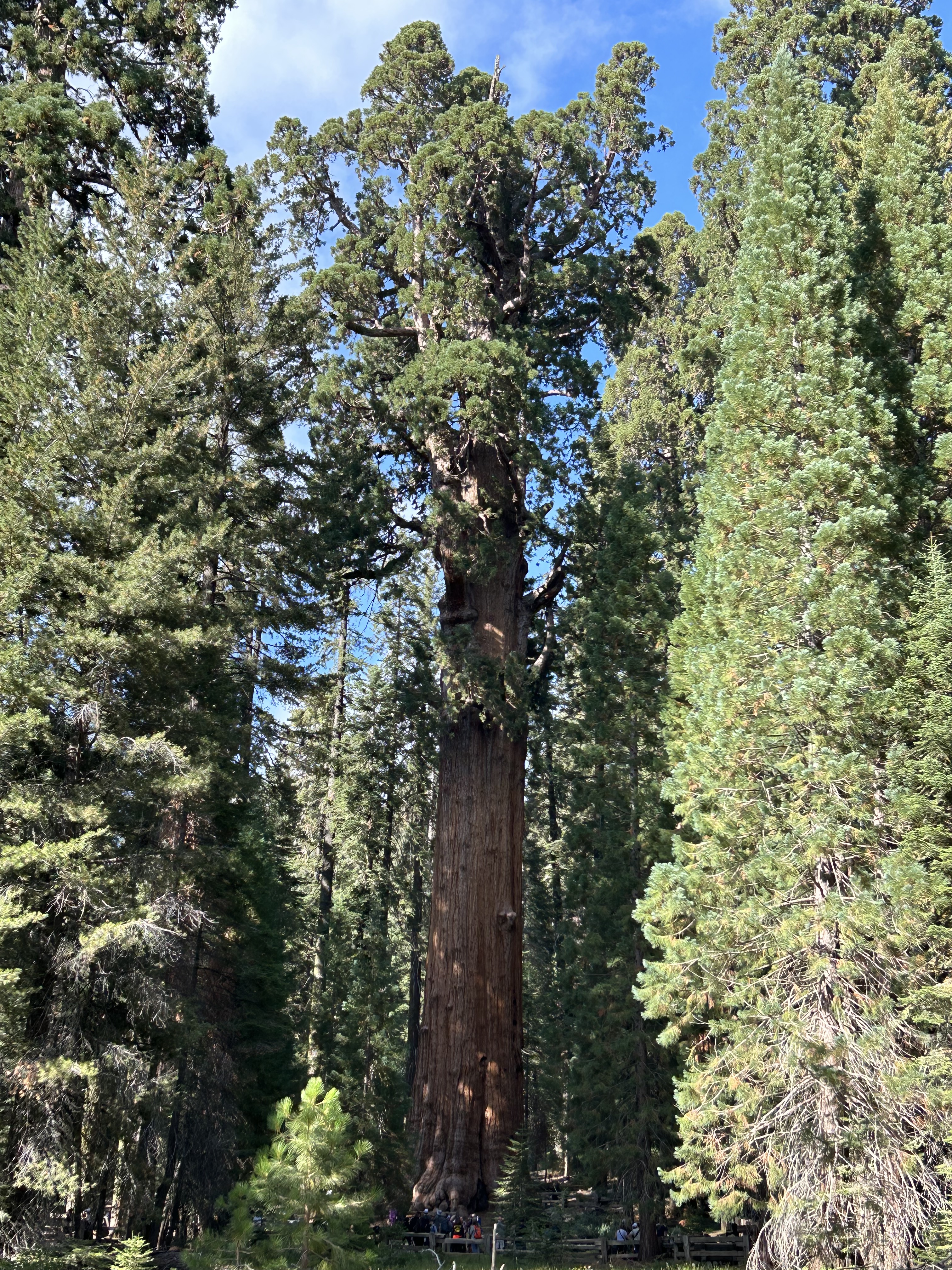
General Sherman, the Giant Sequoia above, is the largest living single organism on earth. Over half of the largest trees on earth are in this park and in neighboring Sequoia National Monument, Sequoia National Forest and Kings Canyon. This park is my favorite for giant trees. For millions of years, these magnificent trees thrived here, near the southern end of the Sierra Nevada—‘jagged, snowy’—mountains. The taller, thinner coastal redwoods mainly live closer to the Pacific where cool ocean breezes bring fog, protecting them.

But in a small fraction of one Giant Sequoia’s 3,000 year lifespan, humans have burned so much carbon into the atmosphere that the mountains here no longer hold snow all year, serving the immovable trees an eviction notice. Just in 2020-2021, between 13% and 19% of the world’s Giant Sequoias were burned to death in consecutive huge wildfires here. These trees evolved to survive fire, and, until recently, mature Giant Sequoias survived wildfires. The Climate Crisis has changed that, putting this species at risk of extinction in our lifetimes.

Many of the groves and much park wilderness are currently unreachable, due to post-fire erosion washing out roads, bridges and trails. Finding sections of the park unmarred by burn scars is challenging. The trees here are magnificent, but I recommend visiting Redwood to find solace. While most of our Giant Sequoias still live here for the time being, please don’t burn gas to get here. The last giant forests the loggers failed to destroy with sawmills, we are destroying with our cars and airplanes. By choosing to burn carbon, we are destroying the ecosystem these magnificent trees needed to live naturally for thousands of years. It would be too sad to visit only to say goodbye. 

Kings Canyon National Park

John Muir loved the view from Panoramic Point above, as did Stephen Mather, the first national parks director. I visited the park years ago with my family, and the scenery was stunning. But the view was less inspiring when I visited this summer. Smoke from a wildfire shrouds the view of Kings Canyon in the distance. You can hardly see the lake in the photo above. Behind me stand acres of dead trees burned in the huge wildfires of the past few years, and the main road into the heart of Kings Canyon wilderness was still closed this summer due to fire damage. If Muir & Mather visited now, they would be as heartbroken as I.

Experts employed at this California park have long argued influentially in favor of more fires, have implemented prescribed burns in forests across the west, and they chose to let the wildfire above burn itself out. Their dogma blamed past firefighters for causing today’s wildfires. Even though park rangers are not allowed to smoke, leave campfires unattended, burn out shelters in trees, or use fire to hunt, this park’s scientists used to argue that we needed those ‘Native American burn practices’ for forest health, even though these forests evolved without humans. Too many forest rangers and climate change deniers use this illogical nonsense to ignore and dismiss the danger of carbon. 

This year 46 million acres of wilderness forests burned in Canada in roadless wilderness areas consistently ignored by firefighters in the past. How could these wildfires have been caused by past ‘fire suppression’? The dogma is wrong. After the unprecedented recent wildfires, park scientists here have belatedly begun to recognize the predominant threat of climate change, far worse than any prior suppression errors. 

When Muir & Mather described the area, they did not remark on seeing any large areas of burned trees, made no note about any fires that regularly demolish many thousands or even a million acres every few years, and they did not write about the supposed benefits of Native Americans regularly setting fires while pelt hunting. Instead, they were inspired by the beauty of huge swaths of living forests and pledged to protect them forever. Scheduled fires, tree density limits, species removal, reseeding, and other human intervention are not what Stephen Mather had in mind when he called such places ‘untrammeled wilderness’. Muir would have harsh words against the ~$250 million annual timber sales in the forests he and Teddy Roosevelt protected. 

If Muir & Mather could return, they would notice that the whole forested range has changed dramatically, the air and ground are drier, the temperature is unseasonably hot, the rivers and creeks are dry, and that the snow is gone from the mountaintops. They would be dismayed by the decline of once abundant wildlife. Muir, who never rode in cars, preferring horses or hiking, would see the lines of buses, RVs and cars burning gasoline, and he would shout ‘STOP’!

In the future, doubtless people will be horrified to learn that in the face of climate change fueled wildfires, we chose to burn our remaining forests ourselves, releasing even more carbon into the air. It’s like using leeches to cure people, even though they make the patient weaker. Or like destroying the village to save it.

Forest science must face the future, not misrepresent the past. We need national policies to limit carbon pollution, not taxpayer-funded ‘prescribed burns’ that increase carbon pollution. If new conditions require fire breaks or dead trees need to be removed, then why can’t trees be cut down and buried with sand, instead of being burned? If certain types of trees will no longer survive in the future hotter climate, then we shouldn’t be paying people to plant seedlings for more of the same trees in the same places that burned down two years ago. We need to charge visitors in gas-burning vehicles a carbon surcharge to encourage people to switch to electric vehicles (and to mitigate some of the damage they do). 

We ended wilderness. Our carbon pollution is trammeling every species on earth. We have precious little time remaining to figure out how to save species before they go extinct forever.

Without wilderness, we will eventually lose the capacity to understand America.
Our drive, our ruggedness, our unquenchable optimism and zeal and elan
go back to the challenges of the untrammeled wilderness.

Harvey Broome, founder of the Wilderness Society

Oregon, California & Mormon Pioneer National Historic Trails

The first recorded pioneers to take the trail with wagons were the Whitmans in 1836, who settled in Washington 11 years before the massacre. In 1841, the Whitmans were followed by the Bidwell-Bartleson party, which split midway and settled in both Oregon and in California, after a harrowing journey. In 1843, a thousand pioneers made it to Oregon, finding a safer path through southern Idaho. In 1846, the Donner party got caught in early, heavy snow near Lake Tahoe and engaged in cannibalism before being rescued. That same year Brigham Young led 500 Mormons to Salt Lake City, leaving from Nauvoo, Illinois, two years after a mob broke into jail and killed Joseph Smith.

Gold was discovered near Sacramento in January 1848, and then Mexico ceded the state in February after the Mexican-American War ended. So, there was a flood of migrants to the mountains in California. To be clear, ox-driven wagons were used for gear. Pioneers walked. Many miners did not have wagons. And most Mormons pushed their carts by hand. Cholera and other diseases spread rapidly on the trail. Many of the pioneers were economic migrants or seeking freedom from persecution, and some did not have legal rights to settle where they did. As we celebrate our pioneer heritage, let’s not close the door on today’s migrants.

All three trails were heavily traveled in the 1850s and 1860s, and all passed through Scotts Bluff—see photo above & read how coffee saved lives—and Fort Laramie. The Mormon trail ends at Salt Lake. The Oregon trail goes past Hagerman Fossil Beds in Idaho and on to Fort Vancouver in Washington. The California trail breaks into different routes in Wyoming, with some passing through City of Rocks in Idaho, before the trail joins together to cross central Nevada. And then, the route depends on the destination: some north through Lassen to Whiskeytown, some through Carson City Nevada to Sacramento, and others south near Yosemite to the central valley.

Naturally, the trails only cover the most common routes, and there are pioneer trails all over the west, including some carved into cliffs. But all three main historic trails were used heavily, in both directions, until the railroad was completed in 1869. Our history includes many changes and challenges in transportation. Today, the Climate Crisis demands that we switch to electric vehicles. Compared to the pioneer stories, that should be easy.