In case you want to visit all the National Parks in the contiguous US, this year I’m sharing my recommendations for 3-5 National Parks to visit each month. By the end of the year, you’ll have a full list of all 51 parks, evenly spread out over the different seasons with as few compromises as possible.
Since January is typically the coldest month, it makes sense to visit southern Florida, the only tropical climate in the continental US. That means Biscayne, the Dry Tortugas and the Everglades. These are beautiful parks for enjoying snorkeling, beaches and nature outdoors, so January is a great month for avoiding the hot, humid weather with afternoon thunderstorms that would bother you much of the rest of the year.
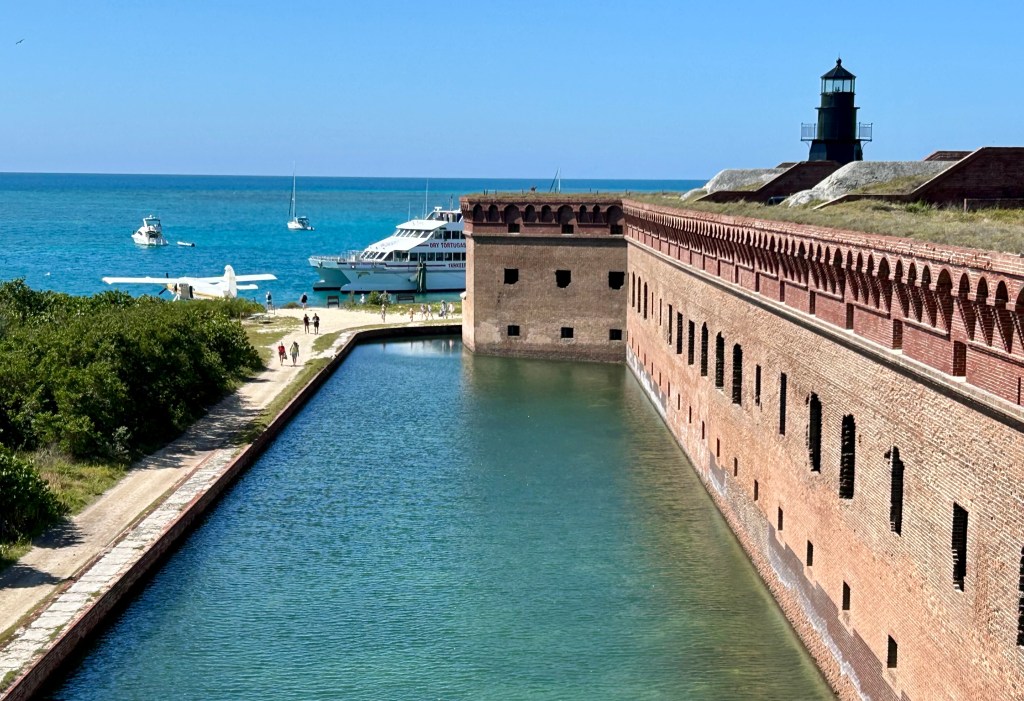
Hurricane season is lengthening, and now some tropical storms form in May before the official season of June through November. I visited the Dry Tortugas in May with an eye on the weather, and I was lucky. Some see sea turtles up close, but I was not lucky. Nesting beaches are often off-limits, and the water visibility wasn’t as clear for snorkeling as it would be in January. If you want to see the turtles, take the short, low altitude seaplane out to the Dry Tortugas, and you will see them swimming all year long.
Sometimes a winter storm will bring winds down to the keys with cold snaps in the 50s, but they don’t last. Many places that rent snorkel gear will have various wetsuits to keep you comfortable, if needed, but the water temperature usually stays above 70° F. Day highs are around 75° F, and most evenings are very mild.
Since the Everglades are dry in January, wildlife tends to concentrate around reliable water sources, making them easier to spot. Birding is best in January, as many migratory birds are in the park, and large charismatic birds like roseate spoonbills and wood storks are laying eggs. And there are few mosquitoes in January.
Weather makes a big difference in how much we enjoy our park visits, so—despite the high season costs—, I recommend visiting these three tropical parks in January, when most other parks are cold, closed and difficult to access. Plan ahead, be flexible on where to stay, and be efficient with your time to save money. But enjoy your time on a tropical beach or amongst the mangroves while others are home shoveling snow.
Merry Christmas & Happy New Year! I’m introducing two new topics for next year, more at the end.
Nobody wants our climate to destabilize, and yet that is what we’re doing. In my last installment on better thinking, I wrote about how this blog is a product of imaginative thinking, and below are some more specific points.
Rational people base their thinking on logic and knowledge. The Farmer’s Almanac was able to predict the weather for over 200 years with remarkable accuracy simply by carefully recording weather patterns. Seasons used to be stable enough to plan your crops well. But, in a sign of the times, the old Farmer’s Almanac is going out of business. I don’t know whether climate change had anything to do with their decisions, but accurately predicting weather based on past history is now unreliable. (And, now that the National Center for Atmospheric Research is going to be closed, both climate and weather forecasting will suffer.)
In early June of 2022 I visited Theodore Roosevelt National Park in North Dakota, and as I was driving back to California, the weather changed. There was a late season heavy snowfall in the mountains, followed by heavy rain. I remember thinking that the return to warmth and rain would melt all that late snow very quickly, so I decided not to dawdle. A few days later, the Yellowstone River washed out a whole bunch of roads after I passed.
They called the Yellowstone event a ‘500 year flood’, trying to put the event into historic context. But terms like ‘100 year floods’ no longer make sense, because the climate has already changed so much that the floods happen far more frequently either than expected or than they ever did in our written history. A biennial ‘25 year’ flood is oxymoronic.
Bereft of precedents, we need to use our imagination more when we plan the road ahead. You may have planned to retire to some beachfront property like the Outer Banks, but rising seas and more severe storms may make that much riskier than expected. Or maybe you planned a cabin in the woods, but increasing wildfires risk that dream as well. Or maybe you planned to move to a desert retirement community, but rising heat waves and diminished water are making that unsustainable. Or snorkeling coral reefs, now irrevocably damaged. Or seeing glaciers, now disappearing. Of course, there will still be plenty of beautiful places to visit and wonderful experiences to have, but our poor carbon choices are diminishing some of them rapidly. So we need to think ahead.
And it’s not easy. The most arable land in Canada is already farmed for crops like wheat, and much of the rest of the soil is a poor thin layer over the rocky Canadian Shield. So any fertile farms lost to sea level rise in Alabama are not going to be replaced in Labrador. And warmer average global temperatures do not mean an end to winter. Winter is caused by our tilted earth’s angle to the sun, so Greenland will still be dark and mostly uninhabitable for long winter months. Instead, some places in the southwestern US may become practically uninhabitable for long hot summers.
Seasons will continue and will increase in importance as weather becomes more extreme. In the long evolutionary fossil records, the species that are small, light and highly mobile tend to do better than slow moving, heavy creatures that spend all their time in one place, especially in times of climate change. Obviously, being the first species theoretically capable of diverting an asteroid, it’s shameful that we’re not trying harder to avoid the mass extinctions that we’re going to cause with our carbon emissions.
Considering all this I am writing two new monthly series for Saturdays next year. At the beginning of the month I will recommend which national parks to visit in which months, with a few adjustments for the changing climate. And mid-month, I will write about relevant climate consequences. I encourage you to use your imaginative thinking to make the most of your road ahead.
UNESCO chose to emphasize the land reclaimed by the Acadians, but the emotional power of the place is conveyed in Longfellow’s epic poem, Evangeline. The British, often at war with their rivals the French, gathered up thousands of neutral Acadian civilians, many whose families had lived in Nova Scotia (and nearby areas) for a hundred years, loaded them on ships and forcibly deported them to France and various colonies. The Grand Dérangement began in 1755, lasted 9 years, deported over 80% of the 14,000 Acadians, and 5,000 of those died due to shipwrecks, disease and starvation. A cross marks the spot where families were loaded into small boats, often separated, and taken on the dramatic tides out to ships in the bay.
The land is important too. The British certainly wanted control of the productive farming land that the Acadians had reclaimed from the sea using a remarkable system of dykes and aboiteaux or sluice gates. Tens of thousands of acres of farmland lies below high tide here, drained by one way gates in massive 17th century dykes. The replacement English speaking settlers, many from New England, maintained the dykes, and today’s warming climate allows vineyards on the surrounding hills. My cousin kindly showed me a working sluice gate, now operated remotely, and we walked along one of the dykes, appreciating the innovation and contemplating the rich red mud cut in deep channels.
Through our inaction on carbon pollution, we cause the sea to rise and claim our productive land. We cause hundreds of millions to be displaced, forcing refugees to move inland. We cause huge economic costs and more deaths due to disease, heat, pollution, starvation and storms.
It is easy today to say that the British were wrong to deport the Acadians. Yes we must admit that we’re committing a far worse global atrocity through our indifference to our carbon emissions.
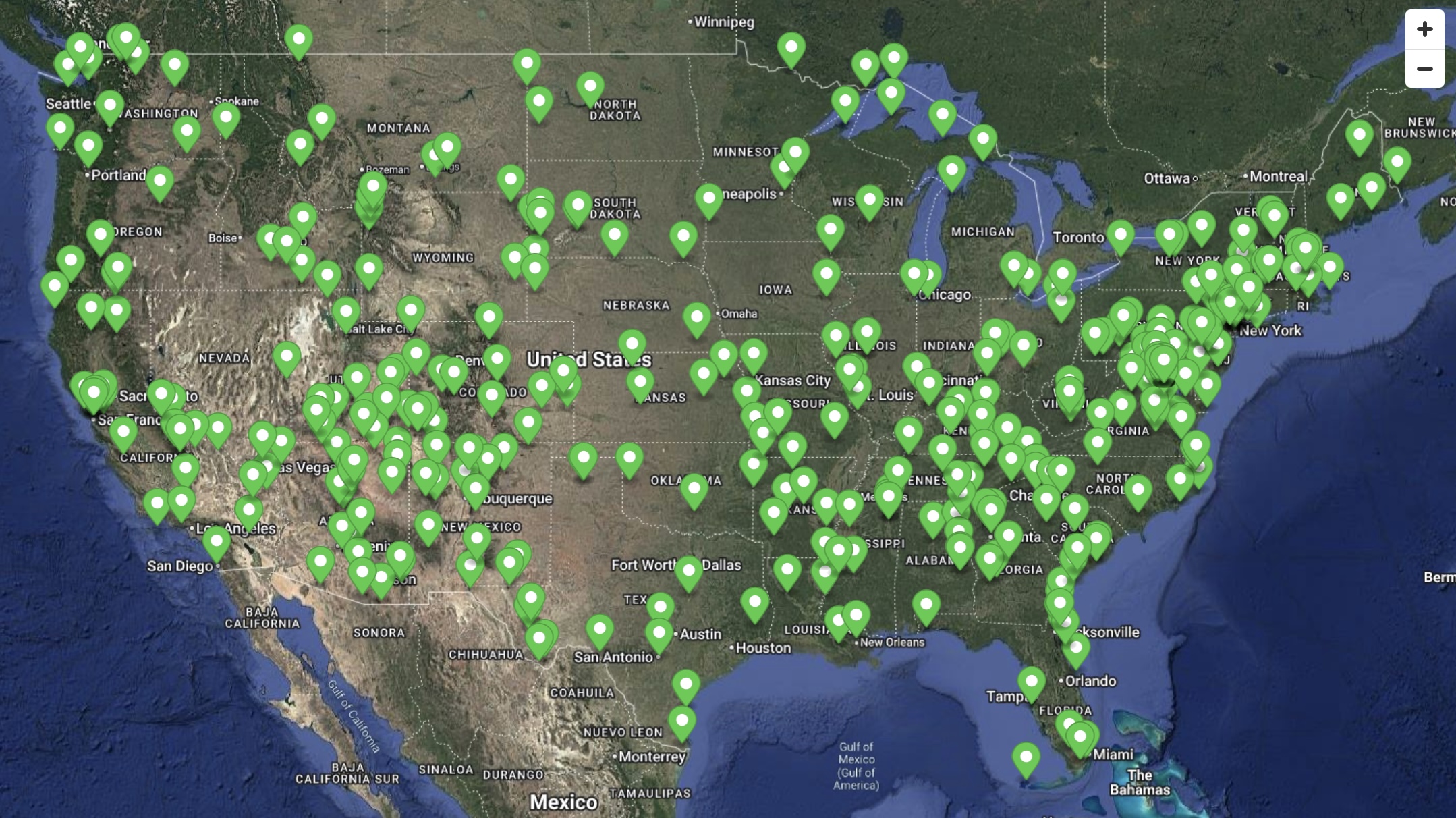
Late this year, I visited my 395th park site, earning a rare park stamps award for all official NPS sites in the 48 contiguous states (see map). Plus I drove my EV to 29 NPS affiliates, 60 heritage areas, and 24 national trails (not on map). Read about my favorite sites below.
‘Best’ is subjective, as it depends so much on your individual taste and experience. If you are lucky enough to have great weather, a lucky wildlife sighting, or an inspiring ranger-led tour, that day will be one of your favorites. Click on the links to read my past favorites from 100, 200, and 300 park units visited, and here are favorites from 400 park sites, including affiliates, heritage areas and trails. I have no changes to my previous favorite park units, but I have a few additions.
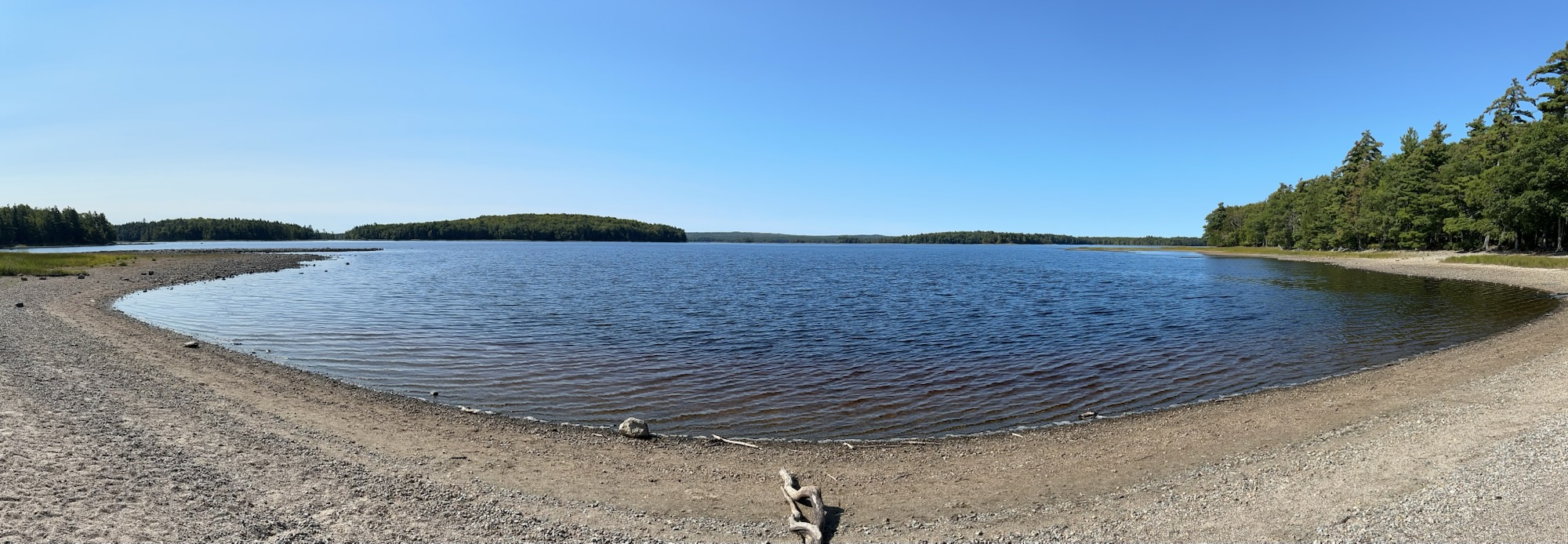
Much of southern Nova Scotia belongs to this UNESCO Biosphere, and the at the center is Kejimkujik Lake, historic site and national park above. My cousin was instrumental in gaining early recognition for the area’s exceptional starlight and dark skies, making it a great place to stargaze. The visitor center has a couple beautiful birchbark canoes and exhibits on the First Nation people who have lived in the area since time immemorial.
Due to extreme fire conditions, the backcountry was closed during my visit, but a few lakeside trails were open. The lake was low, the air and forest dry, but the day was lovely and quiet. The climate change is even more visible to the north, and there were many fires burning in Newfoundland in September. The national park includes a seaside section on the southeast coast with nesting piping plovers on a (closed) beach from April to September, but the biosphere covers far more land, outside the core park, from Yarmouth to both southwest and southeast Nova Scotia.
I write this on the Sea of Cortez, where sparrows chirp in the palms, brown pelicans splash down to catch their lunch, a whale takes a quick breath before diving down again, and a sign on the beach warns me not to step on stingrays. Most of the time, we live and work in air conditioned buildings, watch fiction on screen, and eat processed foods produced by big agricultural conglomerates. Nature often seems distant, filtered and controlled, which suppresses our natural affinity with other living creatures. Here, I am surrounded by many different forms of life, filling my senses, each living free. Looking out over the ocean is calming, and the smell of salt in the air reminds me that our roots are in the ocean; it’s in our blood. When we are in nature, we feel more connected with all living things that eat, breathe and cheat death, like we do.
But our selfish thoughtlessness now risks mass extinctions, as we unbalance the living world oblivious to the damage done by our pollution. Anger is what I feel most when contemplating the climate crisis, but also despair. People refusing to change, repeating lies, smugly imagining themselves smarter than scientists. Despair about the coming diseases, droughts, mass extinctions, famines, floods, heatwaves, refugees, storms and wildfires. Do we not fear death, like those trapped in their attics during Katrina or engulfed in Lahaina on Maui? Have we lost our survival instinct?
I’ve already seen huge wilderness forests, in areas largely untouched by man, burned over 95% in wildfires 100 or 1000 times larger than normal. I’ve stumbled on the moraine where glaciers once clung to mountaintops. I’ve swum along dead coral reefs that were brimming with fish when I was a teenager. In Mexico last year I heard about the decline in monarch butterflies in their winter refuge after migrating from all across North America. This year I heard about the decline in gray whales, breeding less due to less food, as our carbon pollution is rapidly changing the ocean’s temperature, acidity and salinity, poisoning the lifeblood of the smallest and simplest organisms upon which larger ones rely to survive.
We are betraying our evolution. I feel shock, despair and anger that my fellow humans knew and mostly refused to act. Pain of loss is what I feel when I know that future generations will never again experience the bounty of life we once had, to learn from or appreciate the living natural beauty we could have enjoyed, but recklessly gave up, unwilling to change our behavior.
Next week, I’ll wrap up this trip to Baja, and then we need to work on thinking rationally.
The trouble with thinking these days is that few do it correctly. First, most Americans are chemically impaired, irrational or misinformed. Second, modern conveniences help us do many things every day without thinking. We act habitually, instinctively and follow others, and when nothing goes wrong, we declare ourselves ‘smart’. Third, we don’t know what real thinking requires. For most, ‘thinking’ starts with an unconscious desire, is validated by a childhood belief and is rationalized by something we once heard somewhere. However common, that’s mush.
Don’t feel bad. Few, if any, were taught how to think both methodically and comprehensively in school. Even well-trained academics are often either one-dimensional thinkers or at best employ self-developed, mismatched thinking techniques. After obsessing over mistakes for years, I finally recognized how haphazard and contradictory our way of thinking has become. So, on alternate Thursdays, I’m going to write about thinking: how to do it better, how to make fewer mistakes, and how better thinking is the way to a better future.
[That’s it really, but, if you want to read more, I belabor the point below.]
Most Americans are exposed to chemicals that reduce our cognitive skills. Self medication with products containing THC, the active ingredient in marijuana, is even higher than prescription antidepressants which have also soared, with over 20% of seniors consuming cannabis and 60+ million Americans consuming CBD. Long term exposure to THC can cause problems with memory, concentration, IQ, and ability to make decisions. 1/2 of American adults today were exposed to unhealthy amounts of lead as children, from leaded gas fumes and leaded drinking water pipes, lowering IQ a few points. And 2/3 of American adults drink alcohol regularly. Obviously all that presents an obstacle to thinking clearly.
But, even if folks got off dope and booze, most would still do the bare minimum of thinking. Our modern convenient lives are filled with routines, absorbing views from others and our habitual responses. Like Forrest Gump in the Army, not thinking is the path of least resistance. The Age of Reason lacks followers. We have returned to an age of Mob Rule, where illusions and emotions drive society. It’s very easy to become deluded today, surrounding yourself with whatever views you like: most Americans believe in aliens or ghosts, many believe in conspiracy theories, and unrealistic expectations are common. Critical thinking, weighing evidence and predicting consequences are ignored, and instead decisions are made by general feelings.
The climate crisis is a good example. Scientists agree that humans burned so much fossilized carbon from eons before we evolved, that we have caused global average temperatures to rise to levels that drive and will continue to drive mass extinctions for long beyond our lives, leaving our descendants to face unprecedented challenges to life on earth. That’s a fact. But even people who claim to be rational, logical thinkers find ways to downplay that threat and avoid taking action to help solve the problem. ‘Alternative facts’ are available online, you can simply refuse to believe evidence, or you can just ignore it and distract yourself with entertainment.
It’s easy and fair to blame politicians, biased media, hostile foreign governments and corporate lobbyists for lying to us. But how did we get to the point where most adults can’t tell fact from fiction, can’t see obvious consequences ahead, and can’t imagine how to solve basic problems like reducing carbon pollution? We can no longer simply raise a problem, discuss honestly, brainstorm and agree on the best solution. Sure, it’s a failure of leadership, but we’re all failing to face the truth and act appropriately. At this point we must admit we all have trouble thinking.
I will tell you the truth. I am neither an expert in human psychology nor intelligence. But I have way too much experience making and struggling with mistakes. Determined to understand what went wrong, I obsessively analyze my own mistakes, specific historic mistakes and the broader, general mistakes humans make. Frustrated, I travel, visiting sites of beauty and pain, of conflict and success, and of nature and destruction. Each day trying to see a better way. Isolated both by choice and by my own mistakes, eventually my view became as clear and honest as a distant peak on the horizon, emerging from the mist and hit by the sun above the wilderness.
So now I have a few worthwhile thoughts about thinking. Unfortunately, my realizations come a bit too late for me. Too late to save friendships, my first degree, marriage or my career. Too late to discuss with my father. But not too late for you to benefit, if you continue to read this blog.
We do not think how we think we think. Because we think wrongly, we make predictable mistakes. And we become depressed, which also decreases our cognition. But we could change how we think. We can become aware of how we really think and exercise more control over unhelpful ways of thinking. Better thinking could solve problems, help us make better choices, and help us come up with better ideas. Then we would all feel better about ourselves and our future, instead of medicating ourselves into false comfort in an increasingly troubled world.
While we quickly agree that others need to learn how to think better, our vanity makes us reluctant to believe that our own way of thinking could possibly be improved. I challenge you to read my insights about thinking on alternate Thursdays. Why do I care? I believe we’re on the same side, and I want us to stop making so many mistakes. So I will write for you, so you will think better. Thanks.
Imagine a universe like ours, except devoid of life. Space, stars, planets, air, ocean and rock. Imagine our Earth, with waves on the beach, wind blown sand, lava, floating ice cap, canyons and waterfalls, spinning each day, heating or cooling each month, year after year, for eons. Structurally, very similar, but empty, without any living things, anywhere.
Nobody would explore it. None would appreciate its beauty, and no one could try to divine its purpose. Without any living creatures to inhabit it, and without us, such a world would be meaningless, neither studied, understood nor experienced. Without life, there is no knowledge.
Without knowledge, there is no life. Every living thing contains within it a recipe, the ingredients and the drive to cheat death. The recipe is our genetic code, passed down from our ancestors. Every living cell in our bodies carries this knowledge, which includes hidden traits and alternate characteristics for future generations, a master cookbook of the adaptations our successful ancestors employed to live, including our survival instinct. All living things carry such ancestral knowledge. Life began when some tiny process replicated itself in a repeatable way—an accident, a trick or a miracle. Life began when the knowledge of that trick was passed on to create the next generation. Life is that knowledge, plus every other trick that worked to keep life going for generations, in all forms, through billions of years of evolution.
Some such knowledge may be useless, dangerous or doomed to fail. In nature, failed ways of life die out, and such mistakes are forgotten. But species that have survived many times longer than mere humanity, have proven their success far longer than we have proven ours. Their lineage is noble, deserving of a place among earth’s great tapestry of living creatures. Our more recent genealogy is dubious, as we have used our supposed ‘superiority’ to create both weapons and pollution that could extinguish most life on earth, including ourselves. In our arrogance, we dismiss all wild species for not having adapted to us, when in truth we should adapt ourselves to sharing this earth with them. The mistake is ours, not theirs.
Life is knowledge. Many living things have learned to communicate, to call for help, to warn, locate and comfort each other. The tactics learned by observation, communication and mimicry become living knowledge of ways to outwit death, shared in community and thus kept alive for the next generation. Our species created written records as yet another path, besides our genetic code and our learned behavior. Some trivial knowledge may offer only a scant promise to enhance some future life with a minor convenience or comfort, while other knowledge may redesign human civilization, if we have the wisdom to discern it. We pursue knowledge to survive, to improve life and to pass it on. Because knowledge is life.
So extinction is the permanent loss of the secrets of life, both the code and the living behaviors. Most species have carried that knowledge for millions of years, long before humans evolved. We have learned from many species, observing how they act, adopting their tactics, and we have used tens of thousands of species to make medicines. We neither know the present value nor can estimate the future value of this accumulated knowledge.
Prematurely and unnaturally extinguishing masses of species, is far worse than simply killing. We do not know which species’ removal will affect other species’ survival in the indirectly connected, mutually evolved web of life. Extinction is the permanent end of life, and the erasure of all the accumulated knowledge used to create, to sustain both that life and the other species that depend on it, and to evolve further into some unrealized beautiful future. It is the silencing of tongues we do not understand, before we could learn what they were trying to tell us. And it is permanent. Forever. Never to be seen or heard again, despite eons of outwitting death. Extinction is the loss of what was, what is and what could have been. Artificial extinction is the ultimate betrayal of life.
By recklessly causing extinctions, we are like barbarians burning down the only ancient library of a lost civilization, full of wonderful ideas, miraculous cures, and priceless books, before we learn to read. E. O. Wilson, Harvard professor of evolutionary biology, once said, “destroying rainforest for economic gain is like burning a Renaissance painting to cook a meal.”
The world’s largest rainforest, the Amazon, is being cut down for logging and ranching. We are literally destroying rainforest for hamburgers. Besides the direct extinction of species, we are tipping this critical ecosystem towards desertification, releasing more carbon, raising temperatures, increasing fires, and changing our global climate. There is no wisdom in this course of action, no moral justification, no long-term net economic gain, no rational reason to give up so much for so little gain, no scientific approval, and no appreciation of the beauty of so many forms of life lost forever. And apparently, there is insufficient concern among people today to stop making this colossal mistake.
Butler Flats Light (above) has marked the entrance to New Bedford Harbor in Massachusetts since 1898. It was a clever bit of engineering by a marine architect using a caisson or box to pump out the water for construction, and every day it’s used for navigation by the famed scallop fleet, ferries, the occasional tall ship, and many other boats passing through the hurricane barrier. When the light was built, New Bedford still dominated the whaling industry, sending ships on long voyages to harpoon whales, melt their blubber into oil and return to fuel America.
Behind the light are two wind turbines, which provide electricity today without extinguishing any species. Despite the preposterous claims of fossil fuel industry funded politicians, there is no such thing as ‘windmill cancer’ and bird strikes are rare. But folks who live near the turbines complain that they cast shadows, are noisy or are ugly, so new wind turbines are now built far offshore, south of Martha’s Vineyard. The current project is known as Vineyard Wind, with 62 turbines each generating 13 megawatts when complete. Currently, there’s a pause after a blade broke, requiring inspections and clean up. Massachusetts recently committed to roughly quadrupling wind projects in the area.
The turbine assembly is based in New Bedford, with final installation of the towers at sea. Interestingly, to protect whales from construction noise, they create a circular curtain of bubbles rising up from around the foundation on the seabed. They got the idea from whales, who create a circular curtain of bubbles underneath schools of fish to herd them together into a bite sized meal. Thousands of locals work on the project, in a boon to the economy, and the first project will provide relatively cheap, green energy to 400,000 homes. I’ve observed the gimbaled tower segments and long blades being transported out to sea by huge construction ships on the same routes once used by whaling ships.
Progress is beautiful, especially when it helps save so many different species on earth from extinction. Back in the day, whalers would have argued that smelly whale oil was ‘indispensable’ and ‘higher quality’ than alternative fuels, and they resisted progress. Today, that seems absurd, although now the fossil fuel industry lies routinely to protect its profits. Ironically, during the Civil War, the US government helped launch the fossil fuel industry by buying their new fuel and taxing alternatives to save the Union. Now we need the government to help us transition quickly to green energy to save life on Earth and leave the smelly old fuels unburned.
Originally designed to be a hospital, like Les Invalides in Paris, and named after the bishop, today the World Heritage Site in the historic heart of Guadalajara is a museum, with modern art outside and exceptional murals by Orozco inside. The central masterpiece on the ceiling of the rotunda is ‘The Man of Fire’, a modern version of the myth of Prometheus (in photo on right). I had seen Orozco’s earlier version in the Pomona dining hall in California, considered “the greatest painting in America” by Jackson Pollack. Orozco lost his left hand making fireworks at 21, and he was fascinated by the story of a man who risked his life and suffered to expand human knowledge and civilization, only to be punished by the Gods. He felt the myth was an allegory for artists, explorers and reformers who were punished by conservatives for their efforts to bring enlightened change to the people. Every alcove and wall tells a story of both progress and betrayal, of historic accomplishments and dark consequences.
Prometheus stole fire from the Gods, but today we struggle with the consequences of burning carbon. Fossil fuels helped us achieve great things, but there are always consequences. Struck by the inescapable conclusions of the art here, we see that conflict over ‘progress’ often results in suffering, especially among the poor. Murals require us to step back, to try to see the bigger picture. We can build hospitals, and we can also destroy whole cultures. We can choose sustainable fuels, or we can let powerful men perpetuate destructive fuels. We may believe ourselves invincible and deserving of the powers of the Gods, but our actions come with destructive consequences that we must try to see, understand and prevent. We must give up fossil fuels, or our world will burn.