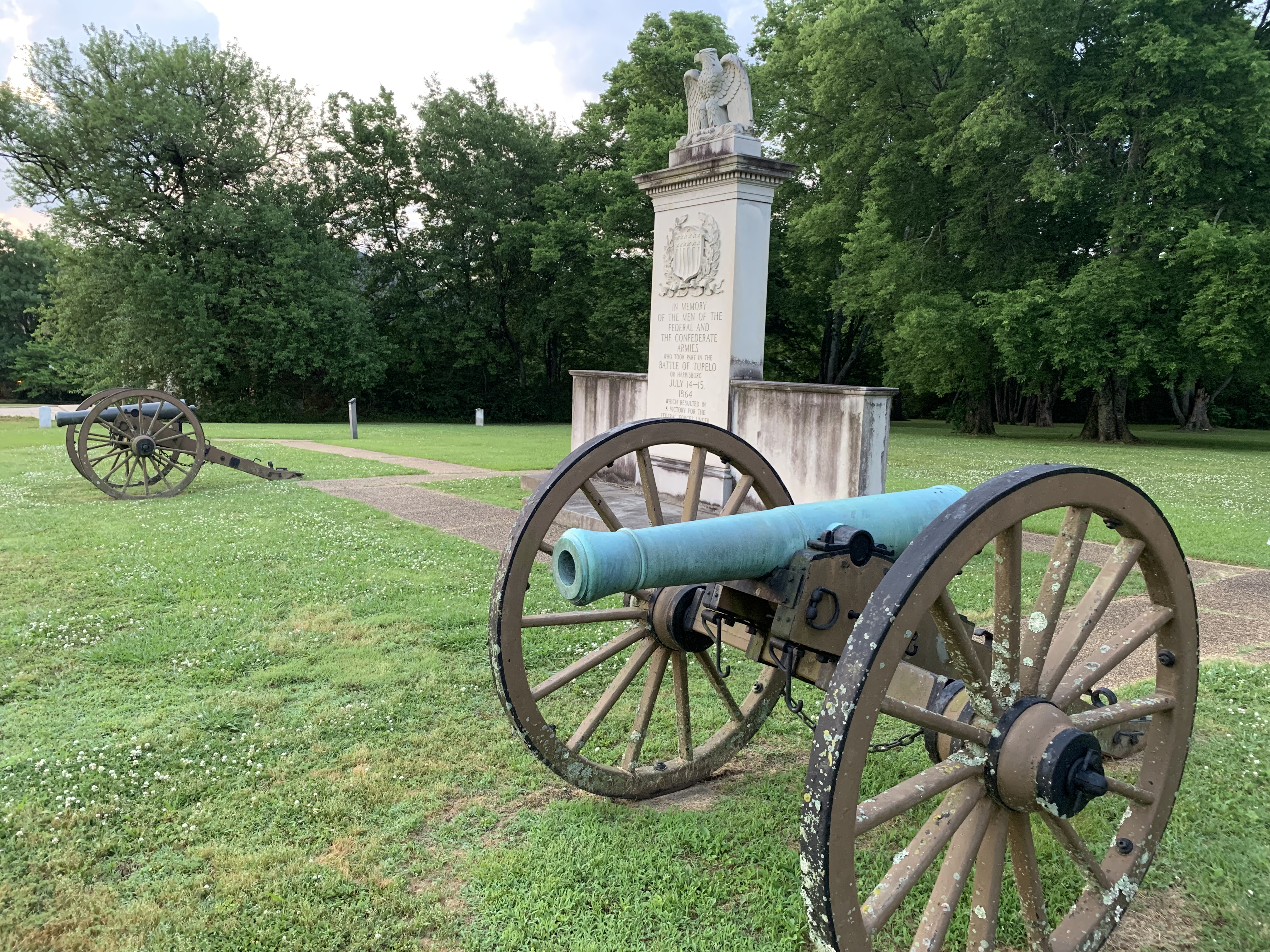
While obviously, Tupelo is most famous for being the birthplace of Elvis, where his family home now has a museum next to it, a late Civil War battle was fought here too. The Union troops defended the railway, but you have to use your imagination to follow the battle. There’s a small memorial on an acre in town. Here’s a photo.
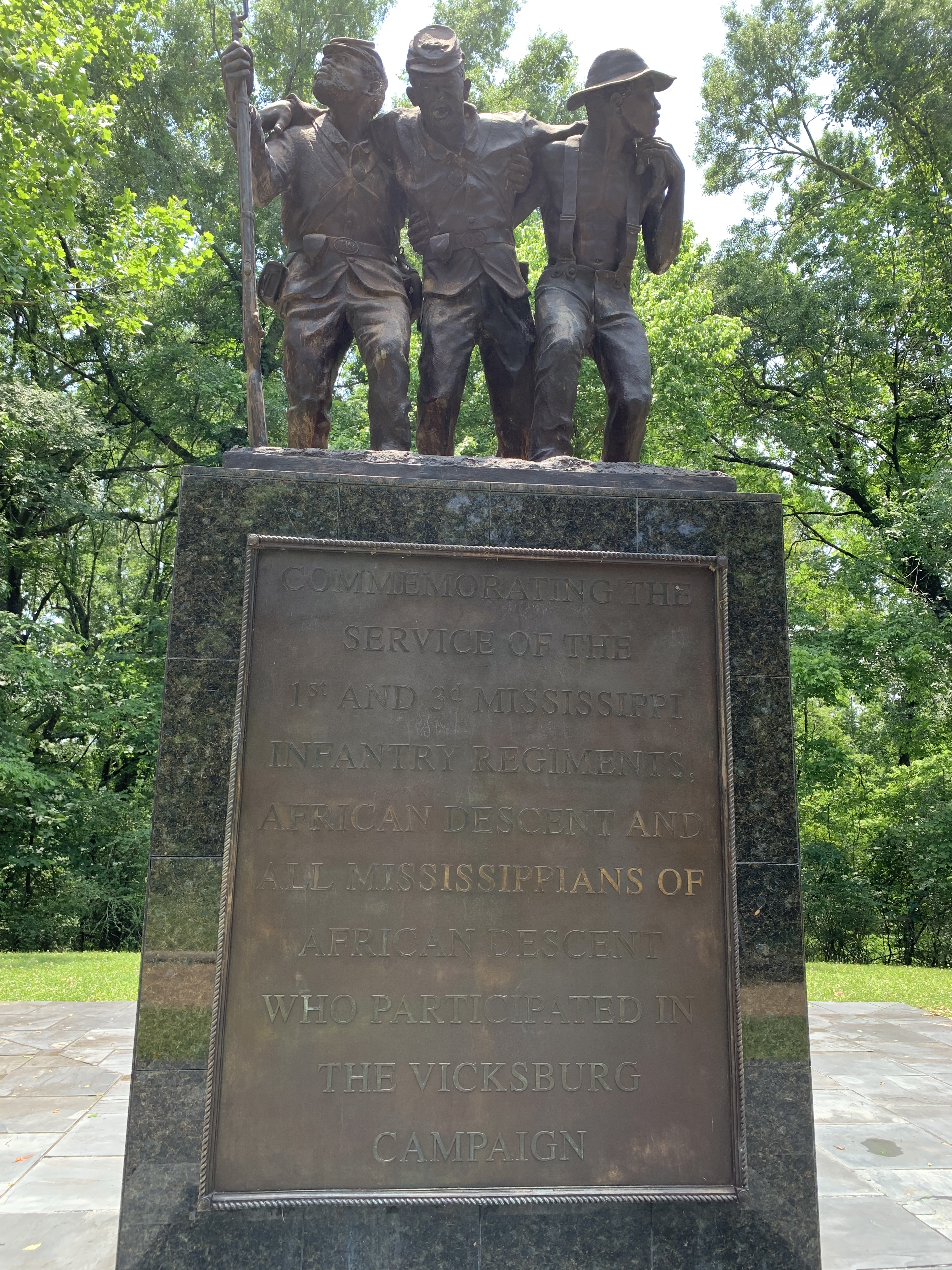
The fighting here lasted the last six months of the Civil War, and the steep hilly terrain is now covered with placards, cannon, graves, memorials, and statues. The road out to my home state’s memorial was under construction, so I turned around near the statue above.
I was momentarily confused, since the plaque says “1st and 3rd Mississippi Infantry Regiments, African American Descent”. I knew that the confederates had no African American soldiers, at least not at this point of the war, when the Union offered full freedom to enslaved people who joined. Then I realized that these were escaped slaves from Mississippi who formed regiments in liberated Louisiana and returned as soldiers to fight slavery. Their units represented a future, free Mississippi, not the old, slavery Mississippi. Later I read about the statue and learned that the man on the right is looking back at slavery, while the man on the left is looking forward to freedom.
The Arkansas River connects the Mississippi River to the Santa Fe Trail in Kansas, so the fort facilitated Native American removals along the Trail of Tears. The courthouse here dealt with many cases of serially displaced tribes. This was the base for US Marshals to “control disputes” and arrest whiskey traders out in Indian Native American Territory. The jail here was known as “hell on earth”.
There weren’t any major Civil War conflicts here, as the Union abandoned it at the beginning and the confederacy did the same two years later. Native Americans regiments were formed on both sides during the war, and Cherokee engaged Union troops north of the fort at Pea Ridge. It was at this fort in 1865 when the US informed the tribes that they were all enemy combatants, regardless of which side they had been on or whether they were one of the five “civilized” tribes that had largely integrated, and that all the tribes lost the Civil War. The slaves were freed, but the Native Americans again lost their land and still had no rights.
Despite the lack of Civil War battles here, there are no lack of Civil War reenactments here. Although the park service does not allow battles to be reenacted on park property, the folks above demonstrated by firing the cannon, while women separately participated in gentler “living history” nearby. That anyone would want to reenact such a dark and tragic history, especially when it glorifies and perpetuates the immoral beliefs of the traitorous pro-slavery side, is living proof that the ugly racism of our past still continues today.
This view is from the East Overlook facing the Union Headquarters and the Federal Line of artillery. The battle here in northwest Arkansas took place about seven months after Wilson’s Creek in southwest Missouri. The Union army had regrouped and pushed the confederates out of Missouri, and they won here too, killing two generals and keeping Missouri from being retaken.
A unique part of the battle here is that two regiments of Cherokee (about 1,000 men) fighting for the confederacy routed a couple hundred Union cavalry before being forced back by cannon fire. If you wonder why the Cherokee fought the Union, you only have to go to the Elkhorn Tavern down the hill where over 11,000 Cherokee were marched off by US government soldiers about 20 years earlier on the Trail of Tears.
Here’s the creek. It’s quite pretty, and there used to be a mill here. I saw a bald eagle nearby.
Alright. An important Civil War battle was fought here. To appreciate the story, you need to understand that Missouri was an important strategic state, with a neutral populace and a pro-slavery governor, which President Lincoln very much wanted on the Union side. Lincoln asked Missouri for troops, and the governor refused and plotted to seize the arsenal in St. Louis to help the confederates.
The arsenal’s Captain, Nathaniel Lyon, however, had already secretly moved the weapons to Illinois. After being promoted, Lyon took the state capital and forced the governor to retreat to southwest Missouri, where Wilson’s Creek is. In the summer of 1861, General Lyon marched his forces here, attempting a surprise attack. But the confederates had assembled a larger force. On August 10th, here on Bloody Hill, the forces engaged brutally for five hours. Lyon fought aggressively, was wounded twice in action and was killed leading a countercharge that morning, becoming the first Union general killed. The Union army retreated, but Missouri remained in Union control, despite many guerrilla battles to retake it.
Built in 1842 to defend the “permanent” frontier with Native American territory, the fort quickly fell behind events. Settlers were already moving west on the Santa Fe Trail. Within four years the actual frontier was being taken from Mexico, with cavalry “dragoons” riding a thousand miles west from here to fight in that war. The fort was abandoned in 1853 and the buildings auctioned. But the military withdrawal set the stage here for Bleeding Kansas, the conflict that presaged the Civil War. Turns out the military wasn’t needed here to keep peace between the settlers and the “warlike” Natives, but rather between the slavers and the abolitionists.
When the Supreme Court overturned the Missouri Compromise and the government passed the Kansas-Nebraska Act, the US government officially decided that it was best to just let the states decide on slavery by themselves. Here, the pro-slavery townspeople– and “border ruffians”–took over the fort to defend against militant abolitionists in the surrounding countryside who were determined to prevent the expansion of the moral abomination of slavery. Around 60 people were killed, including a pro-slavery former deputy marshal, whose widow is remembered for swearing revenge.
The US military returned to use the fort during the Civil War and defended it from guerrilla attacks. Both African American and Native American regiments were formed here. And after the war, soldiers were again sent west to defend the railroads against squatters who protested being cheated out of the land stolen from the natives.
While educational, I believe the park service has a responsibility to do more than simply illustrate the views of both sides. The Civil War was not “a controversy over states’ rights” nor was Bleeding Kansas merely “growing pains” as park exhibits say. The only states’ “right” being contested was the “right” to chain and breed people, on the basis of race, in perpetual ignorance and slavery, including women and children, forever. By any standard of human rights, that is not a right, but a profound moral crime. There is no legitimate justification of slavery. Perpetuating traitorous and racist views that there was any honor in fighting for slavery is dangerous to society and deeply offensive, to those held in bondage, to their descendants and to those who fought and died to end slavery in America.


 Zero Carbon Travel