25 of 25 battlefields & military parks visited: e.g. Revolutionary War
40 of 42 memorials visited
71 of 75 historic sites
55 of 62 historical parks (broader than historic sites)
77 of 84 monuments
48 of 73 recreational areas, reserves, rivers and others
24 of 31 world heritage sites in USA, plus 5 in Canada
I spent $9,000 on charging, over 85% at superchargers. Heavy use of superchargers beyond the recommended daily limit has also reduced my battery capacity by 9%. Most electric car drivers charge overnight at home, so their costs are far lower. I should have cut costs with more free chargers and better route planning, but I drive capriciously, rushing around depending on weather and my curiosity. Like my mileage, my charging cost excludes borrowing an S when my 3 was in the shop and includes driving to visit family. A comparably priced new pickup truck for the same distance would have cost at least $16,000 for gas, based on average mpg and $/ gallon, more if they carried a boat or a bike like I do.
In September I plan to post a few of the affiliated trails I’ve stopped along, more west coast parks, a couple others I still need to edit, and hopefully some more Rocky Mountain parks from the road. Posting schedule will slow down in Q4 but each week will include a national park. Stay tuned for more adventures!
Canada is to the left of the mountain with the historic Prince of Wales chalet on the far left bluff, and to the right is Glacier National Park in the US. This World Heritage Site includes both parks. Waterton village is accessed from Canada, uses Canadian dollars, but is mostly on US soil. Not that it matters. I saw no border officials here, and it indeed very peaceful. There’s a classy old tour boat which runs down into Montana, as well as camping and lots of interesting trails.
Unfortunately, there was a terrible forest fire here in 2017, and the only glacier above is far off in the distance to the right, a shadow of its former self and a reminder that we all must reduce our carbon footprint. I was happy to spend several hours charging my car at the marina’s destination charger, walking the shoreline, eating, trying the local beer and just soaking in the view above. I enjoyed my detour to Alberta’s five world heritage sites very much, and I didn’t have any trouble charging in Canada. The Tesla even converts the speed limit to mph, so you don’t need to do any math.
It’s easier than you may think. Does your car tell you when you’re about to drive too far from the nearest gas station? Does it include fuel stops in your itinerary automatically, or let you know the prices before you decide where to fuel up? When was the last time you filled up for free? Can you fuel up overnight while staying at Mesa Verde, in a campground, while eating a burger, drinking a white mocha or watching the base jumpers fly off the bridge into the Snake River Gorge in Twin Falls, Idaho, above?
I have only had a few tricky charging situations so far. One was at the Dairy Queen in Needles, California, where every time the owner updates his seasonal specials, his sign truck blocks 3 of the 4 chargers for much of the day. I asked him why he didn’t tell Tesla in advance, so that the cars would route drivers to a different charger, but that never occurred to him. I also suggested that he could park the truck on the other side of the sign and only block 2 of 12 gas pumps, and he looked at me like I was crazy. I decided not to buy any ice cream while waiting.
Recently, I was unable to contact the owner of a JuiceBox charger in Terlingua, Texas, so I just charged up a little for free. One more tricky situation was at the supercharger in Lamar, Colorado, where the town was celebrating some event and the street was temporarily blocked off. But while I was waiting, a town councilwoman came up to offer me BBQ and asked if I was enjoying the live band. I had a beer to help me survive the wait.
Like any vehicle, you can go further if you slow down or turn off heating/cooling and open the windows. To extend my range while traveling in remote areas, I use the free PlugShare App to scout out my charging options and use my adapters (standard J1772, RV 50v, RV 30v, and rarely CCS). The trick is to remember that you need to sleep somewhere on a long road trip, so just find a campground with electricity or a hotel near a slow charger and plug in over night. Tesla destination chargers can be found in some spectacular areas, and they’re often free to hotel guests. [No, I’m not compensated by Tesla in any way].
A few folks quibble that this is not entirely “zero carbon” travel, but it’s not my fault if the grid isn’t fully renewable yet. The sooner we all switch to electric vehicles, the sooner fossil fuel goes extinct. My vehicle doesn’t burn carbon, and I can’t help exhaling carbon dioxide. And to clarify my rules, I have two different goals: 1) to travel to as many places as I can without burning carbon and 2) to enjoy those places, which sometimes involves burning a little bit of carbon to get around the parks.
Most folks seem to understand that driving EV’s save money compared to gas, but I don’t think people fully appreciate the difference. While I was on my way to the restroom, a guy asked me how much it cost to fill up, so I told him usually less than $20. He said, “just like my truck”, but I know his truck costs $200 to fill up at those gas prices. And both vehicles have comparable range. Math isn’t that hard.
I tried to convince the rangers at Death Valley to do more to encourage visitors to switch to EV’s, but they said that they don’t want to force people to buy “expensive vehicles”. A $100,000 5th Wheel or $200,000 Class A rig only goes a mile or two per dollar of fuel. I go at least ten times that, over 15 miles per dollar. It’s very easy to save $10,000 in fuel costs per year switching to an EV, and even more if you go on long road trips, find free charging or use solar to recharge at home.
But the real reason to switch to EV’s is to save life on Earth. Why wait?
The white peak on top of the center red rock is Mount Hayden, 5000’ above the canyon floor, viewed from Point Imperial, North Rim, looking east. The Colorado River is down there somewhere, along with the Painted Desert and Marble Canyon to the left. Everyone should visit the Grand Canyon, and the grandest, widest and most awe inspiring views are from the popular South Rim. I took my family there years ago, and I’ll never forget ‘Ooh, Aah’ point, which was so windy that the name required exclamation marks of terror.
But the North Rim is more conducive to contemplation than the South Rim, because instead of development and crowds, there are bright yellow and gold Aspen forests, meadows and quieter vistas. The yellow Cliffrose was in bloom along the trail, and a large coyote crossed the road in front of me. Angels Window makes for a nice photo and has a great overlook on top. Bright Angel Point is just a few steps from the Grand Canyon Lodge, and it is one of several overlooks nearby that have spectacular panoramic views.
The season is shorter on the higher altitude North Rim, but fall is beautiful. There was wildfire damage and some smoldering burns in the Kaibab Forest, but overall the forests still look healthy. The ranger gave a talk trying to explain how difficult it is for them to respond to climate change locally, let alone nationally or globally. Logistically, my long range EV can visit the North Rim from Page AZ, where there’s a supercharger, round trip, but getting all the way out to Cape Royal would have been too far. The nearest destination chargers are at Cliff Dwellers Lodge at Lees Ferry (mean steak & eggs) and at Days Inn in Kanab Utah. I used both and continued northwest.
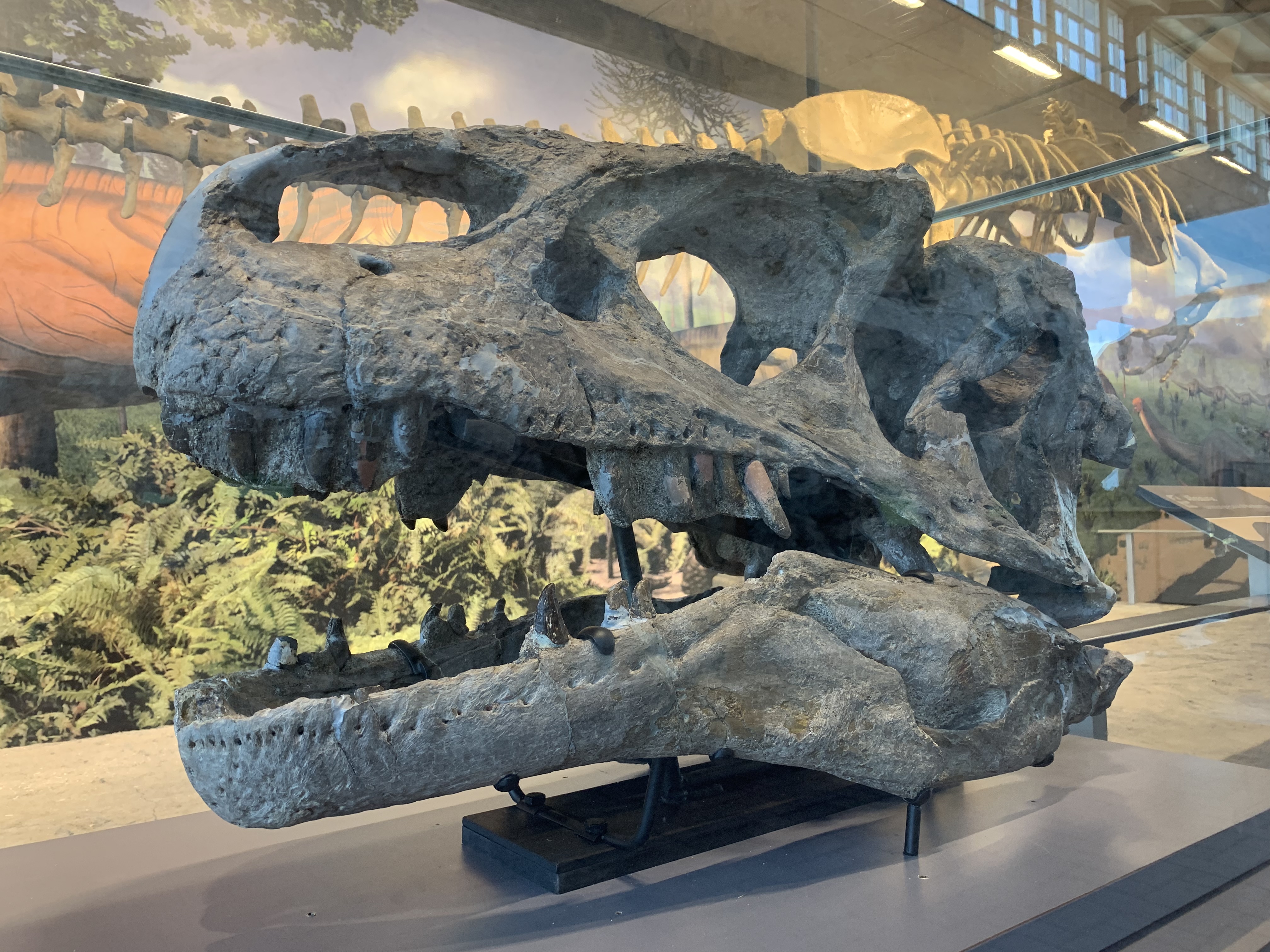
The Quarry Exhibit Hall, near Jensen Utah, has a crazy collection of large, late Jurassic dinosaur bones set in a two story high, very wide quarry wall, and you can touch them. It’s awesome. The Allosaurus skull above, a raptor talon-claw, Apatosaurus leg bones, and many Camarasaurus bones including a skull still set high in the quarry wall are all fascinating. This dinosaur exhibit is at the east end of the park after the Green River comes out of Split Mountain Canyon, and there’s a nice view, petroglyphs & pictograms.
Up the Green River is the extremely deep Canyon of Lodore, explored by John Wesley Powell, accessed from the north via permitted river trips or visible after a hike from the Gates of Lodore campground. There’s a conservation area north of the park in Utah named after Powell. Colorado’s Yampa River joins the Green from the east near Harper’s Corner, which has “the best view in the park” at the end of a hike and a 48 mile round trip drive. Unfortunately, I did not plan my charging to include either of those sections, so maybe next time.
There aren’t many good Tesla chargers around Dinosaur. Not sure why, but I noticed that some of the surrounding towns still support coal, have Halliburton operations, and have unfortunately unstable, irrational, fossil-fuel supporting representation in Congress. There’s a welcome center in Dinosaur Colorado with EV charging, but I don’t (yet) have the right kind of “combined charging system” CCS adapter. Since I’m in a hurry trying to visit high altitude parks during a short timeframe, I made due with a couple of 3rd party chargers I found using the PlugShare app, rather than stay in state park campgrounds. Especially when you get unexpected roadwork detours, being able to tap into other chargers is helpful.
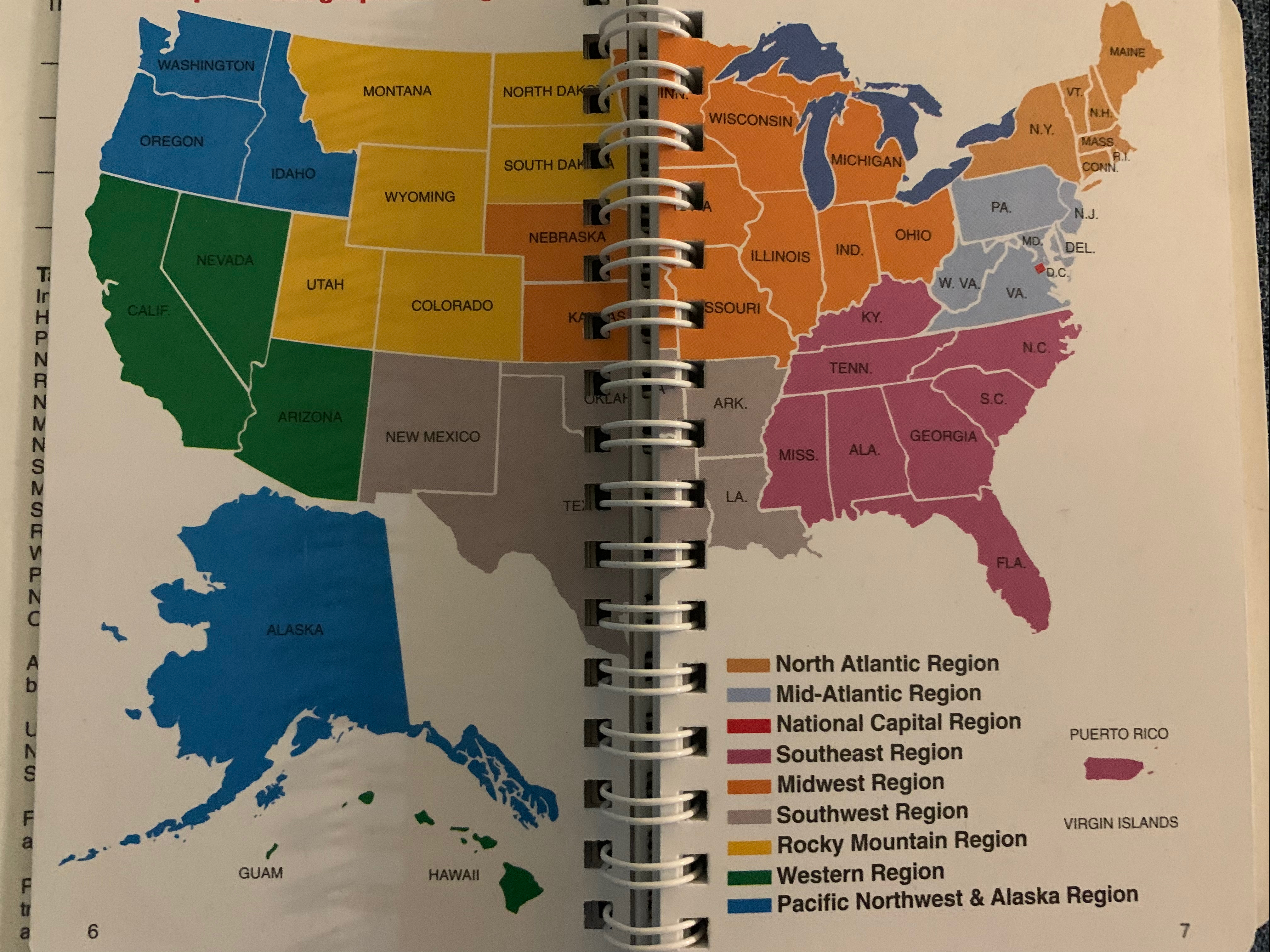
The National Parks Passport (which National Park Travelers Club members use to save visit stamps) divides the units into nine self-explanatory regions. The club has useful information for trip planning, and I log my park visits there too. The US Department of the Interior has reorganized their park unit regions a few times into something less useful for me, so I still use the map above to organize the site geographically. And the NPTC often does a better job keeping their park unit information completely up to date, compared with the NPS.
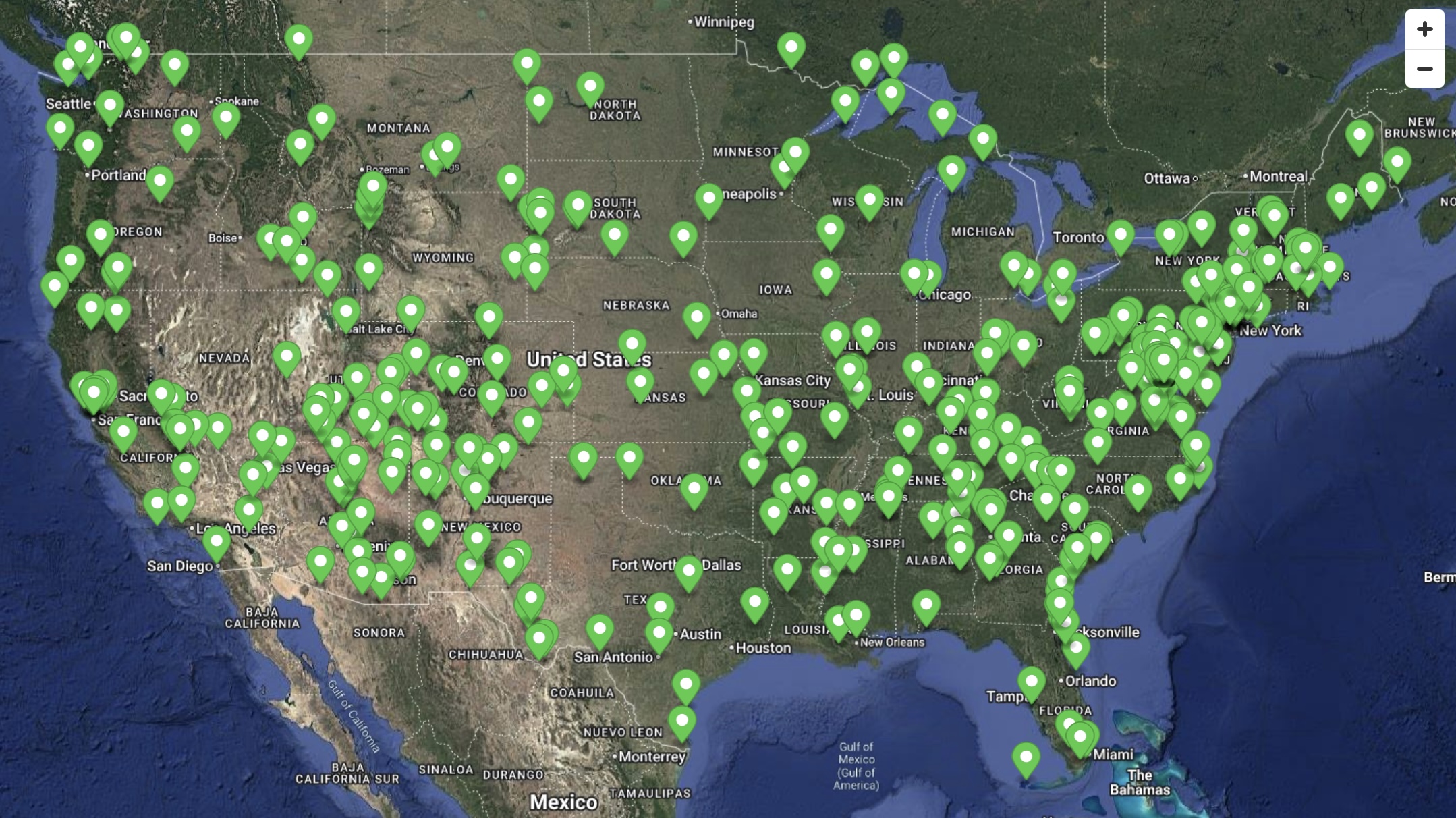
I visited all national park units in the contiguous 48 states in my electric car in the last four years; see my NPTC map below. Every state has at least one national park unit. If you want to see my visits in your state, ‘Click a State’ above, find your region and click the summaries to explore.
My first region completed was National Capital with 23 units, then Southwest with 42, Mid-Atlantic with 56, Rocky Mountain with 41, Midwest with 47 and North Atlantic with 44. Each of those links takes you to a summary of my park visits there. That leaves three extremely challenging regions to complete. The Western region includes Hawaii. The Pacific Northwest has Alaska. And the Southeast includes US territories in the Caribbean.
As I mentioned in my post on Cumberland Gap, this blog is partly an object lesson to show that traveling in an EV is a great way to visit our national parks. I can travel hundreds of miles per day, stopping briefly to charge, use the restroom and eat, and filling up costs me a fraction of my Prius. I use a CCS and a few RV plug adapters on rare occasions when they’re more convenient than a Supercharger, and I find charging locations with the PlugShare app. When I stay in state park campgrounds, I charge my car overnight without paying extra. Even if I were more concerned with my money than our climate, I would travel this way. And I love driving my Tesla.
I’ve only had range or charging trouble twice. Once in Kansas, I could not reach a park before closing due to poor planning on where to charge, but when I returned, Tesla had opened a new Supercharger nearby. (The car tells me whenever I’m heading out of range from the nearest Supercharger). Another time, the owner of the Dairy Queen in Needles California was blocking 3 out of 4 chargers all day with a truck, because he wanted to change the seasonal advertising on his sign. I called Tesla to let them know, which is what he should have done in advance. I’m not going to say traveling cross-country by EV is idiot proof, but I can do it, so it kinda is.


 Zero Carbon Travel