Imagining the Road Ahead

Merry Christmas & Happy New Year! I’m introducing two new topics for next year, more at the end.

Nobody wants our climate to destabilize, and yet that is what we’re doing. In my last installment on better thinking, I wrote about how this blog is a product of imaginative thinking, and below are some more specific points.

Rational people base their thinking on logic and knowledge. The Farmer’s Almanac was able to predict the weather for over 200 years with remarkable accuracy simply by carefully recording weather patterns. Seasons used to be stable enough to plan your crops well. But, in a sign of the times, the old Farmer’s Almanac is going out of business. I don’t know whether climate change had anything to do with their decisions, but accurately predicting weather based on past history is now unreliable. (And, now that the National Center for Atmospheric Research is going to be closed, both climate and weather forecasting will suffer.)

In early June of 2022 I visited Theodore Roosevelt National Park in North Dakota, and as I was driving back to California, the weather changed. There was a late season heavy snowfall in the mountains, followed by heavy rain. I remember thinking that the return to warmth and rain would melt all that late snow very quickly, so I decided not to dawdle. A few days later, the Yellowstone River washed out a whole bunch of roads after I passed.

They called the Yellowstone event a ‘500 year flood’, trying to put the event into historic context. But terms like ‘100 year floods’ no longer make sense, because the climate has already changed so much that the floods happen far more frequently either than expected or than they ever did in our written history. A biennial ‘25 year’ flood is oxymoronic.

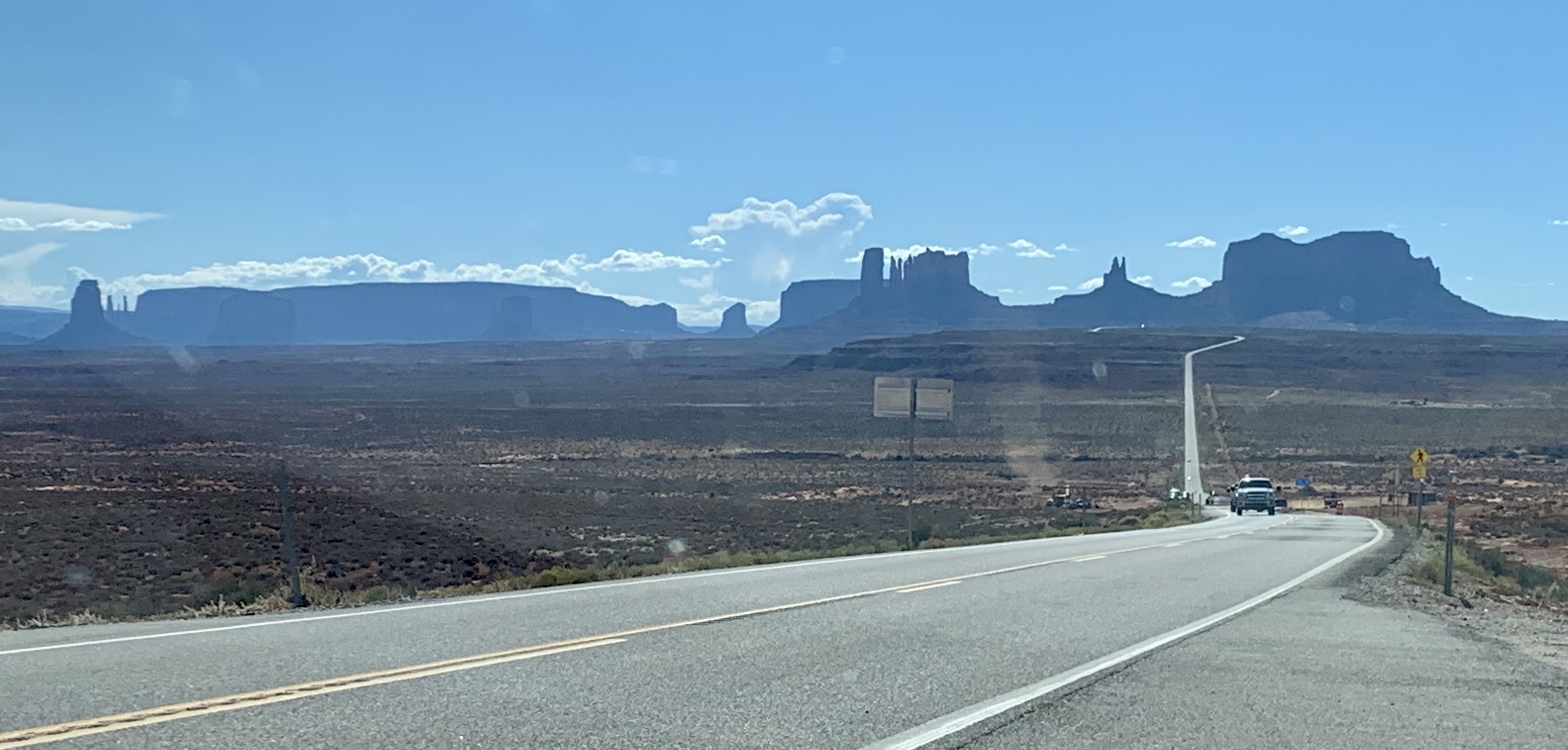
Bereft of precedents, we need to use our imagination more when we plan the road ahead. You may have planned to retire to some beachfront property like the Outer Banks, but rising seas and more severe storms may make that much riskier than expected. Or maybe you planned a cabin in the woods, but increasing wildfires risk that dream as well. Or maybe you planned to move to a desert retirement community, but rising heat waves and diminished water are making that unsustainable. Or snorkeling coral reefs, now irrevocably damaged. Or seeing glaciers, now disappearing. Of course, there will still be plenty of beautiful places to visit and wonderful experiences to have, but our poor carbon choices are diminishing some of them rapidly. So we need to think ahead.

And it’s not easy. The most arable land in Canada is already farmed for crops like wheat, and much of the rest of the soil is a poor thin layer over the rocky Canadian Shield. So any fertile farms lost to sea level rise in Alabama are not going to be replaced in Labrador. And warmer average global temperatures do not mean an end to winter. Winter is caused by our tilted earth’s angle to the sun, so Greenland will still be dark and mostly uninhabitable for long winter months. Instead, some places in the southwestern US may become practically uninhabitable for long hot summers.

Seasons will continue and will increase in importance as weather becomes more extreme. In the long evolutionary fossil records, the species that are small, light and highly mobile tend to do better than slow moving, heavy creatures that spend all their time in one place, especially in times of climate change. Obviously, being the first species theoretically capable of diverting an asteroid, it’s shameful that we’re not trying harder to avoid the mass extinctions that we’re going to cause with our carbon emissions.

Considering all this I am writing two new monthly series for Saturdays next year. At the beginning of the month I will recommend which national parks to visit in which months, with a few adjustments for the changing climate. And mid-month, I will write about relevant climate consequences. I encourage you to use your imaginative thinking to make the most of your road ahead.
Katahdin Woods and Waters National Monument

I figure I climbed Mt Katahdin in Maine over a dozen times as a kid, so I decided just to hike out here to Orin Falls (above), about 6 miles round trip. Surprisingly little has changed in the decades since I last visited. The logging roads are still long, unpaved, bouncy and largely unmarked, and they still have lean to’s for the Appalachian Trail that officially ends on the mountain. The Swift Brook Road one lane bridge is still spectacular, and there are still moose here, wandering out in the roads and ducking into the woods to avoid being photographed. (Definitely a “save this park for offline use” ahead of time if you’re using the NPS app, otherwise you could get lost. My watch kept asking me if I wanted to send an SOS.)

The counselors/ environmentalists who brought us here as summer campers to teach us about nature would be pleased that this is now a national monument, but they would see that not everything has remained unchanged. Man has dramatically altered our climate, so the species here are virtually all in decline. The environmentalists may have won a battle over the logging industry here, but we’re losing the war. On the tour road I stopped at Lynx Pond—one of the most beautiful places I had ever seen as a teenager—, but it was surrounded by dead trees and was much drier than I remember. The slow growing forests of Canada and the northern states are at risk of wildfire, if they’re not burning already. It is not enough to save places like this. We must also save the climate.

Florissant Fossil Beds National Monument

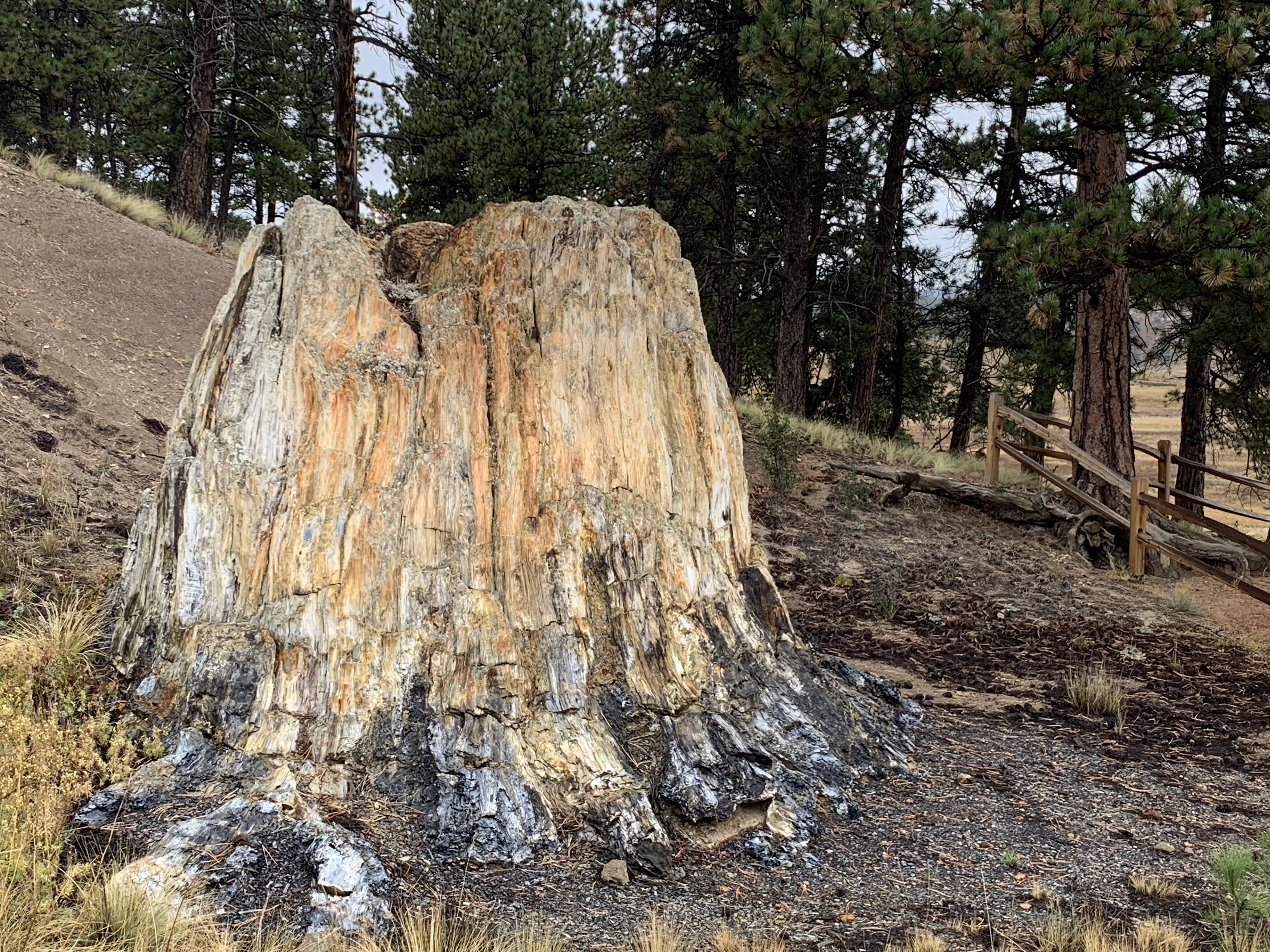
Giant Redwood trees once lived here, in Colorado, and many of their colorful stumps were preserved by volcanic ash along the easy 1 mile Petrified Forest Loop (at 8,400’). Early visitors took pieces of the petrified stumps and even left saw blades in the Big Stump above. See an array of Eocene fossils in the visitor center, including plants, bugs, fish and animals, and a rhinoceros bone. The volcanic ash layer captured a snapshot of the lake, meadow and forest here, which helps us understand how various plants and creatures evolved and adapted to a changing climate. But make no mistake, the current man-made climate crisis does not provide time for evolution or normal adaptation. Suddenly, our planet has a new, unprecedented and deadly climate, and most life won’t survive, unless we fix it now.

I wondered how large the peak range of the redwood trees must have been to have survived until today. They must have been successful in many different areas, like here, where the climate eventually become inhospitable to them. Now they only remain naturally in California and Oregon. People don’t seem to appreciate that for plants to survive over the long term, they need more than a few small, isolated reserves. They need to thrive in many different locations to have a chance of finding a stable and suitable one where they will have a future. Human limits, including pollution caused climate change, will extinguish species and ecosystems until we prioritize the protection of living things. Otherwise, all that will remain will be fossils and images of once thriving species.

Golden Spike National Historical Park

The two sides racing to complete the transcontinental railway actually went far past each other before they finally agreed to meet here. The celebration drew many, as did the centennial, but the location is fairly remote and sparsely populated. There’s a plaque honoring Chinese laborers who contributed, even though many were not allowed to remain in the US.

Many visitors come to see the old style trains shown periodically, but the site is most interesting as a historic symbol of a new age dawning. There’s a large solar array under construction nearby, and hopefully our next transportation revolution from fossil-fueled to electric vehicles can be as dramatic and sudden as the shift from horse to train and telegraph.

Petrified Forest National Park

The Triassic forests are gone, and all that remains are fossils like these. Our climate changes frequently, but extremely slowly. Sudden change is a crisis, because plants and animals lack the ability to adapt or evolve quickly. Hundreds of millions of years ago, this area was an equatorial jungle. The trees were buried by volcanic ash and sediment and soaked in mineral rich waters to fossilize, offering a rare glimpse back before the Jurassic dinosaurs.

The park film explains the distant past, the recent past and current attractions. I hope they improve their camping opportunities, so that visitors spend more time here. I enjoyed my brief time here. But it was difficult to find a car-camping campground in the area, so I moved on too quickly.

Our carbon emissions since the industrial revolution are like an asteroid strike against all life on earth. The Anthropocene, or human dominated age, has been very short, but it will be characterized by extensive global mass extinctions. And unlike a meteor, this time the devastation is entirely by choice. We know that we’re killing the plants & animals that we claim to love. But most of us apparently don’t care enough about the future to make any significant changes to save life on earth.

Click to see my photos of all national park units in Arizona.