Bras d’Or Lake

Bras d’Or Lake Biosphere Region is the brackish waters and surrounding land that takes up much of the middle of Cape Breton Island in northeast Nova Scotia. The ‘Golden Arm’ lake area is famed for beauty, boating and seafood. There are many narrow channels dividing the lake restricting the tides which are extreme in the surrounding area, and several rivers reduce the salt content. Above is the Little Narrows cable ferry.

Alexander Graham Bell lived and worked here for many years, and his family still own his beautiful home on the lake. Among many inventions, he designed a hydrofoil that broke the world speed record here in 1919, and it can be seen at his historic site in Baddeck. I enjoyed a day here exploring and admiring the views. Many folks venture up into the highlands on the Cabot Trail or attend ceilidhs (‘kayleez’) to listen to Gaelic music. I enjoyed a couple fine seafood meals and some good local music in Baddeck.

Rideau Canal

A series of locks allow small boats through Jones Falls below on the lovely historic river and canal connecting Ottawa to Kingston in Canada. In season from mid-May to mid-October, the boats tie up on the dock to the right and wait their turn, perhaps staying or getting something to eat at the 1870s lakeside Hotel Kenney. Chaffey’s Lock is another of the many pretty, historic locks, and it has a fancy hotel, a lock-master’s fort—in case the Americans try to invade by canal—, and a swing bridge that rotates on a wheel to let tall boats clear the lock.

The canal is recognized by UNESCO as a World Heritage Site. There are a couple dozen locks between Ottawa and Kingston Ontario built almost 200 years ago to facilitate trade and travel between the Great Lakes and the Atlantic Ocean. Today, giant cargo ships stick to the main St Lawrence Seaway, but that shift left a dozen or more adorable “timeless” little villages along the original canal route. Small boats still use this canal to avoid heavy barge traffic, dangerous currents and because it’s beautiful and fun. Much of the canal is short sections that connect a series of lakes, including Lake Rideau. If you visit the town of Westport, I recommend dinner at the atmospheric old Cove Inn, which often has live music.

Fire Island National Seashore

The 32 mile narrow island park is interspersed with small communities of folks who have taken responsibility for protecting their long and fragile wilderness. Around Watch Hill there’s a salt marsh, home to many birds. Near Sailors Haven, there’s a Sunken Forest of centuries old Holly trees below protected by a double row of dunes. There are beaches, boardwalks, small boat harbors and historic homes within the park too. In 2012, Hurricane Sandy temporarily breached the Fire Island Wilderness, cutting a path from the Atlantic above through the dunes to Long Island Sound. You can cross the Smith Point bridge—while its replacement is being built—at the eastern end of the park and hike in from the Wilderness Visitor Center.

If you’re driving in from NYC, navigation software might direct you across the Robert Moses Causeway to the west end where you can hike to the lighthouse. But be aware that park ‘roads’ are limited to authorized vehicles, and visitors typically arrive via passenger ferry from places like Sayville. After just such a detour, I barely caught the Sunday ferry to Sailors Haven, my last chance to see the Sunken Forest below for a week during the limited fall schedule. Besides a stand in Gateway NRA in Sandy Hook NJ, this is the only grove of its kind in the world, and there’s a lovely boardwalk nature trail to enjoy the trees, birds and scenery.

Bighorn Canyon National Recreation Area

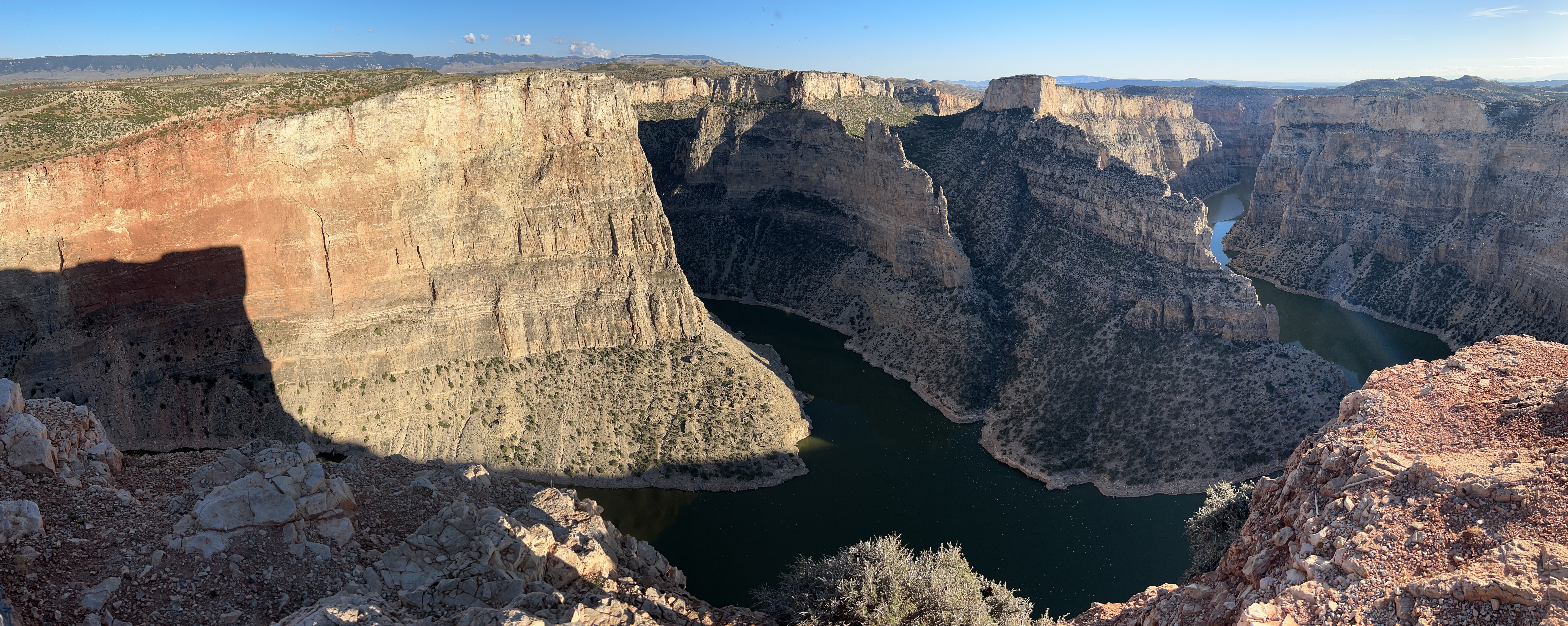
The choice is either to start at the dam in Montana and go up the canyon by boat or to start in Wyoming and take in the views from the rim. It was a long way for me to dodge power boats without easy stopping points, and the water level is obviously artificial. So, I chose to admire the views from above, passing through the wild horse refuge area and finding Devils Canyon Overlook above. I didn’t see any horses, but a turkey vulture flew right by my head so close the loud whoosh and sudden breeze startled me. Maybe he was hoping I’d fall over the extremely steep edge.

The topography of the area is disconcerting, as you see mountains & high ground and assume the Bighorn River would run south, but for all the uplift, the river has just carved its way deeper through the partially flooded canyon. Far upriver further south, it does the same thing, but there it’s called Wind River and cuts through Wind River Canyon. Ultimately, the basins and lesser mountain ranges in Wyoming matter far less to the river direction than the Rocky Mountains, which on this side of the Continental Divide cause the rivers like the Shoshone and Bighorn to flow east and north, joining here before flowing into the Yellowstone River on its way to the Missouri River. In the photo above, that flow is from the upper right to lower left, below the large shadow on the cliff across the canyon. The stretch of water in the upper middle, below the fans is Devil’s Canyon, partly filled by the dam’s backwash and sometimes fed by Porcupine Creek. The foreboding names match the inhospitable scenery. This is a rough and remote area, but it’s also starkly beautiful and dramatic.